Bitcoin’s recent bounce may look like a sign of renewed strength, but the price action tells a more deceptive story. With downside liquidity still thin and support holding firm, the market appears primed for a move that draws in eager bulls rather than rewarding them. This rally could be less about recovery and more about setting the stage for maximum pain when sentiment flips.
Aligning The Mid- And Long-Term Bitcoin Outlook
During an in-depth technical and psychological analysis, Mr. Wall Street explained that his broader outlook on Bitcoin had already been clarified a week earlier, after some confusion around his mid and long-term stance. With those time horizons now clearly defined, he turned his focus to the short-term picture, outlining current market behavior.
Related Reading
He reiterated that while his mid-term bias on Bitcoin remains bearish, the short-term structure has turned bullish. The reason centered on insufficient downside liquidity to justify market makers initiating the next major leg lower. This imbalance supported the case for a temporary relief move to the upside.

Thus, Mr. Wall Street placed long positions around the Value Area Low between $80,000 and $84,000 on a bounce that could later evolve into a bull trap. Shortly after, Bitcoin dipped and successfully retested the $84,000 level, which aligns with the weekly MA100, following several deceptive upside moves.
As a result, his long orders were filled as planned, leaving him holding a position from $84,550. The analyst noted that he plans to exit only in the $98,000–$104,000 zone, where a Fair Value Gap converges with heavy liquidity, making it an ideal area to take profit.
Being In Longs Doesn’t Change The Macro Bearish Thesis
Mr. Wall Street clarified that holding long positions does not signal a bullish shift on Bitcoin. The broader outlook remains bearish, with expectations for the next major downside move toward the $64,000–$70,000 region. In the short term, Bitcoin is sitting at strong support while downside liquidity is limited, which reduces the probability of an immediate continuation lower.
Related Reading
A more logical scenario involves market makers engineering a bullish move to attract retail participation. As late buyers enter long positions, they gradually become exit liquidity, setting the stage for a larger downside move once sufficient liquidity is built.
He also mentioned the $68,000–$74,000 zone had become too widely anticipated to function as a true “maximum pain” area capable of resetting market structure. For that reason, the downside target was revised lower to the $64,000–$70,000 range, with expectations that this zone could be reached in late Q1 or early Q2 of 2026. This level represents an initial major target rather than the final bottom.
Recent price action was highlighted as a clear example of these dynamics. Bitcoin’s rapid move from $87,000 to $90,000, followed by a sharp drop to $85,000 within hours, resulted in widespread liquidations. Many traders chased the upside and were quickly trapped, and fake moves in both directions are likely to continue as liquidity is built ahead of a larger move lower.
Featured image from Pixabay, chart from Tradingview.com
Damaging Impact: Cardano Founder Reveals How Trump’s Crypto Moves Hurt the Market Bitget
Source link ]]>
Hoskinson promises audit, is ‘deeply hurt’ by $600M Cardano treasury claims StartupNews.fyi
Source link ]]>
Zaheer Ebtikar, the Chief Investment Officer (CIO) and founder of Split Capital—a hedge fund specializing in liquid token investments—has attributed the Ethereum underperformance over the last months to strategic missteps by the Ethereum Foundation and structural shifts in crypto capital flows. In an analysis shared via X (formerly Twitter), Ebtikar writes, “Independent of the myriad of (probable) bad decisions that the ETH foundation & co have made there’s another structural reason why ETH has traded like a dog this cycle.”
Why Is The Ethereum Price Lagging Behind?
Ebtikar began by emphasizing the importance of understanding capital flows within the crypto market. He identified three primary sources of capital flow: retail investors who engage directly through platforms like Coinbase, Binance, and Bybit; private capital from liquid and venture funds; and institutional investors who invest directly through Exchange-Traded Funds (ETFs) and futures. However, he noted that retail investors are “hardest to quantify” and are “not fully present in the market today,” thus excluding them from his analysis.
Focusing on private capital, Ebtikar highlighted that in 2021, this segment was the largest capital base, driven by crypto euphoria that attracted more than $20 billion in net new inflows. “Fast forward to today, private capital is no longer the heavy hitter capital base as ETFs and other traditional vehicles have taken the role of the largest net new buyer of crypto,” he stated. He attributed this decline to a series of poor venture investments and overhang from prior cycles, which have “left a bad taste in the mouths of LPs.”
These venture firms and liquid funds recognized that they couldn’t wait out another cycle and needed to be more proactive. They began taking more “shots on target” for liquid plays, often through private deals involving locked tokens such as Solana (SOL), Celestia (TIA), and Toncoin (TON). “These locked deals also represented something more interesting for a lot of firms—there’s a world outside of Ethereum-based investing that is actually growing and usable and has enough market cap growth relative to ETH that could justify the underwriting of the investment,” Ebtikar explained.
Related Reading
He noted that investors were aware it would be increasingly difficult to raise funds for venture and liquid investments. Without the return of retail capital, institutional products became the only viable avenue for a bid for ETH. Mindshare began fragmenting as the three-year mark of the 2021 vintage approached, and products like BlackRock’s spot Bitcoin ETF (IBIT) gained legitimacy as the de facto benchmark for crypto. Private capital had to make a choice: “Abandon their core portfolio hold in ETH and move down the risk curve or hold your breath for traditional players to start bailing you out.”
This led to the formation of two camps. The first consisted of pre-ETF ETH sellers between January and May 2024, who opted out of ETH and swapped to assets like SOL. The second group, post-ETF ETH sellers from June to September 2024, realized that ETF flows into ETH were lackluster and that it would take much more for ETH’s price to gain support. “They understood that the ETF flows were lackluster and it would take a lot more for ETH price to begin being supportive,” Ebtikar noted.
Turning his attention to institutional capital, Ebtikar observed that when spot Bitcoin ETFs like IBIT, FBTC, ARKB, and BITW entered the market, they exceeded expectations. “These products broke any realistic target investors and experts could’ve fathomed with their success,” he stated. He emphasized that Bitcoin ETFs have become some of the most successful ETF products in history. “BTC went from being a dog in the average portfolio to now the only funnel for net new capital in crypto and at a record rate too,” he said.
Despite Bitcoin’s surge, the rest of the market didn’t keep up. Ebtikar questioned why this was the case, pointing out that crypto-native investors, retail, and private capital had long since reduced their Bitcoin holdings. Instead, they were “stuck in altcoins and Ethereum as the core of their portfolio.” Consequently, when Bitcoin received its institutional bid, few in the crypto space benefited from the new wealth effect. “Few in crypto were beneficiaries of the newly made wealth effect,” he remarked.
Investors began to reassess their portfolios, struggling to decide their next moves. Historically, crypto capital would cycle from index assets like Bitcoin to Ethereum and then down the risk curve to altcoins. However, traders speculated on potential flows into Ethereum and similar assets but were “broadly wrong.” The market started to diverge, and the dispersion between asset returns intensified. Professional crypto investors and traders moved aggressively down the risk curve, and funds followed suit to generate returns.
Related Reading
The asset they chose to reduce exposure to was Ethereum—the largest asset in their core portfolios. “Slowly but surely ETH started losing steam to SOL and similar, and a non-trivial percentage of this flow started really moving downstream to memecoins,” Ebtikar observed. “ETH lost its moat in crypto-savvy investors, the only group of investors who were historically interested in buying.”
Even with the introduction of spot ETH ETFs, institutional capital paid little attention to Ethereum. Ebtikar described Ethereum’s predicament as suffering from “middle-child syndrome.” He elaborated, “The asset is not in vogue with institutional investors, the asset lost favor in crypto private capital circles, and retail is nowhere to be seen bidding anything at this size.” He emphasized that Ethereum is too large for native capital to support while other index assets like SOL and large caps like TIA, TAO, and SUI are capturing investor attention.
According to Ebtikar, the only way forward is to expand the universe of potentially interested investors, which can only happen at the institutional level. “ETH’s best odds of making a material comeback (short of changes to the core protocol’s trajectory) is to have institutional investors pick up the asset in the coming months,” he suggested. He acknowledged that while Ethereum faces significant challenges, it is “the only other asset with an ETF and likely will be for some time.” This unique position offers a potential avenue for recovery.
Ebtikar mentioned several factors that could influence Ethereum’s future trajectory. He cited the possibility of a Trump presidency, which could bring changes to regulatory frameworks affecting cryptocurrency. He also pointed to potential shifts in the Ethereum Foundation’s direction and core focus, suggesting that strategic changes could reinvigorate investor interest. Additionally, he highlighted the importance of marketing the ETH ETF by traditional asset managers to attract institutional capital.
“Considering the possibility of a Trump Presidency, change at the Ethereum Foundation’s direction and core focus, and marketing of the ETH ETF by traditional asset managers, there are quite a few outs for the father of smart contracting platforms,” Ebtikar remarked. He expressed cautious optimism, stating that not all hope is lost for Ethereum.
Looking ahead to 2025, Ebtikar believes it will be a critical year for cryptocurrency and especially for Ethereum. “2025 will very much be an interesting year for crypto and especially for Ethereum as so much of the damage from 2024 can be unwound or further deepened,” he concluded. “Time will tell.”
At press time, ETH traded at $2,534.
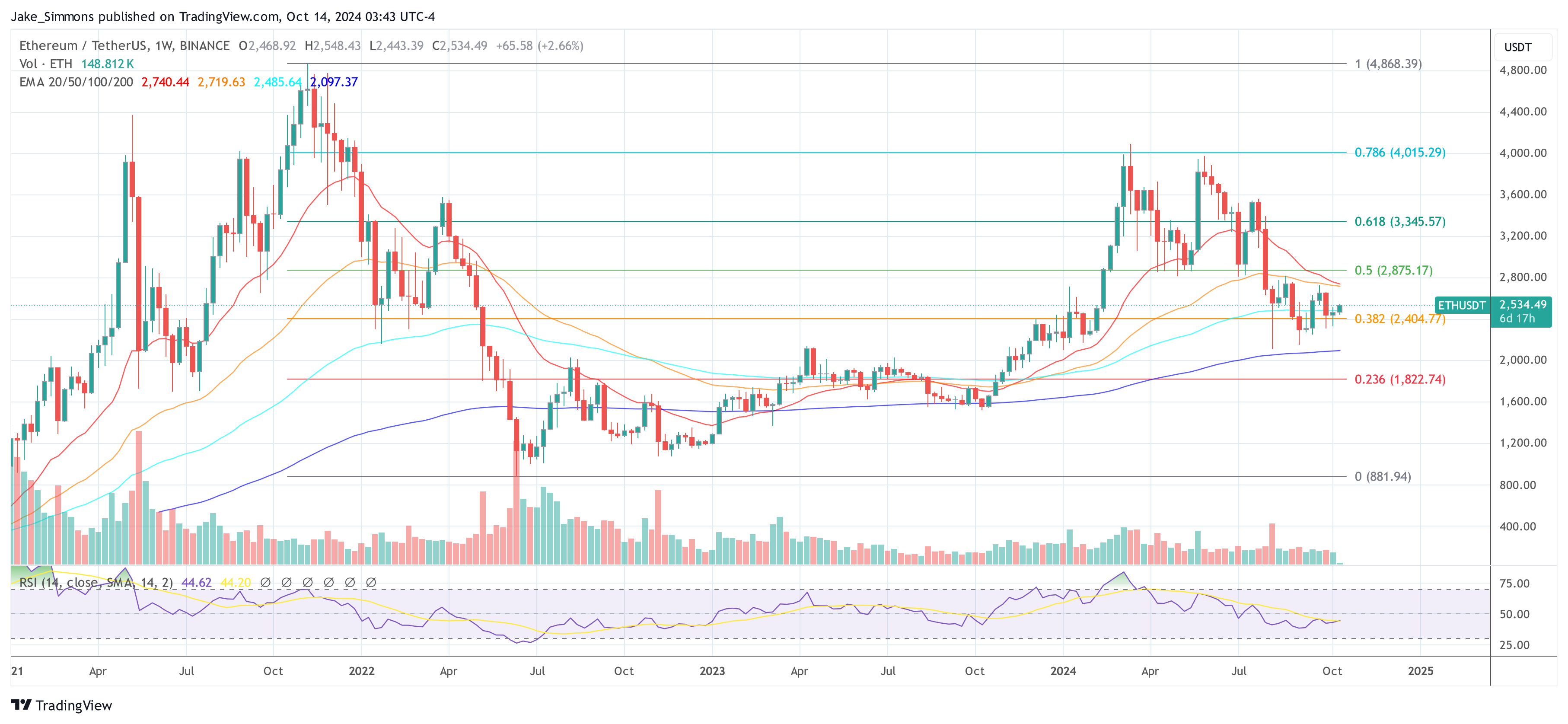
Featured image created with DALL.E, chart from TradingView.com

-
Binance has been on a slow decline since touching $315
-
The cryptocurrency has lacked positive catalysts to take the price higher
-
BNB faces a decline to the $266 support zone
Binance (BNB/USD) continues to consolidate but is on a short-term descent after tapping a minor resistance. As of press time, BNB was trading at $289 and looking increasingly bearish. Investors now stare at a possible price bottom at $266.
The decline in BNB comes amid limited fundamentals to support the cryptocurrency. Across the general sector, the market is mixed, with most cryptocurrencies consolidating. That underlines that BNB’s price action mirrors that of the sector, with investors still reeling from the FTX impacts. While Binance’s reassurances of stability have at least supported BNB, the recent slow gains mean investors are cautious.
The trading comes even as a bitter exchange ensues between Binance CEO Changpeng ‘CZ’ Zhao and former FTX head Sam Bankman-Fried. The exchange on Twitter related to an exit by Binance on investment in FTX back in 2021. Bankman-Fried accused CZ of demanding an extra $75 million kickback. Instead, CZ called SBF a “fraudster,” looking for someone to blame for the FTX implosion. Of course, the exchange harms an already depleted market confidence as investors are unsure which exchange is next.
BNB trends lower, with weakening momentum
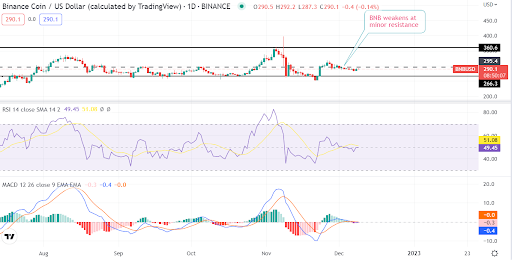
Technically, BNB is slightly bearish. The RSI is at the midpoint meaning that bulls are muscling equally with the bears. However, the MACD indicator shows that momentum has weakened. Similarly, the MACD and signal line lies in the neutral zone.
Will BNB stay bearish?
With the limited fundamentals to support BNB price and the non-ensuing confidence crisis, the token may fall further. The price action supports a decline to the next support at $266.
Buyers are, however, relentless, as shown by the reading on the RSI and MACD. For BNB to maintain the uptrend, the price must recover above $315. However, as it looks, we may have to shelve the ambitions until a further date.
Where to buy BNB
eToro
eToro offers a wide range of cryptos, such as Bitcoin, XRP and others, alongside crypto/fiat and crypto/crypto pairs. eToro users can connect with, learn from, and copy or get copied by other users.
Binance
Binance is one of the largest cryptocurrency exchanges in the world. It is better suited to more experienced investors and it offers a large number of cryptocurrencies to choose from, at over 600.
Binance is also known for having low trading fees and a multiple of trading options that its users can benefit from, such as; peer-to-peer trading, margin trading and spot trading.
Bitcoin Price Prediction News: Bitcoin price is struggling to recover amid the increased selling pressure and volatility in the market. The declining BTC price has also led to an all time high (ATH) mining difficulty for Bitcoin miners. However, experts have suggested that miners might capitulate again.
Miners to drop more Bitcoin?
A report by Cryptoquant suggests that the Bitcoin mining difficulty is very high for the miner. This directly means that the costs are getting higher and the current situation is not suitable for doing business. This is the main reason why miners do not work in full force.
It added that this is the first time in months that the Bitcoin hash rate is dumping hard. This is likely a signal that miners are capitulating. However, this also signals that the bottom is near.
However, increased inflation and declining Bitcoin price have created such an environment for the miners. Meanwhile, the current results might not fall in line with the previous results. Positive mining difficulty adjustment can help miners plan for the next adjustment which might happen around 6th December.
Will BTC drop more?
Bitcoin prices have dropped by a massive 23% in the last 30 days. Bitcoin price is trading at an average price of $16,219, at the press time. However, its 24 hour trading volume is up by 31% to stand at $24.9 billion.
Glassnode reported that Bitcoin miners are distributing over 135% of their mined coins. This suggests that miners are dipping into their 78K BTC strong treasuries.
As the FTX contagion expands, the mining industry has become another sector of concern in the crypto market. Mining revenue is witnessing a huge revenue reduction. The production cost has gone up by 68% while Bitcoin price is down by 76% over the last year.
Miner’s Bitcoin balance currently stands at around 78K which is equal to more than $1.2 billion, as per BTC price.

The presented content may include the personal opinion of the author and is subject to market condition. Do your market research before investing in cryptocurrencies. The author or the publication does not hold any responsibility for your personal financial loss.
Bitcoin continues to lose momentum on low timeframes, as bulls were unable to follow through on yesterday’s upside impulse. The cryptocurrency was rejected around the mid-area of its current levels and might be bound for a fresh re-test of local support.
At the time of writing, Bitcoin price trades at $20,000 with a 1% loss and a 3% profit in the last 24 hours and 7 days, respectively. Despite its negative price performance, BTC remains relatively strong when compared with other cryptocurrencies in the top 10 by market cap.

Bitcoin At Record Correlation With Gold And Equities In 2022
Data from Kraken Intelligence shows that Bitcoin has been increasing its correlation with risk-on assets, and with other traditional assets in the legacy financial market. This phenomenon has been common across 2022, as global markets move in tandem reacting to the U.S. Federal Reserve (Fed).
The financial institution has been trying to slow down inflation in the U.S. dollar by hiking interest rates. This has brought negative consequences across all assets class.
As seen in the charts below, the price of Bitcoin saw a decline in its correlation with major equities indexes, the Nasdaq 100 and S&P 500. In the past months, this correlation stood at its low below 0.5 but is re-approaching high correlation levels at around 0.8 and 0.74, respectively.
Something similar is happening with Gold and U.S. Treasuries. Unlike stocks, Bitcoin has been less correlated to the precious metal and U.S. Treasuries, but that appears to be changing in light of the increase in economic uncertainty.

Earnings Seasons Might Cap Bitcoin Bullish Momentum
This data suggest that Bitcoin might be more and more susceptible to events related to stock and major indices. Jurrien Timmer, Director of Macro for Investment firm Fidelity, believes the upcoming earnings season might bring hurdles for traditional assets.
Timmer supports his theory on the recent rally in the U.S. Dollar, as measured by the DXY Index. This tool allows market participants to get a sense of the strength of the dollar compared mostly to the Japanese Yen, the British pound, and the Euro.
We see the same disconnect in the chart below, when comparing the dollar’s rate of change to the expected EPS growth rate (NTM divided by LTM). Estimates should be coming down faster, it seems. /4 pic.twitter.com/G49jAMu0Y0
— Jurrien Timmer (@TimmerFidelity) October 6, 2022
The higher the DXY Index, the weaker these other currencies, and other risk-on assets by extension, such as Bitcoin. Timmer claims that 40% of the S&P revenue comes from abroad which could lead to a noticeable negative impact on profit margins and U.S. companies’ earnings. The expert wrote:
Expectations are for revenue growth to fall to 4% and stay there. Given that the DXY’s rate of change is +19%, that seems too high. So, based on the dollar and market breadth, we might get some negative earnings surprises.
- Dogecoin creator blames Coinbase exchange regarding manipulation
- Cryptocurrency investors are not being tracked by the exchange and the commission
- There is a psychological pressure on investors showing strong drops in the market
The maker of the main image money Dogecoin, Billy Markus, tended to one of the greatest digital currency trades in the business Coinbase-and got some information about the need of steady cost refreshes during convoluted economic situations.
The Dogecoin people group likewise upheld Markus and got down on Coinbase, saying that there is no compelling reason to remind clients about the declining execution of different digital currency resources, even those that are not being followed by financial backers.
Numerous analysts noticed that by continually showing solid digital money drops available, organizations are putting a pointless measure of mental strain on financial backers.
Financial backers
There are an assortment of social pointers that track opinion among financial backers, and during the revision, the majority of these measurements dropped altogether, recommending that there is vulnerability available.
The most well known pointer that involves feeling in the crypto local area, the Fear and Greed file, is at present excess in the “dreadzone, proposing that the greater part of the market is as yet not prepared to take significant actions or even purchase new monetary forms.
The disturbance of the remedy available is the fundamental purpose for expanded alarm among financial backers. Most computerized resources have lost more than half of their worth on account of the gamble of inclinations on monetary business sectors and surge of assets from the crypto business.
Memecoins like Dogecoin and Shiba Inu are likewise encountering one of the most awful exchange periods in their set of experiences, with the two resources losing more than 60% of their worth from the current ATH. At press time, Dogecoin exchanges at $0.1 while staying in a seven-day remedy cycle.
It’s a considerable number of critical occasions and history paths in the digital currency world throughout the most recent years. After the new intrusion by Russia into Ukraine, The entire crypto market dropped fundamentally. The top image coins Shiba Inu is down more than 10% in about fourteen days while Elon Musk’s cherished cash Dogecoin (DOGE) have plunged 20% simply over this month.
Dogecoin in the fray
In this negative market, a few areas like metaverse still appear to stay unaffected and keep on furnishing financial backers with beneficial speculation open doors. Metaverse based crypto like MetaworldworldPad, sent off as of late has expanded by more than 600% in the beyond about fourteen days in any event, when Shiba Inu and Dogecoin cost is plunging
Also read: SundaeSwap: An evolving sweetest DEX on Cardano
Dogecoin, the thirteenth most famous cryptographic money was sent off in 2013 by Billy Markus and Jackson Palmer as a “joke” to ridicule other digital currencies. The Tesla organizer, Elon Musk, declared the “Dogefather.” is one of the most powerful allies of Dogecoin because of his obscure tweets’.
Dogecoin (DOGE) just ejected into public and got enormous reception toward the start of 2021 after ceaseless support from Elon musk’s tweets. Dogecoin expanded by over 13000% from the start of 2021 to its present high in May of a year ago.
Between March 1 to March 8, 2021, the cost of Dogecoin was exchanging at $0.12. While the cost is Dogecoin right now pluging, it is prudent to stand by quietly to perceive how it will act once the market bounce back. Dogecoin costs attempt to keep up with force after every rebound, suggesting an enormous inflow of benefit taking.

Andrew is a blockchain developer who developed his interest in cryptocurrencies while his post-graduation. He is a keen observer of details and shares his passion for writing along with being a developer. His backend knowledge about blockchain helps him give a unique perspective to his writing
Commission-free trading app Robinhood warned investors on Thursday that its fortunes may be tied to a cryptocurrency that got its start as a joke.
In revealing its financials for the first time while filing to go public, Robinhood said Dogecoin accounted for 34 percent of its cryptocurrency transaction-based revenue in the first quarter, up from 4 percent in the prior quarter. Any slowdown in demand, it said, could adversely affect its financial results.
“A substantial portion of the recent growth in our net revenues earned from cryptocurrency transactions is attributable to transactions in Dogecoin,” the company disclosed under the risk warnings section of its S-1 filing with the Securities and Exchange Commission.
“If demand for transactions in Dogecoin declines and is not replaced by new demand for other cryptocurrencies available for trading on our platform, our business, financial condition and results of operations could be adversely affected,” it added.
Dogecoin reached a peak in early May of about 73 cents per coin as it was cheered on by notable supporters including Tesla CEO Elon Musk. But it started off as a prank in 2013 by a tech marketer who melded two popular Internet themes — cryptocurrency and a the Shiba Inu pup behind the so-called Doge meme — to make a Twitter joke.

“Investing in Dogecoin,” Jackson Palmer tweeted at the time, “pretty sure it’s the next big thing.”
The meme currency, which was then made real by software engineer Billy Markus, has more recently fallen from its recent highs to about 25 cents per coin, but is still up more than 10,000 percent from a year ago, according to data from Coinbase.
Robinhood on Thursday also noted that cryptocurrency transaction-based revenue made up 17 percent of Robinhood’s total revenue in the first quarter, or $87.6 million, compared with just 3 percent, or $4.2 million, a year earlier.

The company launched its crypto trading business, known as RHC, in 2018 and currently lets users trade seven different cryptocurrencies: Bitcoin, Bitcoin Cash, Bitcoin SV, Dogecoin, Ethereum, Ethereum Classic and Litecoin.
“RHC’s business may be adversely affected, and growth in our net revenue earned from cryptocurrency transactions may slow or decline, if the markets for Dogecoin deteriorate or if the price of Dogecoin declines, including as a result of factors such as negative perceptions of Dogecoin or the increased availability of Dogecoin on other cryptocurrency trading platforms,” Robinhood went on.

Total crypto assets held on Robinhood grew 23 times over in the first quarter compared with the same period a year ago, Robinhood said in its filing. Over the same period, Robinhood’s total revenue increased 309 percent in the period to $522 million.
The explosive growth in Robinhood’s revenue from dogecoin and other cryptocurrencies earlier this year coincided with a rapid run-up in price throughout the crypto market.