
Kenyan authorities have revealed talks with the Nigerian government for the extradition of escapee Binance executive, Nadeem Anjarwalla. A new TechCabal report says the Nigerian government has officially asked its Kenyan counterpart to extradite Anjarwalla after he escaped detention in the country.
According to the report, an unnamed detective at the Directorate of Criminal Investigations (DCI) acknowledged the requests for extradition but added that the country was yet to act. He noted that the extradition issue will take a process involving both sides.
“You cannot just walk in and arrest him based on the request. It’s a process. Also, the Anjarwallas are influential and have the backing of some powerful people,” the detective explained.
Possible Red Notice For the Binance Executive?
Per the report, the detective asked not to be named because of the sensitivity of the case. The issue borders on crimes he allegedly committed in another country and instances involving a red notice or foreign arrest warrant might differ.
“Police agencies share information among themselves and through the Interpol. The collaboration can only go up to a certain level as allowed by the law. Effecting an Interpol red notice or foreign arrest warrant is entirely different.”
Possible Procedure for The Anjarwalla’s Extradition
The procedure and legal issues involved in extradition are often debated not to breach local and foreign laws. For an extradition of the Binance executive, a Nigerian court must issue an arrest warrant which will be forwarded to Kenya’s attorney general.
After arrest, the court’s consent is also required and could take months. The report also added, citing the detective, that Anjarwalla is the son of Atiq Arjarwalla, a partner in one of the largest firms in East Africa.
The Nigerian government arrests two Binance executives following allegations that the exchange facilitated naira exchanges on its platform. Nigeria charged Binance and two executives on money laundering charges with Gambaryan pleading not guilty.
Meanwhile, the cryptocurrency community continues to stand with Gambaryan asking for his immediate release from custody.
Also Read: Crypto Security: Here’s How Paradigm Exec’s SEAL-ISAC Can Make a Difference

The presented content may include the personal opinion of the author and is subject to market condition. Do your market research before investing in cryptocurrencies. The author or the publication does not hold any responsibility for your personal financial loss.
Cardano-Funded Kenyan Fintech, Pezesha, Gets a Digital Lending … bitcoinke.io
Source link ]]>

Pezesha, a Kenyan fintech focused on providing bridging finance to small and medium-sized enterprises, recently raised $11 million in pre-Series A debt-equity funding round. The Women’s World Banking Capital Partners II led the round in which the Cardano blockchain builder Input Output Global also participated.
Pezesha Solving Working Capital Problems for MSMEs
A Kenya-based fintech, Pezesha, announced recently that it raised $11 million from its pre-Series A debt-equity funding round. According to a Techcrunch report, this series was led by Women’s World Banking Capital Partners II with the Cardano blockchain builder Input Output Global (IOG) also participating. Other participants were Verdant Frontiers Fintech Fund and Cfund.
As per the report, Pezesha plans to use the funds to expand its embedded finance business to micro, small medium-sized enterprises (MSMEs) operating in countries like Nigeria, Rwanda and Francophone Africa.
Commenting on how Pezesha plans to avail its lending infrastructure to more MSMEs following its successful round, the fintech’s founder Hilda Moraa reportedly said:
The opportunity and impact in solving working capital problems for MSMEs is huge. [We are] solving the root cause, which is information asymmetry issues, to ensure quality and responsible borrowing. Pezesha solves this through our robust API-driven credit scoring technology.
Pezesha to Target Women Entrepreneurs
For his part, Charles Hoskinson, the co-founder of IOG and Cardano explained how this investment fits his organization’s core objective of helping African economies grow and create jobs.
“Our vision is centred on using technology to make it easier for people across the globe to borrow and lend to each other in a regulated way. This investment in Pezesha is an important milestone, and we’re excited to be a part of their growth story,” Hoskinson is quoted stating in the report.
Besides availing funding to MSMEs, the report said Pezesha would specifically target women entrepreneurs who presently cannot easily access funding from the formal banking system.
Register your email here to get a weekly update on African news sent to your inbox:
What are your thoughts on this story? Let us know what you think in the comments section below.
Image Credits: Shutterstock, Pixabay, Wiki Commons
Disclaimer: This article is for informational purposes only. It is not a direct offer or solicitation of an offer to buy or sell, or a recommendation or endorsement of any products, services, or companies. Bitcoin.com does not provide investment, tax, legal, or accounting advice. Neither the company nor the author is responsible, directly or indirectly, for any damage or loss caused or alleged to be caused by or in connection with the use of or reliance on any content, goods or services mentioned in this article.
Access to finance remains a key growth constraint for small businesses, with data showing a $330 billion financing deficit for the small enterprises that make up 90% of Africa’s businesses.
This is the gap that Kenya’s embedded finance fintech Pezesha seeks to bridge as it expands into Nigeria, Rwanda and Francophone Africa following a $11 million pre-Series A equity-debt round led by Women’s World Banking Capital Partners II with participation from Verdant Frontiers Fintech Fund, cFund and Cardano blockchain builder Input Output Global (IOG). The round also included a $5 million debt from Talanton and Verdant Capital Specialist Funds.
The fintech’s new growth strategy follows its plan to power its embedded finance offering beyond its current markets including Uganda and Ghana, to bridge the financing gap affecting millions of micro, small medium-sized enterprises (MSMEs) across these markets.
Founded in 2017 by Hilda Moraa, Pezesha has built a scalable digital lending infrastructure that allows both traditional and non-traditional finance institutions to offer working capital to MSMEs.
“The opportunity and impact in solving working capital problems for SMEs is huge. [We are] solving the root cause, which is information asymmetry issues, to ensure quality and responsible borrowing. Pezesha solves this through our robust API driven credit scoring technology,” Moraa, also the CEO, told TechCrunch.
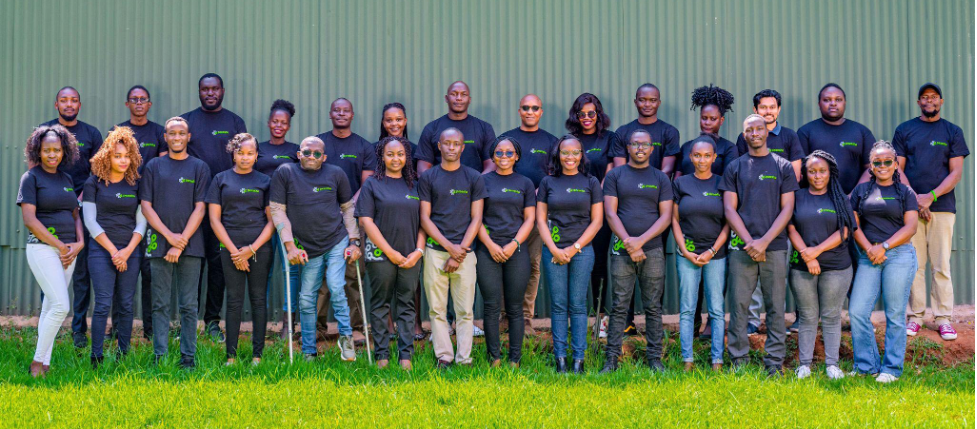
Pezesha is tapping local and international banking institutions, HNWIs and DeFi for additional liquidity for onward lending. Image Credits: Pezesha
The fintech works with partner companies such as Twiga and MarketForce, which integrate its credit scoring APIs in their platforms to enable their customers get real time loan offers.
Pezesha said it is currently working with over 20 partner companies that have enabled it to extend loans to over 100,000 businesses to date. It expects this number to grow before the end of the year as an additional 10 companies integrate with its infrastructure. The fintech is able to extend loans of up to $10,000 at single digit interest rates, and a repayment period of one year.
Pezesha plans to create a $100 million financing opportunity each year for businesses by tapping local and international banking institutions, high net-worth individuals and decentralized finance.
“We are building for the future and this means tapping new innovations for additional liquidity that allows us to offer affordable loans to SMEs,” said Moraa, a two-time founder, who started Pezesha after successfully exiting Weza Tele in 2015.
Charles Hoskinson, the co-founder of IOG and Cardano, while commenting on their investment in Pezesha said in a statement that, “Facilitating the movement of capital into emerging markets to support economic growth and job creation is a core promise of blockchain and cryptocurrencies. Our vision is centered on using technology to make it easier for people across the globe to borrow and lend to each other in a regulated way. This investment in Pezesha is an important milestone, and we’re excited to be a part of their growth story.”
The IOG’s investment into Pezesha follows an earlier announcement that the two companies had partnered to build a peer-to-peer financial operating system for Africa.
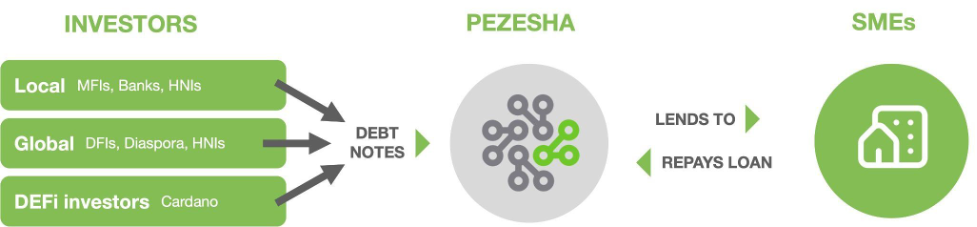
Image Credits: Pezesha
Moraa said that working with strategic partners like Cardano will open up the debt liquidity market and offer the affordable capital critical for the growth of all sectors of the economy.
The fintech plans to open up more lending opportunities for women entrepreneurs who continue to be locked out by the formal banking sector.
“Pezesha is dedicated to solving Africa’s working capital problem through its robust lending infrastructure, and this investment will allow them to deepen the range of financial products offering especially to women owned MSMEs,” said Christina “CJ” Juhasz, the chief investment officer of Women’s World Banking Asset Management.
Pezesha did not reveal how much it has raised in the past, but Moraa noted that 20% of its initial pre-seed investment in 2017 was from local angels. The fintech, which raised seven figures last year, counts Seedstarts, GreenHouse Capital and Consonance Investment Managers, among its several investors.
“We have the right business model, are profitable, and continue to pursue the kind of investors that are aligned with our goals and values,” Moraa said.
✓ Share: