
- Futu Securities launches Bitcoin and Ethereum trading in Hong Kong with zero fees.
- New users can receive incentives like Bitcoin or shares of Alibaba and Nvidia.
- Futu seeks a crypto exchange license for PantherTrade amid Hong Kong’s crypto hurdles.
Futu Securities International, Hong Kong’s largest online broker, has introduced retail cryptocurrency trading in the city, marking a significant advancement in its financial services.
The brokerage firm, known for its extensive reach and innovative offerings, now allows residents to trade Bitcoin and Ethereum on its platform. This initiative comes after a partnership with HashKey Exchange, one of only two licensed cryptocurrency exchanges in Hong Kong.
Bonuses and waived crypto trading fees
The launch comes with enticing bonuses. New account holders who deposit HK$10,000 (approximately $1,280) for 60 days can receive either HK$600 worth of Bitcoin, a HK$400 supermarket voucher, or a share of Alibaba.
Those who deposit HK$80,000 are eligible for HK$1,000 in Bitcoin or a share of Nvidia, whose stock has surged by about 130% this year.
Additionally, Futu has waived commission fees for crypto trading starting August 1st, enhancing the appeal of their new service.
Futu looking for a crypto exchange license
Futu is also pursuing a cryptocurrency exchange license for its new platform, PantherTrade, which currently operates under a ‘deemed to be licensed’ status.
PantherTrade is among 11 platforms in Hong Kong awaiting full approval from the Securities and Futures Commission (SFC).
Hong Kong crypto industry challenges
Despite these advancements, Hong Kong’s aspiration to become a global crypto hub faces hurdles. The city has experienced the exit of major global trading platforms and low trading volumes for crypto ETFs.
Increased fraudulent activities, such as a recent scam involving counterfeit currency, have further complicated the situation.
In response, Hong Kong authorities are enhancing their regulatory measures and law enforcement capabilities to address these issues and boost investor confidence.
As Futu Securities deepens its presence in the cryptocurrency market, the success of its initiative will depend on balancing innovation with stringent oversight to ensure a secure trading environment.
In a significant development for the recently approved Ethereum ETFs in Hong Kong, the ETF product launched by Chinese fund manager ChinaAMC has seen a significant increase in net inflows, reaching over HK$5 million (US$640,780) as of mid-day Wednesday.
This surge follows a previous high of HK$3.77 million on Tuesday, marking the largest inflow since the ETF’s launch, while investors are anticipating the approval of similar products in the United States for the market’s second-largest cryptocurrency, which has contributed to the increased interest in these ETFs.
Hong Kong’s Ethereum ETFs Break Trading Records
According to a South China Morning Post report, on Tuesday, the ETF witnessed over 1.28 million shares being traded, surpassing the average daily trading volume of around 500,000 since its launch on April 30.
Meanwhile, this week, the other two spot Ethereum ETFs in Hong Kong, issued by investment firms Harvest Global, Bosera, and HashKey Capital, have also experienced “higher-than-usual” trading volumes. The prices of all three ETFs recorded an increase of over 18 percent on Tuesday.
While Hong Kong’s spot crypto ETFs were hailed as a significant step in the city’s pursuit of becoming a virtual asset hub, their turnover has remained modest on most days since their launch. The trading volume pales compared to spot Bitcoin ETFs in the United States, where the products were approved in January.
By the numbers, SoSo Value data shows that on Tuesday, the total net inflow of Bitcoin Spot ETF was $306 million, marking seven consecutive days of net inflows.
Grayscale’s ETF, the Grayscale Bitcoin Trust (GBTC), had a single-day net outflow of $0.00, BlackRock’s ETF IBIT had a single-day inflow of $290 million, and the total net asset value of Bitcoin spot ETF was $58.910 billion.
Market Optimism
ETFs are viewed as vital means of attracting mainstream investors to volatile virtual assets, potentially bolstering prices. However, the initial impact of Hong Kong’s ETF launches on the global cryptocurrency market appears to have been relatively muted.
Analysts at Bloomberg have pointed out that Hong Kong’s ETF market is substantially smaller than that of the United States. Nonetheless, they assert that the city’s spot crypto ETFs, the first in Asia, play a pivotal role in the global adoption and acceptance of virtual assets.
The recent surge in Ethereum ETFs trading volume in Hong Kong coincides with a significant rally in cryptocurrency prices following reports suggesting an increased likelihood of the US Securities and Exchange Commission (SEC) approving spot Ethereum ETFs.
Bloomberg Intelligence ETF analysts Eric Balchunas and James Seyffart recently raised their estimated probability of approval for Ethereum ETFs in the US from 25 percent to 75 percent, indicating a potential shift in the SEC’s stance on these products.
ETH, the second-largest cryptocurrency by market capitalization, has experienced a price surge of over 20 percent, surpassing US$3,700 this week. The largest cryptocurrency also climbed by approximately 4 percent, surpassing US$71,000.
Featured image from Shutterstock, chart from TradingView.com
As Hong Kong accelerates its drive to list the first batch of spot Bitcoin and Ethereum ETF, China’s top asset managers are currently in the final preparations to kickstart trading by April 30. The launch certainly brings excitement for Asian crypto investors after seeing the success of US spot Bitcoin ETFs that accumulated more than $56 billion in assets within just three months of launch.
Competing With US Bitcoin ETFs
HashKey Capital and Bosera have announced that Hong Kong spot-ETFs will adopt an in-kind subscription and redemption mechanism. This allows the exchange of underlying assets for ETF units and vice versa, contrasting with the cash redemption model used by US funds.
According to Evgeny Gaevoy, co-founder of crypto liquidity provider Wintermute Trading Ltd, the in-kind approach is particularly attractive to crypto natives, market makers, and digital asset exchanges. It offers greater efficiency and arbitrage opportunities.
A spokesperson for HashKey mentioned that the Bosera-HashKey Capital spot products will commence trading on April 30. In Hong Kong, crypto-futures-based ETFs are already permitted, with three listed so far: CSOP Bitcoin Futures, CSOP Ether Futures, and Samsung Bitcoin Futures. However, their total assets amount to approximately $175 million, significantly less than US offerings such as the $2.5 billion derivatives-based ProShares Bitcoin Strategy ETF.
Gaevoy added: “Setting realistic expectations for the Hong Kong ETF market is crucial, especially when considering the relatively modest size of the region’s existing futures ETFs”.
Does Hong Kong Have Its Own BlackRock
For over a year, Hong Kong has been in competition with Singapore and Dubai to establish a tightly regulated hub for the virtual asset industry. The demand for the upcoming ETFs will serve as an indicator of Hong Kong’s progress in this endeavor.
Potential sources of demand include Chinese wealth held in the city and crypto exchanges and market makers operating in the Asia-Pacific region. Bloomberg Intelligence ETF Analyst Rebecca Sin estimated that the Hong Kong Bitcoin ETFs could accumulate only $1 billion in assets under management over two years.
US-based Bitcoin funds from industry giants like BlackRock Inc. and Fidelity Investments have already attracted global interest. On the other hand, Hong Kong’s prospective issuers – Harvest Global and Bosera Asset Management – have been lacking similar recognition. Roger Li, co-founder of One Satoshi said: “Hong Kong doesn’t have the ‘BlackRock’ effect to call on”.

The presented content may include the personal opinion of the author and is subject to market condition. Do your market research before investing in cryptocurrencies. The author or the publication does not hold any responsibility for your personal financial loss.
Hong Kong’s financial regulator has flagged the activities of two virtual assets platforms for suspected fraudulent activities. In a recent release, the Securities and Futures Commission (SFC) warned users about the operations of companies trading under the names “CBEX Group” and “Bitget Pro”.
“The Securities and Futures Commission (SFC) today warns the public of entities operating under the names of “CBEX Group” and “Bitget Pro” for suspected virtual asset-related fraudulent activities (Notes 1 and 2).”
The SFC took action after multiple users reported withdrawal difficulties. According to the release, it is believed that both firms might have deceived users with fake withdrawal records.
SFC Moves To Block Fake Websites
The Hong Kong financial regulator placed both firms on the SFC’s alert list and warned users to be vigilant. Hong Kong authorities have ramped up efforts to prevent users from faking victims to bad actors in recent times. Scammers can deploy fake websites similar to a trading platform to exploit users.
The SFC requested the Hong Kong police to block the flagged websites while issuing more warnings to users about fraudulent activities in its jurisdiction.
“Online investment scams may involve any type of assets and are perpetrated through multiple channels, and investors can suffer substantial losses. Therefore, investors should stay vigilant and beware of fraud when making investment decisions.”
Hong Kong Ramps Up Regulatory Efforts
The collapse of FTX in 2022 was a turning point in crypto regulations as most jurisdictions rolled out new guidelines for crypto firms. Hong Kong has consistently released rules and sessions with relevant stakeholders in the sector.
While investor protection remains key, the country seeks to promote the web3 landscape becoming a leader in associated technology. This blend of certain rules has attracted crypto firms to the market. This week, the country’s Securities Association recommended a level of self-governance for crypto firms.
Per the statement, it will drive development in the sectors as firms respond to certain issues like in other regions.
Also Read: Memecoins Becoming Livewire To US Hedge Funds: Report


The presented content may include the personal opinion of the author and is subject to market condition. Do your market research before investing in cryptocurrencies. The author or the publication does not hold any responsibility for your personal financial loss.
The Hong Kong Securities and Futures Professional Association (HKSFPA) has recommended the creation of an independent self-governing organization for crypto regulation among others.
In an April 22 release, the body tipped self-regulation for the securities and futures industry, asset management, and cryptocurrencies. According to the statement, to boost the overall economic capability of the region, a form of crypto self-regulation is needed.
Comparing the proposal to other countries, the body added that jurisdictions that develop at a fast pace have some form of semi-official industry regulation to focus on development.
“The Association has discovered that many economically developed regions in the world, including my country, have established statutory semi-official industry self-regulatory institutions to focus on industry development and maintenance of market ecology. Therefore, the Association believes that Hong Kong can refer to a similar approach…”
Potential Market Utility
Per the release, the body focuses on the development of market structure and crypto regulation. If a sector becomes partially self-regulatory, some flaws will be detected internally between companies before getting to the financial regulator giving it an all-round flavor.
Also, the financial regulator will not be overburdened making it function better to protect investors in the market. This will promote a healthy competitive ecology through multiple proposed models. The body rolled out four methods for authorities to throw more light.
“The independent member self-regulatory organization model uses two methods to foster a competitive securities market: first, accelerate business focus, relieve some of the regulatory responsibilities of stock exchanges and regulatory agencies, make it more competitive, and promote securities trading can focus on business development..”
Crypto Firms Involved in Regulation
Stakeholders will be responsible for business conduct relating to adverts, a certain corporate governance level, and positioning the jurisdictions globally. In recent months, global regulators have ramped up efforts to protect investors with the increase of bad actors in the space.
These regulations rolled out by authorities are sometimes described as market stifling but an approach driven by participants will aid the development of the sector.
Also Read: Cardano Foundation Debut PRAGMA to Drive Open-Source Project Development
The presented content may include the personal opinion of the author and is subject to market condition. Do your market research before investing in cryptocurrencies. The author or the publication does not hold any responsibility for your personal financial loss.
On Monday, the Hong Kong Securities and Futures Commission (SFC) announced that it had approved a number of Spot Bitcoin and Ethereum ETFs for trading. This decision has been a long time in the making and has been expected by all in the crypto community. As expected, the announcement turned out to be bullish for the market, driving a notable recovery in the prices of cryptocurrencies all across the space.
Bitcoin Bounces Toward $67,000
Over the weekend, the crypto market saw a market crash that sent the Bitcoin price back below $60,000. This development was brought about partly by the move from Iran toward Israel, with many anticipating that it would be the start of World War III. However, both sides have since backed down, giving the markets time to recover.
Amid this recovery came the announcement from the Hong Kong SFC, which has given the market a much-needed boost. The Bitcoin price had been trending around the $64,000 line following the cease-fire, and the announcement pushed it further.
One reason the Hong Kong SFC approving the trading of Spot Bitcoin and Ethereum ETFs in the space is due to the success of Spot Bitcoin ETFs in the United States. As institutional investors packed up BTC to back the investments in their funds, the Bitcoin price rose rapidly alongside it.
In the same vein, as Chinese investors gain access to Spot Bitcoin and Ethereum ETFs, a lot of buying is expected to happen as the funds have to hold the underlying cryptocurrencies to back the investment. This way, more buying is expected to happen in the coming weeks.
Can BTC Reclaim $70,000?
Despite the weekend flush, there is still a lot of bullishness in the market, showing that crypto investors believe the crash was a chance to buy back in. Bitcoin’s price, already up over 3% to above $66,000 in the last day alone, proves this to be the case.
In addition, Spot Bitcoin ETF issuers continue to buy the asset, increasing their AuM to over 4.7% of the total BTC supply. As the Hong Kong funds join the race, the portion of the BTC supply owned by institutional investors is expected to grow rapidly, and this competition to buy up the asset could lead to a supply squeeze.
In the case of a supply squeeze, the Bitcoin price could rise quickly to reclaim the $70,000 level once more, which is a less than 5% move from here. Then, to reach a new all-time high, BTC would have to move around 12%, something that has proven easy to do in the last few months.
BTC price at $66,200 | Source: BTCUSD on Tradingview.com
Featured image from Reuters, chart from Tradingview.com
In a recent analysis, Stanislas Bernard, the founder of Sinz 21st.Capital, delved into the complexities surrounding Hong Kong’s consideration to approve spot Bitcoin ETFs against the backdrop of China’s escalating economic crisis. With the nation grappling with a record debt-to-GDP ratio of 288% in 2023, and witnessing one of the most severe housing market collapses in three decades, the financial instability has triggered an unprecedented capital flight towards overseas markets.
The Perfect Timing For A Spot Bitcoin ETF?
Amidst these turbulent economic times, Hong Kong’s potential approval of spot Bitcoin ETFs stands out as a pivotal development that could not only be a safe haven for Chinese investors but also significantly influence Bitcoin’s valuation, potentially catapulting it to the elusive $100,000 mark.
China’s economic woes have been intensifying, marked by a towering debt ratio and a plummeting housing sector that has investors scrambling for alternatives. “China currently faces a significant economic downturn, exacerbated by soaring debt and malinvestments in real estate. The crisis, becoming well-known in 2021 with the default of Evergrande Group, has now spread, causing a ripple effect that will likely slow down the Chinese economy for years to come,” Bernard pointed out.
This backdrop of economic instability has incited a significant shift in investor behavior, notably among Chinese investors who, faced with stringent capital controls, have sought refuge in ETFs that offer exposure to foreign markets. Yet, this avenue has been fraught with its own challenges.
“Investors are paying premiums as high as 43% on certain US-focused ETFs due to quota limitations, which speaks volumes about the desperation to find safer investment harbors,” Bernard notes. Such premiums underscore the pervasive fear and uncertainty that have gripped the Chinese market, driving investors towards seemingly any available exit from the volatility of the domestic market.
The Role Of Hong Kong
Bernard believes that not only Hong Kongers but also Chinese mainlanders will flock to Bitcoin ETFs. “They are pretty integrated. Mainland is HK’s largest trading partner. Would not be possible to approve a spot ETF and then close it to mainland. They will enforce transaction limits instead,” the expert said.
In the midst of these developments, Hong Kong’ Securities and Futures Commission (SFC) is reportedly considering the approval of spot Bitcoin ETFs already by the end of April, as reported yesterday. This move is viewed as a strategic effort to capture a portion of the capital flowing into Bitcoin, especially in the wake of the SEC’s approval of similar ETFs in the US, which saw a meteoric rise with $12 billion of net flow.
“Hong Kong is scrambling for a change. The approval of spot Bitcoin ETFs could unlock a vast reservoir of stranded Chinese capital into Bitcoin, providing a much-needed life raft for investors,” Bernard explained.
The anticipated approval of spot Bitcoin ETFs by Hong Kong authorities has been met with significant enthusiasm within the crypto community. Influential figures such as Bitcoin Munger and Stack Hodler have been vocal about the potential impact of this development on Bitcoin’s price.
“Hong Kong ETFs approval have accelerated to next week. Most accounts on CT weren’t making a big deal about them, but they are a big deal. They are going to take us to $100k+ in due time. Tick tock!” stated popular Bitcoin analyst Bitcoin Munger (@bitcoinmunger). He refers to the regional yearly year-over-year supply change from West to East.
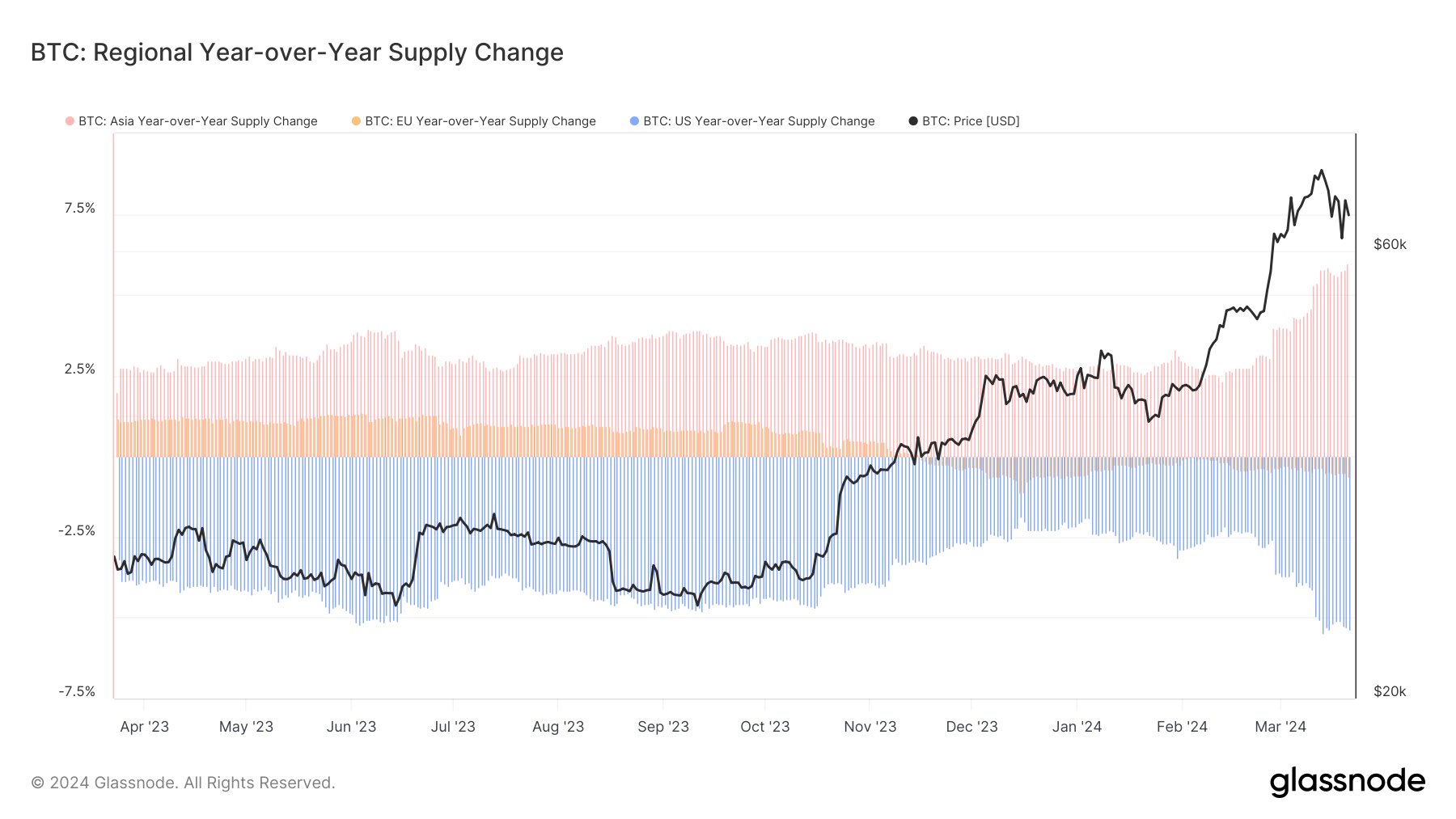
Stack Hodler (@stackhodler) further emphasized the urgency among Chinese investors to find secure investment avenues outside the traditional system, “Chinese investors were panic-buying a Gold fund at a 30% premium this month as they attempt to get their wealth into something outside the Chinese system. The approval of Hong Kong spot ETFs could be the turning point, offering a sanctioned avenue for wealth preservation amidst the crumbling real estate market.”
Overall, the potential approval of spot Bitcoin ETFs in Hong Kong is poised to be a landmark development, not just for the region but for the global market. By offering a secure and regulated channel for investment, it could serve as a catalyst for significant capital inflow into Bitcoin, reinforcing its status as a viable store of value.
“As we stand at the cusp of this historic development, the implications for Bitcoin and the broader cryptocurrency market could be profound. The approval of spot Bitcoin ETFs in Hong Kong could indeed be the harbinger of a new era, potentially driving Bitcoin’s value to new heights,” concluded Bernard.
At press time, BTC traded at $70,945.
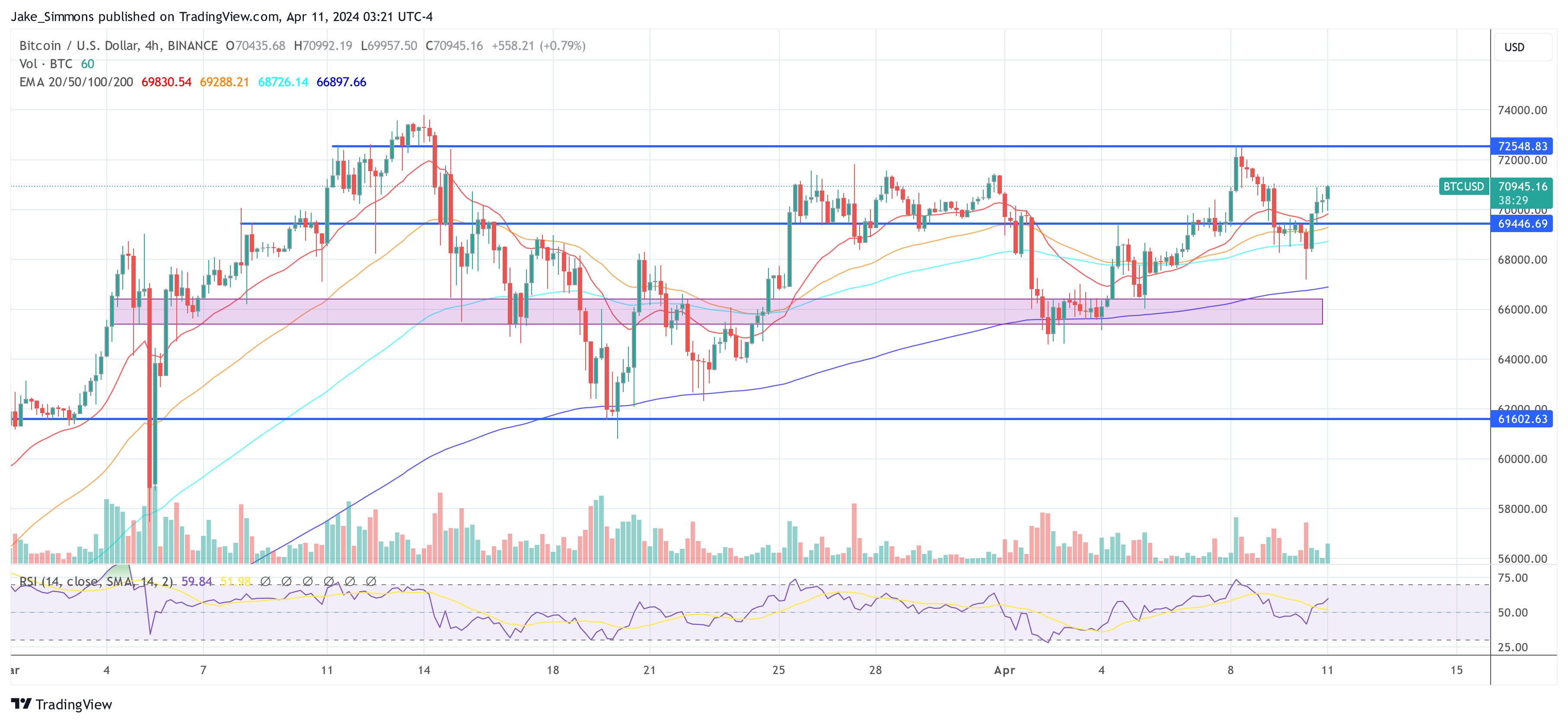
Featured image created with DALL·E, chart from TradingView.com
Disclaimer: The article is provided for educational purposes only. It does not represent the opinions of NewsBTC on whether to buy, sell or hold any investments and naturally investing carries risks. You are advised to conduct your own research before making any investment decisions. Use information provided on this website entirely at your own risk.
The defunct Atom Asset Exchange (AAX) in Hong Kong has started moving large amounts from inactive wallets. Ether worth over $56 million has been moved to different trading platforms, which has caused doubts about the objective of these transactions.
Funds Movement Sparks Concern
Cyvers Alerts, a blockchain analytics firm, reported that over 24,000 Ether, worth about $55.6 million, began to be moved from AAX Exchange wallets at the beginning of this month.
Analysts point out that the manner of these transactions reflects an effort to evade Anti-Money Laundering (AML) controls. Additionally, it has become known that part of the funds linked with the exchange has been frozen by Tether, making the unfolding event more intriguing.
Before its abrupt failure in November 2022, AAX had over 2 million registered users, making it one of Hong Kong’s largest crypto exchanges. The collapse was caused by the cessation of withdrawals and erasure of all social networks due to exposure to counterparty risks. This action followed the bankruptcy filing of another crypto behemoth, the FTX, emphasizing a period of crypto chaos.
Arrests and Allegations
The fallout of the shutdown led to the arrests of AAX’s ex-CEO, Thor Chan, and board member Haoming Liang, by the Hong Kong police. They were arrested for trying to escape the city during a crisis. Despite this, the exchange’s founder, whose identity is yet unknown, is alleged to be at large with large amounts of user funds and the vital private keys to the exchange’s wallets.
This has left 2 million AAX users unable to access their accounts or withdraw their assets. Complaints from victims worldwide, including mainland China, Taiwan, Italy, France, and others, have been received with losses totaling HK$98 million. The police investigation established a deceitful ploy where system maintenance was falsely claimed to stop asset withdrawal, resulting in vast sums of money being lost.
Hong Kong Police Action and Asset Recovery
Police have promptly taken action in response to the fraudulent activities and arrested two people related to AAX. Ongoing efforts are being pursued to map the path of the transferred funds and retrieve the affected users’ assets. The police have also warned about the risks associated with cryptocurrency trading, especially in light of recent operational difficulties faced by various platforms.
Read Also: Bitcoin ETF Hype is Likely Impacting Coinbase’s Popularity Among Retail Investors

The presented content may include the personal opinion of the author and is subject to market condition. Do your market research before investing in cryptocurrencies. The author or the publication does not hold any responsibility for your personal financial loss.
How Hong Kong’s Pressure on HSBC Might Affect Caged Beasts, Polygon, and Cardano: Do Banks Work With Crypto? Crypto Mode
Source link ]]>
✓ Share: