
- Cronos (CRO) gains momentum from Crypto.com’s real-world payment adoption.
- Cronos price rise backed by Bitcoin ETF inflows and 58% volume surge.
- The key levels to watch in the near term are the support at $0.0772 and the resistance at $0.0809.
Cronos (CRO) has seen renewed attention in recent weeks, fueled by a mix of market-wide momentum and positive developments in the cryptocurrency payments space.
The partnership between Crypto.com and KG Inicis in South Korea has added another layer of optimism for the token.
This collaboration allows tourists to use digital assets for everyday purchases, expanding the practical utility of CRO and other supported cryptocurrencies.
Impact of the Crypto.com, KG Inicis Partnership on CRO
The partnership enables Crypto.com Pay to integrate with KG Inicis’ extensive merchant network across South Korea.
This means that foreign visitors can use cryptocurrencies to pay at a variety of physical stores and online platforms.
For merchants, there is flexibility in receiving payments either in digital assets or immediately in fiat currency.
This real-world use case is significant for CRO.
While much of the token’s past activity has been driven by market speculation, adoption in daily transactions adds tangible utility.
Increased acceptance of CRO for payments could encourage higher trading activity and engagement from a broader user base.
Beyond simple adoption, the partnership reflects a growing trend of cryptocurrency integration in tourism and cross-border spending.
Digital currencies are moving from being primarily investment vehicles to practical tools for everyday use.
For CRO holders, this could translate into a more stable demand floor, particularly as the payment system attracts foreign visitors who are likely to convert local currency into crypto for spending.
The news also reinforces investor sentiment in the short term.
Cronos has a history of following broader market trends, but developments that enhance its ecosystem strengthen the token’s narrative beyond just price correlation with Bitcoin.
Practical use cases can often support prices during periods of market volatility, as traders see potential for both transactional and speculative value.
CRO price analysis
Cronos has climbed to $0.0801, marking a 1.7% increase over 24 hours.
This movement closely mirrored Bitcoin’s 1.42% rise, reflecting a period of strong institutional demand, particularly in Bitcoin ETFs.
Notably, the price increase was accompanied by a 58% surge in trading volume, highlighting genuine buying interest rather than a thin-market spike.
The combination of market momentum and tangible adoption news has created a cautiously positive environment for CRO.
Eyes are on the Bitcoin ETF inflows, as continued institutional interest tends to lift correlated altcoins.
Conversely, negative macro developments or regulatory concerns could trigger pullbacks, underscoring the importance of monitoring broader market conditions.
Cronos price forecast
From a technical standpoint, the near-term outlook for CRO is focused on key support and resistance levels.
Immediate support sits near the 7-day simple moving average at $0.07790.

Holding above this level would maintain the short-term bullish trend and could allow the token to test the 0.382 Fibonacci resistance level at $0.08297.
A decisive break above $0.08297 would open the path to a recent swing high near $0.088821, suggesting potential upside for traders targeting short-term gains.
On the other hand, a drop below $0.07790 could signal a consolidation phase or minor pullback, particularly if Bitcoin or the broader market reacts negatively to upcoming macro events.
Unlocking utility for world’s biggest meme coin The Korea Times
Source link ]]>
Cardano Price Prediction: South Korea KOSPI Crashes 20 Percent openPR.com
Source link ]]>
The government of South Korea has announced plans for the promotion of digital asset exchange-traded funds, especially a Bitcoin ETF, within this year. This is coming after a series of developments regarding stablecoins and blockchain-based settlements. South Korea Gov Plans to Launch Bitcoin ETFs by 2026 As reported, the country has a plan to list
The post Breaking: South Korea Confirms Spot Bitcoin ETF Launch in 2026 appeared first on CoinGape.
]]>
- 258 victims’ personal data stolen from six public and financial portals.
- BTS star Jungkook targeted with 8.4B won HYBE stock theft attempt.
- 21.3B won in virtual assets stolen, 12.8B won recovered by police.
South Korean authorities have uncovered one of the country’s largest cyber fraud cases, dismantling an international hacking ring that stole nearly 39 billion won from high-profile victims.
The Seoul Metropolitan Police Agency confirmed that the group exploited weak security across government, IT, and financial platforms to steal data from 258 people, which was later used for large-scale SIM-swap fraud.

The suspects targeted wealthy business leaders, lawyers, athletes, crypto investors, and celebrities, including BTS member Jungkook, who narrowly avoided losing 8.4 billion won worth of HYBE stock.
Investigations revealed the cross-border scale of the operation, stretching from Seoul to Bangkok.
Hackers exploited data from 258 victims
Between July 2023 and April 2024, the ring infiltrated six public and financial portals with weak protections. The breaches exposed personal details such as resident registration numbers and financial verification data.
Police said 258 victims were affected, including 75 business executives, 11 lawyers and officials, 12 celebrities, six athletes, and 28 virtual asset investors.
Collectively, the group accessed accounts with combined holdings estimated at 55.22 trillion won, with some single accounts exceeding 12 trillion won.
To execute the fraud, the hackers created 118 mobile accounts under the names of 89 victims. These accounts were then used to bypass security checks and siphon money directly from bank and crypto wallets.
In total, 16 victims lost 39 billion won, while financial institutions managed to block a further 25 billion won in attempted thefts. The largest confirmed loss involved 21.3 billion won in virtual assets.
BTS star Jungkook targeted with 8.4 billion won attempt
The scheme gained widespread attention after police confirmed that BTS member Jungkook was one of the intended victims.
Hackers attempted to move 8.4 billion won worth of HYBE stock under his name, but the suspicious transaction was blocked before funds left the account.
Officials credited banks and agencies with flagging abnormal activity, preventing Jungkook’s potential losses. In total, police managed to recover 12.8 billion won through swift interventions, including freezing accounts and stopping withdrawals.
However, investigators highlighted that the case exposed a critical weakness in South Korea’s non-face-to-face authentication systems, which the group manipulated to carry out its operations.
Arrests across South Korea, China, and Thailand
The investigation began in September 2023, when unauthorised mobile phone activations were first reported to Namdaemun Police Station. Over the following months, 16 suspects were identified and detained.
The ringleaders, identified only as Mr. A (35) and Mr. B (40), moved frequently between China and Thailand. Both were eventually arrested in Bangkok in May after Seoul police collaborated with Thai authorities and Interpol.
Mr. A was extradited to South Korea on August 22 and faces 11 charges, including large-scale fraud and hacking, while Mr. B remains in custody in Thailand pending extradition.
Three suspects are still in detention in South Korea, while the rest face prosecution for fraud, hacking, and violating the Information and Communications Network Act.
Police noted that the outcome could have been far worse had the group been allowed to continue operations.
Crypto scams rising in South Korea
The case adds to a growing wave of cybercrime linked to cryptocurrency in South Korea. On May 15, Jeju police arrested 25 suspects for running fake investment schemes that defrauded 48 people of 734 million won.
In a separate incident, a police officer in Incheon was charged with embezzling 700 million won from investors in a bogus crypto project.
Meanwhile, Park “Jonbur Kim,” known as the “Coin King,” is on trial for manipulating the Artube coin, which caused investor losses of 68 billion won.
Authorities are also investigating large-scale money laundering. Prosecutors say unlicensed brokers funnelled 943.4 billion won through Neteller Pay between 2019 and 2024, earning 26 billion won in commissions.
Assets worth 4.4 billion won in Ethereum have since been seized from hidden wallets.
Cases have even extended into romance scams, with a man in his 50s losing 100 million won in July, and celebrity-linked fraud, with actress Hwang Jung-eum facing trial for embezzling 4.3 billion won from her agency for crypto purchases.
Despite these risks, South Korea remains one of the world’s most active crypto markets. Chainalysis data shows $130 billion in inflows in 2024, with over 10.8 million Koreans trading digital assets.
More than 10,000 investors hold balances above 1 billion won, especially among traders in their 20s. Regulators are now preparing to approve the nation’s first spot crypto ETFs and a won-pegged stablecoin, as major exchanges expand custody services to institutions.
XRP News Today: Altcoin Trading Volume Surges 100% in South Korea Led by XRP and Dogecoin AInvest
Source link ]]>
Bitcoin, Ethereum, Dogecoin Dip On Macro Jitters From Trump’s Japan, South Korea Tariffs: Analyst Says BTC 6 Months Away From Top If History Repeats Benzinga
Source link ]]>
US President Donald Trump looks to revive ghosts of the April 2 ‘Liberation Day’ as he moves forward with his reciprocal tariffs ahead of the July 9 deadline. The president has announced a 25% tariff on goods from Japan and South Korea. Meanwhile, the BTC price is now at risk of dropping below the $108,000
The post Breaking: Trump Announces 25% Tariffs on Japan and South Korea, BTC Price Reacts appeared first on CoinGape.
]]>Reason to trust

Strict editorial policy that focuses on accuracy, relevance, and impartiality
Created by industry experts and meticulously reviewed
The highest standards in reporting and publishing
Strict editorial policy that focuses on accuracy, relevance, and impartiality
Morbi pretium leo et nisl aliquam mollis. Quisque arcu lorem, ultricies quis pellentesque nec, ullamcorper eu odio.
A crypto analyst has shared insights into the recent strength in the XRP price, suggesting that South Korea may be the reason behind it. The analyst noted that the altcoin has been seeing high trading volume on South Korean exchanges, and this localized demand may be holding up its price while other altcoins struggle to gain traction.
How South Korea Is Bolstering The Price
According to XForceGlobal South Korea is currently one of the major drivers of the XRP price action. In a recent post on X (formerly Twitter), the analyst disclosed that the engagement and adoption from the crypto users in South Korea was a major contributor to XRP’s bullish performance.
Related Reading
Currently, South Korea is one of the most active crypto markets in the world, leading in global trading volume across multiple assets. However, among the numerous cryptocurrencies in the market, XRP stands out the most within the country. The analyst has revealed that even during low trading days, XRP frequently outpaces Bitcoin, underscoring its high demand and adoption in South Korea.
XForceGlobal has suggested that South Korea’s notable interest in XRP likely stems from its status as one of the most isolated countries in terms of crypto regulations. The analyst revealed that millions of citizens currently own the altcoin, making up about 20% of the cryptocurrency’s market cap valuation.
Moreover, due to a lack of large-scale cross-border payment solutions, most South Koreans opt to use cryptocurrencies like XRP to facilitate transactions. This, in turn, fuels adoption and strengthens the cryptocurrency’s utility, which positively influences its price action.
Compared to South Korea, the regulatory uncertainties and legal challenges in the United States (US) have slowed down XRP’s growth. XForceGlobal has stated that the active participation of retail institutions, strong community support, and early adoption in South Korea have helped prop up prices despite the difficulties it faced over the past years.
What The Future Holds For XRP In South Korea
While discussing the impact of South Korea’s support for XRP on its price action, XForceGlobal offered insights into the cryptocurrency’s future in the country. The analyst revealed that the market is at a pivotal moment where XRP has evolved from a speculative asset to a symbol of Korea’s dominance in the crypto market.
Related Reading
Currently, Upbit, the largest crypto exchange in South Korea, holds the most significant market share of XRP in terms of total supply. The exchange reportedly has about 6 billion XRP, accounting for roughly 5% of the entire supply.
XForceGlobal has revealed that the continued demand from retail investors combined with Upbit’s massive XRP reserve will make South Korea a key driver to the cryptocurrency’s global future price action.
Moving forward, the analyst has discussed XRP’s price movements on the Korean won chart, suggesting that its current action may be foreshadowing upcoming events. He pointed out that the altcoin has already formed a lower low on the chart, possibly hinting at a more controlled pullback rather than an impulsive decline — an outlook he described as “arguably bearish”.
The crypto analyst also noted that XRP may be forming a potential bottom on the Korean won chart, indicating a possible impulse to the upside and a bullish continuation.
Featured image from Adobe Stock, chart from Tradingview.com
As the US prepares to implement new tariffs, the crypto market is seeing increased volatility. Recent developments involving China, Japan, and South Korea may further contribute to market uncertainty.
The three countries have agreed to respond jointly to the tariffs, raising questions about how global trade tensions will affect the crypto market. With President Trump’s planned “Liberation Day” tariffs on the horizon, questions loom over the future of Bitcoin and other cryptocurrencies.
U.S. Tariffs and Global Trade Tensions
China, Japan, and South Korea have reportedly confirmed that they would cooperate in addressing the U.S. tariffs, which are set to be introduced in early April. The tariffs target multiple industries, including the automotive and pharmaceutical sectors. This move comes on the back of US threats to impose additional tariffs which President Donald Trump has termed as ‘Liberation Day,’ set to happen on April 2, Wednesday.
Moreover, these three nations America’s important trading partners, and these tariffs can affect the stability of their economic sectors. Such cooperation indicates that they have formed strategic alliances in order to safeguard their export destinations and economic advantages.
The announcement comes in the wake of the trade ministers of the three countries meeting in a bid to intensify cooperation hence reducing the effects of the policies of the United States of America. However, tensions on the trade issue may even escalate further, and the odds of a trade war are still looming over the crypto market . These developments have led to alerts over various global financial markets, especially due to increasing integration of the national and global stages for business, especially in the crypto market.
Bitcoin Price Analysis Amid Tariff Concerns
The crypto market has already shown signs of distress, with Bitcoin experiencing a noticeable decline. As of March 31, Bitcoin was trading at $82,687, down nearly 2% in a 24-hour period. The cryptocurrency has faced a series of lower lows, with the most recent drop continuing a bearish trend. Bitcoin’s price has struggled to maintain its momentum, and the market has responded cautiously to global economic news.
Overall, the activities in the US market play a key role for the Bitcoin price decrease. The US being close to ‘Liberation Day’ on April 2 when new tariffs are anticipated to be implemented, traders are preparing themselves for increased fluctuation in the crypto market. These aspects, including the future of global trade and uncertainty around what the US policies would be like for the world economy, has given investors more reason to pause. Bitcoin, in particular, has been caught in this downward spiral, with its price showing weaker momentum.
Bitcoin’s recent price movement reflects a broader risk-off sentiment, with traders reducing exposure to more volatile assets. While Bitcoin was able to recover slightly after four consecutive days of decline, the overall sentiment remains bearish. Bitcoin has not managed to break past key resistance levels, and the possibility of further downward pressure remains high.
Institutional Interest and Long-Term Outlook
Despite the short-term declines in Bitcoin’s price, institutional interest in the cryptocurrency remains strong. On-chain data analyzed by Glassnode reveals that the number of addresses containing from 1000 to 10000 BTC has also been slowly rising, indicating that institutional investors are still active in the market.
This acquisition by institutional investors shows that investors are increasing their holdings of Bitcoin in the long-term despite short-term downturns. At the same time, the Fear & Greed Index is still in the “fear” territory, which means that traders are concern about long-term impact of the tariffs.
Bitcoin Fear and Greed Index is 34. Fear
Current price: $82,687 pic.twitter.com/wDyPuGshJG— Bitcoin Fear and Greed Index (@BitcoinFear) March 31, 2025
Similarly, XRP and Cardano (ADA) alongside Solana (SOL), Dogecoin (DOGE), and Ethereum (ETH) have been on the decline due to the general bearish crypto market.
Additionally, Bitcoin exchange-traded funds (ETFs) have shown sustained inflows, highlighting that there is still demand for Bitcoin from institutional traders. This ongoing interest from large investors contrasts with the risk-off sentiment observed in the broader market. However, analysts remain cautious, as the tariffs and economic uncertainty could keep Bitcoin’s price rangebound in the short term.
Bitcoin’s Price Resistance Should Crypto Market Decline Persist
Bitcoin price has reached important support and resistance zones, and analysts like Rekt Capital are also considering these levels crucial. For the moment, Bitcoin is hovering slightly above the $82000 level. The immediate target on the upside is found at $85,000 which has offered a major resistance to Bitcoin in the past few days. If the Bitcoin price can get through this level and establish an upward movement, then there could be some kind of a bounce back.
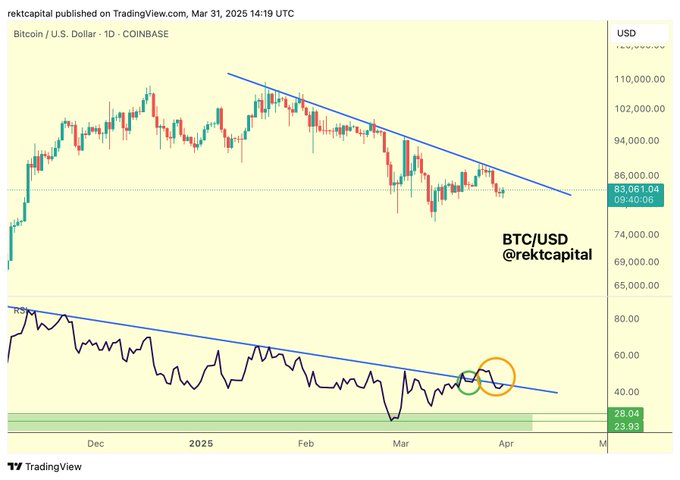
However, if the tariffs result in further economic instability, Bitcoin may struggle to maintain its price levels. Some analysts suggest that Bitcoin could experience a V-shaped recovery if the market stabilizes.
On the other hand, if the bearish trend continues, Bitcoin price could see further declines, potentially testing lower support levels around $70,000 or even below, depending on the market’s reaction to the tariffs and global trade tensions.

Kelvin Munene Murithi
Kelvin is a distinguished writer with expertise in crypto and finance, holding a Bachelor’s degree in Actuarial Science. Known for his incisive analysis and insightful content, he possesses a strong command of English and excels in conducting thorough research and delivering timely cryptocurrency market updates.
Disclaimer: The presented content may include the personal opinion of the author and is subject to market condition. Do your market research before investing in cryptocurrencies. The author or the publication does not hold any responsibility for your personal financial loss.
✓ Share: