Ethereum price started a downside correction below $4,120. ETH is moving lower below $4,000 and might decline further if it trades below $3,880.
- Ethereum started a downside correction below $4,050 and $4,000.
- The price is trading below $4,000 and the 100-hourly Simple Moving Average.
- There is a bearish trend line forming with resistance at $4,000 on the hourly chart of ETH/USD (data feed via Kraken).
- The pair could continue to move down if it trades below $3,880.
Ethereum Price Dips Further
Ethereum price failed to stay in a positive zone and started a fresh decline, like Bitcoin. ETH price declined below $4,120 and $4,050 to enter a bearish zone.
There was a clear move below the 61.8% Fib retracement level of the upward move from the $3,708 swing low to the $4,252 high. Besides, there is a bearish trend line forming with resistance at $4,000 on the hourly chart of ETH/USD.
Ethereum price is now trading below $4,000 and the 100-hourly Simple Moving Average. If there is another increase, the price could face resistance near the $4,000 level and the trend line. The next key resistance is near the $4,030 level and the 100-hourly Simple Moving Average.
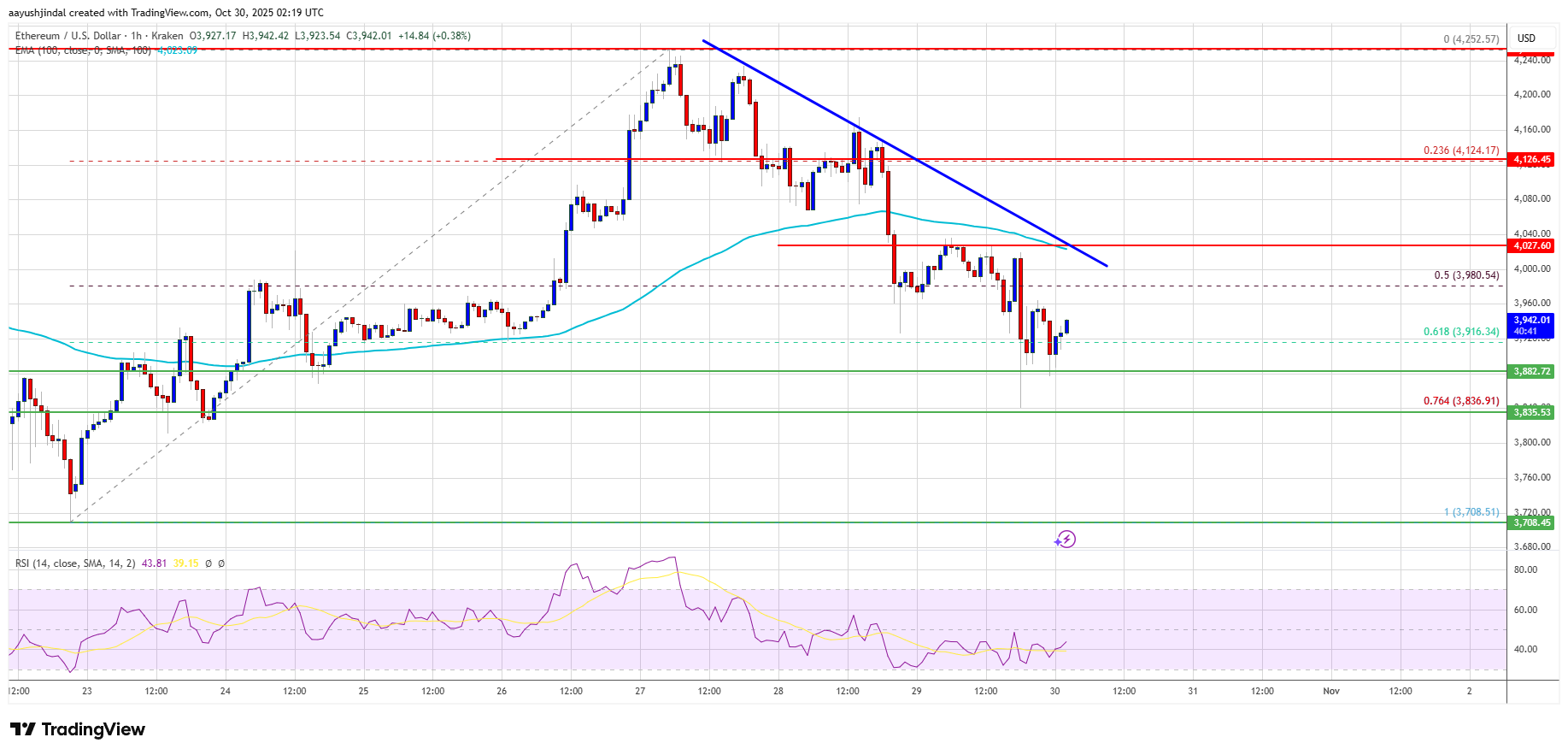
The first major resistance is near the $4,080 level. A clear move above the $4,080 resistance might send the price toward the $4,120 resistance. An upside break above the $4,120 region might call for more gains in the coming sessions. In the stated case, Ether could rise toward the $4,200 resistance zone or even $4,220 in the near term.
More Losses In ETH?
If Ethereum fails to clear the $4,000 resistance, it could start a fresh decline. Initial support on the downside is near the $3,880 level. The first major support sits near the $3,840 zone and the 76.4% Fib retracement level of the upward move from the $3,708 swing low to the $4,252 high.
A clear move below the $3,840 support might push the price toward the $3,750 support. Any more losses might send the price toward the $3,700 region in the near term. The next key support sits at $3,650 and $3,620.
Technical Indicators
Hourly MACD – The MACD for ETH/USD is gaining momentum in the bearish zone.
Hourly RSI – The RSI for ETH/USD is now below the 50 zone.
Major Support Level – $3,880
Major Resistance Level – $4,000
Cardano And VeChain Lack Momentum As Funds Position Early Into Remittix For Projected 25x Returns This Year Crypto Economy
Source link ]]>
Cardano Price Drops 55% Amid DeFi Decline, Lack of Bullish Catalysts AInvest
Source link ]]>
Cardano (ADA) Slips, But Lack of Panic Selling Signals Hope BeInCrypto
Source link ]]>
Shiba Inu and Pepe Price Rallies Suggest A Lack Of Interest; What Are Traders Buying? CoinCentral
Source link ]]>

- Over the past 10 years, the federal government has sold around 195,000 Bitcoin for $366 million
- Today, that figure would be worth over $17 billion
- Sacks said the lack of a “long-term strategy” has cost American taxpayers
White House artificial intelligence (AI) and crypto czar David Sacks has criticized the US federal government’s lack of “long-term strategy” with the sale of confiscated Bitcoin.
“Over the past decade, the federal government sold approximately 195,000 Bitcoin for proceeds of $366 million. If the government had held the Bitcoin, it would be worth over $17 billion today. That’s how much it has cost American taxpayers not to have a long-term strategy.”
Over the past decade, the federal government sold approximately 195,000 bitcoin for proceeds of $366 million. If the government had held the bitcoin, it would be worth over $17 billion today. That’s how much it has cost American taxpayers not to have a long-term strategy.
— David Sacks (@davidsacks47) March 6, 2025
Michael Saylor, Strategy’s chairman, responded: “You do not sell your Bitcoin.” Since 2020, Strategy (formerly MicroStrategy) has been actively purchasing Bitcoin. It currently holds 499,096 Bitcoin, valued at $44.72 billion.
Crypto Summit
The comment from Sacks comes as the White House gets ready to host its first Crypto Summit.
So far, 20 crypto leaders have been invited to the event, which will take place on March 7. According to Sacks, they decided to keep the numbers down to have a “meaningful conversation” regarding crypto policies.
An earlier report suggests that US President Donald Trump will unveil his plans for a Bitcoin reserve strategy during the roundtable. In an interview, US Commerce Secretary Howard Lutnick said:
“A Bitcoin strategic reserve is something the President’s interested in. He spoke about it all during the campaign trail, and I think you’re going to see it executed on Friday.”
Some of those attending include Vlad Tenev, co-founder and CEO of Robinhood; Arjun Sethi, CEO of Kraken; Brian Armstrong, CEO of Coinbase; Cameron and Tyler Winklevoss, founders of Gemini; and Michael Saylor, executive chair of Strategy.
Members of the Presidential Working Group on Digital Assets will also be in attendance.
“Crypto czar”
In December, Trump announced that Sacks would be the lead policy advisor on artificial intelligence and crypto, dubbing him the “White House AI and Crypto Czar.”
Trump wrote that Sacks will take up the role which are “two areas critical to the future of American competitiveness,” adding, among other things, that “he will work on a legal framework so the crypto industry has the clarity it has been asking for, and can thrive in the US.”
As part of his role, Trump added that Sacks will focus on making America a “global leader” in these areas, something Trump promised during his election campaign in August.
RollBlock gains recognition as Shiba Inu, Floki falter from lack of utility crypto.news
Source link ]]>
Memecoins Shiba Inu, DOGE, PEPE Important In The Ecosystem Despite Lack Of Practical Use Cases ZyCrypto
Source link ]]>
Analysts at global asset management firm, Bernstein have expressed bearish sentiment for Spot Ethereum ETFs prospects. According to Bernstein analysts, Gautam Chhugani and Mahika Sapra, Spot Ethereum ETFs may see less demand than Spot Bitcoin ETFs due to a lack of staking features.
Analysts Predict Sluggish Demand For Spot Ethereum ETFs
In a new research report published on Monday, Bernstein analysts suggested that Spot Ethereum ETFs will likely experience a wane in investor demand following its launch. The analysts painted a bearish picture for the recently approved investment asset, noting that the enthusiasm for Ethereum Spot ETFs might be on a smaller scale than the initial excitement for Spot Bitcoin ETFs.
Chhugani and Sapra attributed their pessimistic predictions to the lack of ETH staking features in Spot Ethereum ETF filings. However, they wrote that the “basis of trade” for Spot Ethereum ETFs may likely improve over time, attracting more investors and ultimately improving liquidity.
The analysts also wrote that the basis of the trade would involve a unique strategy where investors purchase Spot Ethereum ETFs and sell futures contracts while waiting for prices to converge. This approach would potentially ensure that the ETF market gains ample liquidity and sustainability.
Considering Bernstein’s bearish outlook for Spot Ethereum ETFs, a potential drop in investor demand could lead to significantly reduced inflows. This outcome would be a stark contrast to the strong inflows observed after the launch of Spot Bitcoin ETFs.
After the United States Securities and Exchange Commission (SEC) approved Spot Bitcoin ETFs on January 10, and it launched a day after, millions of inflows flooded the market within a few days, fueled by investors’ demand and prior anticipation for the digital assets. These massive inflows also contributed to Bitcoin’s rise to new all-time highs above $73,000.
Bloomberg Analyst Reinforces Ethereum ETFs Launch Date
Spot Ethereum ETFs are likely to hit the market by July 2024. According to senior Bloomberg analyst, Eric Balchunas, asset management firm, VanEck has filed its 8-A form for Spot Ethereum ETFs. The analyst disclosed in an X (formerly Twitter) post that approximately seven days after VanEck filed the same form for Spot Bitcoin ETFs, the ETFs launched.
Uncanningly, July 2, about seven days after VanEck’s recent 8-A filing, is the date Balchunas predicted for the launch of Spot Ethereum ETFs. The Bloomberg analyst has doubled down on his previous prediction, indicating that Ethereum Spot ETFs could debut on this date.
Responding to his post, a crypto community member inquired about the inclusion of staking in features for the Ethereum Spot ETFs. Balchunas clarified with a “no,” indicating the SEC’s concerns about the classification of staking as an unregistered security. The community member further pointed out that the absence of staking would render Ethereum Spot ETFs significantly less appealing than their Bitcoin versions.
Featured image created with Dall.E, chart from Tradingview.com
On-chain analytics platform Glassnode has provided insights into why the Bitcoin price recently dropped below $70,000. The platform suggested that the flagship isn’t yet seeing enough demand, which could send its price to new highs.
Demand For Bitcoin Is Still Modest
In one of its latest market reports, Glassnode mentioned that “the rate at which new capital is flowing into the Bitcoin network has slowed down considerably from its peak.” They made this assertion based on the Realized Cap metric, which measures the value of each Bitcoin based on the last time it was traded. Glassnode claimed that Bitcoin’s Realized Cap is currently at $574 billion.
Related Reading
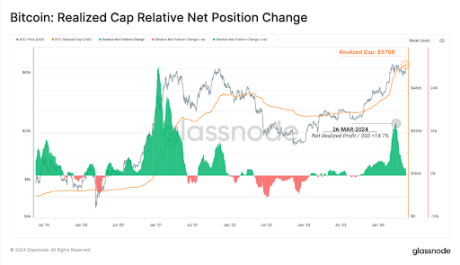
The platform further revealed that the injection of liquidity into Bitcoin has cooled off since the flagship crypto hit an all-time high (ATH) of $73,750. This is in stark contrast to the period before Bitcoin hit that ATH, with Glassnode noting that the flows into Bitcoin back then were “extremely sharp, culminating at a value of $3.38 billion daily.”
Meanwhile, Glassnode stated that the Realized Cap “remains in positive profit-dominated territory and is returning towards an equilibrium position.” However, they noted that Bitcoin’s modest demand was still able to spark this recent rally thanks to the “declining sell-side headwinds from mature investors.”
Basically, Glassnode suggested that things were looking up for Bitcoin but that it could be way better if there were more capital inflows. There could indeed be an increase in capital inflows soon enough, considering that the Spot Bitcoin ETFs have broken their streak of net outflows and are once again recording impressive net inflows into their funds.
Data from Farside Investors shows that these funds have already seen almost $700 million in net inflows this week. Specifically, these Bitcoin ETFs recorded a net inflow of $305.7 million on May 21 alone. That day was also BlackRock’s iShares Bitcoin Trust (IBIT) most profitable day yet, with the fund taking in $290 million.
Some Positive Key Takeaways
Glassnode also assessed some other vital on-chain metrics, which provided some positives for Bitcoin’s future trajectory. The platform noted that there has been a “large decline” in Bitcoin’s Sell-Side Risk Ratio, which “suggests the market has found a degree of equilibrium over the course of this correction.”
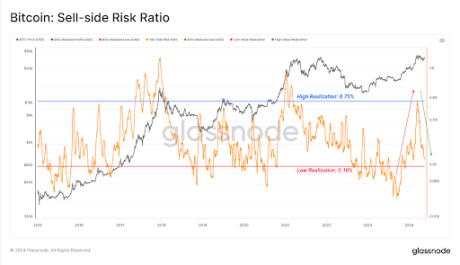
To assess market volatility, they also measured the percent range between the highest and lowest price ticks over the last 60 days. They concluded that “volatility continues to compress to levels typically seen after lengthy consolidations and prior to large market moves.”
Related Reading
Meanwhile, Glasnode revealed that 2.14M BTC out of the Short-term holder (STH) supply, currently at 3.36M BTC, fell into an unrealized loss following the recent market correction. They claim that this suggests that many of the BTC held by this category of investors are held at an unrealized loss, which reduces the risk of top-heaviness developing.
Featured image created with Dall.E, chart from Tradingview.com