
Ethereum co-founder and ConsenSys chief Joseph Lubin appeared on Bloomberg Crypto on October 7 and confirmed that ConsenSys is building the prototype for SWIFT’s new blockchain-based shared ledger—an initiative that, according to SWIFT’s own announcement last week at Sibos in Frankfurt, will bolt a permissioned, always-on ledger into the global messaging cooperative’s infrastructure and natively integrate ISO 20022 financial messaging.
SWIFT Builds On Ethereum
Lubin said the first build “will most definitely implement messaging, financial messaging using ISO 20022,” adding that while SWIFT itself is “careful to stay in their lane and focus on the messaging part,” some participating banks are “interested in potentially diving down into settlement layers.”
“I have to be careful about what I say. It is a project that we’re building out. There will be technologists on their side and lots on our side. And I’m glad that you called it a prototype, because that’s what it is,” the ConsenSys founder added.
He declined to give a deployment timeline. “I do have an idea of what sort of timeline, and I can’t say too much about it. We’re defining what we believe will be the end state, and we’re backing that out, so I don’t know if SWIFT will be comfortable releasing the timeline at this point,” Lubin said.
SWIFT’s move—framed explicitly as a shared ledger that records, sequences and validates transactions—was unveiled on September 29, with the cooperative stressing that the project aims to deliver instant, 24/7 cross-border transactions at global scale and to accelerate “the transition to digital finance” while remaining asset-agnostic and interoperable with public and private networks. The formal materials did not name a base chain, but they did name ConsenSys as a core technology partner and emphasized ISO 20022 compliance and smart-contract-enforced business rules.
In his Bloomberg interview, Lubin underscored a broader strategic shift: the long-standing separation between “TradFi” and “DeFi” is breaking down. “Since the start of Ethereum, we had to stay on our own rail… the vibe in Frankfurt was very different,” he said, describing overwhelmingly positive bank feedback and calling it “about time for TradFi to merge or make use of DeFi.” He also characterized the current build as a true prototype with technologists “on their side and lots on our side,” reiterating that SWIFT would control the messaging scope while banks explore deeper layers like atomic settlement.
What “Using Ethereum” Means In Practice
While SWIFT has not officially specified the underlying chain in its press releases, multiple industry reports following Sibos and subsequent public remarks by Lubin say the prototype will run on Ethereum infrastructure—specifically ConsenSys’ Linea, an Ethereum layer-2 network that uses zero-knowledge proofs—positioning the build within the Ethereum ecosystem while maintaining a permissioned perimeter consistent with bank compliance requirements. That reporting aligns with ConsenSys’ own statement that it is “supporting Swift with early-stage prototyping” for the shared ledger.
The institutional context matters. SWIFT’s ledger initiative comes amid rapid growth in the $300 billion stablecoin market and a wave of bank tokenization pilots; its stated design goal is to extend existing rails rather than replace them, allowing banks to opt into tokenized processes where it improves speed, transparency, and finality.
Beyond SWIFT: Lubin’s Treasury Thesis
Lubin also used the Bloomberg segment to discuss the rise of “digital-asset-backed treasuries” (DATs) such as the Ethereum-focused vehicle he chairs at SharpLink. He argued that corporate ether accumulation is a “dampener on volatility,” describing ether as a “productive, yielding asset unlike bitcoin” when staked, and outlining a Berkshire-style flywheel in which a growing ETH base is deployed across Ethereum-aligned protocols for non-dilutive growth.
The strategic through-line is clear: if financial incumbents standardize on Ethereum-based rails for messaging and, increasingly, settlement, balance-sheet ETH becomes a strategic asset for institutions seeking exposure to the network’s activity and yield.
At press time, ETH traded at $4,484.
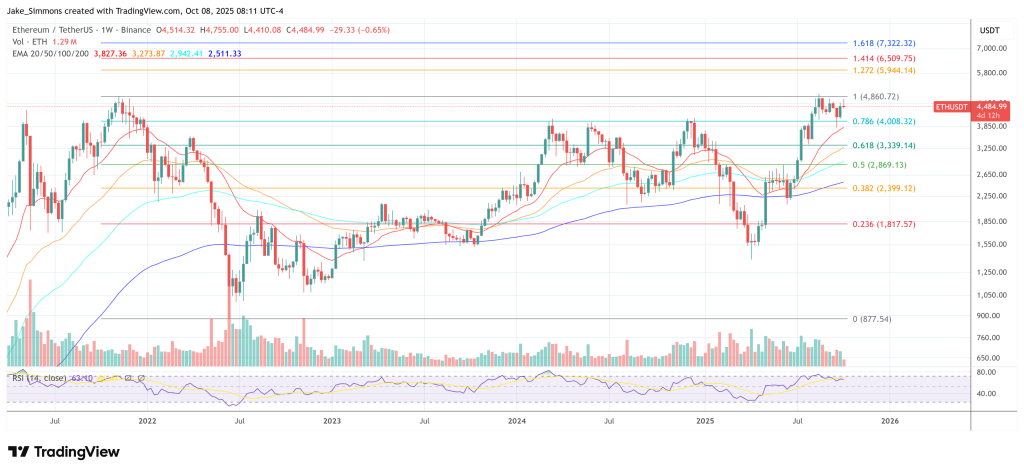
Featured image created with DALL.E, chart from TradingView.com
Editorial Process for bitcoinist is centered on delivering thoroughly researched, accurate, and unbiased content. We uphold strict sourcing standards, and each page undergoes diligent review by our team of top technology experts and seasoned editors. This process ensures the integrity, relevance, and value of our content for our readers.
Cardano (ADA) Upgrade Ogmios v6.7.0 Just Landed: What’s New U.Today
Source link ]]>
Franklin Templeton’s Ethereum Spot ETF ticker has appeared on the Depository Trust and Clearing Corporation (DTCC) list, indicating a possible signal that the United States Securities and Exchange Commission (SEC) could approve Ethereum ETFs.
Franklin Templeton’s Spot Ethereum ETF Gets Listed By DTCC
On Friday, April 26, the proposed Ethereum Spot ETF of American multinational investment firm, Franklin Templeton made its debut on DTCC’s official website, under the ticker symbol EZET.
Franklin Templeton’s new listing on DTCC’s platform comes amidst the ongoing deliberations of the SEC regarding approving Ethereum Spot ETFs. Earlier in January, following the approval and launch of Spot Bitcoin ETFs, many analysts anticipated the emergence of additional cryptocurrency ETFs, with speculations centering on Ethereum being the next in line to receive an ETF after Bitcoin.
However, despite prominent financial services firms such as BlackRock, Grayscale, VanEck, Fidelity and others submitting applications for an Ethereum Spot ETF, approval from the US SEC has been delayed consistently.
The regulatory agency disclosed in a recent filing on Tuesday, April 23, that it would be designating a longer period to decide on its appropriate mode of action regarding the Spot Ethereum ETF proposed by Franklin Templeton and Grayscale. The commission had scheduled June 11 as the new deadline to approve or reject the Ethereum Spot ETF proposals.
This move appears to be anticipated by other crypto and financial experts in the industry, as analysts from Standard Chartered as well as VanEck CEO, Jan Van Eck had previously expressed skepticism about the likelihood of the US SEC authorizing Ethereum Spot ETFs soon.
Ethereum is now trading at $3,120. Chart: TradingView
Is The New Listing A Sign Of An Imminent Approval?
The recent addition of Franklin Templeton’s proposed Ethereum Spot ETF in the DTCC listing is seen as an initial step in the trading process and does not guarantee approval from the SEC which holds sole authority to green light or reject such investment products.
Before the approval of Spot Bitcoin ETFs, the DTCC had listed BlackRock’s previously proposed Spot Bitcoin ETF on its platform, fueling speculations and raising hopes of possible approval by the SEC. However, the clearing and settlement company later removed BlackRock’s Bitcoin ETF from its platform, clarifying that the listing did not imply the SEC’s endorsement of Spot Bitcoin ETF applications.
Amidst the anticipation of an Ethereum Spot ETF approval, the US SEC has remained ambiguous about its position. Senior Bloomberg ETF analyst, Eric Balchunas also revealed earlier in March that their odds for an Ethereum ETF approval was only 25%, reflecting a rather pessimistic outlook.
Overall, the broader crypto market is still closely monitoring the developments surrounding Franklin Templeton and other financial firm’s Ethereum Spot ETF applications along with the SEC’s final decision, acknowledging a potential approval as a significant step forward in the digital asset sector.
Featured image from Pexels, chart from TradingView
This Shiba Inu and Pepe Hybrid Just Landed on Major Exchange U.Today
Source link ]]>