Bitcoin, Ethereum, XRP, Dogecoin Recover But ‘Extreme Fear’ Sentiment Lingers: Analyst Says Markets Will Remain ‘Boring’ Until This Day Benzinga
Source link ]]>
After days of intense bearish action, the price of Bitcoin appears to be entering a calmer state, as it recovers above the $86,000 level. The latest on-chain data shows that several investors tried to take some profit in the past week, providing a basis for the premier cryptocurrency registering a double-digit loss.
Bitcoin Exchange Inflow Spikes As Price Faces Downward Pressure
In a recent post on the social media platform X, crypto analyst Ali Martinez revealed that significant Bitcoin amounts were sent to centralized exchanges in the past week. Data from Santiment shows that about $20,000 BTC (worth nearly $2 billion) has been moved to these exchanges in the past seven days.
Related Reading
The relevant indicator in this on-chain observation is the Exchange Inflow metric, which tracks the volume of an asset (in this case, Bitcoin) that flows to centralized exchanges within a specified period. This metric is often important because one of the prominent exchanges’ service offerings is selling.
Hence, an increase in the Exchange Inflow metric suggests the potential offloading of an asset by investors. The resulting increased supply of this cryptocurrency in the open market often adds downward pressure on the coin’s price, especially if there is no corresponding increase in demand.
In a separate post on X, CryptoQuant’s head of research, Julio Moreno, shared a data piece supporting the recent spike in exchange inflows. According to data highlighted by the crypto researcher, the Bitcoin exchange inflows stood at about 81,000 BTC (the highest level seen since mid-July) on Friday, November 21.
Ultimately, this recent spike in exchange inflows explains the volatility experienced by the price of Bitcoin on Friday. The flagship cryptocurrency succumbed to significant bearish pressure, seeing its price fall to just above $80,000 as the weekend approached.
As of this writing, the price of BTC stands at around $86,070, reflecting an over 2% jump in the past 24 hours.
Bitcoin In Profit-Taking Phase: CryptoQuant CEO
CryptoQuant CEO Ki Young Ju revealed that Bitcoin is in a profit-taking phase, as evidenced by the rising exchange inflows. The crypto founder made this assertion based on the PnL Index Signal, which measures profit and loss levels using all wallets’ cost basis.
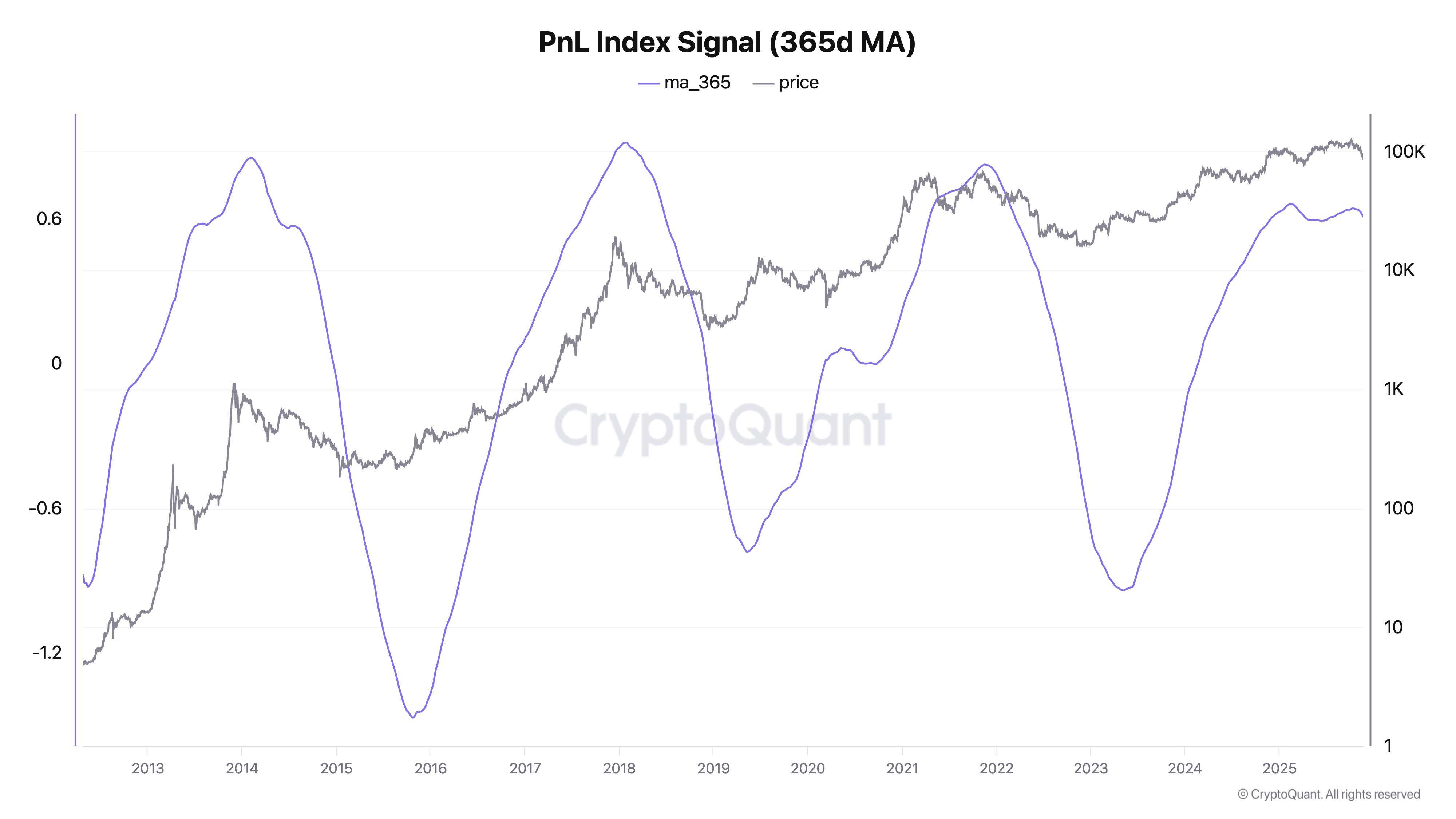
With the current reading of the PnL Index Signal, Ju proclaimed that the classic cycle theory says that BTC is entering a bear market. According to the CryptoQuant CEO, only macro liquidity can override the profit-taking cycle—just as seen in 2020.
Hence, all eyes will be on the Federal Open Market Committee (FOMC) meeting in December, especially with the falling expectations of an interest rate cut by the US Federal Reserve (Fed).
Related Reading
Featured image from iStock, chart from TradingView
XRP forecast: $5 price target lingers while Cardano and MAGACOIN FINANCE enter buy zones MSN
Source link ]]>
Shiba Inu and Cardano Investors Move To This DeFi Coin As Market Downturn Lingers Analytics Insight
Source link ]]>
Solana and Cardano Holders Take Refuge in This Crypto Gem As Market Correction Lingers Analytics Insight
Source link ]]>
Analyst Says ‘That’s Often Where Opportunities Lie’ As Cardano Lingers in ‘Deep Depression Phase’ The Daily Hodl
Source link ]]>
$0.001 SHIB Price Outlook Lingers As Shiba Inu Team Reveals Stablecoin Plans Amid Shibarium Growth ZyCrypto
Source link ]]>
$0.001 Shiba Inu Price Lingers as Expert Who Nailed Early Bitcoin Boom Forecasts Mega SHIB Explosion ZyCrypto
Source link ]]>
Typically, investors reduce their exposure to speculative assets, such as stocks and cryptos, when faced with high uncertainty. So far this year, the S&P 500 is down about 12%, compared with a 17% decline in bitcoin (BTC). Meanwhile, gold, a traditional safe haven asset, is up 3% over the same period, albeit down 8% from its recent peak in March.
Bitcoin is currently trading above $57,000 rekindling hopes that BTC might get to new record highs before year-end. Regaining last week’s losses triggered by the new Omicron Coronavirus variant and fears around regulations in India, Bitcoin price crossed above the $58,000 psychological level on Sunday nigh and is still up 5.77% over the last 24 hours.
The BTC price forecast remains uncertain for many for the remaining part of the years as fears around Corona remains. Bears still have the choice of taking advantage of the leveraged bulls against the backdrop of the recent rally.
Against this background and the month set to end in two days, it is important to understand how technical will shape BTC’s performance this week.
Bitcoin Price Bounces Off The 100 SMA
BTC/USD bounced off the 100-day Simple Moving Average (SMA) around $54,202 over the weekend as Bitcoin price rose to produce a weekly close of $57,248 according to data from CoinMarketCap. With this closure, BTC avoided its lowest weekly closure in two months.
Note that regaining the $58,000 level is crucial for BTC bulls sustaining the uptrend. At the time of writing, the big crypto is exchanging hands at $57,410 and is struggling to push above the downtrend line. A break out above the resistance line will see Bitcoin rise to tag the $60,000 psychological level.
The upward movement of the Relative Strength Index (RSI) indicator accentuates this bullish outlook.
BTC/USD Daily Chart
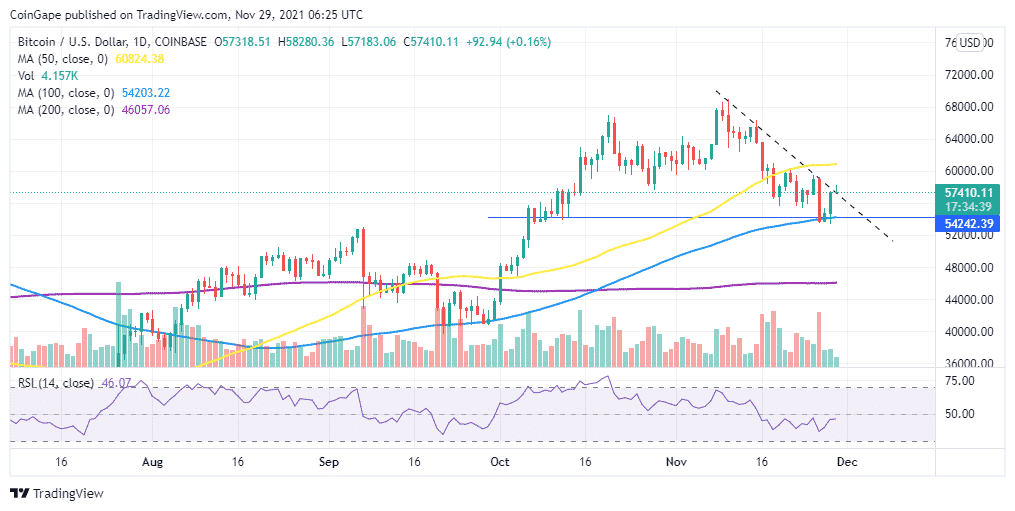
However, the RSI is still positioned in the neutral zone at 46.01 indicating that the overhead pressure might still push the BTC price further down.
Note that the $60K level remains untouched even after the rebound as BTC has been fiercely rejected from this point since flipping it into resistance on November 18.
However, there is still optimism from the Bitcoin community that the asset will close the Month above $60,000. Well, we have less than 48 hours to find out.
Disclaimer
The presented content may include the personal opinion of the author and is subject to market condition. Do your market research before investing in cryptocurrencies. The author or the publication does not hold any responsibility for your personal financial loss.
About Author
