
Staking activity on the Ethereum network is taking the spotlight as the altcoin’s price continues to face heightened volatility. One notable aspect of the development is the significant increase in staking activity among large institutional investors. The most recent staking move triggering a frenzy in the ETH community comes from The Ethereum Foundation.
Major ETH Stake by Ethereum Foundation
With the market still lingering in a bearish state, the frenzy around Ethereum’s price has cooled down and shifted toward a more dynamic trend. However, A recent notable move by the Ethereum Foundation is attracting attention to the staking activity across the ETH network, which appears to be experiencing substantial growth over the past few months.
Crypto commentator and investor Kyle Chasse has taken to X to report a massive staking from the Foundation, which saw $42.2 million worth of ETH being locked away in staking contracts. This development coincides with an increase in staking participation as more holders, especially institutional, decide to lock up their assets in exchange for yield.
By allocating a sizeable portion of ETH to staking, the Ethereum Foundation is showcasing its robust confidence in the network’s economics and security in the long term. With these persistent large ETH staking from The Foundation and other large institutions across the sector, the expert believes that the altcoin could change forever.
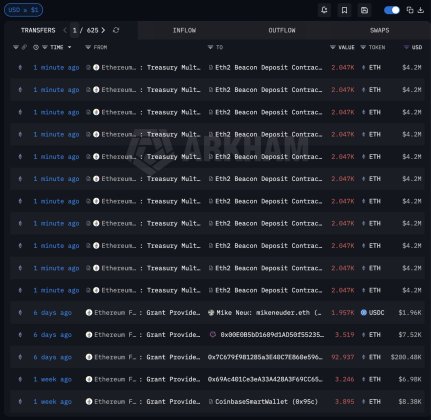
According to the expert, the Foundation made the move as Vitalik Buterin, the founder of Ethereum, gave an open statement about changing ETH’s direction. This revelation from the founder carries major weight since it will reshape the altcoin and its network’s future.
Chasse stated that there is still a lot to build, and a pivot like this is capable of redefining the entire ETH ecosystem. However, this move still poses some real risk if it eventually fails at execution. In the event that the team discovers the right angle and delivers real utility, this plan could go down as one of the most crucial moves in crypto history.
ETH Is Being Locked Away Everywhere
A market expert with the nickname AltCryptoGems has outlined the magnitude of Ethereum staking after multiple moves. While ETH is getting sold on the chart, the leading altcoin is being staked across the sector. Currently, nearly 3 million ETH is sitting around to be staked, with the entry queue now around 50 days.
At the same time, the exit queue has almost vanished as very few are leaving, which indicates a clear imbalance. If confidence were weak, exits would have spiked, causing staking to slow down. However, the opposite is happening as participants are locking ETH for months at a 2.7% yield.
Total ETH staked has now surpassed 38 million, representing over 31% of the entire supply. Meanwhile, this number continues to increase despite declining price action. ETH’s price is demonstrating weakness, but participation is showing strength, a classic disconnection that does not last long. Supply may be getting locked away, but demand is building.
Featured image from Pexels, chart from Tradingview.com
Editorial Process for bitcoinist is centered on delivering thoroughly researched, accurate, and unbiased content. We uphold strict sourcing standards, and each page undergoes diligent review by our team of top technology experts and seasoned editors. This process ensures the integrity, relevance, and value of our content for our readers.
Cardano (ADA) Locks $1.1B in DeFi TVL with 680 Weekly Commits but Price Compression Below $0.30 Deepens openPR.com
Source link ]]>
Dogecoin (DOGE) Displays Distressed Price Action as $0.10 Support Locks in Weak Hands CCN.com
Source link ]]>
Cardano Eyes Breakout, Ethereum Rebounds, and BlockDAG Locks In Launch-Day Stability With 40/60 Vesting! openPR.com
Source link ]]>
Shiba Inu and Baby Dogecoin Hold—But Troller Cat Locks 2024% Gains in Best Meme Coin to Buy Today BlockchainReporter
Source link ]]>
Dogecoin News Today: Crypto Whale Locks $2.14M Profit Closing Dogecoin Position AInvest
Source link ]]>
DTX Exchange Locks 440% Gains for Early Backers, But Why Is Shiba Inu Struggling? Analytics Insight
Source link ]]>
Ripple Labs, a leading American-based payment firm has locked away a substantial amount of XRP tokens in its escrow wallet as part of its monthly unlock program to help bolster its ecosystem and XRP.
Ripple Takes Back 800 Million XRP
A recent report from on-chain tracker Whale Alert revealed that Ripple took back about 800 million XRP tokens. This is no surprise, as the stated transaction has been a recurring outcome by the payment firm.
The payment firm locked the aforementioned funds after its monthly 1 billion XRP release, which has caught the attention of the crypto space. According to Whale Alert, the firm carried out the transaction in two distinct transfers.
For the first transaction, Ripple locked away 500 million XRP tokens, valued at $253 million at the time of the report. Data from XRPScan shows that the 500 million XRP were initially transferred from “Ripple 23” to “Ripple 11” wallets before they were locked away.
Meanwhile, the second transaction saw 300 million XRP valued at about $151 million being transferred to the company’s escrow wallet. Whale Alert revealed the transaction was carried out by another wallet address identified as “Ripple 10,” according to data from the XRPScan.
The firm has been releasing XRP from its escrow holdings every first day of the month. This process is a component of Ripple’s strategy to regulate the amount of XRP in circulation and uphold stability in the dynamic world of digital assets.
After making up 55% of all XRP supply at first, the escrow accounts now own 40.7% of the supply. This is a result of the progressive unlocking process since it began in December 2017.
As of December 2017, the firm held 55 billion XRP as part of the escrow system initiative, which was mostly implemented on the XRP Ledger (XRPL).
XRP Whales On Dumping Spree
Whale Alert has also detected a substantial dump of XRP on cryptocurrency exchanges (CEXs). Whale Alert reported that over 67 million XRP was observed being moved to Bitso and Bitstamp platforms.
Further data shows that the unknown wallet address r4wf7enWPx…5XgwHh4Rzn transferred 37.9 million XRP to a Bitso-based wallet address. As of the time of transfer, the funds were valued at approximately $19 million.
Later on, 29.7 million XRP was moved to Bitstamp, a Luxemburg-based crypto exchange, in a separate transaction. According to the tracker, the same wallet address carried out the transaction worth about $15 million. This particular wallet address has been carrying out this type of transaction to the CEXs for a while now. It is believed that this might be due to Ripple’s strategic partnership with these centralized exchanges.
The price of XRP is still down by over 2% in the past week, trading at $0.505. Its market capitalization is currently up by 2%, but its trading volume has decreased by over 36% in the past 24 hours.
Featured image from iStock, chart from Tradingview.com
Disclaimer: The article is provided for educational purposes only. It does not represent the opinions of NewsBTC on whether to buy, sell or hold any investments and naturally investing carries risks. You are advised to conduct your own research before making any investment decisions. Use information provided on this website entirely at your own risk.
Arbitrum DAO recently took a step toward addressing an obstacle. The DAO has committed to locking 700 million ARB tokens, valued at an estimated $770 million, into a vesting contract to foster transparent governance and accountability, per a community proposal.
The approval for this commitment came from an improvement proposal introduced during a contentious period within the Arbitrum ecosystem. The specifics of this commitment involve gradually releasing these funds to the Arbitrum Foundation over four years.
Details Of The Vesting Contract
The new initiative, aptly termed AIP 1.1, solves recent disagreements concerning Arbitrum’s internal governance. Earlier this year, the project was embroiled in controversy due to a proposal for a ‘special grants’ program.
This controversial program was originally designed to assign more than 700 million ARB tokens directly to the Arbitrum Foundation. These funds, representing $1 billion at the time, were proposed to be directed toward backing projects utilizing Arbitrum’s advanced technology.
The sheer magnitude of the allocation sparked concerns about the transparency of a project whose ethos is grounded in collective decision-making. This resulted in an alternate proposal to redirect the funds from the Foundation back to the DAO, which was subsequently rejected.
To satisfy the concerns of the community, the proposal AIP-1.1 was introduced. This strategic proposal aimed to impose stricter controls on the allocation of the DAO’s treasury. This plan empowers the DAO with the authority to modify the vesting period, allowing them to lengthen, shorten, or even halt the vesting process entirely.
This move towards financial transparency marks a milestone for Arbitrum’s DAO, reinforcing its commitment to its decentralized and democratic ethos. It not only provides a check on the arbitrary allocation of funds but also ensures that decisions align with the interests of the Arbitrum community.
Implications for Arbitrum
Securing $770 million in ARB tokens through a vesting contract is a significant event for Arbitrum’s DAO. By taking this action, the Arbitrum Foundation can establish a consistent source of funding and demonstrate to the community at large their dedication to transparency and accountability.
The measure could also impact the market dynamics for the ARB token. With a significant amount of the tokens locked up, the reduced supply could potentially influence its price.
This further underscores the importance of this step by the Arbitrum DAO, as its ramifications extend beyond governance to directly influencing the ecosystem’s dynamics.
Furthermore, this development within the Arbitrum ecosystem signifies the project’s maturity and commitment to its democratic ideals. It exemplifies how DAOs can effectively manage significant resources while maintaining transparency and accountability, setting a precedent for other similar organizations in the crypto ecosystem.
Meanwhile, over the past 24 hours, Arbitrum’s native token ARB has witnessed an upward trend of 2.3%. This bullish trend comes after the asset has seen slight retracement in the past week, dropping by nearly 2%. ARB currently has a market price of $1.12 at the time of writing.
Featured image from iStock, Chart from TradingView

Djed, a Cardano-based algorithmic stablecoin, has collected over US$10 million in its reserves in the first 24 hours since it was launched on Tuesday.
See related article: Cardano expresses interest in buying CoinDesk from cash-strapped Digital Currency Group
Fast facts
-
Djed is an overcollateralized stablecoin that is pegged to the U.S. dollar. It is backed by ADA, the native cryptocurrency of the Cardano blockchain.
-
Djed had a circulating supply of over than 1.736 million tokens backed by more than 27 million ADA (about US$10 million) in its reserves, giving it a 591% reserve ratio at 9 p.m. in Hong Kong, according to the stablecoin’s website.
-
SHEN token, the stablecoin’s reserve currency that shares Djed’s collateral pool, is also minted by locking up ADA. The shared pool allows the stablecoin to maintain a collateralization rate between 400% and 800% despite price fluctuations in ADA.
-
When Djed’s collateral drops below 400%, the smart contract blocks users from burning SHEN. When the ratio goes above 800% the network will prevent new minting of SHEN.
-
SHEN holders are incentivized to stake their tokens by receiving mint and burn fees, delegation rewards and farming rewards.
-
Djed was launched by blockchain payment firm Coti and developed by Input Output Global (IOG), after passing a security audit, according to Coti.
See related article: Stablecoin project Ardana on Cardano halts operation