
While buying interest in Ethereum may be losing momentum, the staking ecosystem has been experiencing significant growth over the past few months. Following a period of steady rise, the quantity of ETH locked away in staking contracts has reached a critical landmark that could impact its market outlook.
Over Half Of All Ethereum Now Staked
Ethereum’s price has fallen below the $2,000 mark once again as Wednesday drew to a close. During the waning price action, the network seems to have reached a historical inflection point, as shown by the massive staking ecosystem growth.
In an X thread, Everstake, a leading and responsible validator, has outlined a crucial landmark for ETH, which could play a role in shaping its future. ETH staking activity just exploded, with more than half of the entire supply being locked away in staking, marking the first time in its history. With the switch to proof-of-stake, Ethereum’s staking participation has increased steadily. However, its economic design enters a new phase when it surpasses the 50% of all supply.
Everstake’s report is solely derived from data from Santiment, a popular on-chain data analytics platform. Data from the platform shows that the proof-of-stake contract on Ethereum now controls 50.18% of the total historical ETH issuance. Beyond just being a remarkable figure, it represents a key milestone in the project’s 11 history. In other words, this implies that the majority of ETH is no longer circulating or active in the market.
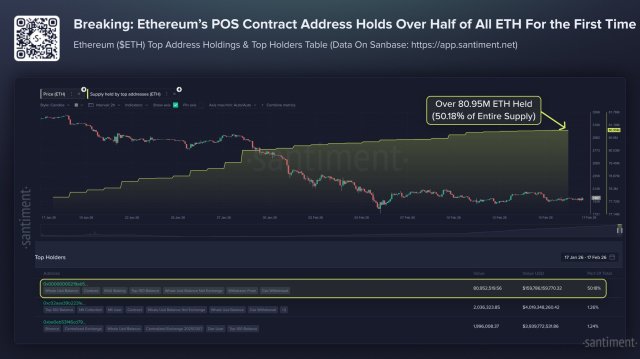
When over 50% of the supply is being locked away in staking contracts, the liquid supply reduces, and fewer coins become available for trading. Such patterns often ignite sentiment as they decrease selling pressure and create a market sensitivity to new demand. At the same time, the development indicates conviction from long-term holders.
Users are determined to secure the network rather than carry out trades in short-term volatility. Everstake remains confident that this is a structural shift for Ethereum. It’s reducing supply coupled with steady or growing demand points to robust price dynamics for ETH over time. “It doesn’t guarantee an immediate pump, but it changes the foundation the price is built on,” the firm stated.
A Market That Has Fallen Into Cold Levels
After an analysis of the MVRV Z-Score, RVT, and NUPL, Alphractal disclosed that the Ethereum market temperature is near cold levels. Specifically, this key metric measures whether the market is overheated or oversold, providing insights into risk-elevated periods and when asymmetry favors long-term positioning.
When it gets close to zero or falls below, it indicates that the market has calmed down. Historically, readings below 0 typically precede a phase where risk and speculative are flushed, increasing the potential for long-term accumulation even as price declines.
These zones underscore periods of reduced unrealized profits, triggering a balanced valuation and removing emotional excess from the market. In the past, major expansion phases have been preceded by extended positions in cold temperature zones, as weaker participants gradually exit and stronger hands progressively accumulate.
Featured image from Pixabay, chart from Tradingview.com
Editorial Process for bitcoinist is centered on delivering thoroughly researched, accurate, and unbiased content. We uphold strict sourcing standards, and each page undergoes diligent review by our team of top technology experts and seasoned editors. This process ensures the integrity, relevance, and value of our content for our readers.

- House of Doge takes majority control of Italy’s US Triestina Calcio 1918.
- Crypto payments to launch for tickets, food, and club merchandise at Triestina’s matchdays.
- Dogecoin price holds key support at $0.1918 with bullish targets up to $0.86.
House of Doge, the corporate arm of the Dogecoin Foundation, has become the largest equity holder in US Triestina Calcio 1918.
The acquisition, completed alongside merger partner Brag House Holdings (NASDAQ: TBH), places a cryptocurrency commercialisation vehicle squarely into the ownership structure of a historic Italian club.
It’s official! House of Doge is now the majority owner of U.S. Triestina 1918, one of Italy’s oldest professional football clubs!
Dogecoin was founded on Community—and the world’s game is one of the biggest communities there is. We will support Triestina with immediate capital… pic.twitter.com/npUKFiROtR
— House of Doge (@houseofdoge) October 20, 2025
The club officials say the deal will bring immediate capital and a plan to pilot crypto payments at the club’s home venue, Stadio Nereo Rocco.
Triestina was founded in 1929 and once competed in the earliest Serie A seasons, but it has spent decades outside Italy’s top flight.
House of Doge declined to disclose the precise size of its stake. Company executives, however, emphasise that the funds will shore up football operations and community programs.
What the acquisition means for Triestina
Triestina currently sits at the bottom of Serie C and faces the immediate sporting challenge of avoiding relegation.
The new ownership says it will prioritise short-term stability and long-term growth.
Management intends to inject resources to strengthen the squad and improve back-office systems.
At the same time, advisers with experience in major-league governance have been engaged to help modernise the club’s commercial approach.
House of Doge plans to pilot cryptocurrency as a practical payment method at matchdays.
Triestina’s supporters will reportedly be able to buy tickets, concessions, and merchandise using digital currencies.
The club and House of Doge say the move aims to improve the fan experience and diversify revenue streams.
Brag House Holdings will provide the listed structure and governance framework for the partnership, while its gaming and fan-engagement platforms are expected to tie into Triestina’s outreach.
Dogecoin price outlook
Analysts watching Dogecoin (DOGE) say the memecoin faces a technical crossroads as market interest returns.
Market analysis points to a multi-year ascending triangle pattern and key support around $0.16–$0.19.
$Doge/Monthly
Ignore the noise
A no-wick monthly chart shows just how bullish we are#Dogecoin pic.twitter.com/zTvYKMFgDc
— Trader Tardigrade (@TATrader_Alan) October 18, 2025
Short-term resistance levels lie at $0.205 and $0.227, with a further target near $0.242.
More bullish scenarios place subsequent resistance at higher levels, such as $0.45 and $0.86, and some commentators even speculate about a long-range $1.50 possibility if momentum intensifies.
Other analysts suggest that DOGE must hold above $0.1918 to press toward $0.2054, while failure below $0.1918 could open a slide to $0.1820.
The House of Doge becoming the largest equity holder in US Triestina Calcio 1918 and introducing Triestina’s stadium payments, merchandising, and community programs could be a major boost for the Dogecoin price.
Furthermore, if Triestina’s stadium payments, merchandising and community programs successfully adopt crypto in practical, fan-friendly ways, the result could offer a tangible template for other clubs and investors.
Dogecoin Firm Buys Majority Stake in Struggling Italian Soccer Club US Triestina Crypto News Australia
Source link ]]>
Shiba Inu Recovery Timeline: Majority of SHIB Wallets in Loss as DTX Exchange Prepares for 13,100% Jump Analytics Insight
Source link ]]>
Cardano Price Prediction: Majority of ADA Holders Remain Profitable FX Leaders
Source link ]]>
Shiba Inu Targets $0.000026 As Majority Of Traders See Losses The Coin Republic
Source link ]]>
Majority of Dogecoin (DOGE) investors in profit despite ongoing volatility Invezz
Source link ]]>
The majority of net inflows into spot Bitcoin exchange-traded funds (ETFs) are likely driven by arbitrage transactions, according to Real Vision CEO Raoul Pal. Data indicates that hedge funds are the primary holders of U.S. Bitcoin ETFs, suggesting that institutional investors, rather than retail investors, dominate this market.
In a post on X, Raoul Pal stated, “If this is correct, it shows that the vast majority of ETF flows are just arbitrageurs, and retail investors are not the key driving factor.” This insight highlights the sophisticated financial strategies at play in the cryptocurrency ETF market, particularly those involving arbitrage opportunities where traders exploit price discrepancies between different markets or instruments.
Institutional Dominance and Divergent Views
Markus Thielen, CEO of 10x Research, echoed Pal’s sentiments, noting that his firm has been emphasizing this point since March. Data from Farside Investors supports this claim, showing that the top 80 holders of spot Bitcoin ETF shares collectively manage around $10.26 billion, making up roughly two-thirds of the $15.42 billion in net inflows since the launch of these ETFs on January 11.

Notably, international hedge fund Millennium Management leads with $1.94 billion in Bitcoin ETF shares, diversified across multiple issuers including Bitwise, Grayscale, Fidelity, BlackRock, ARK, and 21Shares. However, some industry experts dispute Pal’s assertions, pointing out that, excluding the Grayscale Bitcoin Trust (GBTC), the 10 U.S. Bitcoin ETFs collectively hold $42 billion in assets under management, with additional short interest on the CME.
Also Read: US CPI and Core CPI Estimates By Wall Street Signals Crypto Market Recovery
Recent Outflows and Market Caution
The timing of critiques like Pal’s is significant as it coincides with notable outflows from U.S. Spot Bitcoin ETFs. On June 11, these ETFs experienced a collective outflux of $200.4 million, interrupting the robust inflows of recent weeks and signaling growing investor caution. This retreat is particularly evident in the Grayscale Bitcoin Trust (GBTC), which saw $121 million withdrawn, and the ARK 21Shares Bitcoin ETF ARKB, with $56.5 million exiting.
These movements suggest that investors are adopting a more conservative stance, potentially in response to upcoming economic indicators and Federal Reserve decisions. Crypto trader Joseph B. noted that while recent inflows might be attributed to the basis trade, this strategy constitutes less than 15% of overall ETF flows. Pal’s observation underscores that major hedge funds engaging in these ETFs primarily focus on arbitrage rather than taking directional risks based on Bitcoin’s price movements.
Also Read: Elon Musk Drops the Lawsuit on OpenAI For Breach of Mission, What’s Next?

The presented content may include the personal opinion of the author and is subject to market condition. Do your market research before investing in cryptocurrencies. The author or the publication does not hold any responsibility for your personal financial loss.
Bitcoin Ethereum, Dogecoin Sink Further As Regulatory Woes Weigh Down Investors: Analyst Says Majority Top … Benzinga
Source link ]]>
Majority of Dogecoin, Shiba Inu and Pepe Holders Remain Profitable Despite Latest Crypto Correction: IntoTheBlock The Daily Hodl
Source link ]]>
✓ Share: