
In a recent post on X, crypto analyst Pumpius argued that the recent drop in XRP’s price is not natural but the result of deliberate actions by Binance. According to him, the exchange wants to protect its position because the digital currency poses a threat to the system it has built over the years. He says the exchange is doing more than just selling tokens; it is working to hold XRP back.
Binance Accused Of Coordinating XRP Price Suppression
Pumpius says Binance is not only selling XRP but is also actively manipulating the market around it. He points to sudden drops in liquidity, heavy waves of sell pressure, and red flashes on charts that appear whenever there’s an announcement of positive Ripple news. He claims this is not a coincidence but evidence of coordination and a strategy to keep XRP from breaking out.
Related Reading
The analyst stresses that the real reason Binance targets XRP is that it is different. XRP is not a meme or speculative bet but a payment infrastructure. Pumpius argues it could replace the liquidity pools that Binance has used for years, and if that happens, the exchange’s market-making business could crumble.
He also warns that it is not only Binance that is involved. According to him, powerful investors, legacy financial players, and offshore networks all see XRP as a threat. He says that because XRP runs on transparent rails, it could expose money flows they prefer to keep hidden. Therefore, price suppression becomes their primary tool to slow down the process.
Why Suppression Could Backfire As XRP Price Fundamentals Strengthen
Despite these heavy claims, Pumpius argues that the pressure on XRP may backfire. The crypto expert points to Ripple and its ecosystem, noting that the fundamentals are strengthening every day. New payment corridors are opening in Japan and the UAE. Projects such as DNA Protocol are using the XRP Ledger to anchor IDs and even genetic data.
Related Reading
Pumpius believes this shows the suppression is artificial. The fundamentals are exploding, he says, while the adverse price action comes from deliberate dumping. He adds that every time Binance sells, more XRP moves into self-custody wallets. Instead of weakening the community, this decentralizes the asset even more. Holders are preparing for the day when real utility drives demand at a scale far beyond speculation.
In his view, when that switch flips, Binance’s paper games will be meaningless compared to trillion-dollar settlement flows. He warns that the exchange may think it is winning now, but it’s only exposing the truth about the digital currency. XRP, he says, is not just a trader’s coin. It is the backbone of a new financial order. And according to him, no amount of dumping can stop already living rails.
Featured image from Dall.E, chart from TradingView.com
Major fluctuations in the Ethereum (ETH) market yesterday triggered a wave of reactions across social media, with one Ethereum co-founder claiming that certain large holders—or “whales”—were deliberately pushing the asset’s price downward.
The activity reached a fever pitch on Monday, February 4, when the ETH price swung from around $2,900 to as low as $2,120 before bouncing back sharply. Despite the intraday plunge, Ether ultimately closed the day sporting a 26% green wick—an uncommon price rebound in such a short window.
Ethereum Price Manipulated By Whales?
Analysts attributed the dramatic movement to external macroeconomic forces, most notably the US trade war under President Donald Trump. After imposing tariffs on Mexico and Canada early in the day, the president later struck an arrangement that spurred a rapid recovery across global markets, including cryptocurrency.
Related Reading
The turbulence led one observer, identified simply as “intern” (@intern), the director of growth at Monad, to post a stark sentiment on X: “ETH is dying right in front of us. honestly never thought this would happen.”
In response, Ethereum co-founder and ConsenSys CEO Joseph Lubin offered a composed outlook, underscoring that these types of price swings are not unusual for the digital asset: “It happens regularly. Then it surges. What we are seeing is whales taking advantage of economic turmoil and negative sentiment to shake out weak hands, run stops, and then buy back when they can run that same playbook in reverse.”
Lubin’s statement presents a cyclical understanding of crypto volatility, implying that larger players capitalize on market anxiety—often exacerbated by macro developments—to pressure less resilient investors into selling.
Several prominent crypto traders also commented on the events, specifically on accusations of whale-led manipulation.
One well-known figure, Hsaka (@HsakaTrades), advised newcomers not to assume ETH’s decline was driven purely by organic market sentiment: “Dear noobs, Ethereum is NOT naturally going down. It is being pushed down via whales placing spoofy sell orders on exchanges to make noobs and risk managers sell to ‘buy back lower’. They are stealing your bags and will make you buy back at a higher price.”
Related Reading
The notion of a concerted “spoofing” strategy—where large sell orders are placed and then canceled or only partially filled—has long circulated within crypto communities. The tactic reportedly aims to trigger panic sells, thereby letting so-called whales accumulate positions at more favorable price levels.
Prominent trader Pentoshi (@Pentosh1) offered a brief but pointed reaction, highlighting how ETH has underperformed relative to Bitcoin (BTC) over the past three years: “3 year shake out so far. Hope you’re right.”
The question of why whales would single out Ether in particular was raised by community member EVMaverick392.eth (@EVMaverick392): “Maybe I’ll sound naive, but why do whales perform this maneuver exclusively on ether?”
Lubin responded by drawing a parallel to conventional bank robberies and suggesting that the recent wave of unease surrounding the Ethereum ecosystem has made the asset a prime target: “Why do bank robbers rob banks— or used to? The (unjustified) FUD toward the Ethereum ecosystem is currently most pronounced.”
At press time, ETH traded at $2,704.
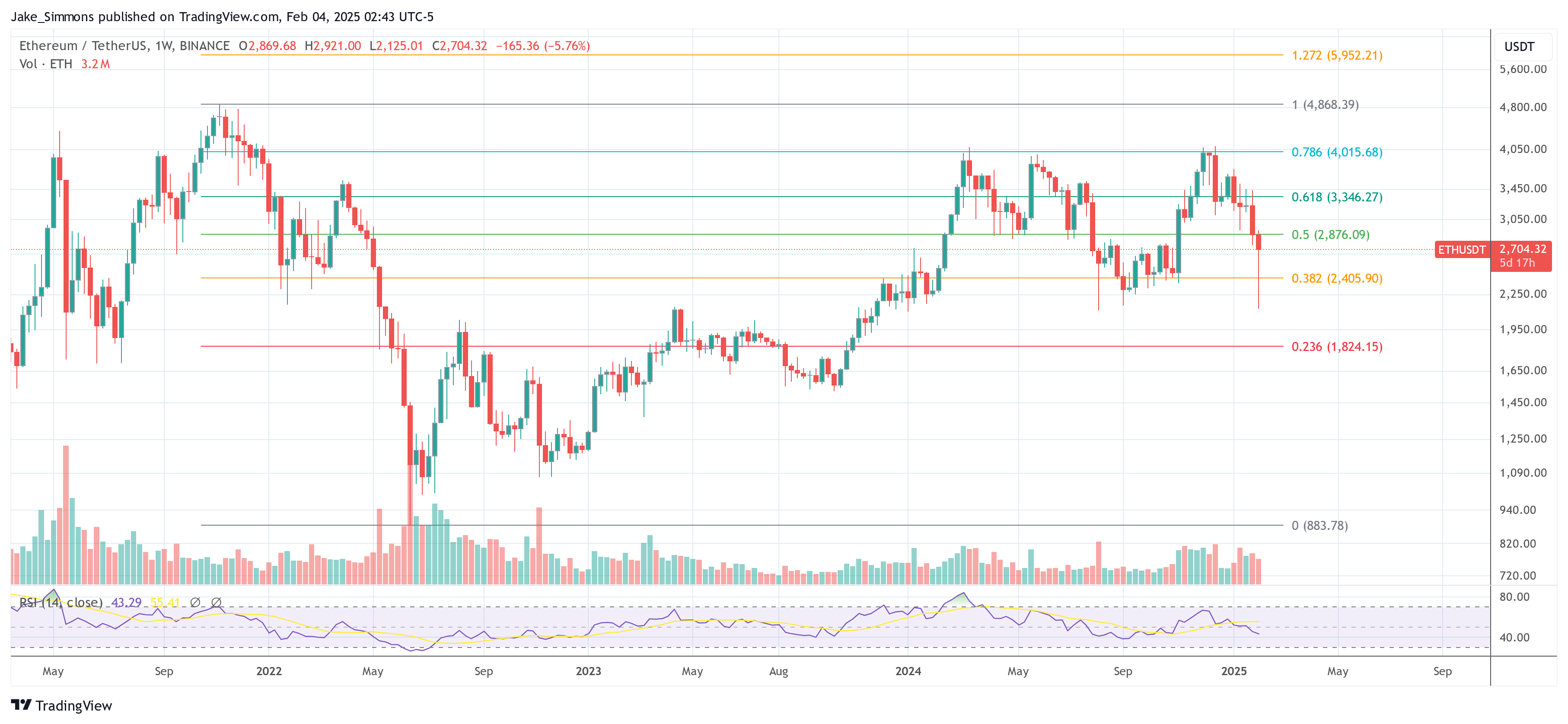
Featured image created with DALL.E, chart from TradingView.com
Elon Musk accused of manipulating Dogecoin price in $258 billion lawsuit Mashable
Source link ]]>
In this weekly segment, ExchangeWire sums up key industry updates in media, marketing, and commerce from around the globe. In this edition: eBay purchases NFT marketplace KnownOrigin; Elon Musk is sued over claims the billionaire ran a Dogecoin pyramid scheme; Snap runs internal tests for its premium service, Snapchat Plus; the CMA warns the UK could become a “rule taker” of EU tech regulation; and Ukrainian president Volodymyr Zelensky urges the ad industry to focus on the Russia-Ukraine.
eBay acquires KnownOrigin in move toward NFTs
Ecommerce giant eBay has leapt into digital collectibles by acquiring KnownOrigin, one of the largest NFT marketplaces in the world. The San Jose-based sales platform has hosted NFT sales on the site since last year, with approved sellers listing the digital collectibles as they would physical items. By purchasing KnownOrigin, eBay will be better placed to regulate sales of NFTs, ensuring transactions can be monitored.
Commenting on the deal, which was announced via a press release from eBay on Wednesday (22nd June), KnowOrigin co-founder Davide More said, “This partnership will help us attract a new wave of NFT creators and collectors.”
Elon Musk sued over claims of manipulating Dogecoin market

Elon Musk is being sued for USD$258bn (£209bn) following accusations he used a pyramid scheme to profit from Dogecoin. The cryptocurrency, which was launched in 2013 to parody Bitcoin, skyrocketed in value last year, soaring from USD$0.004 (£0.00327) to USD$0.73 (£0.58) over four months. The cryptocurrency’s value has since tumbled by 92%.
During this time period, Musk frequently tweeted about Dogecoin and even described it as a “hustle” while hosing Saturday Night Live. The complaint against Musk, which was filed in New York last week, claims the billionaire “used his pedestal as the world’s richest man to operate and manipulate the Dogecoin pyramid scheme for profit, exposure and amusement,” causing financial loss to other buyers in the market.
Snap runs internal tests for new Snapchat Plus

Snapchat parent Snap is running internal tests on a new paid subscription entitled Snapchat Plus. The premium tier is set to give users early access to new features, in addition to changing the Snapchat icon and seeing who rewatches their stories.
Speaking to The Verge, Snap spokesperson Liz Markman said: “We’re excited about the potential to share exclusive, experimental, and pre-release features with our subscribers, and learn more about how we can best serve our community.”
According to tweets from app researcher Alessandro Paluzzi, a subscription for Snapchat Plus will be €4.59 (£3.94) per month, or €45.99 (£39.50) annually. Snap’s venture into a subscription-based service follows hot on the heels of tech giant Telegram, who is in the midst of rolling out its premium tier.
CMA chief warns inaction will make the UK a “rule taker” of EU tech law

The chief of the Competition and Markets Authority (CMA) has warned that government procrastination has placed the UK at risk of becoming a “rule taker” of EU regulation.
Speaking to the Financial Times, Andrea Coscelli explained that the costs associated with waiting for the UK to diverge from EU law have driven companies to embrace legislation set out in Brussels. “As a country, we are in a great place to set up smart, pro-business, pro-competitive rules of the road in a number of these areas,” Coescelli stated. “If we don’t, then in practice we become a rule-taker because of the cost of divergence,” he added.
New legislation to rein in big tech companies and enhance data protection were featured in the Queen’s speech earlier this year, but with limited details.
“We need people like you” – Zelensky to Cannes Lions participants

The president of Ukraine called on festival-goers at Cannes Lions to address his nation’s ongoing fight against Russia.
Via a pre-recorded message, Volodomyr Zelensky stated, “We are defending against a nuclear state that has unlimited access to money and has disregarded any limits on violence. I’ll be honest with you – the end of this war and its circumstances depend on the world’s attention. And that’s why I need allies. We need people like you”.
The Ukrainian leader added that those in the audience could help to bring peace to Europe by using their professional qualities to keep the world’s attention on the war. Zelensky urged festival goers not to “let the world switch to something else,” adding “Your every success will mean saving thousands of lives”.
Also in the news:
– The MadTech Podcast Special: Sustaining Creativity in Cookieless Environments
– Aniview’s Roy Cohen on the Open Web and Video Ad Infrastructure
– Leveraging AI with Contextual: Q&A with Seedtag
– Children’s Privacy Risks in Mobile Advertising – Jalal Nasir, Pixalate
– AI and the New Dawn of Virtuous Advertising – Rémi Lemonnier, Scibids
– Decentralisation for More Effective Advertising – Ben Putley, Alkimi
Catch up on ATS London 2022:
– Maximising Your Most Valuable Currency: First-Party Data
– Where the Action is: Harnessing the Power of Retail Media
– Creative Transformation: Combining Data, Technology & Creativity
 TOP Crypto TIPS In My Newsletter
  https://guy.coinbureau.com/signup/
 My $3.5K Trading Comp & Deals https://guy.coinbureau.com/deals/
 Coin Bureau Insider Channel https://t.me/cbinsider
 Follow Our Twitter https://twitter.com/coinbureau
~~~~~~~~~~~~~~~~~~~~~~~~~~~~~~~~
– TIMESTAMPS –
0:00 Intro
2:19 What Are Stablecoins?
4:56 Recent Stablecoin Printing
7:08 Stablecoin Volatility
8:40 Why Print Stablecoins?
11:04 Stablecoin Manipulation!?
14:04 Stablecoin vs. Governments
17:37 Stablecoin Concerns
20:30 Final Thoughts
~~~~~~~~~~~~~~~~~~~~~~~~~~~~~~~~

 Useful Links
► Stablecoin Market Cap: https://messari.io/chart/stablecoin-market-cap-47A96D06
► Blockchain Research x University of Hamburg Stablecoin Study: https://www.blockchainresearchlab.org/2020/06/24/how-do-stablecoin-issuances-affect-cryptocurrency-markets/
► VOXEU Stablecoin Study: https://voxeu.org/article/stable-coins-dont-inflate-crypto-markets
► EU Stablecoin Legislation: https://cointelegraph.com/news/chasing-the-hottest-trends-in-crypto-the-eu-works-to-rein-in-stablecoins-and-defi
► Circle Freezes USDC Account: https://cointelegraph.com/news/centre-freezes-ethereum-address-holding-100k-usdc
► Stablecoin Printer Tracker: https://twitter.com/usdcoinprinter?lang=en
~~~~~~~~~~~~~~~~~~~~~~~~~~~~~~~~
 What Are Stablecoins
Stablecoins are cryptocurrencies whose values are pegged to a more stable asset such as the US dollar. There are also stablecoins pegged to denominations of precious metals like gold.
Stablecoins have been controversial. Many in the crypto community believe that stablecoins have been used to manipulate Bitcoin’s price. Both Tether and USDC work closely with law enforcement and have a history of freezing wallet addresses which were suspected of being involved in criminal activities.
You’d also be hard pressed to find a single stablecoin which has maintained a perfect peg during times of high volatility. Despite these concerns, stablecoin share of the overall market cap of the crypto space has been growing exponentially over the past year.
 Recent Stablecoin Printing
The market cap of the 8 largest stablecoins has grown from 5 billion to over 22 billion over the last 6 months. Most of this growth has come from Tether, which went from a market cap of 4.5 billion to nearly 17 billion during this period.
There appear to be two distinct surges in stablecoin printing over the last 6 months. The first wave of stablecoin printing seems to have begun after that flash crash in March and continued until early July.
 Stablecoin Volatility
When demand of stablecoins is high, clever traders can sometimes sell a stablecoin for slightly more than its peg. This is because people want stablecoins so badly that they are willing to pay a small premium to protect against further losses in the cryptocurrency they are desperately trying to sell.
The opposite happens when demand for stablecoins falls. If everyone is trying to sell their stablecoins at the same time to buy into Bitcoin or another cryptocurrency, the sudden flood of supply can drive prices slightly below the 1 dollar peg they are supposed to hold.
 Stablecoin Manipulation!?
There doesn’t appear to be any tangible evidence that stablecoins can be used to inflate the cryptocurrency market. This is all comes down to another factor which separates stablecoins from the fiat they are pegged to: redeemability.
The two largest stablecoin issuers, Tether and USDC, actually allow you to redeem your tokens for real US dollars. If the price of USDC was to drop significantly due to a sudden spike in supply, this means that someone could buy up a bunch of USDC at a discount, go over to Circle’s website, and demand their 1-dollar peg.
As such, the amount stablecoins you see in circulation are, in theory, necessary. Stablecoin supply is fundamentally an indicator of demand for cryptocurrencies as a whole and not an indicator of market manipulation.

 Stablecoin Concerns
Stablecoins make US dollars readily accessible to anyone with an internet connection. This threatens the stability of foreign currencies because the moment they start to lose value, their citizens can easily accelerate that devaluation by selling their native currencies for US dollars. In a worst-case scenario, this could completely tank another national currency, making the affected country’s economy heavily dependent on US monetary policy.
~~~~~~~~~~~~~~~~~~~~~~~~~~~~~~~~
 Disclaimer
The information contained herein is for informational purposes only. Nothing herein shall be construed to be financial legal or tax advice. The content of this video is solely the opinions of the speaker who is not a licensed financial advisor or registered investment advisor. Trading cryptocurrencies poses considerable risk of loss. The speaker does not guarantee any particular outcome.
#Stablecoin #bitcoin #tether #crypto #manipulation #trading
source
Topline
Though he’s kept quiet for much of dogecoin’s meteoric rise over the past year, the coin’s cofounder Jackson Palmer broke his silence to rail against cryptocurrencies in a wild tweetstorm Wednesday afternoon, offering a rare glimpse into his long and fraught history with the nascent space that’s grown nearly 300-fold since he abandoned it years ago.
In a rare return to Twitter, one of dogecoin’s two cofounders claimed the crypto market is … [+]
Key Facts
The Australian-born Palmer, one of the two software engineers who created the massively popular coin as a joke in 2013, started his 10-tweet critique by saying that after years of studying cryptocurrencies, he never plans on returning to the space because he believes it’s an “inherently right-wing, hyper-capitalistic technology.”
Palmer lamented the crypto market’s resurgence over the past year, claiming it’s “controlled by a powerful cartel of wealthy figures,” and seemed to take jabs at Tesla chair and self-proclaimed “Dogefather” Elon Musk, saying retail investors have been sold a “false promise of one day being a fellow billionaire.”
Now a director of product management at Adobe, according to his LinkedIn profile, Palmer has been mostly quiet online and in the media since early 2015, when he stopped working on dogecoin and announced on Twitter an “extended leave of absence” from the cryptocurrency space, calling it “toxic and frankly, stagnant.”
However, he’s also emerged online sporadically—particularly during periods of increased market mania: When dogecoin’s market capitalization first surged past $1 billion in 2018, Palmer called the excitement over cryptocurrency’s investing potential “worrying” in now-deleted tweets.
Palmer has said he abandoned what could’ve been a dogecoin fortune when he left in 2014, saying he “didn’t come away with any money” in a 2018 interview.
More recently, he reportedly called Musk a “self-absorbed grifter” after Tesla decided to stop accepting bitcoin as a method of payment in May, prompting a widespread sell-off that the cryptocurrency market has yet to recover from.
Key Background
Palmer and Billy Markus created dogecoin in December 2013 to poke fun at the wildly popular Doge meme (of a Shiba Inu dog) and the growing hype around the nascent crypto market (bitcoin itself was not even five years old). “It was always like a hobby project, like a side project thing,” Palmer said in 2018. Markus has fully embraced the dogecoin meme even though he also left the project in 2015. Markus, who now runs an active Twitter account with more than 400,000 followers, says he sold and gave away all his dogecoin holdings at the time, but he’s since purchased some more. “I bought dogecoin after eight years of vowing never to buy crypto again, an hour ago,” he tweeted in June.
Crucial Quote
“These days even the most modest critique of cryptocurrency will draw smears from the powerful figures in control of the industry and the ire of retail investors who they’ve sold the false promise of one day being a fellow billionaire,” Palmer tweeted Wednesday. “Good-faith debate is near impossible.”
Surprising Fact
Though it at one point soared nearly 1,500% this year, dogecoin’s price has crashed nearly 75% from an all-time high on May 8, the night of Musk’s Saturday Night Live debut. At its peak, the cryptocurrency amassed a market cap above $93 billion.
Further Reading
The man who dodged the Dogecoin (Decrypt)