Morocco is now vying for a spot in the BRICS economic alliance, formally submitting a request for membership ahead of the much-anticipated summit next week. As the bloc continues expanding, Morocco hopes to join other contenders like Saudi Arabia, Indonesia, and Egypt to gain membership.
Read More: India Sidesteps Dollar, First Rupee Oil Trade Ahead of BRICS Summit
BRICS summit: expanding the economic bloc
BRICS, the economic coalition of Brazil, Russia, India, China, and South Africa, has grown in recent months. The forthcoming summit will bring together around 60 heads of state to set expansionary standards for possible new BRICS members. However, the final decision on which countries will join will likely be deferred.
JUST IN:
Morocco officially submits application to join BRICS.
— BRICS (@BRICSinfo) August 15, 2023
With its sustained interest in BRICS, Morocco is poised to join the growing list of nations seeking membership. However, it faces competition from other candidates, and the outcome of its request will depend on the criteria set forth at the upcoming summit.
Currency promotion, not de-dollarization
Contrary to speculation, the summit will not prioritize de-dollarization, despite BRICS countries’ recent moves away from the US dollar. South Africa’s BRICS Ambassador, Anil Sooklal, has clarified that the focus will be on promoting local currencies within the bloc.
“Trading in local currencies is clearly on the agenda,” Sooklal told Bloomberg in an interview. “There is no de-dollarization agenda item on the BRICS agenda.” The dollar will remain a prominent global currency; that is a given.”
Sooklal emphasized that BRICS is not a counter to the West or the G7, as some narratives suggest. Instead, the alliance aims to “advance the agenda of the Global South and build a more inclusive, representative, just, and fair global architecture.”
As reported by CoinGape, rich dad poor dad author Robert Kiyosaki predicted that a common BRICS currency will be end of US dollar as global reserve.
Expansion and currency development
The forthcoming meeting, set to take place in Johannesburg from August 22-24, will likely discuss the bloc’s enlargement and the setting up of a unified payment system. The August 22-24 Johannesburg conference is anticipated to focus on bloc enlargement and a uniform payments system. As negotiations continue, a technical committee may contemplate a shared currency, a long-term goal.
More than 42% of the world’s population, 23% of GDP, and 18% of trade are BRICS, founded in 2009-10. However, the union has yet to fully fulfill its geopolitical dominance and economic might. The summit will likely be critical in establishing a more comprehensive and balanced global architecture.
The alliance’s economic reach is evident, with BRICS members striving to conduct more trade in their currencies to gain global influence and counterbalance US dominance. The New Development Bank, established by BRICS, aims for a third of its lending to be in domestic currencies by 2026.
BRICS’s upcoming summit holds promise for the future expansion of the alliance and the strengthening of local currencies. As Morocco awaits the decision on its membership request, the world looks on with interest at the summit’s potential outcomes.

The presented content may include the personal opinion of the author and is subject to market condition. Do your market research before investing in cryptocurrencies. The author or the publication does not hold any responsibility for your personal financial loss.

The CDA has been hard at work on our organizational structure and nurturing IOHK support to help bolster our future operations. We have also continued our conversational focus on education and deciding the more effective topics to bring forward that benefit both the developer and consumer communities. Education remains our highest priority for building the ecosystem and is a cornerstone of our formation
We have also accepted 3 new members since our last update; MuesliSwap, MetaDex, and COTI. We are happy to incorporate their teams and you can read more about each one at the end of this article.
Membership applications and integrations are currently on hold until we have finalized our structure and begun to provide more for the community. This halt will allow us to create a stronger foundation to more easily integrate new members and harness their strengths and expertise more effectively to bring the Cardano community greater tools to build with.
The first topic:
CIP 31, 32, 33 and Why They Matter
If you’ve been lurking in the community discord for any of the CDA protocols, you’ll probably notice a theme. Many of us outright require, or greatly benefit from CIP’s 31, 32, and 33.
But what even is a CIP? And what do these 3 CIP’s actually change about the chain’s behaviors?
CIP stands for Cardano Improvement Proposals. These represent the currently recommended solutions to common problems on-chain. These allow the Cardano development community to weigh in on changes to Cardano itself, as well as align on common solutions for interoperability. They are governed by the CIP Editors, who meet biweekly here: https://www.crowdcast.io/cips-biweekly.
CIP’s 31–33 were introduced in late December and merged into the CIP repo over the following 2 months, as IOG committed to prioritizing these changes for the June Hard fork.
In order to have a high-level understanding of these changes, we need to understand something fundamental about the EUTXO model, which Cardano uses to enable smart contracts. In UTXO systems, rather than having an account, your total funds are divided into parcels of tokens which:
- must reside at an address (your wallet, a smart contract)
- must have some contents: some minimum amount of Ada, optionally other assets.
- can have some data attached
These parcels of tokens are called ‘transaction outputs’, in a transaction, one or more ‘transaction outputs’ are spent, and new outputs are created, holding the tokens at their new locations. In the case of smart contracts, the ‘data attached’ is used to determine if it is OK to spend these outputs in different situations by the smart contract. Each output is spent exactly once.
If you need to show a special token or get some special information on-chain to satisfy a smart contract, it means you need to spend the output that holds that token or holds the special information as data. If you spend that data in the current block, that means nobody else can! So for example, if we need to know the current price for a trade on a dex, we need to consume an output that can tell us that kind of information. This issue is framed really well in the SundaeSwap Medium Article Concurrency, State & Cardano.
This brings us to CIP-31 — Reference inputs, This fundamentally changes how transaction outputs can be used — in short, if you do not change the content of an output, but only examine it, then the output does not need to be spent, and can be used by others in the same block. This is a game-changer as it will allow greater information sharing and address many of the concurrency concerns that make it difficult to design and build complex protocols on Cardano.
CIP-32 — Inline Data is a convenience — but a valuable one. This allows developers to write data directly on the transaction outputs themselves, where currently the outputs need to reference the data on the transaction that consumed them. This change will make it easier for developers to find and use the data associated with transaction outputs, as well as enabling CIP 33. Currently getting this information can be quite difficult and often involves keeping an indexed cache of many transactions available. This change should decrease the infrastructure required to run a dApp, and make it easier to decentralize smart contract applications.
Finally, CIP-33 — Reference Scripts is critical as it provides on-chain script storage, similar to what is available on Ethereum today. Currently, our on-chain scripts must be attached to the transaction itself, which makes transaction sizes very large and makes it difficult to fit transactions within the on-chain limits for script size. This CIP will allow us instead to set an on-chain smart contract script as the Data on a transaction output, which can then be referenced by many transactions. Script size is currently a huge obstacle for many developers, and this may allow us to be more flexible in designing solutions that leverage larger scripts, in order to spare memory and execution units.
Cardano’s Block & transaction size limits are not very different from Ethereum’s, and one of the key differences is how script sizes are included in the transaction size on Cardano, Moving the script size out of the transaction is a tremendous benefit to developers as it greatly increases expressive capabilities on-chain.
So to summarize the changes that we expect from this aspect of the June HardFork:
- Ability to more easily share critical information between transactions in parallel
- A simplified model for storing data & information needed on-chain
- Move script size out of the Transaction, making it much less of a concerns
New Members:
MuesliSwap:
MuesliSwap is an orderbook decentralized exchange on Cardano mainnet and Milkomeda. MuesliSwap’s goal is to bring together the best of traditional finance and decentralized finance (DeFi) . The orderbook approach to token trading by MuesliSwap is tailored to the Cardano EUTXO model, distinguishing it from the popular DeFi approach using AMMs. Overall, MuesliSwap aims to enrich the Cardano Defi ecosystem with a range of new trading features like limit orders.
‘’We are very excited to join the Cardano DeFi Alliance because we believe the biggest strength of Cardano isn’t the technology, which is absolutely brilliant, but the community itself. So joining the CDA makes it somehow official for us and it’s a great feeling to be a part of it.’’
MetaDex:
MetaDEX strives to provide true innovation to DeFi — both on the mathematical, social and meta-level. Regarding the tech, it is built on various yet unseen — irrespective of chain — research efforts. On the topic of community, the project aims to live decentralization on all levels; most importantly, financially unwise tokenomics and the striving for transformation of a regular dev team into a culture of free experts co-owning what they built. Finally: MetaDEX, being the most meta DEX, will seed the fastest moving cluster of innovation with unapologetic perfectionism; the same philosophy that makes Cardano as a whole so great. We don’t have time to fix more fundamentally broken coordination points, let’s do it right from now on.”
Quote regarding the CDA:
“While chaos breeds intriguing diversity, MetaDEX is excited to collaborate with the other prime movers of the ecosystem on solving the most pressing barriers we face. Let us demonstrate how the most decentralized and ambitious chain can live the original vision of our industry.”
COTI:
COTI is a layer 1 fintech on the blockchain ecosystem, specifically designed for payments.
COTI meets the challenges of both centralized finance (fees, latency, global inclusion, and risk) and Decentralized Finance DeFi (fees, clogging, and complexity) by introducing a new type of DAG-based base protocol and infrastructure that is scalable, fast, private, inclusive, low cost and is optimized for finance.
Djed, Cardano’s algorithmic stablecoin is powered by COTI. As part of COTI’s role, COTI is in charge of developing the user interface system and will operate the integration between users to the smart contracts for the stablecoin. COTI will partner with enterprises, developers, and other parties in order to mint both the stablecoin and the reserve coin used as part of the pegging algorithm.
“We are delighted to join CDA, the Cardano DeFi Alliance. By powering Djed, the main native algorithmic stablecoin of the Cardano DeFi network, we feel it is only natural to take part in this important alliance to contribute to the standardization of best practices within the Cardano DeFi ecosystem”. ~ Shahaf Bar-Geffen, CEO

Ukraine said it had formally applied for membership in the European Union as preliminary talks with Russia over the ongoing Russia-Ukraine conflict proved to be inconclusive.
Ukraine Applies for EU Membership
The Parliament of Ukraine tweeted on Monday that President Volodymyr Zelensky had signed the application for entry into the bloc, as fighting with Russian forces continued.
President @ZelenskyyUa has signed application for the membership of #Ukraine in the European Union.
This is a historic moment! pic.twitter.com/rmzdgIwArc
— Verkhovna Rada of Ukraine (@ua_parliament) February 28, 2022
Zelensky also said on Monday that he had a phone call with EU President Ursula von der Leyen discussing more aid, and Ukraine’s potential membership.
The move comes as early stage talks between Russia and Ukraine, hosted at the Belarus border, proved to be largely inconclusive. After speaking for five hours, both sides agreed to resume negotiations in Belarus in the near future after more counsel, Belarus’ Ministry of Foreign Affairs said.
Both parties also said they would issue a joint statement in the near future.
Interfax reported that Russian officials said the talks showed some potential to reach an agreement, but only time would tell.
It is important for the sides to hear one another and be ready in the very near future to look for the possibility of reaching a common denominator on these key issues
-Leonid Slutsky, Head of the Duma foreign affairs committee
Both parties had stated no preconditions for the talks. But Ukraine’s position was for an immediate ceasefire, and a complete withdrawal of Russian troops.
Ukraine tensions shine a spotlight on crypto?
Tensions over the invasion had battered crypto markets in February, wiping out as much as $200 billion of market capitalization.
But the conflict has also thrust crypto further into focus. Ukraine citizens were seen using crypto as the central bank suspended electronic cash payments. Trading volumes in both Russia and Ukraine also spiked as their respective currencies slumped.
Speculation over Russia’s adoption of crypto to avoid U.S. sanctions has been rife, given the country’s fairly strong holdings. The Ukraine government also called for major exchanges to ban Russian users.
News of the talks had spurred some optimism in financial markets, with major cryptocurrencies extending gains on hopes of a de-escalation. Bitcoin blew past a key $42,000 resistance level, while crypto market capitalization hovered just below the $2 trillion mark.
Disclaimer
The presented content may include the personal opinion of the author and is subject to market condition. Do your market research before investing in cryptocurrencies. The author or the publication does not hold any responsibility for your personal financial loss.
About Author


At COOLLAUNCH rewarding our loyal community members with guaranteed allocations to projects launching through the platform is what we enjoy doing. Identical to our raise structure, projects that launch through us will host a wide distribution model, while sporting relatively low contribution caps per individual. Our design is built to maintain both foundational and proven economic structures shown to provide the highest opportunity for organic growth, while presenting a larger distribution to (potentially) risk averse contributors. Along with our native insurance policy, Coollaunch has made sure to implement user experience and protection as top priorities.
Tiers
Currently there are 4 tier levels which our users qualify for. The requirements for each tier are detailed below:
Tier System
After much consideration and community deliberation that have gone into designing the tier system in a way that provides access to early adopters, while limiting the number of community members who can qualify for placement. As with any limited asset, tier positions should be expected to price out smaller holders for this reason, tier requirements are subject to governance. They may be restructured or reformatted to a model which allows the community to grow, and/or to make the tiers more accessible.
Staking
Projects launching through CoolLaunch platform will each have their own designated staking pool. COOL holders that wish to participate in the sale will be required to stake a minimum number of COOL in the respective pool for 7 days prior to a project’s sale to be guaranteed allocation for that project.
Pool Weight (Example)
Here’s an instance of how tiers and pool weight would enable us to calculate allocation for a sale:
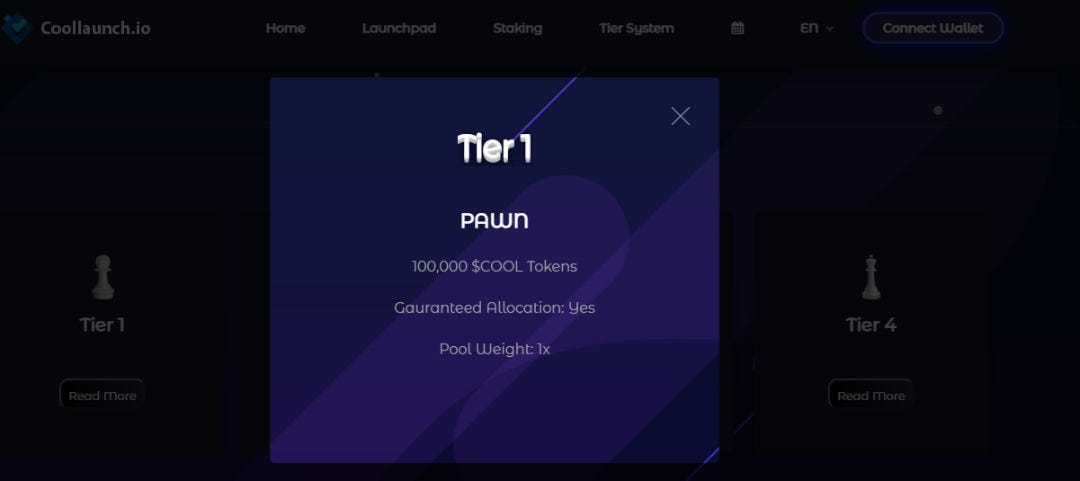
Tier 1(PAWN)
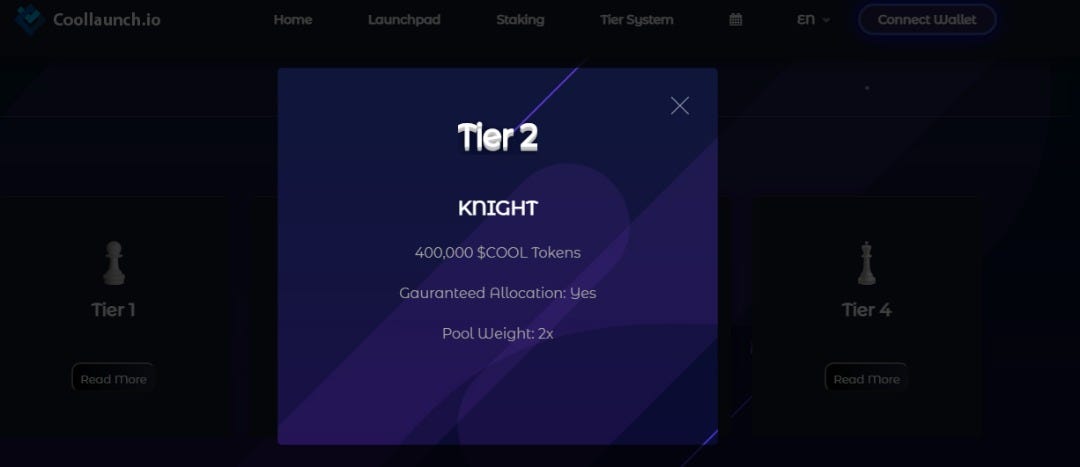
Tier 2(KNIGHT)

Tier 3(BISHOP)
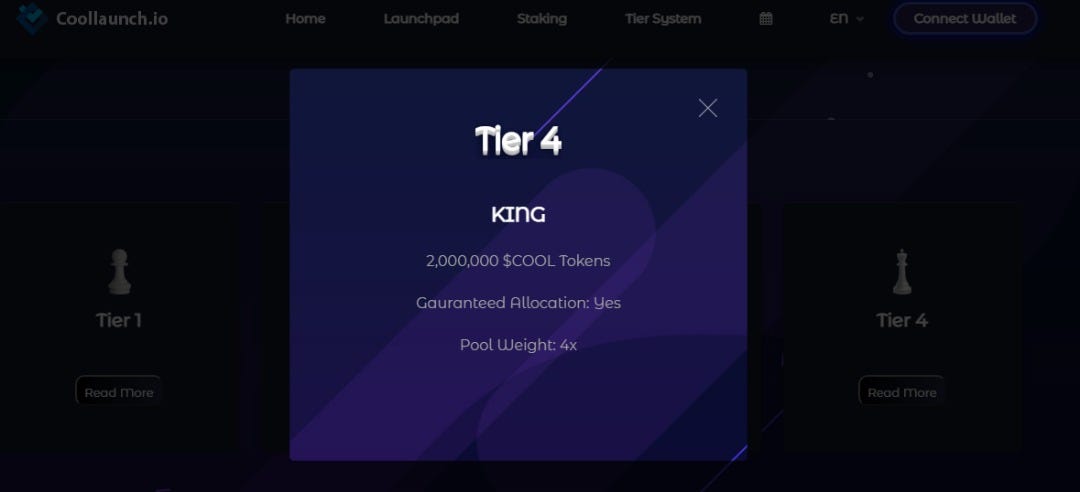
Tier 4(KING)
A project launching through CoolLaunch, say (Project Z) wants to sell 5,000,000 tokens in their initial raise. 200 COOL holders have staked their required amount to gain allocation to the sale of Project Z.
100 Pawn Members have staked their required 100,000 COOL each for 7 days
(Pool Weight 1X*100=100 Pool Shares)
50 Knight Members have staked their required 400,000 COOL each for 7 days
(Pool Weight 2X*50=100 Pool Shares)
40 Bishop Members have staked their required 1,000,000 COOL each for 7 days
(Pool Weight 3X*40=120 Pool Shares)
10 King Members have staked their required 2,000,000 COOL each for 7 days
The total number of pool shares for all tier members is (Ts=100 +100+120+40=360). Therefor, the 5,000,000 tokens available in Project Z’s sale would be divided by 360 (5,000,000/360=13,888.8) Each share of pool weight equals 13888.8 tokens, meaning that Pawn Members (Pool Weight 1X) would have the ability to buy 13,888.8 tokens, Knight Members (Pool Weight 2X) would be able to buy 27,777.6 tokens, and Bishop Members (Pool Weight 3X) would have a 41,666.4 tokens
King Members (Pool Weight 4X) would have a 55,555.2 tokens in Project Z’s sale.
Reservations:
Vesting, soft/hard caps for projects will be determined on a case-by-case basis to meet the requirements of our launchpad partners.
Although a COOL member may stake and be qualified for allocation in a project’s sale, it’s possible that not all community members will fulfill their allocation. If a project’s first sale round closes, and they haven’t achieved their hard cap, the remaining tokens will be released in a second round. The tokens will be available in this round on a first come first serve basis (FCFS), and are accessible to both COOL community members and non COOL members, alike.
The Pawn Pool Weight Allocation that was calculated the first round will carry over to round two, establishing the new maximum cap per individual.
Continued Staking and Insurance Policy
COOL community backers who participate in project sales are eligible for coverage under Coollaunch’s insurance policy. This feature will be built to provide community members a sense of financial protection in the case of a project that is failing to deploy. To be eligible for insurance coverage, a COOL backer must keep their COOL staked in a project’s designated staking pool following the completion of a sale.
Terms, conditions, and requirements for Coollaunch’s Insurance Policy will be expressed further in a subsequent article.
Our Official Links:
Website | Telegram | Twitter | Instagram | Medium