Rep. Max Miller is circulating a 14-page draft of a proposed crypto tax bill in the U.S. House of Representatives. The framework targets stablecoin payments, digital asset borrowing, and the tax timing of mining and staking rewards. It introduces measures that tighten how current tax rules apply to crypto transactions. That crypto tax bill came
The post Breaking: Rep. Max Miller Unveils Crypto Tax Bill, Includes De Minimis Rules for Stablecoins appeared first on CoinGape.
]]>In his latest blog post titled “Why I’m Still Betting on Bitcoin,” financial expert and seasoned investor Bill Miller IV, CFA, CMT, Chairman and CIO of Miller Value Partners, reiterated his bullish stance on Bitcoin. According to Miller, who is the Chairman, CIO of Miller Value Partners and son of legendary investor Bill Miller III, Bitcoin remains in the early stages of a secular transition in global capital and governance perspectives.
Bitcoin: It’s Still Early
Miller’s analysis begins with a reflection on a thesis he first introduced in 2015 in his paper, “A Value Investor’s Case for…Bitcoin?!”. He argued that Bitcoin held potential far beyond its valuation at the time, either as a revolutionary payment network or as a viable alternative to traditional fiat capital.
Fast forward to today, Miller observes Bitcoin’s ascendancy but maintains that its journey is far from over. His current valuation places Bitcoin’s market capitalization at about $1.5 trillion, a figure he considers minuscule compared to the nearly quadrillion-dollar global fiat capital system.
Related Reading
“Despite Bitcoin recently hitting new highs against every fiat currency, I believe Bitcoin today is still significantly undervalued and that the world is likely in the early stages of a secular shift around how humans think about capital and its governance,” Miller writes. He points out the inadequacies of current monetary systems, which are prone to human error and manipulation, often leading to the devaluation of currency through inflation and mismanagement.
Supporting his argument, Miller references “Broken Money” by Lyn Alden, which outlines the historical precedence for superior monetary technologies eventually eclipsing their outdated counterparts. Alden’s analysis suggests that when people are presented with better options for preserving or growing their financial resources, they will invariably gravitate towards those options.
“History shows that the best monetary technology inevitably wins, as people trade inferior depreciating capital technologies for superior ones that better align with users’ goal of preserving or growing their option set over time,” writes Miller. Bitcoin, with its decentralized, transparent, and immutable ledger, offers a robust alternative to the governance-laden fiat systems.
Miller also delves deeper into the technical and philosophical underpinnings of Bitcoin, describing it as a “true technological breakthrough.” Unlike traditional monetary systems, Bitcoin operates on a global scale without the need for centralized control, enabling transactions that are resistant to censorship and confiscation. This property alone, according to Miller, radically changes the dynamics of how property rights are transferred and managed across borders and generations.
Related Reading
He also comments on the general public’s struggle to understand and value revolutionary technologies, citing the substantial returns generated by companies like NVIDIA, Google, and Meta as examples of what happens when new paradigms are embraced. “Humans are notoriously bad at contextualizing the relevance and potential of new technologies,” Miller states, emphasizing that Bitcoin’s case is no different.
“This gap is especially wide for groundbreaking concepts of an epistemic nature – that is, inventions that change the way we think about and relate to information and each other. It also explains why NVIDIA, Google and Meta have generated outsized returns relative to other stocks,” Miller states.
In a compelling conclusion to his argument, Miller acknowledges the inherent risks and volatility associated with Bitcoin. As a technology and asset class that is still in its developmental phase, it faces potential shifts in perception and regulatory landscapes. However, he warns that underestimating Bitcoin’s long-term potential could be as harmful as ignoring the early signs of any major technological shift.
“It’s still early,” concludes Miller, suggesting that the journey for Bitcoin is just beginning. He remains confident that as the world continues to grapple with the limitations of fiat currencies and the possibilities presented by digital assets, Bitcoin’s true value will eventually be realized, reflecting its capacity to redefine the fabric of economic systems worldwide. This stance not only reinforces his investment strategy but also serves as a bold forecast for the future of finance.
At press time, BTC traded at $67,406.
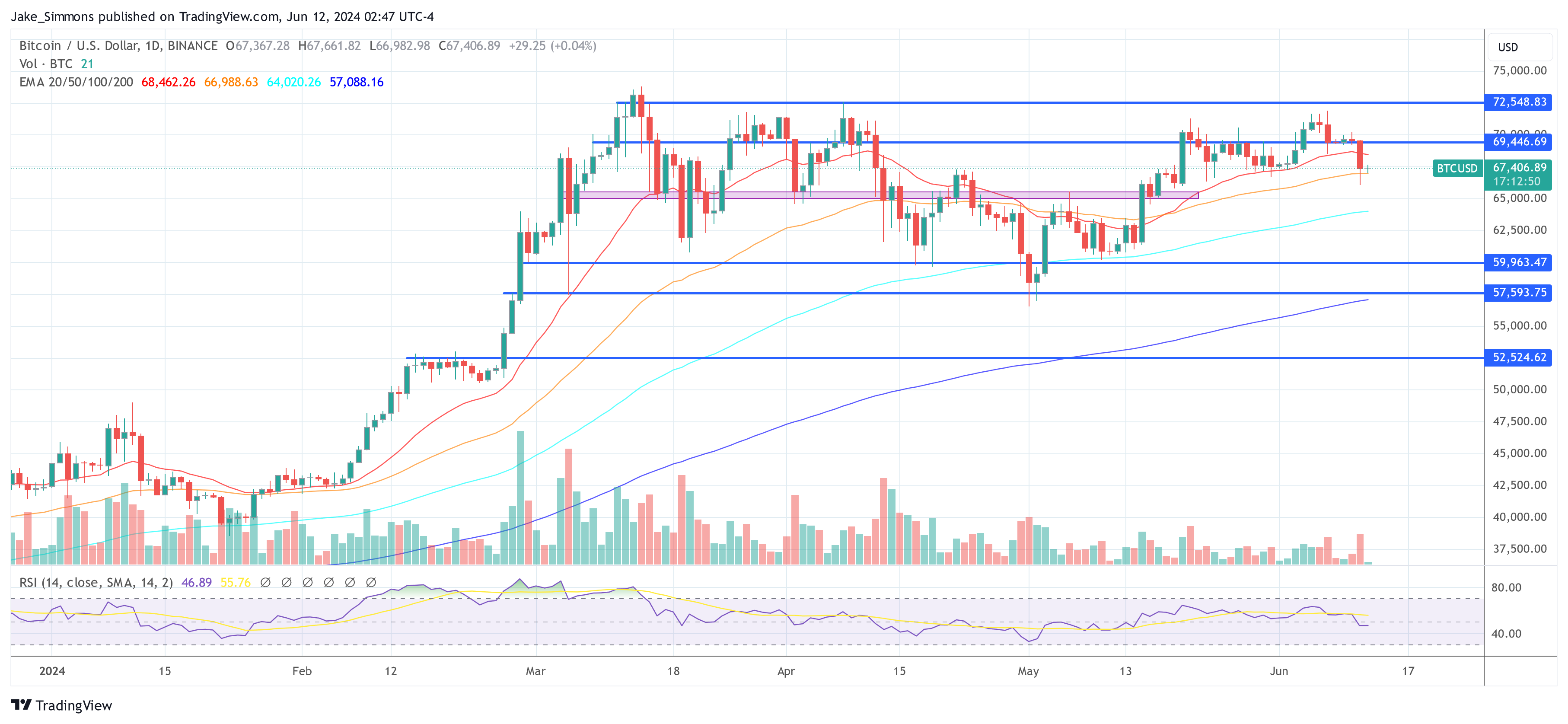
Featured image from CNBC chart from TradingView.com
Cardano $ADA Airdrop Comprehensive Tutorial: Claim 300$ Now! | by Manuel Miller inBlockchain | Feb, 2024 Medium
Source link ]]>
Bill Miller IV, CFA at Miller Value Partners, stated that he believes investing in the MicroStrategy (MSTR) stock is better than choosing Spot Bitcoin ETFs. He shed light on the shortcomings of these ETFs, including liquidity restrictions. In addition, he encouraged investors to invest in MSTR to indirectly bet on Bitcoin (BTC).
Why is MicroStrategy stock better than Spot Bitcoin ETFs?
Miller noted that MicroStrategy is the biggest holder of Bitcoin currently. Hence, betting on the MSTR stock would open up opportunities to leverage the profits Bitcoin makes. Moreover, he noted that the MSTR stock provides better liquidity than Bitcoin ETFs.
Additionally, Miller underscored that despite fee waivers eventually, Bitcoin ETFs would charge a fee while investing in MicroStrategy doesn’t require any additional charges. Also, the stock provides massive optionality when it comes to Bitcoin adoption.
In a CNBC interview, when asked about the deviation in the value of the underlying Bitcoin, Miller Value CFA noted that if the price moves above the intrinsic value, it would be a great opportunity for MicroStrategy. He suggested that the company could sell some of its shares in the market to buy BTC and earn from the price shift.
Also Read: MicroStrategy’s Michael Saylor Sells 5,000 MSTR Stocks For Investing Into Bitcoin
MSTR & Spot BTC ETF Performance
Though the Miller Value CFA encourages investment in the MSTR stock, its recent performance hasn’t been great. On Friday, January 12, the stock plunged 9.45% to $485.53, losing 50.65 points. Currently, it holds a market cap of $7.04 billion.
Moreover, in the aftermarket hours on Friday, the stock tumbled 1.19% to $479.75, down by 5.78 points. In addition, the MSTR stock has lost over 24% in value since Monday when it opened at $640. The recent slump could be attributed to the major sell-off by MicroStrategy CEO Michael Saylor.
According to a Bloomberg report, Saylor offloaded 3,882 to 5,000 MSTR shares almost every day from January 2 to January 10. The timeline coincides with the SEC’s deadline for a decision on Spot Bitcoin ETF. Hence, Saylor’s move indicates his interest in leveraging BTC profits when the ETF hype was at its peak.
On the other hand, the approved Spot Bitcoin ETFs also didn’t perform well on the second day of trading. Here’s a list:
- Grayscale’s GBTC closed at $38.58, losing 5.19%.
- BlackRock’s IBIT tumbled 10.63% to $24.97.
- The ARK 21 Shares ETF (ARKB) plunged 6.20% to 43.86.
- Bitwise’s BITB lost 6.19% in value, closing at $23.96.
- Fidelity Wise’s FBTC witnessed a dip of 6.19% and closed at $38.35.
- WisdomTree’s BTCW dropped by 5.50% to $46.61.
- The Invesco Galaxy ETF (BTCO) closed 5.74% lower at $43.86.
- Valkyrie’s BRRR suffered the maximum loss, plunging 11.56% to $12.47.
- VanEck’s HODL declined by 6.24%, closing at $49.62.
- Franklin Templeton’s EZBC registered a 6.03% dip and closed at $25.42.
- Hashdex’s DEFI closed at $52.39, down by 6.51%.
Moreover, these ETFs also tumbled in the after-hours of the market, except for Hashdex’s DEFI which gained over 2% in value.
Also Read: Grayscale Moves 21.4K Bitcoin Worth Over $900 Mln Amid Spot Bitcoin ETF Hype

The presented content may include the personal opinion of the author and is subject to market condition. Do your market research before investing in cryptocurrencies. The author or the publication does not hold any responsibility for your personal financial loss.
-
Legendary investor Bill Miller compared Bitcoin to an insurance policy, noting that it may lack intrinsic value but duly comes in handy in case of a catastrophe.
-
Miller said he still holds a significant portion of Bitcoin in his portfolio.
-
BTC price climbed above $45,000 on Thursday, jumping above the resistance level amid high volatility in the market.
Bitcoin is what investors need to hedge against financial catastrophe, legendary investor Bill Miller said in an interview with CNBC.
According to the fund manager, who in January revealed that he held a significant chunk of his personal wealth in Bitcoin, the cryptocurrency acts “like an insurance policy.”
Explaining his analogy, the famed investor told CNBC that people go for insurance even when they know that the policies do not have intrinsic value.
The former chief investment officer at Legg Mason Capital Management Value Trust said that it is exactly this factor (a lack of intrinsic value) that makes people want to get insurance. It’s not because they wish to see their property destroyed or hope to get into an accident, but because the insurance always comes in handy if the calamity ever happened.
“Bitcoin is insurance against financial catastrophe,” he explained in comments referenced by Insider.
Miller also commented on his crypto portfolio, noting that his earlier allocation in BTC grew exponentially during the bull market to Bitcoin’s peak in November. Although the holdings had taken a hit during the recent market slump, the investor said he still held a “big position.”
On overall adoption of cryptocurrencies, the investor says the trend will see major banks, endowments, and pensions funds add Bitcoin to their balance sheets. According to him, the move by KPMG Canada is the beginning of a major shift.
Bitcoin was trading around $45,350 at the time of writing, about 3% up in the past 24 hours and over 22% up this past week. Today’s market action saw the cryptocurrency sharply fluctuate as markets reacted to fresh inflation data from the US.
The run to intraday highs above $45,600 included a sharp decline below $44,000, but analysts are bullish the crypto bull market is not over yet.
Miller Opportunity Trust, a hedge fund owned by billionaire investor Bill Miller revealed it holds 1.5 million shares of Grayscale’s premium Bitcoin investment product $GBTC. The $GBTC holdings of the hedge fund take its Bitcoin investment to worth $58 million or nearly 1,200 Bitcoin. The firm revealed its $GBTC holdings in an SEC filing on Friday.

Bill Miller is a known Bitcoin proponent and back in February the Miller Value Fund had also filed for Bitcoin investment via $GBTC, thus the latest holding reveal didn’t come as a surprise, but the valuation of the investment surely shows Miller owned investment products bitcoin interest.
The hedge fund joins the growing list of Wall Street firms to take the Bitcoin route. Grayscale’s Bitcoin Trust is one of the most sought-after Bitcoin investment products in absence of regulated product offerings. Investors buy physical Bitcoin and put it in the Grayscale treasury to get $GBTC shares in return which are unlocked every 6-months. The investor hopes to sell their shares at a profit. $GBTC shares are currently trading at $38.7.
A few days back, Morgan Stanley, a Wall Street Financial giant also revealed one million in $GBTC holdings. While the regulatory status of $GBTC shares is unclear, it is seen as a lucrative investment option by institutional investors until a Bitcoin ETF is passed. Grayscale also plans to convert its $GBTC product into a full-fledged ETF offering.
Institutional Interest in Bitcoin at ATH Despite Uncertainty Around Bitcoin ETF
The institutional interest in Bitcoin this bull season is unparallel as a number of Wall Street giants including former critics likes JP Morgan, Goldman Sachs, Morgan Stanley, and several others have rushed to either invest in Bitcoin or offer investment vehicles amid growing clients demand. Many expected the SEC to pass the first-ever Bitcoin ETF looking at the soaring institutional demand and growing calls from lawmakers. However, SEC has given no specific timeline for approval.
Recent withdrawals of Ethereum ETF by VanEck and ProShares after filing the Bitcoin Futures ETF indicated that SEC might be more willing to approve a Futures ETF over a physical one. A Bloomberg analyst predicted that the first Bitcoin Futures ETF could be approved as early as October.
Disclaimer
The presented content may include the personal opinion of the author and is subject to market condition. Do your market research before investing in cryptocurrencies. The author or the publication does not hold any responsibility for your personal financial loss.
About Author


✓ Share: