Can the Dogecoin Price Reclaim $0.73 or Has the 30,000% Window Already Moved to the Exchange Presale openPR.com
Source link ]]>
Dogecoin Whale Activity Surges: 500M DOGE Moved in 24 Hours Amid Price Dip AD HOC NEWS
Source link ]]>
Proceeds from Bitcoin sales have paid for healthcare, environmental programs, and government worker salaries in Bhutan — a detail that puts the kingdom’s latest crypto move in sharper focus.
Related Reading
A Small Nation With A Big Bitcoin Strategy
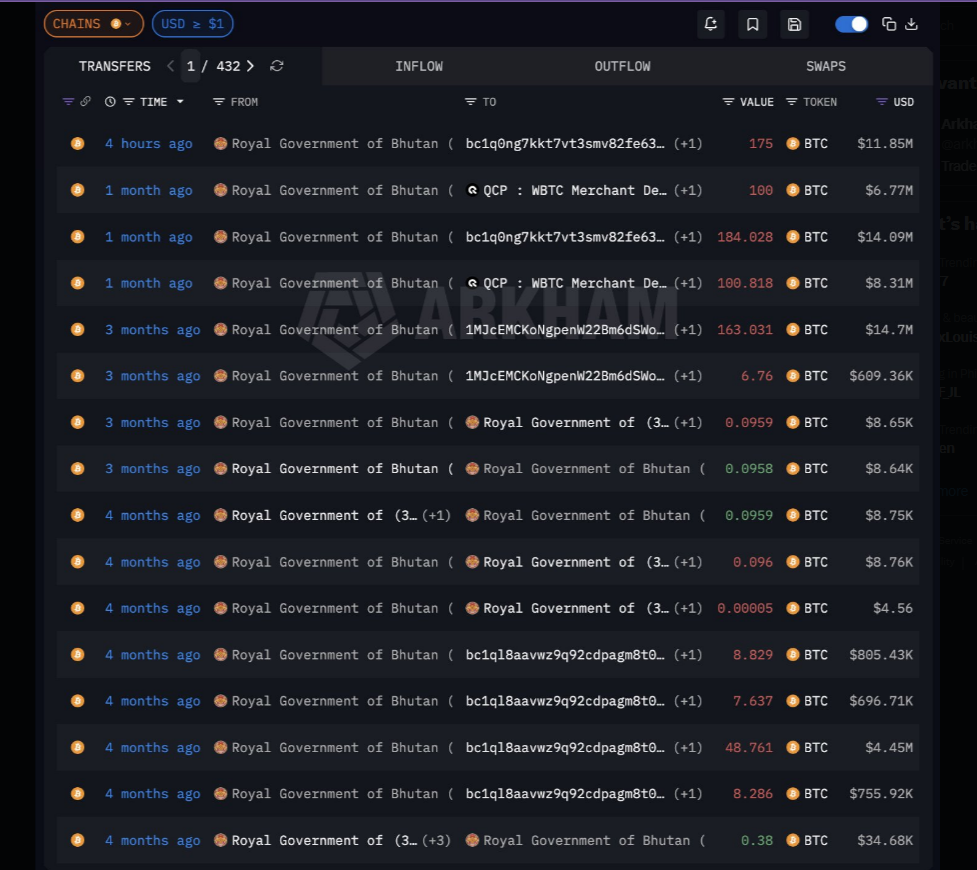
On Monday, blockchain analytics firm Arkham flagged a transfer of 175 Bitcoin, worth roughly $11.85 million, out of Bhutan’s main government wallet.
The funds moved to an address created about a month ago, one that had already received 184 Bitcoin from state accounts. As of Tuesday, the coins had not moved again. No sale has been confirmed.
But the transfer fits a pattern Arkham has tracked for months. Data shows Bhutan tends to offload Bitcoin in batches of $5 million to $10 million at a time. The heaviest selling on record came in mid-to-late September 2025.
Back in February, a similar transfer preceded a $7 million sale to Singapore-based crypto trading firm QCP Capital.
Bhutan just moved another $11 Million of Bitcoin out of its main holding addresses.
The last time they did this was 1 month ago, and they were selling $7 Million of BTC with QCP Capital.
Bhutan periodically sells portions of its Bitcoin in clips of $5-10M, with a particularly… pic.twitter.com/tBuz280bBe
— Arkham (@arkham) March 9, 2026
How Bhutan Built Its Stash
The kingdom did not buy its Bitcoin on an exchange. It mined it. State-backed operations began in 2019, powered almost entirely by hydroelectric energy.
During summer months, Bhutan’s rivers run fast and full, pushing its hydropower plants into surplus. Rather than waste that extra electricity, officials directed it toward Bitcoin mining.
That strategy produced roughly 13,000 Bitcoin over several years, making Bhutan one of the larger sovereign holders in the world.
Arkham currently puts the country’s holdings at around 5,400 Bitcoin — a figure that reflects years of periodic selling. Among nations, Bhutan ranks seventh. The US holds the top spot by a wide margin, with 328,372 Bitcoin worth close to $22 billion.
The April 2024 halving hit the operation’s profitability hard. Mining rewards dropped to 3.125 Bitcoin per block, pushing up the effective cost of each coin produced.
Since then, Bhutan has sold more frequently, and some Bitcoin miners globally have shifted their computing power toward artificial intelligence and data center work instead.
Related Reading
Druk Holding Manages The Portfolio
All of Bhutan’s digital assets — Bitcoin included — are managed by Druk Holding and Investments, the country’s sovereign wealth fund. The portfolio also holds smaller amounts of Ether and a memecoin called KiboShib, which was reportedly generated by artificial intelligence.
What makes Bhutan’s position unusual is how grounded its crypto activity is in basic public finance. The kingdom is not sitting on Bitcoin as a long-term ideological bet. It is mining when the energy is cheap, selling when prices allow, and using the money to keep the lights on.
Featured image from Unsplash, chart from TradingView
Bitcoin Reclaims $92,000 Level; Ethereum, XRP, Dogecoin Also Gain: Analytics Firm Says Retail Crowd Has Moved From Fear To Greed Benzinga
Source link ]]>
$642 Million in Bitcoin and Ethereum Moved by BlackRock in Minutes, XRP ETF Sees $15 Million Outflow in First Week, Shiba Inu (SHIB) Volume Hits Near-Zero Level — Crypto News Digest TradingView
Source link ]]>
Here’s The $2 Trillion Market That Shiba Inu Just Moved Into | Bitcoinist.com Bitcoinist.com
Source link ]]>
Ethereum is showing signs of weakness as it struggles to reclaim higher price levels amid sustained selling pressure and broader market uncertainty. After several failed attempts to break above key resistance near $3,600, the asset remains range-bound, reflecting the cautious sentiment across the crypto market. Despite this, several analysts believe the current phase could represent the final shakeout before Ethereum begins its next major rally.
Related Reading
According to recent on-chain data, large holders — including institutional players and crypto whales — continue to accumulate ETH even as volatility persists. This steady inflow from big buyers suggests growing confidence in Ethereum’s long-term potential, particularly as network fundamentals remain strong and liquidity conditions begin to stabilize.
The divergence between price weakness and whale accumulation highlights a recurring pattern seen in previous cycles, where accumulation intensifies near local lows before a significant recovery. While short-term traders remain defensive, long-term investors appear to be positioning ahead of a potential breakout once macro conditions improve.
Whale Activity Signals Renewed Ethereum Accumulation Ahead of Potential Rally
According to on-chain data, the well-known Ethereum whale “66kETHBorrow” — already one of the most active large buyers in recent weeks — has made another major move. After purchasing 385,718 ETH worth roughly $1.33 billion since early November, this whale has now borrowed an additional $120 million USDT from Aave and transferred it to Binance, a move widely interpreted as preparation for further accumulation.
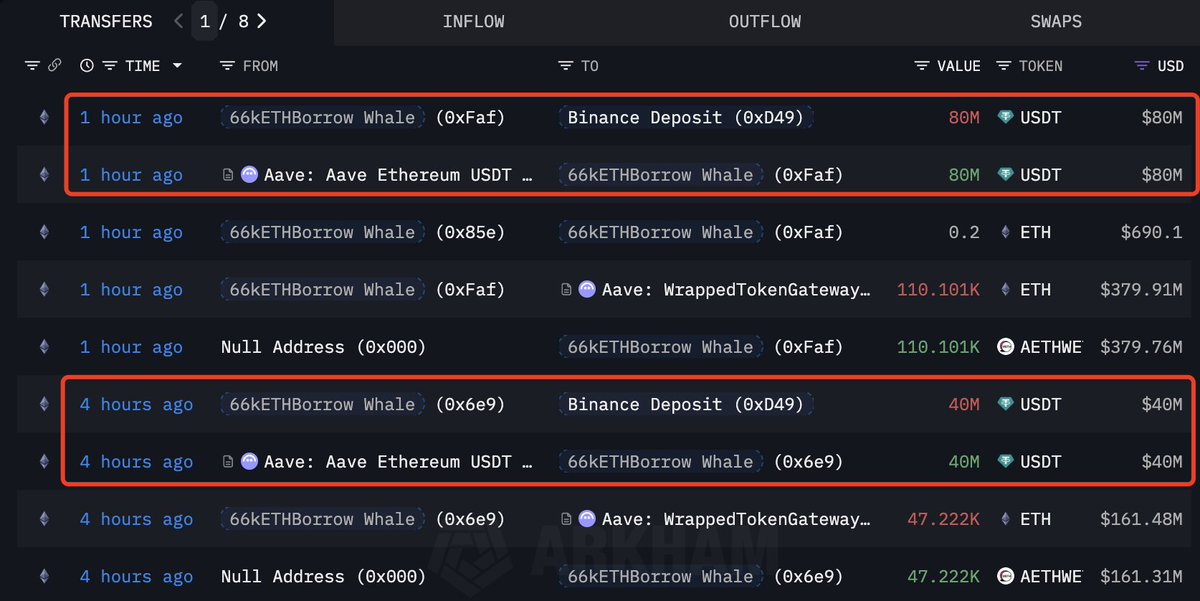
Such behavior from a high-capital market participant often signals renewed confidence in Ethereum’s medium-term outlook. By leveraging borrowed funds, the whale is increasing exposure, suggesting expectations of a significant price rebound. This type of leveraged accumulation can create upward pressure on the market, especially when liquidity is thin and sellers are exhausted.
However, this strategy also carries risks. If Ethereum fails to sustain its current support near $3,400–$3,500, the whale could face mounting liquidation pressure — amplifying volatility across the broader market. Still, the scale and persistence of these purchases indicate that smart money continues to buy the dip, positioning ahead of what could be a major recovery phase.
Related Reading
Ethereum Consolidates Above as Bulls Attempt to Regain Control
The daily Ethereum chart shows a clear consolidation pattern forming above the $3,450–$3,500 zone, signaling an ongoing battle between bulls and bears. After weeks of selling pressure, ETH is attempting to stabilize, finding support at the 200-day moving average (red line), which continues to act as a critical long-term defense level.
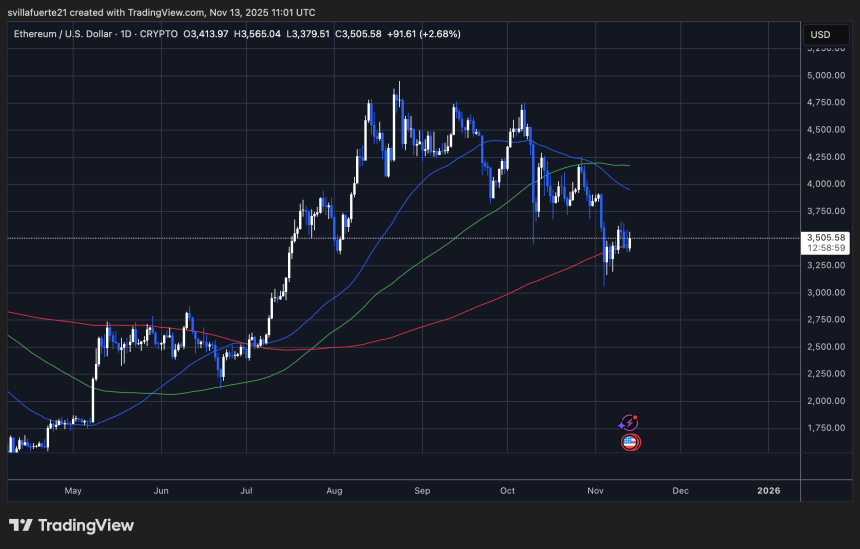
Despite failing to reclaim the 50-day moving average (blue line), currently near $3,700, the structure suggests that downside momentum is weakening. Recent candles show tighter ranges and declining volume, often a sign of equilibrium before a potential breakout. For Ethereum to confirm a shift in trend, bulls need a decisive close above $3,650, which would open the door toward $3,900–$4,000, where the next key resistance cluster sits.
Related Reading
On the downside, if ETH loses the $3,400 support zone, the next major area of interest lies around $3,100, aligning with previous reaction lows and the psychological barrier where buyers have historically stepped in.
Featured image from ChatGPT, chart from TradingView.com
352 Million Dogecoin (DOGE) Moved Off Bybit In Massive Transfers BlockchainReporter
Source link ]]>
Shiba Inu Price Prediction: SHIB’s Early Backers Have Moved on, Here’s The Meme Coin They’re Betting on in 2025 DNA India
Source link ]]>
Are Pepe Coin and Shiba Inu Still Worth Buying, or Have Smart Investors Already Moved On? BlockchainReporter
Source link ]]>