Ethereum price started a fresh increase above $2,920. ETH is now attempting to clear the $3,050 resistance and might accelerate higher.
- Ethereum started a fresh increase above the $2,920 and $2,950 levels.
- The price is trading above $2,950 and the 100-hourly Simple Moving Average.
- There was a break above a short-term bearish trend line with resistance at $2,825 on the hourly chart of ETH/USD (data feed via Kraken).
- The pair could continue to move up if it settles above the $3,050 zone.
Ethereum Price Eyes Upside Break
Ethereum price managed to stay above $2,720 and started a fresh increase, like Bitcoin. ETH price gained strength for a move above the $2,850 and $2,880 resistance levels.
There was a break above a short-term bearish trend line with resistance at $2,825 on the hourly chart of ETH/USD. The bulls even pumped the price above $2,950. However, the price is now testing a key barrier at $3,050. A high was formed at $3,047 and the price is now consolidating above the 23.6% Fib retracement level of the recent move from the $2,718 swing low to the $3,047 low.
Ethereum price is now trading above $2,950 and the 100-hourly Simple Moving Average. If there is another upward move, the price could face resistance near the $3,050 level.
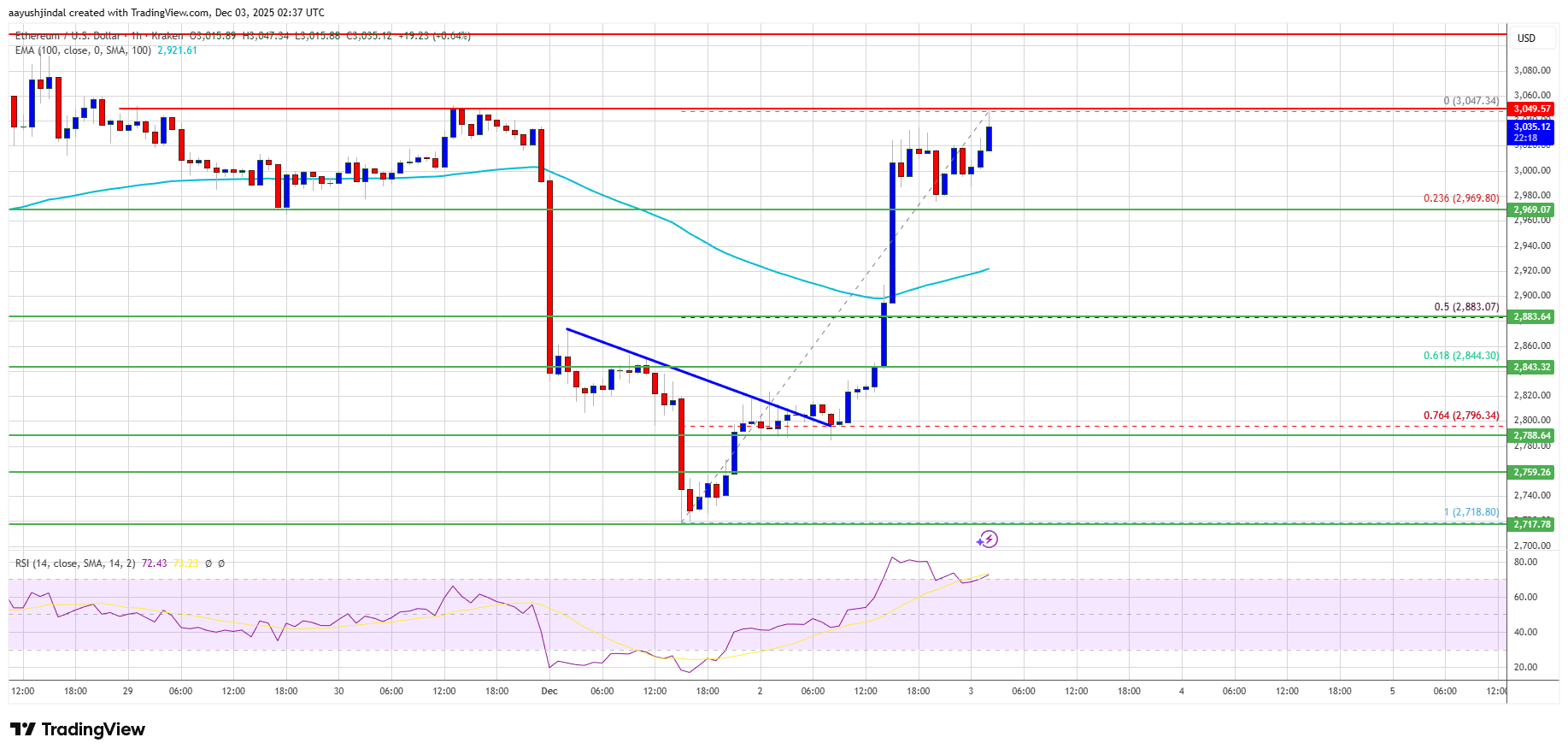
The next key resistance is near the $3,080 level. The first major resistance is near the $3,120 level. A clear move above the $3,120 resistance might send the price toward the $3,200 resistance. An upside break above the $3,200 region might call for more gains in the coming days. In the stated case, Ether could rise toward the $3,350 resistance zone or even $3,380 in the near term.
Another Decline In ETH?
If Ethereum fails to clear the $3,050 resistance, it could start a fresh decline. Initial support on the downside is near the $2,970 level. The first major support sits near the $2,880 zone or the 50% Fib retracement level of the recent move from the $2,718 swing low to the $3,047 low.
A clear move below the $2,840 support might push the price toward the $2,800 support. Any more losses might send the price toward the $2,750 region in the near term. The next key support sits at $2,720 and $2,710.
Technical Indicators
Hourly MACD – The MACD for ETH/USD is gaining momentum in the bullish zone.
Hourly RSI – The RSI for ETH/USD is now above the 50 zone.
Major Support Level – $2,970
Major Resistance Level – $3,050
As optimism mounts on the likely approval of a bunch of Bitcoin spot exchange-traded funds (ETFs) applications, Bloomberg analyst James Seyffart has pointed out on Twitter (now X) that the Securities and Exchange Commission (SEC) will have a narrow window between January 8 and 10 to make its decision either to reject or approve the proposals.
The development comes as part of a submission made by the agency on the Franklin Templeton and Hashed spot BTC ETF application. In the filing, the SEC promises to “process and review” comments from the public regarding the application. These comments should be submitted to the agency by January 5, 2024.
According to Bloomberg’s Seyffart, the condition to have all public comments submitted by January 5 implies that the approval could take place before January 10.
Window is officially Jan 5th to Jan 10th. Really this means that any potential approval orders are going to come on either Monday Jan 8, Tuesday Jan 9, or Wednesday Jan 10. Mark your calendars people. https://t.co/8ob8Y6pgU5
— James Seyffart (@JSeyff) December 1, 2023
The SEC Could Approval Multiple Bitcoin Spot ETFs
The SEC currently has more than 12 Bitcoin spot ETFs to consider for approval or rejection. Several companies including BlackRock and Grayscale have amended their proposals, ensuring that they are airtight and ready for launch into the market.
Grayscale, which won a case against the SEC on the request to convert its Bitcoin Trust (GBTC) shares into a spot ETF is believed to have a higher chance of getting the approval.
The SEC tends to approve multiple proposals like it did with Ethereum futures ETFs. This ensures that all companies interested in operating the revolutionary products get an equal chance in the market.
Recommended for you: Polkadot Price Prediction As Protocol Brings Real World Assets On-Chain, Bullish Signal?
What’s The Impact of BTC Spot ETF Approval
An exchange-traded fund would allow investors, especially institutional to seek exposure to Bitcoin indirectly. This would be achieved through the purchase of shares of an investment product tracking Bitcoin spot price via a stock exchange broker like you would shares of a publicly listed company.
Investing in the ETF saves investors the hustle of navigating the complex world of digital assets on crypto exchanges while eliminating custody requirements such as having to secure private keys. Spot ETFs would also increase demand for Bitcoin not to mention the assurance that Bitcoin is now a mature asset class.
Related Articles:

The presented content may include the personal opinion of the author and is subject to market condition. Do your market research before investing in cryptocurrencies. The author or the publication does not hold any responsibility for your personal financial loss.

Key Takeaways
- Crypto volatility has picked up in the last two weeks
- A positive court ruling regarding the conversion of Grayscale’s Bitcoin trust into an ETF propelled markets last week
- Gains have since been given up as SEC pushed out assessment date for ETF filings
After a long period of calm, the crypto markets have finally shown signs of life in the last couple of weeks. First, the price of Bitcoin fell from $29,000 to $26,000 two weeks ago, including a 7% dip in ten minutes, as markets recalibrated to more hawkish interest rate expectations.
Last week, the price rose back up to $27,000, buoyed by a seemingly positive ruling in the courts. A federal court ruled last Tuesday that the SEC was wrong to reject an application from Grayscale Investments to convert its trust into an ETF, the judge saying the regulator failed to “offer any explanation” following its ruling.
While this does not guarantee the eventual conversion of the trust into an ETF, it is nonetheless a big win for both Grayscale and traders who were betting on a positive outcome, with a firm recommendation to the SEC that it should review its decision to reject.
Previously, the SEC rejected Grayscale’s application on grounds that the products were not “designed to prevent fraudulent and manipulative acts and practices.” Grayscale subsequently sued.
However, the boost to markets ended up being short-term, for reasons again related to the SEC. The regulating body delayed its decision on all ETF applications, including those filed by Blackrock and Fidelity, to October. Soon, Bitcoin was back down at $26,000.
The week sums up the year so far for Bitcoin, an asset that has been tossed about by developments in the regulatory sphere all year.
However, assessing the price of GBTC, and comparing it to Bitcoin, does show that the market feels more regulatory clarity is on the way – and potentially in a positive way. In the next chart, we have plotted the performance of GBTC against Bitcoin since the latter’s all-time high in November 2021.
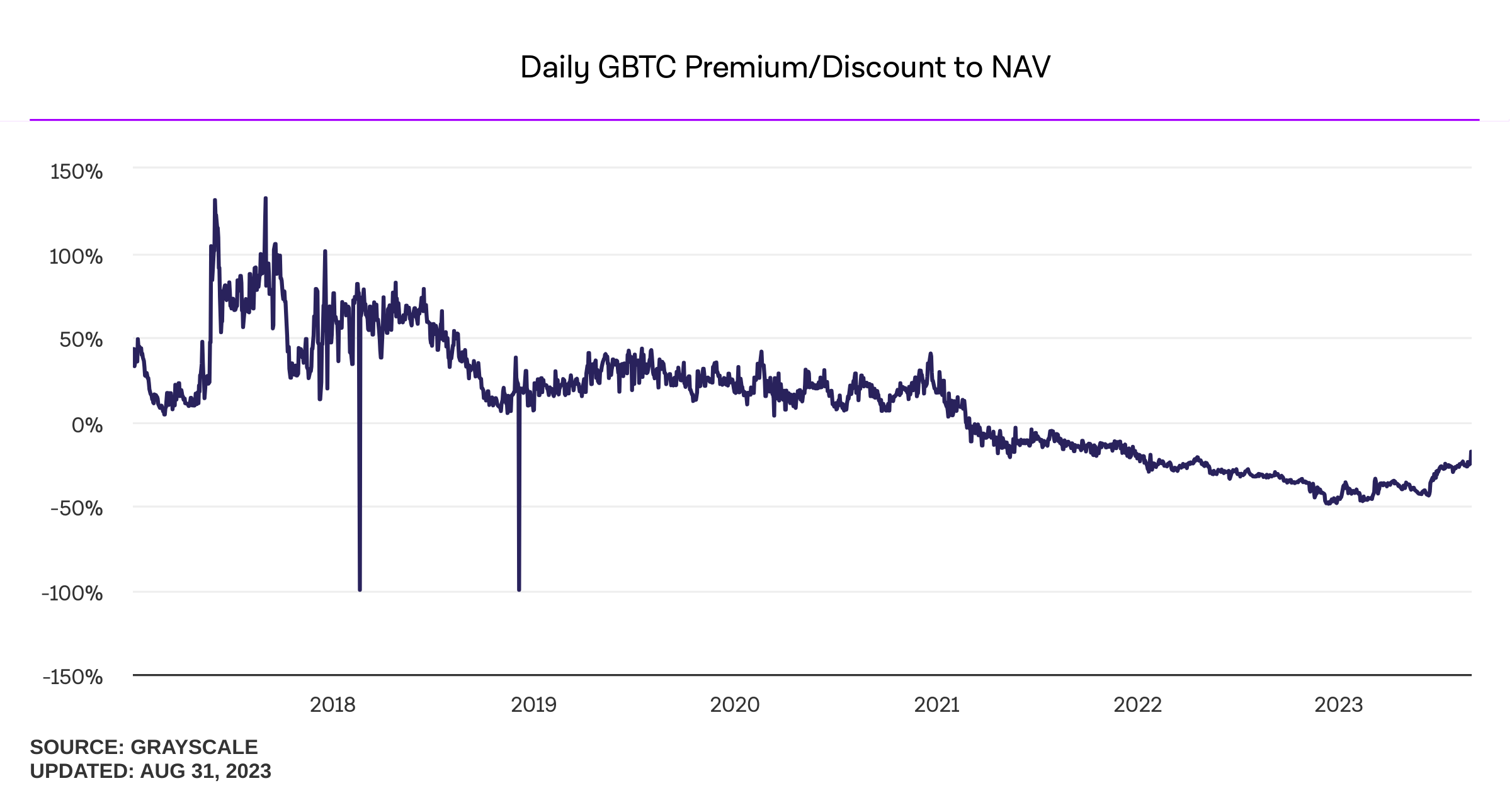
Throughout the bear market, as well as the rebound in 2023, Grayscale investors have suffered worse than counterparts who invested in Bitcoin directly. But in recent months, the discount has been declining, with the court ruling pushing a substantial convergence last week.
If we plot the same two assets again but instead of going back to Bitcoin’s all-time high in Q4 of 2021, we look at returns since the start of the year, it is GBTC that outperforms.
The jump in mid-June stands out, which coincides with the filing of multiple spot Bitcoin ETFs, led by Blackrock. This led the market to move towards the assumption that conversion of Grayscale’s trust into an ETF is more likely – something which has become more real again following the ruling last week against the SEC, and hence caused even further outperformance by GBTC.
Following the ruling last week, the discount of GBTC to its net asset value has narrowed to 19%, the lowest since 2021.
In truth, the conversion of GBTC to an ETF feels inevitable, the court ruling summising what most around the market would believe should happen at some stage.
JP Morgan agrees, and also speculated positively about what the ruling means for other ETF filings, with its analysts writing this week that “[The delay] likely points to approval of multiple spot bitcoin ETF applications at once rather than granting a first-mover advantage to any single applicant.”
The market doesn’t lie, and with the discount on GBTC down to 19%, it represents substantial progress. However, 19% is still an enormous chasm, highlighting that there remains a way to go before all this is resolved.

Key Takeaways
- The Grayscale Bitcoin Trust (GBTC) has persistently traded at a discount to its net asset value
- The discount has narrowed to its lowest mark since September off hope the fund is more likely to be converted to an ETF
- The entire GBTC debacle represents the mess that is the institutional regulatory climate in the US
- Spot ETFs are a question of when rather than if, and such investment vehicles will then be a thing of the past
- That won’t assuage frustration of GBTC investors, who have been caught badly as alternative Bitcoin investment vehicles have come online and demand for the trust has dried up
Among the interesting aspects of the fallout from the slew of recent spot Bitcoin ETF filings is how it affects the controversial Grayscale Bitcoin Trust (GBTC).
The trust has been flying, up 56% in the three weeks since Blackrock’s ETF filing was announced.
Notably, this means it has significantly outpaced its underlying asset, Bitcoin. That sounds like a good thing, but it really summises the problem with this investment vehicle that has done nothing but frustrate investors in recent years, but we will get to that in a moment.
I have plotted the movement of the GBTC against Bitcoin itself in the next chart, highlighting the outperformance the Trust has had since the ETF filing, with Bitcoin itself up “only” 21%.
Grayscale discount to net asset value narrowing but still enormous
The trust’s discount to net asset value has also narrowed to its smallest mark since September, now below 30%. This comes as investors bet the trust is now more likely to finally be allowed to convert to an ETF.
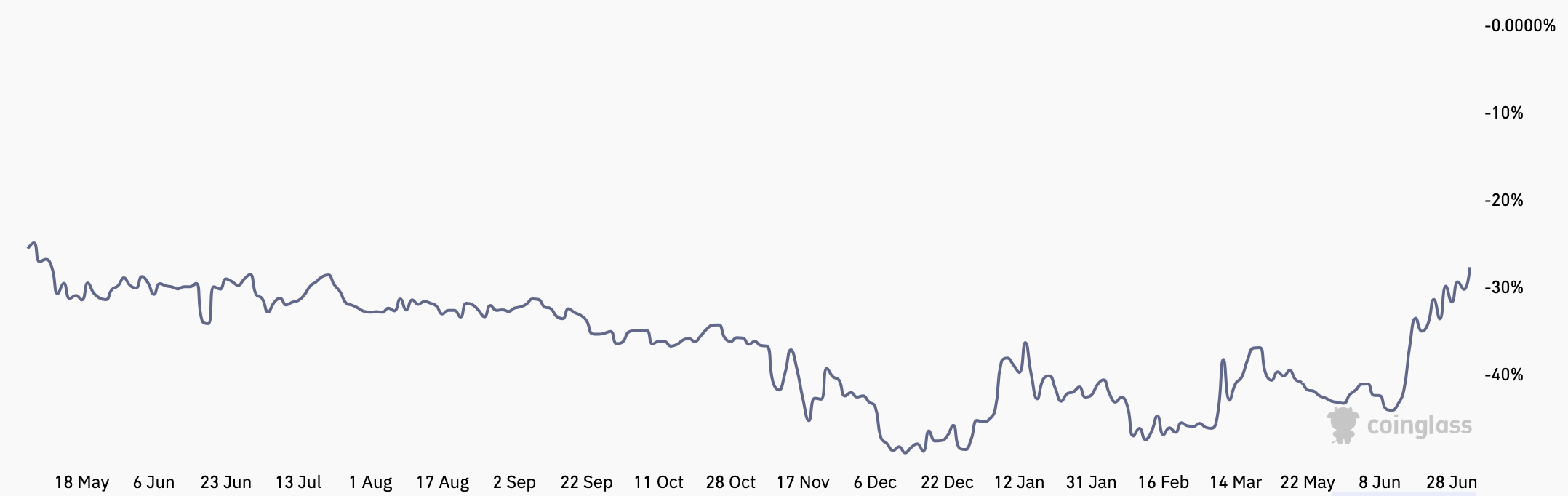
Should this conversion occur, the discount would narrow to near zero, as funds would then be allowed to flow in and out of the vehicle without affecting the underlying assets. For the time being, while it remains a trust, there is no way to get Bitcoin out of GBTC. This, coupled with steep fees (2% annually) means that a heavy discount has persisted.
In truth, the very existence of the Grayscale trust is a black mark on the sector. The discount it trades at is farcical – even following the recent narrowing, a 30% delta is an enormous chasm, one that is hurting investors.
The outsized assets under management – essentially trapped due to the closed-fund nature – feels like a throwback to the days when anyone and everyone wanted to get exposure to Bitcoin through whatever means necessary. Grayscale was the only shop in town, and such was the demand for Bitcoin, coupled with that monopolistic power, that it even traded at a premium for much of its early history.
However, as more mediums through which Bitcoin exposure can be had have come online, the premium has flipped to a discount, and that discount has become large. It is probably fair to say that investors displayed a lack of due diligence for how the fund works, another throwback to the up-only bull market of days gone by.
Without donning a captain hindsight outfit, there was always going to be competitor firms coming online and the premium was bound to come under pressure. An investment in GBTC essentially amounted to two things: a bet on Bitcoin, and a bet that the trust would be converted into an ETF quickly.
But at that, perhaps sympathy can be shown to investors. Investment management firm Osprey Funds has a similar product, and earlier this year sued Grayscale, alleging that its competitor misled investors about how likely it was that GBTC would be converted into an ETF. This, they allege, is how they captured such a share of the market.
“Only because of its false and misleading advertising and promotion has Grayscale been able to maintain to date approximately 99.5% market share in a two-participant market despite charging more than four times the asset management fee that Osprey charges for its services”, the suit alleges.
Whether Grayscale knew of the regulatory difficulty it would face or not, it has tried and failed for years to convert the vehicle into an ETF. Last year, it sued the SEC itself, declaring the latest rejection “arbitrary”.
Institutional climate turning
My thoughts on the trust overall remain the same. I believe it represents a terrible investment (obviously), and its mere existence is only a byproduct of the regulatory travails that the sector has struggled with. There is no reason to even consider buying this unless there is quite literally no other vehicle through which to gain Bitcoin exposure.
There will come a day when all this squabbling over trusts and ETFs will likely be nothing but a throwback of a more uncertain time. But time is a luxury that many investors don’t have, and Grayscale has been a horrendous investment, typical in a lot of ways of the travails the space has had in bridging the gap to become a respected mainstream financial asset.
Not only is the discount jarring as it is, but it widened beyond 50% in the aftermath of the FTX collapse as it emerged that crypto broker Genesis was in deep trouble. Genesis’ parent company is Digital Currency Group (DCG), the same parent company of Grayscale. Genesis eventually filed for bankruptcy in January.
This sparked concern around the safety of Grayscale’s reserves, something which they company did not exactly comfort investors about when it refused to provide on-chain proof of reserves, citing “security concerns”.
6) Coinbase frequently performs on-chain validation. Due to security concerns, we do not make such on-chain wallet information and confirmation information publicly available through a cryptographic Proof-of-Reserve, or other advanced cryptographic accounting procedure.
— Grayscale (@Grayscale) November 18, 2022
While the furore over reserves has quietened down, the episode is yet another stark reminder of the oft-repeated (but perhaps not often enough) phrase: “not your keys, not your coins”.
The problem for institutions to date is that they have had trouble accessing Bitcoin directly for a variety of reasons, primarily regulatory-related. While spot ETFs will also technically violate the “not your keys” mantra, with prudent regulatory oversight and a strong custodian, this should be a safe way for institutions to gain exposure to Bitcoin.
That would end all this nonsense (and that really is the right word) such as trusts trading at 30% discounts, and give investors a secure avenue through which to put their views on Bitcoin into conviction. That may still be a long way off, but if demand for these products remains, it’s only a matter of time.
✓ Share: