Bitcoin, Ethereum, XRP Steady, While Dogecoin Spikes Amid Trump’s Iran Negotiation Buzz: Analyst Outlines BTC’s Path To $80,000 Benzinga
Source link ]]>
Cardano’s Charles Hoskinson Outlines Strategic Funding Roadmap for 2026: Here’s What’s New CryptoPotato
Source link ]]>

Vitalik Buterin is pushing back against the dominant narrative shaping today’s artificial intelligence industry. As major AI labs frame progress as a competitive sprint toward artificial general intelligence (AGI), the Ethereum co-founder argues that the premise itself is flawed.
In a series of recent posts and comments, Buterin outlined a different approach, one that prioritizes decentralization, privacy, and verification over scale and speed, with Ethereum positioned as a key piece of enabling infrastructure rather than a vehicle for AGI acceleration.
Buterin likens the phrase “working on AGI” to describing Ethereum as simply “working in finance” or “working on computing.” In his view, such framing obscures questions about direction, values, and risk.
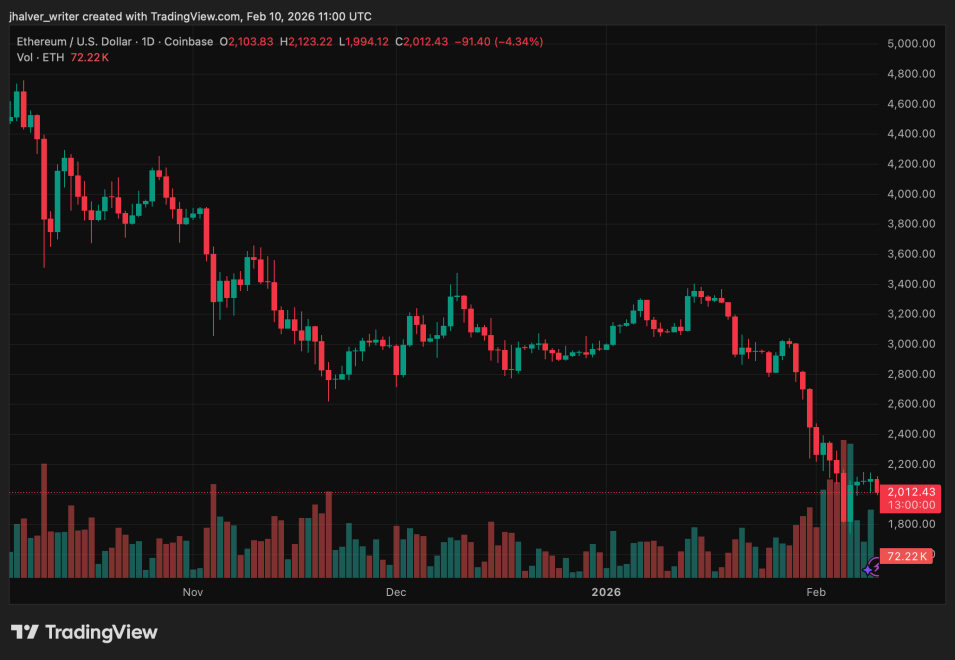
ETH's price trends to the downside on the daily chart. Source: ETHUSD on Tradingview
Ethereum as Infrastructure for Private and Verifiable AI
A central theme in Buterin’s vision is privacy-preserving interaction with AI systems. He points to growing concerns around data leakage and identity exposure from large language models, especially as AI tools become more embedded in daily decision-making.
To address this, Buterin proposes local LLM tooling that allows AI models to run on user devices, alongside zero-knowledge payment systems that enable anonymous API calls. These tools would make it possible to use remote AI services without linking requests to persistent identities.
He also highlights the importance of client-side verification, cryptographic proofs, and Trusted Execution Environment (TEE) attestations to ensure AI outputs can be checked rather than blindly trusted.
This approach reflects a broader “don’t trust, verify” ethos, with AI systems assisting users in auditing smart contracts, interpreting formal proofs, and validating onchain activity.
An Economic Layer for AI-to-AI Coordination
Beyond privacy, Buterin sees Ethereum playing a role as an economic coordination layer for autonomous AI agents. In this model, AI systems could pay each other for services, post security deposits, and resolve disputes using smart contracts rather than centralized platforms.
Use cases include bot-to-bot hiring, API payments, and reputation systems backed by proposed ERC standards such as ERC-8004. Supporters argue that these mechanisms could enable decentralized agent markets where coordination emerges from programmable incentives instead of institutional control.
Buterin has stressed that this economic layer would likely operate on rollups and application-specific layer-2 networks, rather than Ethereum’s base layer.
AI-Assisted Governance and Market Design
The final pillar of Buterin’s framework focuses on governance and market mechanisms that have historically struggled due to human attention limits.
Prediction markets, quadratic voting, and decentralized governance systems often falter at scale. Buterin believes LLMs could help process complexity, aggregate information, and support decision-making without removing human oversight.
Rather than racing toward AGI, Buterin’s vision frames Ethereum as a tool for shaping how AI integrates with society. The emphasis is on coordination, safeguards, and practical infrastructure, an alternative path that challenges the prevailing acceleration-first mindset.
Cover image from ChatGPT, ETHUSD chart on Tradingview
Editorial Process for bitcoinist is centered on delivering thoroughly researched, accurate, and unbiased content. We uphold strict sourcing standards, and each page undergoes diligent review by our team of top technology experts and seasoned editors. This process ensures the integrity, relevance, and value of our content for our readers.
Bitcoin’s price has shown strength over the past 48 hours and is now trading in the mid-$90,000s after days of consolidating around $90,000. Technical analyst Jackis presented a fair assessment of potential paths for Bitcoin’s next significant rise in the context of near-term consolidation and attempted breakouts above $95,000, outlining distinct scenarios for both bulls and bears.
Both Outlooks Have A Case, But Price Has To Confirm
Bitcoin is now back to trading above $95,000 after a 3.1% increase in the past 24 hours. Price action in the past 24 hours alone shows that the outlook might be bullish. However, as it stands, Bitcoin’s price action has reached a point where traders should let the chart tell them what’s next.
Related Reading
According to a technical analysis from a crypto analyst known as Jackis on the social media platform X, arguments alone are not enough here because there are both good bullish & bearish arguments out there for Bitcoin. In his words, he has watched similar-looking price action resolve in opposite directions across different cycles.
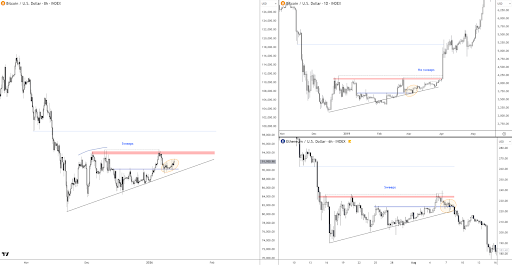
The chart below shows how Bitcoin price action is currently forming an ascending triangle pattern on the 8-hour candlestick timeframe chart. However, examples show how this same formation led to an upward reversal for Bitcoin in the past and then also a bearish continuation for Ethereum in the past.
Based on his read, he currently sees more reasons for downward continuation, and until the market proves otherwise, the active trend is bearish. Both bullish and bearish outlooks have a case, but price action has to confirm.
Bullish And Bearish Scenarios For Bitcoin
Once price breaks out in either direction, the follow-through can be fast, which means being stubborn on the wrong side can be costly.
Related Reading
On the bullish side, Jackis highlighted that a breakout toward $96,000 is the kind of move that would confirm a bullish continuation. He added that a push through $96,000 at this point could open the path to $107,000 or higher.
On the other hand, Jackis’ bearish trigger is tied to the rising support line. Price action can look constructive right up until the trendline snaps, and that’s the point where downside continuation becomes the higher-probability route in this framework.
If Bitcoin were to lose the lower trendline of the ascending trend, then it would likely drift back to the April 24 lows. The April lows refer to how Bitcoin rejected above $106,100 in January 2025 and entered into a multi-month correction that eventually bottomed at a low around $76,000.
This means that a clean breakdown could change the conversation away from range chop in the mid-$90,000s to a reset.
Featured image from Pixabay, chart from Tradingview.com
Shiba Inu Expert Outlines 3 Key Steps for SHIB to Reclaim 2021 Glory CoinCentral
Source link ]]>
Ethereum (ETH) is showing renewed strength after the U.S. government ended its historic 43-day shutdown, an event that had weighed heavily on investor confidence across global markets.
Related Reading: Ethereum’s Fusaka Upgrade Is Just Around The Corner—What To Expect
ETH price is currently hovering above the $3,400 support zone after a volatile week marked by ETF outflows, declining volume, and intense bearish sentiment.
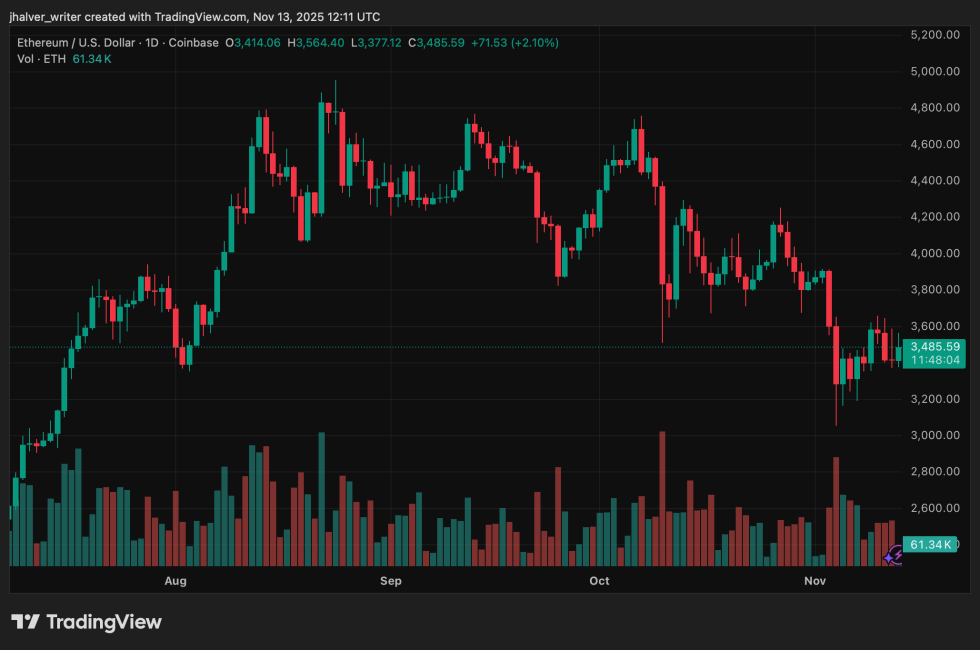
ETH's price trends to the downside on the daily chart. Source: ETHUSD on Tradingview
Shutdown Resolution Lifts Market Sentiment as ETH Reclaims Stability
The broader crypto market reacted positively to news of the shutdown’s resolution, helping Ethereum climb 3.18% on the day and outperform Bitcoin with a 3% gain. Analysts now expect ETH to rise toward $3,814 by November 18, representing a potential 10.37% short-term upside.
Despite the improved macro backdrop, Ethereum remains in a challenging technical position. Key support lies at $3,333 and $3,300, while resistance at $3,590 and $3,666 will determine whether ETH can break its current downtrend.
ETF products continue to show weakness, with all nine Ethereum ETFs recording zero inflows and a combined $107 million in outflows, suggesting institutions remain cautious.
Vitalik Buterin Unveils Scaling Outlook as DeFi Matures Globally
Ethereum co-founder Vitalik Buterin added optimism to the week by outlining a refreshed scaling roadmap and highlighting DeFi’s evolution into a viable global savings tool.
He emphasized that the DeFi ecosystem is now “night and day” safer compared to 2020, citing better security audits, stronger protocols, and improved user-fund recovery mechanisms through innovations like the “walkaway test.”
Central to Buterin’s roadmap is Ethereum’s ongoing Layer 1 and Layer 2 scaling strategy. With rollups, data availability upgrades, and new high-throughput solutions, such as systems already achieving over 10,000 transactions per second, Buterin believes Ethereum is on track to support the next wave of DeFi adoption.
He urged developers to maintain Ethereum’s core values: openness, censorship resistance, and interoperability. Buterin warned that abandoning these principles risks turning Ethereum into a “walled garden,” undermining the ecosystem’s global mission.
Institutional RWA Demand Surges as ETH Eyes Breakout Above $3,700
A growing bright spot for Ethereum is the explosive expansion of tokenised real-world assets (RWAs). More than $200 billion worth of RWAs now sit on-chain, driven by major institutions such as BlackRock and Fidelity.
The BUIDL fund’s tokenised Treasury products, built natively on Ethereum, showcase the network’s rising importance in traditional finance. Institutional RWA assets have surged nearly 2,000% since January 2024, strengthening Ethereum’s long-term fundamentals even as short-term volatility persists.
Related Reading: European Banking Regulator Says EU Crypto Framework Addresses ECB’s Stablecoin Concerns
Technically, Ethereum remains in a descending channel from its failed August rally toward $5,000. Analysts note that a decisive breakout above $3,700 could flip market structure bullish and reopen paths toward $4,700, especially if macro stability continues after the shutdown settlement.
Cover image from ChatGPT, ETHUSD chart from Tradingview
Editorial Process for bitcoinist is centered on delivering thoroughly researched, accurate, and unbiased content. We uphold strict sourcing standards, and each page undergoes diligent review by our team of top technology experts and seasoned editors. This process ensures the integrity, relevance, and value of our content for our readers.
Cardano 10 Million User Thesis Heats Up As Charles Hoskinson Outlines Bold 2030 Vision ZyCrypto
Source link ]]>
Cardano Founder Outlines 2026 Revival Plan Bitcoinist.com
Source link ]]>
A recent post by XRP commentator Remi Relief on the social media platform X has looked into the possibility of XRP’s price reaching the $1,000 price level. XRP is currently trading well below even the double-digit mark. However, according to this crypto commentator, XRP can get to $1,000, and the world doesn’t need to wait until 2030 for this to happen.
Vision Of XRP’s Global Purpose
In his post, Remi Relief questioned the widespread belief that a $1,000 price target could only be achieved by XRP by 2030. The timeline for XRP to reach $1,000 is going to be far less than that, with the analyst noting that the global economy is moving too quickly for it to take that long. He described the altcoin’s rise as something far bigger than predictions, and this is because the cryptocurrency is set to play an important role in stabilizing the world’s financial system.
Related Reading
Remi Relief’s outlook places XRP at the core of a growing realignment in the world’s financial system. “It’s going that high for the world’s sake,” he said. He contends that the cryptocurrency’s growth is tied to a global effort to rebalance debt and liquidity. Hence, the recent price crashes we’ve seen with XRP and other cryptocurrencies are a deliberate play by institutional players to accumulate more XRP while smaller investors capitulate.
According to Remi Relief, these shakeouts are deliberate and designed to clear the market so that major entities can assume dominance before the price finally explodes.
He also suggested that political resistance, particularly from the Democratic Party in the United States, could slow or suppress XRP’s ascent, as maintaining control over the traditional banking system aligns with their interests. If such resistance succeeds, the token might fall short of the $1,000 target but could still reach between $100 and $300 before stabilizing. Nonetheless, this is an acceptable outcome given the current XRP price levels.
What Must Align For The Altcoin To Reach $1,000
Extraordinary developments in both market structure and adoption would be required in order for XRP to reach a four-digit price level. Predictions like these, as we’ve seen from many XRP enthusiasts, are dependent on whether the token gains widespread adoption in the world’s financial ecosystem.
Related Reading
Institutional integration would have to expand to a scale where XRP becomes an indispensable liquidity bridge for global payments, central bank settlements, and large-value transfers. At the same time, demand from major financial institutions, including banks, fintech companies, and possibly even governments, would need to grow exponentially in order for this to be reflected in the XRP price.
At the same time, a reduction in the liquid supply would be needed. This could happen through large-scale lockups, increased network utility, or widespread adoption in tokenized asset systems that reduce the circulating supply of XRP.
In another post on the social media platform X, Remi Relief projected that the altcoin’s price could surge to $1,700 if it repeats its 2017/2018 performance.
At the time of writing, XRP is trading at $2.42.
Featured image from Peakpx, chart from Tradingview.com
Bitcoin Season Or Altcoin Season? Shiba Inu Exec Outlines What’s Happening CryptoRank
Source link ]]>