Bitcoin, ETH, XRP, and Solana are facing pullbacks today ahead of Friday’s crypto options expiry. The crypto market sentiment has significantly improved this week, with traders expecting upside momentum amid strong spot ETF inflows. Crypto liquidations surged to almost $450 million, with almost a similar amount of short and long liquidations. In addition, US-Iran peace
The post Bitcoin, ETH, XRP, Solana Max Pain to Watch as Trump Says Iran War Could End appeared first on CoinGape.
]]>More than $2.3 billion in Bitcoin, ETH, XRP and SOL options to expire on Friday. Crypto market participants are bracing for options expiry and US CPI inflation data release later today. After US PCE inflation rose in line with expectations, markets await cues on how the US-Iran war impacted inflation. Ad Ad Will Bitcoin, ETH,
The post Max Pain Price for Bitcoin, ETH, XRP, SOL as Wall Street Sees Hot US CPI Inflation appeared first on CoinGape.
]]>Analyst Warns: Crypto Is Near Bottom — But Not Done With Pain DailyCoin
Source link ]]>
Culper Research disclosed a short position in ether and ETH-linked securities on Thursday, arguing that Ethereum’s post-upgrade economics have deteriorated enough to put sustained downside pressure on the token. The firm pointed directly at Ethereum’s December 2025 Fusaka upgrade, and at Vitalik Buterin’s recent sales, as evidence that “ETH is going lower.”
“NEW: We are short Ether ETH, and ETH-linked securities, incl. BMNR,” Culper wrote on X. “We think ETH tokenomics are impaired following the December 2025 Fusaka upgrade. Vitalik knows it and is selling, while ETH’s most ardent bull, Tom Lee, is throwing good money after bad.”
Why Culper Is Shorting Ethereum
Culper’s core claim is that Fusaka’s L1 scaling changes altered Ethereum’s demand-fee dynamic more dramatically than expected. The firm pointed to a gas limit increase “45 to 60M” that it said was intended to scale Ethereum’s base layer, alongside estimates that “Vitalik and PTG” believed fees would drop 10% to 30%. Culper contends the realized outcome was far more severe: “In reality, gas fees fell ~90%,” it wrote, adding that Ethereum’s leadership and validators “miscalculated L1 demand elasticity by 3-9x based on outdated math (pre-EIP-1559 and pre-L2s).”
Related Reading
That fee compression matters, Culper argues, because it ripples into validator economics and staking incentives. “Further, the gas-limit increase killed $ETH validators, who are now seeing 40-50% lower tips per gas,” Culper wrote, claiming that lower yields reduce demand for staking and “high-value activity,” undermining the institutional adoption narrative. “The flywheel is now running in reverse.”
The thread frames Tom Lee and BMNR as a prominent counterweight in the ETH bull camp, then attempts to dismantle his post-upgrade read-through. Culper said Lee has defended ether by claiming: “ETH is not in a death spiral because utility is going up.” According to Culper, Lee cited spikes in active addresses and transaction counts after Fusaka as evidence of “strengthening fundamentals” and institutional adoption.
Culper’s rebuttal is blunt and largely definitional: “By Lee’s own logic, if ETH activity does NOT reflect increased utility and strengthening fundamentals, then $ETH would be in a death spiral,” it wrote. “Our research says this is exactly what’s happening.”
Related Reading
To explain the activity surge, Culper said its analysis of on-chain data from January 2025 through February 2026 suggests much of the growth was not organic usage, but a wave of low-value address poisoning and wallet dusting enabled by cheaper blockspace. “Post-Fusaka: 95% of growth in new wallets is explained by newly-created ‘dusting’ wallets,” Culper wrote, adding that poisoning attacks have “more than 3x’ed,” that poisoning explains “>50% of $ETH transaction growth,” and that it now constitutes “22.5% of all ETH transactions.”
Culper said it validated the phenomenon firsthand, claiming it set up two new wallets, transferred between them, and was targeted by poisoning attacks “within 5 minutes,” while asserting that poisoning losses are “already pacing >8x higher than pre-Fusaka.”
Vitalik Is Selling
The firm also tried to tie its tokenomics thesis to Buterin’s recent sales activity, portraying it as informed selling rather than routine treasury management.
“This is why, we think, Vitalik is selling ETH hand over fist. On January 30, Vitalik pre-announced he’d sell 16,384 ETH to fund the Foundation’s ‘austerity period.’ Since then, he’s sold over 19,300 ETH and counting,” Culper wrote. “He knows what Tom Lee doesn’t: ETH tokenomics are broken.”
Culper closed by broadening the bear case into a competition story, claiming ether is losing share to Solana and to Ethereum’s own L2s, and likening ETH’s current position to incumbents that led early eras before being displaced.
At press time, ETH traded at $2,080.
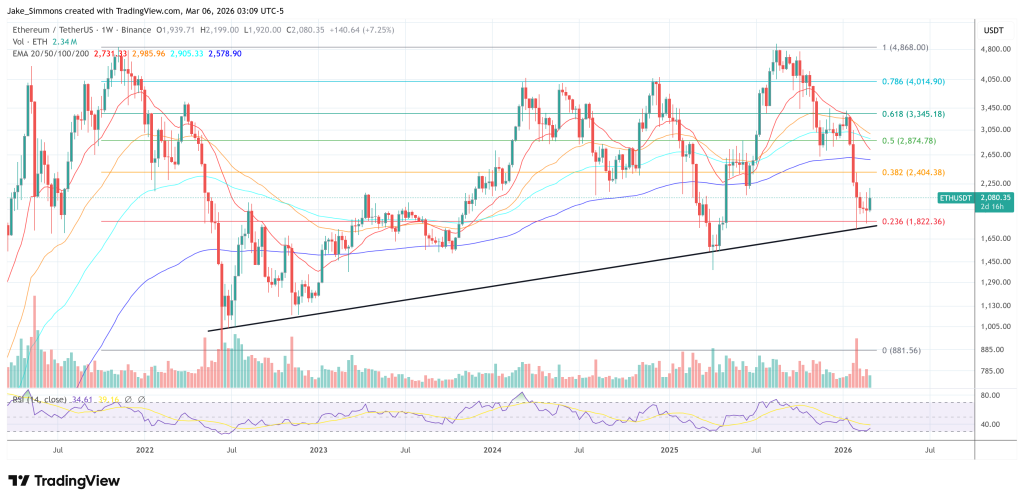
Featured image created with DALL.E, chart from TradingView.com
Dogecoin’s Next Moonshot Or Max Pain? Is The Doge Army Sleepwalking Into Risk Or Opportunity Now? AD HOC NEWS
Source link ]]>
Bitcoin Treasury company GD Culture Group has approved a plan allowing management to sell digital assets to fund a previously announced stock repurchase program. The decision comes as the company faces sustained market pressure and a prolonged decline in crypto prices in recent months. GD Culture Advances Bitcoin Treasury Sale Plan According to a recent
The post Bitcoin Treasury Firm GD Culture Authorizes Sale of 7,500 BTC as Expert Warns Of More ‘Pain’ appeared first on CoinGape.
]]>Dogecoin – Why history suggests holders can expect 2 more years of pain AMBCrypto
Source link ]]>
Crypto market participants are bracing for crypto options expiry, US PCE inflation, Q4 GDP data, and escalating US-Iran war tensions. However, signs of a potential recovery have emerged amid massive short liquidations and on-chain flashing exhaustion of sellers. Will Bitcoin, ETH, XRP, and Solana rebound to their max pain price today? Bitcoin, ETH, XRP, and
The post Will Bitcoin, ETH, XRP, Solana Rebound to Max Pain Price amid Short Liquidations Today? appeared first on CoinGape.
]]>Shiba Inu at Critical Lows: Smart Money Buying or More Pain Ahead? Analytics Insight
Source link ]]>

In line with its bearish market structure, the Ethereum price struggled significantly in the first week of February. The cryptocurrency’s value fell by more than 30% over the week, crashing to as low as $1,850 on Friday, February 6. Amid the Ethereum market downturn, a significant development has emerged — one which could make or mar the world’s second-largest cryptocurrency.
Ethereum Breaches Realized Price Across All Investor Cohorts
In a recent post on Quicktake, on-chain analyst MorenoDV shared a shocking development within the Ethereum network. The analyst highlighted that the Ethereum price recently slipped below the cost basis of multiple investor groups.
The revelation is based on the Realized Price by Balance Cohorts metric, which monitors the average on-chain cost basis of Ethereum holders. The metric groups these investors by wallet size, showing where these cohorts are holding profitably or running at losses.

In the chart above, we see the Ethereum price break beneath multiple cost bases (represented with yellow, green, blue, and purple lines). The most striking, however, is the loss of the realized price of the largest holders (with 100k ETH and above stored), which stands at around $2,074.
Historically, the realized price of this investor class (with more than 100k ETH in holdings) has taken on dual roles for the Ethereum price, depending on its trajectory. According to data from 2019, mid-2020, and late 2022 price actions, whale realized price typically takes on a role of formidably resisting price during downtrends; during uptrends, it interestingly acts as reliable support.
Hence, at periods where the Ethereum price stabs through the whale realized price to the downside, MorenoDV explained that two potential paths typically emerge. In his words: “either a violent snap-back rally as the level flips to support (2020, 2022), or further capitulation into multi-year lows (2018-2019).”
Major ETH Price Levels To Watch
Because the Ethereum price went through all investor cohorts’ realized prices at the same time, there is something worth noting here. MorenoDV pointed out that smaller holders collectively have their realized prices between the $2,534 – $2,675 range.
Thus, should the Ethereum price attempt to recover previous legs, the $2,534–$2,675 price range will pose significant resistance to that effort. However, the aforementioned range is not the most critical one for the Ethereum price.
The analyst highlighted the whale cohort’s realized price, which is approximately $2,074 — to be the most critical for the Ethereum price. Following previous extrapolations, a reclamation of this level would likely follow historical trends and push prices upwards, while failure to retake this level within a period of 30 – 45 days would precede significant drawdowns.
In the event that the latter scenario holds true, the Ethereum price could swiftly fall to $1,800, or even lower. If price breaks beneath $1,800 and is sustained below this level, MorenoDV hypothesizes that this could lead Ethereum to the $1,600–$1,300 levels.
As of this writing, Ethereum stands at a valuation of $2,030, reflecting an over 7% jump in the past 24 hours.
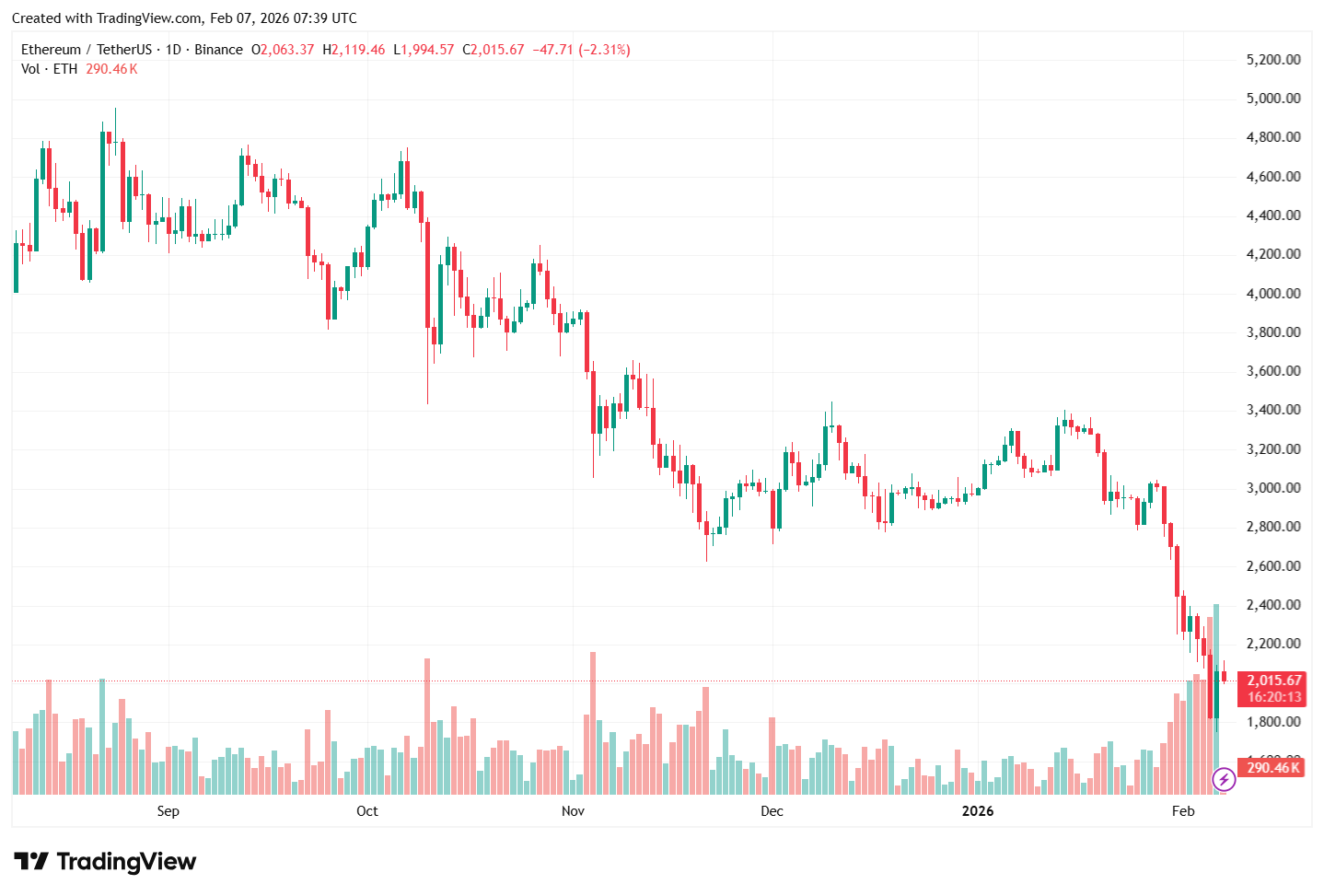
The price of ETH on the daily timeframe | Source: ETHUSDT chart on TradingView
Featured image from iStock, chart from TradingView
Editorial Process for bitcoinist is centered on delivering thoroughly researched, accurate, and unbiased content. We uphold strict sourcing standards, and each page undergoes diligent review by our team of top technology experts and seasoned editors. This process ensures the integrity, relevance, and value of our content for our readers.