
The Ethereum Foundation’s protocol track leads published a new “Protocol Priorities Update for 2026” on Feb. 18, outlining how core R&D will be organized this year and what the next upgrade cycle is expected to emphasize.
Ethereum’s Priorities In 2026
The update looks back at 2025 as a high-throughput year for mainnet changes, anchored by two network upgrades. Pectra shipped in May, Fusaka followed in December with PeerDAS on mainnet. Alongside those upgrades, the community increased the mainnet gas limit from 30 million to 60 million, calling it the first significant jump since 2021.
The main change is organizational. “Now that those milestones are behind us, we have the opportunity to think about how we organize our work at a slightly higher level,” the authors wrote. For 2026, Protocol work is grouped into three tracks: Scale, Improve UX, and Harden the L1, each with named leads.
The Scale track, led by Ansgar Dietrichs, Marius van der Wijden, and Raúl Kripalani, merges last year’s “Scale L1” and “Scale Blobs” initiatives into one effort. The foundation frames this as a pragmatic consolidation, because execution capacity, networking, and consensus changes tend to land in the same client code and influence each other.
On the roadmap, the update highlights continued gas limit increases “toward and beyond 100M,” supported by block-level access lists via EIP-7928 and ongoing client benchmarking. It also flags “the scaling components of Glamsterdam,” including enshrined PBS through EIP-7732, repricings, and further blob parameter increases.
Beyond that, the Scale track includes pushing a zkEVM attester client from prototype toward production readiness, and longer-run state scaling work that spans near-term repricing and history expiry through to binary trees and statelessness.
The Improve UX track, led by Barnabé Monnot and Matt Garnett, narrows in on two areas the foundation calls the most leverage for 2026 usability: native account abstraction and interoperability.
On account abstraction, the update positions EIP-7702 as a step toward an endpoint where smart contract wallets become the default without bundlers, relayers, or extra gas overhead. It points to proposals including EIP-7701 and EIP-8141, described as “Frame Transactions,” as work that moves smart account logic deeper into the protocol itself.
That UX roadmap is also tied to security direction. The foundation argues native account abstraction provides a cleaner migration path away from ECDSA-based authentication, and says parallel proposals aim to make quantum-resistant signature verification meaningfully cheaper inside the EVM.
Interoperability work builds on the Open Intents Framework with the stated goal of “seamless, trust-minimized cross-L2 interactions,” supported by faster L1 confirmations and shorter L2 settlement times.
The new Harden the L1 track, led by Fredrik Svantes, Parithosh Jayanthi, and Thomas Thiery, is framed as insurance policy work that preserves Ethereum’s core properties while scaling continues.
The update ties security efforts to Svantes’ Trillion Dollar Security Initiative, including post-quantum readiness and execution-layer safeguards like post-execution transaction assertions and “trustless RPCs.”
On censorship resistance, Thiery’s scope includes FOCIL via EIP-7805 and extensions that touch censorship resistance for blobs, statelessness work labeled VOPS, and the development of measurable censorship-resistance metrics. Jayanthi’s remit covers devnets, testnets, and client interoperability testing, which the foundation says becomes more critical if Ethereum moves into a faster fork cadence.
Looking ahead, the foundation targets Glamsterdam for the first half of 2026, with Hegotá planned later in the year. The stated ambition bundles parallel execution, significantly higher gas limits, enshrined PBS, continued blob scaling, and progress on censorship resistance, native account abstraction, and post-quantum security, with more track-level updates promised as the year unfolds.
At press time, Ethereum traded at $1,968.
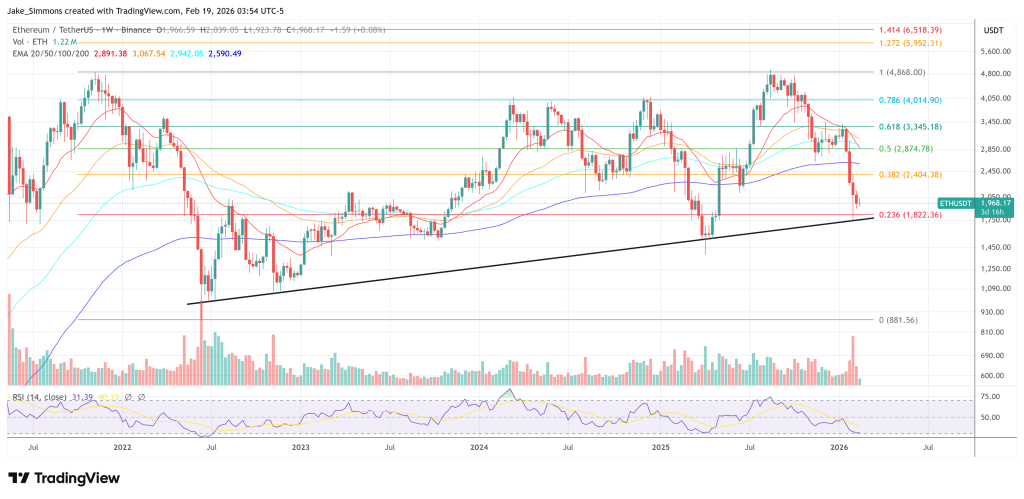
Featured image created with DALL.E, chart from TradingView.com
Editorial Process for bitcoinist is centered on delivering thoroughly researched, accurate, and unbiased content. We uphold strict sourcing standards, and each page undergoes diligent review by our team of top technology experts and seasoned editors. This process ensures the integrity, relevance, and value of our content for our readers.
Are Meme Coins Finished? Shiba Inu and Pepe Coin Struggle for Market Share Amid Shifting Investor Priorities Crypto Reporter
Source link ]]>

The Cardano Foundation has addressed the mounting concerns and criticism over its role within the blockchain network’s ecosystem.
Over the past weeks, the Foundation has faced increased criticism for alleged internal conflicts and claims of sidelining key contributors, including Cardano’s founder, Charles Hoskinson.
Concerns also emerged regarding its role in Catalyst Fund 13, where it participated as a Delegated Representative (DRep) with 180 million ADA tokens.
However, the Foundation clarified its stance by publishing an official blog post and a detailed FAQ on the Cardano forum on Dec. 16.
Cardano Foundation and Project Catalyst
The Foundation reaffirmed its active participation in Project Catalyst since 2021, emphasizing its commitment to advancing decentralization, governance, and sustainability across the network.
For Funds 12 and 13, the Foundation explained that its voting decisions focused on supporting projects that align with these priorities. It stated:
“With our vote, we wanted to double down on the topics of long-term sustainability, decentralization and governance for Cardano. These principles are exemplified by the projects we chose to support.”
Highlighting voter participation challenges, the Foundation pointed to the low engagement levels in Catalyst. Out of 35 billion ADA in circulation, only 4.8 billion ADA were registered to vote, with many participants not actively voting on all proposals. The Foundation’s 180 million ADA stake represents about 3.75% of registered voting power but only 0.5% of the total circulating supply.
The Foundation committed to improving transparency for future rounds, promising more precise criteria for its voting process and ADA allocations. It encouraged other large stakeholders to adopt similar practices to ensure balanced decision-making.
Additionally, the Foundation plans to publish a technical blog explaining its voting process using community tools.
Addressing the relationship with Hoskinson and Cardano Constitution
The Foundation also responded to concerns regarding its alignment with Input Output Global (IOG) and its stance on the Cardano Constitution.
While acknowledging IOG’s contributions under Hoskinson’s leadership, the Foundation emphasized its unwavering support for the Constitution and broader ecosystem goals. It wrote:
“[IOG and Hoskinson’s] work and vision for Cardano is the very reason many of us are in this space. We are sometimes frustrated by their actions and choices. But given the complexity of making Cardano a long-term success, it is to be expected that we will disagree on how this could be accomplished.”
This response comes as Hoskinson recently questioned the Foundation’s alignment with Cardano’s vision. The blockchain network founder had also raised concerns about the Foundation’s activities, including approval of the network’s budget.
However, the Foundation clarified that any budget endorsement would be contingent on its alignment with Cardano’s long-term objectives and specific content.
Mentioned in this article
Key Cardano Priorities for March 2024 Co-Signed by ADA Creator TradingView
Source link ]]>
Key Cardano Priorities for March 2024 Co-Signed by ADA Creator U.Today
Source link ]]>
New Article: Our North Star & Priorities for 2022 – CEO of the Cardano Foundation @F_Gregaard
https://t.co/3WNGKQHSRU— Cardano Community (@Cardano) January 21, 2022

(SocialLY brings you all the latest breaking news, viral trends and information from social media world, including Twitter, Instagram and Youtube. The above post is embeded directly from the user’s social media account and LatestLY Staff may not have modified or edited the content body. The views and facts appearing in the social media post do not reflect the opinions of LatestLY, also LatestLY does not assume any responsibility or liability for the same.)