
- Balancer Labs shuts down after legal and economic pressure.
- BAL token model shifts to zero emissions and buybacks.
- BAL price outlook hinges on execution of the overhaul.
Balancer Labs is set to take a sharp turn after its founder, Fernando Martinelli, proposed a radical overhaul, stating that maintaining a corporate entity tied to past incidents had become a liability.
The decision to shut down Balancer Labs follows months of pressure after a major exploit in November 2025 that drained over $100 million from the protocol and exposed both technical and structural weaknesses.
While the protocol continues to operate, the changes signal a clear break from the past.
At the centre of this shift is the BAL token, whose outlook now depends on whether the proposed overhaul can restore confidence in the once leading DeFi platform.
A full reset of Balancer’s economic model
The proposed changes leave very little of the old system intact as all BAL emissions are set to be halted completely.
The veBAL governance system is also being scrapped.
Incentive programs that once drove liquidity are being shut down across the board, including partner fee splits and vote market mechanisms, which were once considered core pillars of growth but are now viewed as sources of inefficiency and value leakage.
Under the proposal, all protocol fees will be redirected to the DAO treasury, marking a major shift from the previous structure, where only a small portion was captured.
Liquidity providers are also being prioritised differently.
Swap fees in V3 will be reduced to make the platform more competitive to attract organic liquidity rather than relying on token rewards.
At the same time, a large buyback and burn plan is being introduced.
Up to 35% of the BAL token supply could be removed over time. This is paired with compensation for former veBAL participants.
The goal is to reset both supply dynamics and user confidence.
Why Balancer is making this move now
The timing of this overhaul is not random.
The numbers behind the protocol tell a clear story. Despite generating over a million dollars in annual fees, very little value was being retained.
At the same time, emissions were creating constant sales pressure. This imbalance made long-term growth nearly impossible.
Another issue was governance concentration.
Large players, including Aura Finance, had significant influence over decisions. This created misaligned incentives within the ecosystem.
The exploit in November 2025 only made things worse as it introduced ongoing legal risks tied to the existence of a corporate entity.
According to Fernando Martinelli, this made the structure unsustainable and shutting down Balancer Labs removes that liability and pushes the protocol closer to a fully decentralised model.
Meanwhile, operations are expected to continue under a new structure to ensure development and maintenance do not come to a halt.
Balancer (BAL) price forecast
At press time, the BAL token was currently trading near $0.15, just slightly above its recent lows.
This places it in a critical zone where sentiment can shift quickly. The first key level to watch is the recent support around $0.126.
A break below this level could signal further downside and loss of confidence.

On the upside, resistance sits near $0.1785, which has capped price movements in recent weeks.
A sustained move above this level would suggest improving sentiment as the market reacts to the overhaul. Beyond that, the $0.20 level becomes an important psychological barrier.
Traders should watch how the price behaves relative to the proposed buyback zone. If buybacks are executed effectively, they could provide a strong floor for price action.
However, the biggest factor remains execution.
The success of the overhaul will determine whether the Balancer (BAL) price stabilises or continues to struggle.

Ethereum co-founder Vitalik Buterin framed the network’s next scaling step as both audacious and tightly risk-controlled, saying “Fusaka will fix this” while underscoring that “safety first is of the utmost importance.” In a detailed post, Buterin described Fusaka’s core feature—PeerDAS—as “trying to do something pretty unprecedented: have a live blockchain that does not require any single node to download the full data.”
He added that PeerDAS relies on probabilistic sampling of data “chunks,” and, if more than half of those chunks are available, nodes can retrieve them and reconstruct the remainder via erasure coding. “This is all new technology, and the core devs are wise to be super cautious on testing,” Buterin wrote, noting that blob supply will ramp “conservatively at first,” then more aggressively if conditions permit.
Buterin Calls Fusaka the Key To Ethereum L2 Scaling
Buterin’s remarks arrive just as Ethereum’s new blob market shows signs of strain. Head of Data at Dragonfly Hildebert Moulié reported that the chain “hit 6 blobs/block for the first time,” attributing the recent surge primarily to rollups and projects including Base and Worldcoin. According to the same thread, Base submitted roughly 35% of blobs and used about 42% of blobspace, with Worldcoin contributing around 20% of submissions and 25% of usage; Arbitrum, OP Mainnet, Soneium, Scroll and others comprised most of the remainder.
The analyst added that L2s now account for about $200,000 per week in mainnet fees for submissions, validators require more than 70 GB of storage for blobs (over 1.2 TB if unpruned), and that many blobs are not fully utilized—particularly on smaller rollups posting more frequently than they can fill 128 KB payloads. The first sustained base-fee spike since the Pectra hard fork was also observed, although hildobby cautioned that “blob price discovery” still requires a more prolonged saturation of demand.
PeerDAS is the architectural response. Buterin explained that each node requests only a small number of chunks to verify that over half of the data is available; if so, the node “theoretically can download those chunks, and use erasure coding to recover the rest.”
In its initial incarnation, two non-custodial roles still require full-block data to exist somewhere on the network—initial broadcast and emergency reconstruction when a publisher reveals only a fraction of a block—though “we only need one honest actor” for those tasks, and future “cell-level messaging and distributed block building will allow even these two functions to be distributed.” The endgame, he suggested, is to unlock sustained L2 scaling and, as L1 block gas limits rise, to eventually route more L1 execution data into blobs as well.
This pivot lands amid a rapidly evolving blob marketplace. After Pectra, Ethereum increased the blob target and maximum per block, expanding daily data capacity and paving the way for higher throughput from rollups; research desks have linked that shift to a complex interaction between L1 base fees, blob fees, and L2 submission behavior.
The Fusaka timetable adds urgency. Core developers have signaled a mainnet activation for December 3, 2025, following staged testnet rollouts, placing Buterin’s “safety first” emphasis in clear relief. PeerDAS will debut under strict limits, with blob counts increased “conservatively at first,” a posture designed to avoid fee whiplash and to observe how diverse L2s actually consume the added capacity.
Outside the protocol notes, empirical work is accumulating around how networks might use blobspace more efficiently. A 2024 study on “blob sharing” argued that smaller rollups frequently under-fill blobs and could cut posting costs by more than 85% by cooperatively packing data into shared blobs, smoothing the base fee and lowering the total number of blobs submitted.
Ethereum researchers have since expanded that argument, modeling how sharing reduces blocks with more than the target number of blobs and thereby dampens the exponential blob-fee adjustments that kick in when usage overshoots targets. Those findings dovetail with Moulié’s observation that “many blobs aren’t full,” implying large savings are available through better coordination as the market matures.
The conceptual roots of PeerDAS stretch back through Ethereum research notes on data-availability sampling and Buterin’s own writings on “The Surge.” PeerDAS itself implements one-dimensional sampling with erasure coding and succinct per-cell proofs, enabling nodes to validate availability without naively downloading everything. That’s what makes the approach “pretty unprecedented” in a live, high-value blockchain: it seeks to reconcile decentralization and throughput by reducing per-node bandwidth and storage requirements while preserving strong guarantees that data actually exists.
Still, the shift is not without risks. Buterin’s insistence on a careful rollout reflects the reality that Ethereum’s blob economy is young, volatile, and sensitive to sudden changes in demand. As L2s jostle for capacity, fee dynamics can invert quickly, and incomplete blobs, spiky usage, and MEV side effects complicate forecasting. The promise of Fusaka is that PeerDAS can bend those dynamics toward sustainable growth by letting the network scale data availability without forcing any single node to shoulder the whole chain—and by doing so in a way that keeps security assumptions explicit and testable.
At press time, ETH traded at $4,028.
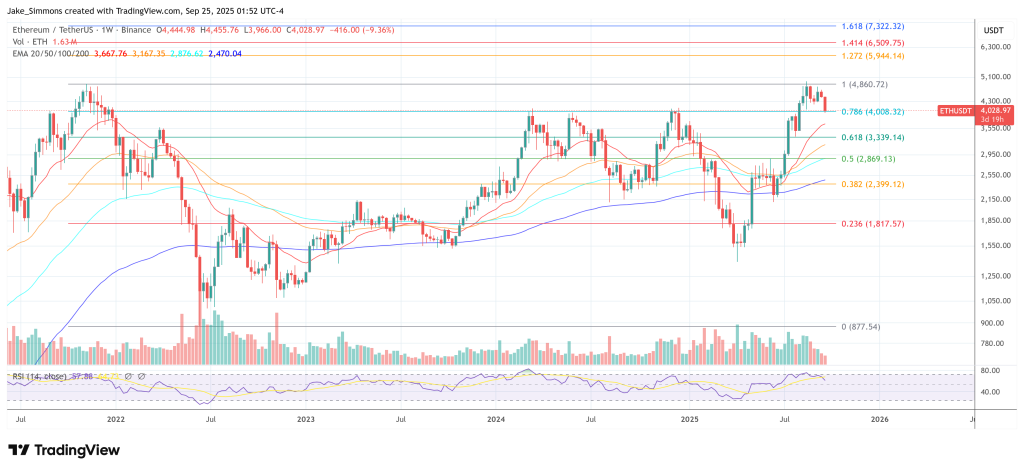
Featured image created with DALL.E, chart from TradingView.com
Editorial Process for bitcoinist is centered on delivering thoroughly researched, accurate, and unbiased content. We uphold strict sourcing standards, and each page undergoes diligent review by our team of top technology experts and seasoned editors. This process ensures the integrity, relevance, and value of our content for our readers.
Cardano (ADA) Whales on Radical Move as Network Activity Heats Up: Details U.Today
Source link ]]>
Cardano Whales Make Radical Move, Adding 150 Million ADA as Price Keeps Rising U.Today
Source link ]]>
Bitcoin
The bitcoin price has helped the broader crypto market—including ethereum, BNB, XRP, solana, cardano and dogecoin—to rally despite a serious warning some other cryptocurrencies could go the same way as the experimental stablecoin terraUSD and its support coin luna.
Now, a Senate committee has introduced a bill that would give the Commodity Futures Trading Commission (CFTC) “exclusive” oversight over a newly-created asset class called digital commodities that includes bitcoin and ethereum while excluding other cryptocurrencies deemed securities—a tighter definition than other proposed crypto bills.
Want to stay ahead of the market and understand the latest crypto news? Sign up now for the free CryptoCodex—A daily newsletter for traders, investors and the crypto-curious
The cryptocurrency market is headed toward a regulatory shake up in coming months as watchdogs … [+]
The Digital Commodities Consumer Protection Act of 2022, introduced by the Senate Agriculture Committee this week, would see the CFTC regulate spot markets for digital commodities, amending the Commodity Exchange Act without going as far as to define which cryptocurrencies are securities.
The Agriculture Committee is expected to hold a hearing on the bill as early as September, according to comments made by Democrat Senate Agriculture Committee chairwoman Debbie Stabenow of Michigan and reported by the Wall Street Journal.
“These rules hold digital commodity platforms to the same standards as traditional financial institutions,” the Senate committee said in a statement. “Without appropriate oversight, customers will continue to be vulnerable to fraud and manipulation, and market participants will lack the regulatory certainty necessary to innovate and grow.”
In recent months, the battle among U.S. federal agencies and congressional committees over who will regulate the red-hot crypto market has intensified. The U.S. Securities and Exchange Commission (SEC) and Federal Reserve have both lobbied for oversight of crypto, potentially increasing their budgets and clout.
The debate over whether some cryptocurrencies should be considered securities has been set alight by the SEC after it branded a handful of digital currencies securities as part of an insider trading case brought against a former product manager at the crypto exchange Coinbase.
Sign up now for CryptoCodex—A free, daily newsletter for the crypto-curious
The bitcoin price has swung wildly this year, playing havoc with the price of smaller … [+]
Meanwhile, the have been a flurry of bills introduced over recent months in an attempt to draw jurisdictional lines around cryptocurrencies. The huge crypto price crash this year—wiping $2 trillion from the combined value of top ten coins bitcoin, ethereum, BNB
This week, the newly-sworn in CFTC commissioner Caroline Pham pushed back against claims the regulator cannot police digital markets, telling Forbes, “it’s really important that people understand that the CFTC regulates not only the most complex products in the world.”
“The CFTC has brought more than 50 enforcement actions in the crypto space since about 2015, when we first came out with our action that said that bitcoin was a commodity,” Pham said.
Ethereum, the second-largest cryptocurrency after bitcoin, has seen its price surge higher in recent weeks as excitement builds ahead of a long-waited, radical upgrade.
The ethereum price is up almost 50% over the last month, topping $1,600 per ether, and leaving the bitcoin price and other top ten cryptocurrencies BNB
Now, ethereum cofounder and the project’s spiritual leader Vitalik Buterin has revealed his plans for ethereum following the “merge” upgrade—with the “surge” next in a series of improvements designed to make the network more secure and decentralized.
Want to stay ahead of the market and understand the latest crypto news? Sign up now for the free CryptoCodex—A daily newsletter for traders, investors and the crypto-curious
The ethereum price has rocketed over the last few weeks, helping the price of bitcoin, BNB, XRP, … [+]
“At the end of this road map, ethereum will be a much more scalable system,” Buterin said in comments reported by Fortune, speaking at the Ethereum Community Conference in France and outlining a plan that includes the surge, verge, purge and splurge upgrades. “By the end, ethereum will be able to process 100,000 transactions per second.”
The surge upgrade is expected to increase scalability for “shadow chain” rollups—a way to scale ethereum by making transactions cheaper—through sharding; dividing transactions across several different chains in a way that’s designed to decrease fees and speed up transactions.
The following verge upgrade will try to optimize ethereum storage and reduce node size, while the purge will involve removing some network history.
“The purge: trying to actually cut down the amount of space you have to have on your hard drive, trying to simplify the ethereum protocol over time and not requiring nodes to store history,” Buterin said in comments reported by Decrypt, adding the splurge upgrade will be “all of the other fun stuff.”
According to Buterin, ethereum development is currently just 40% complete, compared to bitcoin’s 80%. After ethereum’s merge upgrade, penciled in for September, Buterin thinks ethereum will still only be around 55% complete.
Ethereum’s looming merge upgrade will see the network move from proof-of-work, the validation model used by bitcoin, to proof-of-stake—expected to help the network run more efficiently and use less electricity. After the transition to proof-of-stake, ethereum holders will instead “stake” their coins to confirm transactions, rather than so-called miners securing the network in exchange for ether.
Sign up now for CryptoCodex—A free, daily newsletter for the crypto-curious
The ethereum price has rocketed by almost 10% over the last 24 hours, adding to major gains since … [+]
“Proof-of-stake is much more secure than proof-of-work, but it does have its tradeoffs,” said Buterin, pointing to weak subjectivity.
Last year, ethereum began to become deflationary, with more coins being “burnt” than are distributed to so-called miners who verify transactions on the blockchain.
Speaking at the conference, Buterin said ethereum will further change its monetary policy following the merge upgrade, with the annual issuance of its ether expected to be cut by as much as 90%.
“In all cases, [merge] decreases the amount of ether issued by a lot,” Buterin said. “It’s not a fixed amount of issuance anymore, but it is much lower than it used to be. So in this way, the monetary policy is changing.”
Tesla
The price of bitcoin, ethereum and other major cryptocurrencies are meanwhile struggling, with the bitcoin price failing to regain ground over $60,000 per bitcoin and ethereum’s ether dropping back from around its all-time highs.
Musk said via Twitter that web3—the idea that a decentralized version of the internet that some think could use crypto technology will eventually replace the Silicon Valley-centric web 2.0—”sounds like BS” and flagged dogecoin in a reply to a report that high ethereum transaction fees are locking investors out of decentralized finance (DeFi).
Sign up now for the free CryptoCodex—A daily newsletter for the crypto-curious. Helping you understand the world of bitcoin and crypto, every weekday
Elon Musk, the chief executive of electric car maker Tesla, has championed dogecoin over the likes … [+]
“Average venture returns for investments made in the 2020s are going to be much worse than those from the 2010s,” predicted Sam Altman, the chief executive of OpenAI and a legendary Silicon Valley investor. “There’s a flood of capital, and I have never heard so many price-setting VCs openly say they’re willing to accept much lower return targets.”
However, Altman added “web3 might still have 2010s-like returns … but most VCs will miss it.”
Musk responded, saying “web3 sounds like BS” and “I thought nothing could be nuttier than ‘99,” referring to the late-1990s dot com bubble that saw investors pour billions of dollars into internet-based companies that eventually collapsed.
Meanwhile, Musk continued his support of meme-based dogecoin, tweeting “dooooge” in response to a report from the crypto news outlet Coindesk that eye-wateringly high ethereum transaction fees are preventing smaller investors from being able to access DeFi exchanges.
DeFi, using crypto technology to recreate traditional financial services without the need for banks or financial institutions, has seen a surge of interest in over the last years as investors pile into the space.
This week, Twitter co-founder Jack Dorsey left the social network ostensibly to work on web3 development, as well as his payments company Square—now rebranded Block. Dorsey has previously called for the adoption of decentralized internet and spearheaded bitcoin and decentralized projects at Twitter.
CryptoCodex—A free, daily newsletter for the crypto-curious
Elon Musk’s dogecoin tweet sent the dogecoin price sharply higher but it has since dropped back. The … [+]
Coindesk reported that data showed the adoption of decentralized exchanges (DEXs), which facilitate peer-to-peer transactions without an intermediary, are restricted mainly to large traders or so-called whales due to high ethereum fees.
Musk has previously said he thinks dogecoin should speed up transactions and lower fees in order to “beat bitcoin hands down”—at one point proposing dogecoin work with ethereum to do this. Ethereum cofounder and spiritial leader Vitalik Buterin indicated he thought the idea could work.
Musk’s backing of dogecoin this year even after Tesla added billions of dollars worth of bitcoin to its balance sheet has divided the crypto community, many of whom see his mostly Twitter-based behaviour as irresponsible.
Musk’s dogecoin support, along with other high-profile investors like Mark Cuban, has helped the dogecoin price soar many thousands of percent over the last year, pushing it into the crypto top ten by value.
The dogecoin price has lost around 70% of its value since it hit a Musk-fueled all-time high in May this year but has managed to hold onto many of its gains—so far defying some of its critics.
Bitcoin’s first major upgrade in four years has activated, with developers now able to add new features to improve privacy, scalability and security on the bitcoin blockchain—even as some warn bitcoin is already obsolete.
The bitcoin price has rocketed over the last year, soaring to an all-time high of around $69,000 per bitcoin this week in the run-up to taproot’s activation, however, the price of ethereum, Binance’s BNB, solana and cardano, have all risen at a far greater clip during the last 12 months.
The long-awaited bitcoin upgrade, called Taproot, was deployed early Sunday morning and will unlock the potential for bitcoin smart contracts, helping bitcoin compete more directly with the likes of ethereum, Binance’s BNB, solana and cardano.
Sign up now for the free CryptoCodex—A daily newsletter for the crypto-curious. Helping you understand the world of bitcoin and crypto, every weekday
The bitcoin price has risen by around 300% over the last year, soaring alongside the price of … [+]
“The upgrade could be a macro turning point for evolvability and innovation, merging the best of post-SegWit conservatism with the energy of new beginnings,” Ninos Mansor, partner at crypto investor Arrington XRP Capital, wrote in a report out last month.
Bitcoin’s latest upgrade, which includes so-called Schnorr signatures that allow more complex bitcoin transactions to look like just any other transaction, is the first significant change to the protocol since the introduction of Segregated Witness (SegWit) in 2017. SegWit, designed to help bitcoin scale, was implemented at the height of the so-called block size wars that saw the bitcoin community riven in two, with one side breaking away to create a payments-focused fork of bitcoin, known as bitcoin cash.
“Four years in the making, Taproot is a non-contentious proposal, which leaves behind the scar tissue of the block wars and shows the market that bitcoin can evolve while still maintaining an ethos of extreme political stability,” Mansor wrote.
Since 2017, bitcoin has increasingly been seen as a store of value, more comparable to digital gold than a payments network. Mansor believes this could change as bitcoin’s network is better able to compete with ethereum, its smaller rivals and even commercial payment networks like Visa and Ripple’s XRP.
“While most of the market has focused on the rapid innovations in ethereum layer two, the climate for bitcoin layer two is evolving extremely quickly,” Mansor wrote, referring to projects built on top of existing blockchains that can speed up transactions and reduce costs by moving them off-chain, adding: “Bitcoin could theoretically become a Visa competitor, with new products that revitalize bitcoin’s capabilities as a medium of exchange.”
Ethereum and its major rivals Binance’s BNB, solana, and cardano have all seen their prices soar over the last year thanks to booming interest in smart contract, blockchain-based decentralized finance (DeFi) and non-fungible tokens (NFTs)—both largely built on top of ethereum’s network. Many expect Binance’s BNB, solana, and cardano to increasingly steal ethereum DeFi and NFT market share as the rival blockchains battle for dominance.
Many in the crypto community have previously predicted ethereum could eventually overtake bitcoin as the most valuable cryptocurrency, with DeFi—the idea that traditional financial services could be replaced by blockchain-based protocols—and NFTs—using crypto technology to tokenize all manner of digital media and assets—helping to drive ethereum adoption and, in turn, the price of its ether tokens.
CryptoCodex—A free, daily newsletter for the crypto-curious
The bitcoin price has rocketed over the last year, soaring to a market capitalization of over $1 … [+]
Bitcoin’s layer two Lightning Network, speeding up and lowering the cost of bitcoin transactions, is often cited as an example of how bitcoin could compete with the likes of ethereum, Binance’s BNB, solana, and cardano in the future.
“The price surge we’re seeing in bitcoin this week is about more than increased inflows—it’s the result of a combination of tailwinds that have been building for some time,” Noelle Acheson, head of market insights at digital currency prime broker Genesis, wrote in emailed comments.
“The Taproot upgrade, which enhances bitcoin’s smart contract functionality and transaction privacy, reduces its transaction fees and makes Lightning easier and cheaper to use, all of which will boost bitcoin adoption,” added Acheson. “What’s more, it serves as a reminder that bitcoin is a new technology and not just a store of value.”
“Bitcoin’s Taproot upgrade comes timely as development on the bitcoin blockchain has been accelerating quickly this year,” Paolo Ardoino, the chief technology officer at Bitfinex, wrote in emailed comments.
“Taproot will deliver more scalability, privacy and smart contract functionality on the bitcoin blockchain and greatly expands upon what has been possible so far. We can expect Taproot to unlock the power of Lightning Network to bring true scalability to the bitcoin blockchain, readying it for use in more complex operations.”
Elon Musk, the dogecoin-boosting Telsa billionaire, has once again weighed in on the meme-based cryptocurrency, suggesting dogecoin fees need to fall before it can become a viable payment option.
The price of dogecoin has bounced over the last 24 hours, climbing alongside the bitcoin price as confidence returns to the cryptocurrency market. The bitcoin price rally, coming after a steep sell-off, fueled a broad crypto price surge.
Sign up now for the free CryptoCodex—A daily newsletter for the crypto-curious. Helping you understand the world of bitcoin and crypto, every weekday
Tesla CEO Elon Musk has adopted dogecoin as something of a pet project this year, even after adding … [+]
“Super important for doge fees to drop to make things like buying movie [tickets] viable,” Musk said via Twitter
Musk, who has repeatedly called for dogecoin updates and improvements this year, was responding to a tweet by dogecoin co-creator Billy Markus.
“Robinhood announcing wallets, AMC CEO not only talking about accepting dogecoin but saying it was the single most interacted with tweet he has ever made, the crypto market finally seeing some green,” Markus said, referencing an earlier tweet by the chief executive of U.S. cinema chain AMC, Adam Aron, and fee-free trading app Robinhood’s announcement it would soon launch a crypto wallet.
“It’s clear that you think AMC should accept dogecoin,” Aron said after AMC revealed in August it plans to begin accepting bitcoin, ether, bitcoin cash, and litecoin by the end of the year. “Now we need to figure out how to do that.”
Aron had previously run a Twitter poll that attracted 140,000 votes within 24 hours, closing with 68% voting for AMC to accept dogecoin. Another 9% said to go ahead with the cryptocurrency even if they wouldn’t use it, while 23% said AMC shouldn’t bother with dogecoin at all.
“Dogecoin poll was by far my highest ever read tweet,” added Aron. “In 24 hours, 4.2 million views, my most ever retweets, most ever replies.”
Musk “liked” the dogecoin poll on Twitter, prompting Aron to call Musk “the epitome of innovation above all others.”
CryptoCodex—A free, daily newsletter for the crypto-curious
The dogecoin price leaped following Elon Musk’s surprise dogecoin suggestion, climbing alongside the … [+]
Musk, who’s become one of dogecoin’s biggest backers following years of support, has repeatedly endorsed the meme-based bitcoin rival, drawing the ire of the bitcoin community. In July, speaking during a live discussion with Twitter’s Jack Dorsey, and major Tesla and bitcoin investor Cathie Wood, Musk elaborated on ideas he’d previously floated to use dogecoin and ethereum to “max transaction rates and lower transaction costs.”
Earlier this month, Musk called a dogecoin upgrade, designed to secure the dogecoin blockchain and reduce transaction fees, “important.”
Dogecoin, the tongue-in-cheek cryptocurrency that’s been adopted as a pet project by Tesla billionaire Elon Musk, has suddenly crashed—losing 10% of its value in the last 24 hours.
The dogecoin price is down almost 20% over the last week, dropping after YouTuber and dogecoin investor Matt Wallace announced he was buying a new Tiger King-branded cryptocurrency.
Sign up now for CryptoCodex—a free, daily newsletter for the crypto-curious that explains the world of bitcoin with brevity. Arriving in your inbox at 7am EDT every weekday
The dogecoin price has soared many thousands of percent this year as investors pile into the … [+]
“I feel like $tking (Tiger King coin) is going to go crazy when season two of Tiger King comes,” Wallace tweeted over the 4th of July weekend, adding he’s “buying it up fast.”
The Tiger King-branded tking token has soared over 1,000% this week even though Netflix hasn’t announced a second season of the hit show.
Tking, launched in May and traded on the decentralized Uniswap exchange, has been endorsed by an unverified Twitter account claiming to be the “official account for Joe Exotic,” the star of the Netflix documentary series. Tking, with negligible trading volume of $7 million, isn’t large enough to have a confirmed market capitalization on crypto price sites CoinMarketCap or CoinGecko.
Exotic is currently serving a 22-year prison sentence for animal abuse and attempting to hire someone to kill big cat rival Carole Baskin—who’s launched her own cryptocurrency in recent months.
Despite Wallace going on to reaffirm his support of the meme-based dogecoin, a sell-off has sent the dogecoin price more than 30% lower over the last month.
“I am still holding my dogecoin and bitcoin despite the recent drops,” Wallace posted to Twitter last night, following it up with: “Dogecoin actually is the future cryptocurrency of earth.”
CryptoCodex—A free, daily newsletter for the crypto-curious. Helping you understand the world of bitcoin and crypto, every day
The dogecoin price has lost over a third of its value during the last month.
Dogecoin, after seeing its price explode in January amid trading restrictions being placed on so-called meme stocks, broke into the cryptocurrency top ten by value thanks to support from Elon Musk and other high-profile investors and influencers.
However, the dogecoin price is largely dependent on Musk’s continued support and has lost ground in recent weeks as his interest in the token appears to wane.