El Salvador has added 15 BTC to its holdings in staunch defiance of an agreement with the International Monetary Fund (IMF). The country’s authorities have previously agreed with the IMF not to accumulate Bitcoins under an Extended Fund Facility (EFF).
El Salvador Load Up 19 BTC In New Purchasing Spree
President Nayib Bukele of El Salvador has confirmed an increase in the country’s Bitcoin (BTC) holdings, rising by 19 BTC in under a week. The latest purchase came as Bitcoin slipped under $80K at the tail end of February.
El Salvador’s decision to buy the dip saw its splurge around $1.5 million for 19 BTC, bringing its total holdings to 6,100. At current prices, El Salvador’s BTC holdings are valued at around the $500 million mark.
The country began accumulating BTC back in 2021 after elevating the cryptocurrency as a legal tender amid fierce opposition. The IMF has been El Salvador’s most vocal critique, pointing out potential pitfalls to its economy.
With the approval of a Crypto Strategic Reserve by US President Donald Trump, the US could begin its own Bitcoin accumulation spree.
Bitcoin’s Purchase Flouts IMF Requirements
El Salvador’s Bitcoin purchase defies the IMF’s directive for the country to reduce its BTC exposure. The directive came under an Extended Fund Facility (EEF) arrangement valued at $1.4 billion over 40 months.
Under the arrangement, El Salvador is expected to halt its Bitcoin purchases with the IMF stepping up monitoring for compliance. Furthermore, the arrangement will ban the creation of new publicly-owned entities from dabbling in Bitcoin activities.
“Over the course of the program, the authorities have committed not to accumulate Bitcoins,” read the IMF report. “And not to issue nor guarantee any type of Bitcoin-indexed or denominated public debt implying a liability for the government.”
El Salvador halted BTC purchases following negotiations with the IMF in February but appears to be making a reversal.

Aliyu Pokima
Disclaimer: The presented content may include the personal opinion of the author and is subject to market condition. Do your market research before investing in cryptocurrencies. The author or the publication does not hold any responsibility for your personal financial loss.
The Spot Bitcoin ETFs started trading on Thursday, January 11, 2024, marking a historic moment for the crypto arena. However, all’s not well with major Wall Street investment firms. Recently, Vanguard, Merrill Lynch, Edward Jones, and Northwestern Mutual have expressed strong criticism against Bitcoin ETFs. These firms noted that investing in these assets is banned for their clients.
Why are Wall Street firms against Bitcoin ETF adoption?
The above-mentioned firms are preventing retail investors from accessing the newly approved Spot BTC ETFs, as reported by FOX Business. These financial institutions have chosen not to provide their clients with exposure to the burgeoning crypto market.
The move contradicts the Securities and Exchange Commission’s (SEC) decision to approve 11 Spot Bitcoin ETFs. The SEC’s decision marked a pivotal moment for the crypto market, which is now nearing $2 trillion.
The inclusion of Bitcoin (BTC) in a regulated investment vehicle like a Spot ETF allows retail investors to access crypto asset investments through broker-dealers. This eliminates the need for reliance on unregulated crypto exchanges. Additionally, it eradicates the requirement for investors to qualify as accredited investors, a criterion for the Bitcoin futures ETF launched in 2021.
The restriction on this new cryptocurrency investment avenue has led some clients to reconsider financial institutions that embrace the opportunity. In a recent post on X, Yuga Cohler, Senior Engineering Manager at Coinbase, revealed plans to transfer his $401,000 savings from Vanguard to Fidelity. According to the FOX report, he rebuked the investment firm’s approach. He said, “Vanguard’s paternalistic blocking of Bitcoin ETFs does not fit in with my investment philosophy.”
Bitcoin ETF issuer BlackRock‘s competitor, Vanguard, defended its stance, stating that the new ETFs don’t align with the institution’s investment ideology. Moreover, the firm emphasized its commitment to aiding investors in generating positive real returns in the long run. Hence, they noted that the crypto space’s speculative and unregulated nature would obstruct them from achieving their goals.
On the other hand, the internal communication records of Merrill Lynch and its clients highlight its current policy prohibits investment in Spot BTC ETFs. However, there is a possibility of a policy change in the future. According to FOX Journalist Eleanor Terrett’s post on X, Merrill Lynch is going to monitor how the ETFs perform to make a final decision.
Also Read: Grayscale Dominates As Spot Bitcoin ETFs Debut With Over $4 Billion Trading
Will Spot BTC ETFs be banned?
Edward Jones and Northwestern Mutual have mirrored Vanguard’s approach. These firms have informed clients of their decision to join the Bitcoin ETF ban. This indicates that Bitcoin ETFs would be banned at an institutional level, especially among the major Wall Street investment firms.
However, eradicating these ETFs from the U.S. would never be possible, considering the SEC’s decision. If it considered a nationwide Bitcoin ETF ban, the regulatory body would never have approved the proposals. The first Bitcoin ETF was proposed in 2013, marking a decade-long effort to achieve the milestone. Hence, if the SEC has decided to approve the proposals now, it is most likely to stick to its decision.
Moreover, CoinRoutes CEO Dave Weisberger expressed his views on the Wall Street firms’ decision to ban Bitcoin ETF investments. He stated that it’s common for firms to conduct due diligence on individual ETFs before offering them to clients. However, he also noted, “Vanguard’s attitude shows it may have more to do with the asset itself, rather than the performance of the ETF.”
Also Read: Spot Bitcoin ETF: Vanguard Backtracks, Vows Not to Join the Train


The presented content may include the personal opinion of the author and is subject to market condition. Do your market research before investing in cryptocurrencies. The author or the publication does not hold any responsibility for your personal financial loss.
The House Financial Services Committee has greenlit a bill to halt any advances toward creating a U.S. Central Bank Digital Currency (CBDC). The controversial move ignited debates on Capitol Hill, particularly over concerns about stifling innovation and U.S. competitiveness in the global financial landscape.
Hitting the Brakes on CBDC
Headed by Rep. Patrick McHenry (R-N.C.), the committee pushed the bill to ensure that Congress explicitly approves any CBDC development. Moreover, the legislation seeks to protect citizen privacy by outlawing any Federal Reserve initiatives that could be used for surveillance. In addition, U.S. Congressman Tom Emmer, who introduced the bill stated;
“This is an issue of privacy, individual sovereignty, and free market competitiveness,”
In contrast, Rep. Maxine Waters (D-Calif.), the panel’s top Democrat, criticized the move. She accused the Republicans of taking an anti-innovation stance that could ultimately leave the U.S. lagging behind other nations, especially China, in the race to set global standards for CBDCs.
“The legislation would keep the United States behind other countries and stifle research,” Waters emphasized.
Consequently, she warned of potential losses in speed, cost-effectiveness, and simplicity in future payment systems for U.S. citizens.
Besides raising concerns about innovation, the proposed legislation also highlighted its timing. The House’s move came even as the government faces a looming shutdown amid ongoing debates about other critical financial reforms. However, the Republicans insisted on taking proactive steps to restrict the development of a digital dollar.
Senate Showdown on the Horizon?
Significantly, this move may face hurdles in the Senate, where Democrats hold a majority. The Senate Banking Committee, led by Sen. Sherrod Brown (D-Ohio), doesn’t share the same enthusiasm as House Republicans concerning digital assets.
While the Federal Reserve still needs to create a CBDC, it has been engaged in foundational research. Vice Chairman for Supervision Michael Barr has clarified that any movement in this direction would require a directive from the White House and legislative approval from Congress.
Hence, the bill’s future remains uncertain since even if it clears the House floor, the Democrat-led Senate is less likely to offer a warm welcome. Additionally, the bill comes when most countries are either researching or have already started laying the groundwork for their CBDCs, further intensifying the global conversation around digital currencies.
With such divergent views on Capitol Hill, the debate over whether to develop a U.S. CBDC is still ongoing. As the bill moves forward for further consideration, its implications for U.S. financial innovation and global competitiveness remain to be seen.

The presented content may include the personal opinion of the author and is subject to market condition. Do your market research before investing in cryptocurrencies. The author or the publication does not hold any responsibility for your personal financial loss.
Multiple Resistances Restrict Shiba Inu Price Rally to $0.00008 … CoinGape
Source link ]]>
Dogecoin price analysis: Bullish flight at risk after bears restrict price … Cryptopolitan
Source link ]]>
Like many, I watched the excellent Michael Jordan documentary, The Last Dance, during one of approximately thirteen lockdowns in my native Ireland in 2020. There’s one episode in particular that I was reminded of this week, following the developments in Russia and the implications on the cryptocurrency market. It is the sixth episode, examining Jordan’s status as a role model.
“If I had a chance to do it all over again, I would never want to be considered a role model. It’s like a game that is stacked against me. There’s no way I can win”, Jordan lamented.
Jordan, of course, was a global superstar in the 90’s. Kids queued around the block to grab his latest pair of sneakers. His poster adorned teenage bedrooms around the globe. Millions young shoulders donned jerseys with the number 23 on the back.
However, Jordan faced criticism for not utilising his platform to do enough; for not embracing his responsibility as a role model. Not that he was a bad role model, by any stretch. Merely that he took the line of “I’m just an athlete, I just put the ball in a hoop”. Certainly, his lack of activism contrasts to several current sports stars, from basketball heir LeBron James to Formula 1 driver Lewis Hamilton.
In many ways, I felt for MJ. But then again, that’s the game he played – like it or loathe it, there are parts of every job that people don’t like.
Changpeng Zhao
What caused my mind to wander to Jordan’s gravity-defying skills was the issue of the economic sanctions being levelled against Russia, and how the how the cryptocurrency industry ties in to it. Binance CEO Changpeng Zhao gave an interview on Bloomberg TV which I felt took a leaf out of Michael Jordan’s book.
“It’s not our decision to make to freeze user accounts…I think we should separate the politicians to the normal people”, he said. “We are following the position supported by governments all around the world. Again, we do not make the sanction rules; there are organisations who make those rules – we follow them”.
But does CZ, Binance and cryptocurrency at large not have a responsibility to stand up and join the masses in levelling economic sanctions? Are they providing Russia a means to circumvent financial sanctions? Are Binance thereby indirectly inhibiting what are, at heart, measures designed to prevent a war and the deaths of countless innocent people?
Or is Binance merely an exchange? Is CZ merely a CEO of a finance company? Is Michael Jordan simply a basketball player?
Moral Dilemma
In truth, I’m not sure how I feel about this. To be clear, I love crypto with all my heart. I believe it will change the world for the better. It will disrupt what I believe is an archaic, inefficient and unfair financial system, helping to build a more democratic society and a more transparent, trustworthy and efficient monetary framework.
A lot of those advantages come down to the perks that decentralisation offer. The cutting out of middlemen, the pivoting of trust from institutions – who can be corrupt, stack rules in the elite’s favour, increase inefficiency and fees etc – to math, in the form of a transparent, verifiable ledger which the world has come to know as the blockchain.
But what if that decentralisation facilitates malevolent entities such as Russia to circumvent sanctions, granting them the ability to wage a war on an innocent country?
 Poking fun at myself a little here
It’s given me pause and, like I said, I love crypto. I’ve scoffed in the past at what I believe are silly arguments against crypto, such as “it’s for criminals” or “it helps drug dealers”. Sure, but it’s a drop in the ocean – you think the US dollar isn’t used for any crime? (A study from 2009 found that 90% of US dollars contain traces of cocaine).
But the Russian issue has given me pause for thought. Binance, which is centralised, does have the ability to freeze accounts. A KYC-compliant exchange, it has the ability to, say, freeze the account of a Russian oligarch shifting millions of dollars in crypto around. This ability to freeze – because it is centralised – is what crypto purists lament, sniggering at Binance for not being true to the philosophies of crypto.
Kraken
While Binance CEO Zhao played the Michael Jordan card, Kraken CEO Jesse Powell went a step further when refusing to acquiesce to Ukrainian Vice President Mykhailo Fedorov’s below request to freeze all Russian accounts.
“Bitcoin is the embodiment of libertarian values, which strongly favour individualism and human rights” Powell contested.
But what if those individuals are Russian billionaires in cahoots with Putin, funding a devastating war?
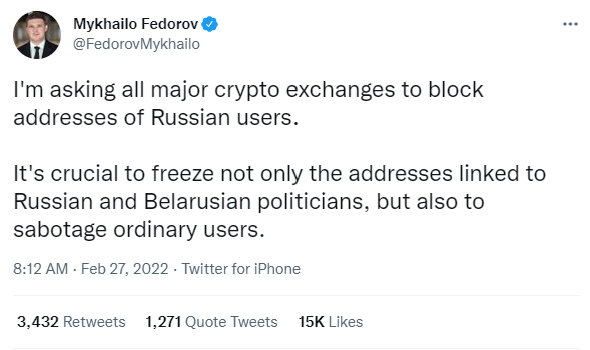
Ukrainian Vice President Mykhailo Fedorov’s appeal to crypto exchanges
So what is the solution?
It’s really difficult. Indeed, we are seeing similar examples all across Big Tech. Twitter banning Trump was possibly the most prominent case – to paraphrase Powell above, is that not one individual exercising his individualism? Spotify’s messy tussle with Joe Rogan is another moral grey area, while Facebook’s feeble efforts to combat false information. Obviously here, the stakes are bigger with the war in Ukraine, but the themes of liberty, censorship and restrictions are similar.
Like I said, I love crypto, and I truly believe in my heart that it can do so much good for this world that we live in. But should we be gung-ho in advocating for a fully decentralised world when malevolent actions of this scale could benefit from it?
Ultimately, I still think the benefits outweigh the downsides. I think it’s slightly exaggerated right now as to what Russia could actually do with cryptocurrency, as on a sovereign scale it simply is not feasible to transact meaningfully. Their frozen foreign assets of $630 billion (for which they could otherwise fight the economic sanctions and help support the ruble) would comprise over three quarters of the Bitcoin market cap. Not to mention the trackable transparency that blockchain offers. The advantages which crypto can offer worldwide are simply too large.
As for the specific cases of Binance and Kraken, I agree with Zhao and Kraken. Like Michael Jordan was just a basketball player, they just run fintech companies. Since when should they make decisions of this magnitude? That’s for governments to do, and both have indicated that they will obey the law, should the politicians decide to act (as happened with the freezing of assets in Canada of protestors recently).
There’s advantages and disadvantages to everything, especially when on the scale of what crypto is trying to do, i.e. disrupt the entire financial sector. The current financial sector certainly isn’t perfect – let’s not forget that. I’m not claiming crypto is either, but it’s only just beginning and it won’t be going anywhere anytime soon. Look how far it has come already in barely a decade.
So don’t twist it, crypto is still the good guy.
Natwest, the British banking giant has joined the growing list of financial institutions cutting their ties with the world’s largest cryptocurrency exchange Binance. The banking giant cited regulatory uncertainty around the crypto exchange in the UK as the key reason behind their decision. The bank said,
“Due to an increase in scams relating to cryptocurrency and regulatory uncertainty surrounding Binance in the UK we have taken steps to restrict payments to this merchant until further notice. We are also aware that Binance is currently not accepting some payments types. For more information about this please refer to Binance direct.”
Natwest had sent out SMS alerts to customers who have made any transaction on Binance over the past 12 months. The bank has also denied payment requests using credit cards for cryptocurrency purchases.
Natwest becomes the third bank to restrict Binance Services
Natwest Group has become the third banking giant in the UK to restrict payment services to Binance post FCA warning. Earlier, Barclays and Santander Bank had also initiated similar steps banning all payments to Binance.
The top cryptocurrency exchange has been in regulatory hot waters for quite some time now and it has only aggravated in the past month with eight countries issuing regulatory and compliance warning against Binance.
The UK FCA had notified that Binance is not in compliance to offer any form of services in the country. They also advised the crypto exchange to suspend all services in the UK.
Soon after the FCA warning, Binance suspended Sterling Pound deposits and withdrawals from the platform for nearly two days before restarting it again, suggesting they have sorted out the issue. However, the very next week its key strategic payment partner in Europe Coin Junction terminated all ties with the crypto exchange.
Binance has been warned by regulators from Japan, Thailand, Singapore, Cayman Islands, Italy, Hongkong, and the UK until now. It is also facing tough regulatory circumstances in the US. The crypto exchange that has been the top platform across numerous countries now fears clampdown from nearly half a dozen nations.
Disclaimer
The presented content may include the personal opinion of the author and is subject to market condition. Do your market research before investing in cryptocurrencies. The author or the publication does not hold any responsibility for your personal financial loss.
About Author


✓ Share: