
As the blockchain sector gradually goes worldwide, the Ethereum Network is turning up as the top contender for blockchain infrastructure across the sector. Currently, the ETH network is the settlement layer for many stablecoins and real-world applications in the crypto space.
Euro Stablecoin Plans Eye Ethereum
A new chapter in blockchain adoption may be unfolding, and the Ethereum network is at the center of this transition as countries across the globe adopt the blockchain. Amid the shift, Ethereum is increasingly being considered as the settlement layer for a potential euro-denominated stablecoin.
Crypto Tice, a market expert and investor, took to the social media platform X to share the development, which has triggered a frenzy in the ETH community. The action demonstrates the increasing interest of politicians and financial institutions in utilizing Ethereum’s well-established infrastructure for practical financial applications.
According to the expert, this move is not a pilot or a sandbox test, as blockchain solutions are being incorporated into Europe’s changing digital banking environment. Rather, it is Europe evaluating real infrastructure in the financial sector. By acting as the foundation for such a project, the network could be crucial in integrating traditional finance with decentralized technology.
Furthermore, the expert has offered insights into why this move matters for the network and the blockchain sector. The first reason is that public blockchains are being increasingly assessed for sovereign-grade settlement infrastructure.
Based on the risks associated with finance, this move would offer transparency, uptime, and security, which are now policy considerations. ETH being considered as a settlement layer for a Euro stablecoin implies that crypt rails are moving from markets, especially from the institutional level, to the governmental stage.
Crypto Tice has debunked every speculation of hype around the move, claiming that this is about who settles money in the future. “Public blockchains just entered the sovereign conversation,” the expert added.
Stablecoin Market To Get A Boost?
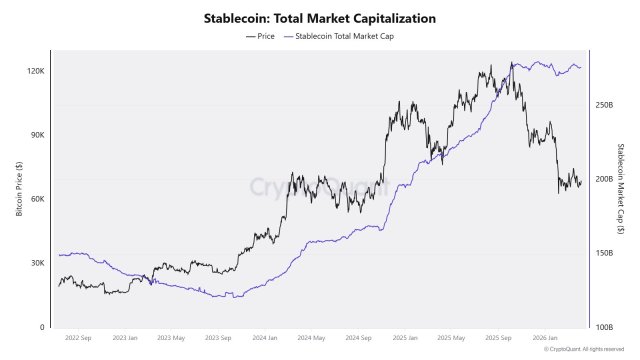
In the meantime, the stablecoin market has slowed down. CW, a crypto investor and data analyst at CryptoQuant, highlighted that the stablecoin market cap has recently stalled at a certain level since October last year. Once this move is confirmed, the news is likely to bolster interest and demand for stablecoins, causing a wave of fresh capital into the market.
However, the growth of the stablecoin market cap is largely linked to the impending CLARITY Act, as the bill will trigger an explosive inflow of funds. In that scenario, the increase in the market cap will lead to a rally in the broader cryptocurrency market.
On crypto exchanges, stablecoin reserves are growing, with Binance experiencing a jump from $45.5 billion following a $2.5 billion March inflow. This jump comes after 3 months of persistent outflows. Darkfost stated that this turnaround is somewhat surprising considering the macroeconomic context.
Despite the escalating geopolitical tensions and unfavorable conditions in March, liquidity flows have started to return to the crypto market. April is already moving in alignment with the pattern, recording more than $1 billion in net stablecoin inflows since the month began.
Featured image from Freepik, chart from Tradingview.com
Editorial Process for bitcoinist is centered on delivering thoroughly researched, accurate, and unbiased content. We uphold strict sourcing standards, and each page undergoes diligent review by our team of top technology experts and seasoned editors. This process ensures the integrity, relevance, and value of our content for our readers.
The Cardano Foundation is becoming less dependent on ADA. Its latest report shows Bitcoin and cash now account for a much larger share of reserves after a year of sharp price divergence.
That shift changes how closely the Foundation’s balance sheet tracks the performance of Cardano’s native token.
In its 2025 Activity and Financial Insights Report shared with CryptoSlate, the Foundation said its total assets stood at 287.5 million Swiss francs, or about $361 million. This represents a 45% decline from the $659.1 million assets it held as of the end of 2024.
The drop in headline value reflected a difficult year for Cardano’s native token, ADA, but the more notable shift came in the composition of the Foundation’s holdings.
Why this matters: The Foundation has historically been one of the largest long-term holders of ADA, so changes to its treasury structure affect the degree of internal alignment between Cardano’s ecosystem and its core institution. A lower ADA concentration reduces direct exposure to the token’s price but also weakens the feedback loop linking the Foundation’s balance sheet to ADA’s performance.
A year earlier, the Foundation said 76.7% of its assets were held in ADA, 14.9% in Bitcoin, and 8.3% in cash, cash equivalents, and financial assets.
However, by the end of 2025, ADA’s share had fallen to about 51.6%, while BTC rose to 25.5%, and cash, cash equivalents, and financial assets climbed to 22.9%.
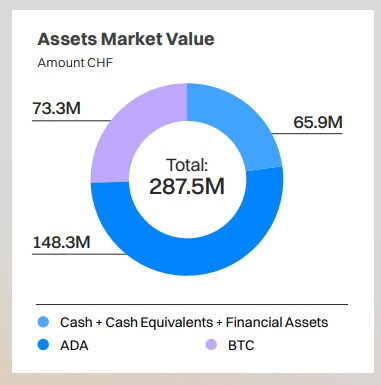
On that basis, the Foundation’s holdings worked out to roughly $186 million in ADA, $92 million in Bitcoin, and $83 million in cash and financial assets.
This essentially means that the Cardano-focused organization’s asset was no longer as concentrated in ADA as it had been a year earlier. Now, nearly half of the balance sheet was tied to Bitcoin, cash, and other financial assets.
How Bitcoin gained a foothold in Cardano’s Foundation assets
Bitcoin’s greater role in the portfolio did not stem from an increase in the Foundation’s BTC holdings.
In fact, the report showed that the Foundation significantly reduced its BTC holdings last year, down 37% to 656 BTC from 1,054 BTC a year earlier.
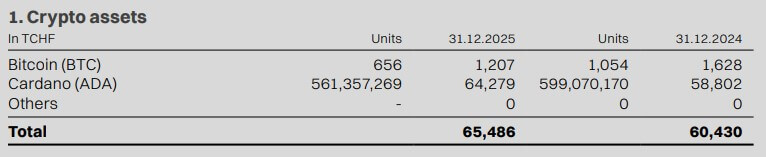
That means BTC’s increased share of the treasury was driven by relative performance and a broader reshaping of reserves, rather than by an outright accumulation of more BTC.
Market moves help explain the change. Data from CryptoSlate showed that ADA has fallen by roughly 63% over the past year, while Bitcoin has shown more resilience, declining by around 25%.
That divergence meant BTC did not need to rise in absolute terms to claim a larger place in the Foundation’s holdings. Instead, the top crypto’s greater resilience during the bear market helped it gain a stronger footing.
Meanwhile, the report also suggests the treasury was becoming more layered, with the Foundation finding more use cases for BTC and also expanding its cash holdings.
The Foundation said part of its Bitcoin allocation was invested in loans and collective investment schemes during 2025.
At the same time, its financial assets, including loans to third parties, investments, and shares, rose to 43.9 million Swiss francs (around $54.9 million) from 14.3 million Swiss francs (equivalent to $17.8 million) a year earlier.
Additionally, the organization’s cash and cash equivalents stood at 20.1 million Swiss francs, or $25.1 million.
Taken together, those figures show a reserve base moving beyond a straightforward ADA-and-bitcoin treasury into something more diversified and more actively managed.
Spending priorities shift
The change in portfolio mix was matched by a clearer reset in how the Foundation spent money in 2025.
The report said 23.6 million Swiss francs (equivalent to $29.5 million) was allocated across three strategic pillars, including technology, adoption, and governance.
Technology accounted for the largest share at 40.3%, or 9.5 million francs. Adoption followed at 39.6%, or 9.3 million francs, while governance spending represented 20.1%, or 4.8 million francs.
That marked a change from 2024, when the foundation grouped its work under adoption, operational resilience, and education. The new structure gives a sharper picture of where resources are now being directed and how the Foundation sees Cardano’s next phase.
Technology spending centered on protocol enablement, developer tooling, node diversity, interoperability frameworks, oracle infrastructure, and operational resilience.
The Foundation said it also increased its focus on community initiatives to improve liquidity and adoption in decentralized finance. At the same time, it expanded its Web3 adoption team with an emphasis on integrations, listings, and real-world asset efforts.
A significant part of the technology and adoption story was tied to digital identity. In 2025, the foundation launched Veridian, a privacy-preserving identity platform designed to let organizations issue and verify digital credentials anchored on Cardano.
Meanwhile, adoption spending covered enterprise solutions, identity and traceability systems, regulatory collaboration, education, and ecosystem partnerships.
The report said the foundation made Originate available as an open-source traceability solution, advanced the Reeve platform through internal use and its first enterprise proof of concept, and pushed Veridian into wider deployment, including a white-label rollout for the United Nations Development Program and the launch of the Veridian Wallet.
The Cardano Academy also expanded through new courses, distribution partnerships, and multilingual deployment. The Foundation said course material was extended to Binance Academy, which it said reaches more than 44 million learners, while collaborations also included the Blockchain Research Institute and Coursera.
Lastly, governance took a smaller share of the budget than technology and adoption, but it remained central to the Foundation’s 2025 agenda as Cardano deepened its commitment to decentralized decision-making.
The report highlighted support for the largest on-chain budget submitted so far on Cardano, resulting in 38 separate treasury withdrawal governance actions. It also pointed to the Foundation’s enterprise membership in Intersect and its work across committees tied to civics, budget, technical matters, product, open-source enablement, marketing, and oversight.
That participation fed into a series of initiatives, including work on the constitutional process, the Cardano 2030 vision and strategy, the Cardano Summit 2025 proposal, and the Cardano 2026 budget process.
The Foundation also said it supported tools aimed at widening participation in governance, including the open-source Cardano Voting Tool, a Proposal Examiner built with Griffin AI, updated governance documentation, and dedicated sessions at Cardano Summit 2025.
The foundation’s DRep Delegation Program distributed 140 million ADA to seven builder DReps, with a further 220 million ADA allocation to adoption and operational DReps announced. It also published the Constitutional Committee’s cold keys and expanded internal frameworks for delegation and elections as the governance transition continued.
2026 will test whether the reset works
The next question is whether the Foundation’s repositioning can translate into a stronger operating story for Cardano itself.
Frederik Gregaard, the Foundation’s chief executive, said the organization’s focus in 2026 would remain on technology, governance, and enterprise and institutional adoption.
He said the group would continue working to strengthen Cardano’s role in real-world asset infrastructure, support the expansion of stablecoin markets and DeFi liquidity, and build the open-source tooling needed for broader adoption.
Notably, this aligns with the blockchain network’s recent efforts to integrate the Pyth network, LayerZero, and Circle’s USDCx stablecoin. All of these efforts are geared towards expanding Cardano’s DeFi ecosystem and stablecoin supply to attract institutional support.
That leaves Cardano facing a clearer test in 2026 to determine if a more diversified balance sheet, combined with heavier spending on infrastructure, governance, and adoption, can help stabilize the economics around ADA itself.
Cysic founder challenges Charles Hoskinson over Google Cloud role in Midnight CoinDesk
Source link ]]>
Billionaire Ray Dalio reaffirmed his cautious stance on Bitcoin while confirming that he still holds about 1% of his portfolio in the asset. He said the position has remained unchanged for many years and continues to represent a small, steady portion of his broader strategy. Ray Dalio Reveals Bitcoin Accounts For 1% Of His Portfolio
The post Billionaire Ray Dalio Reveals Bitcoin Allocation, Says BTC Not Ready For Reserve Role appeared first on CoinGape.
]]>Are Cryptocurrencies ISO 20022 Compliant? The Truth About XRP, HBAR, XLM, ADA, ALGO — And Chainlink’s Role CCN.com
Source link ]]>
Dogecoin’s Role in U.S. Triestina Calcio’s Sponsorship: What You Need to Know OneSafe
Source link ]]>
Based Eggman ($GGs) and Dogecoin Market Trends Highlight the Role of Presale Crypto in Top Altcoins List Cryptopolitan
Source link ]]>
They say journalists never truly clock out. But for Christian, that’s not just a metaphor, it’s a lifestyle. By day, he navigates the ever-shifting tides of the cryptocurrency market, wielding words like a seasoned editor and crafting articles that decipher the jargon for the masses. When the PC goes on hibernate mode, however, his pursuits take a more mechanical (and sometimes philosophical) turn.
Christian’s journey with the written word began long before the age of Bitcoin. In the hallowed halls of academia, he honed his craft as a feature writer for his college paper. This early love for storytelling paved the way for a successful stint as an editor at a data engineering firm, where his first-month essay win funded a months-long supply of doggie and kitty treats – a testament to his dedication to his furry companions (more on that later).
Christian then roamed the world of journalism, working at newspapers in Canada and even South Korea. He finally settled down at a local news giant in his hometown in the Philippines for a decade, becoming a total news junkie. But then, something new caught his eye: cryptocurrency. It was like a treasure hunt mixed with storytelling – right up his alley!
So, he landed a killer gig at NewsBTC, where he’s one of the go-to guys for all things crypto. He breaks down this confusing stuff into bite-sized pieces, making it easy for anyone to understand (he salutes his management team for teaching him this skill).
Think Christian’s all work and no play? Not a chance! When he’s not at his computer, you’ll find him indulging his passion for motorbikes. A true gearhead, Christian loves tinkering with his bike and savoring the joy of the open road on his 320-cc Yamaha R3. Once a speed demon who hit 120mph (a feat he vowed never to repeat), he now prefers leisurely rides along the coast, enjoying the wind in his thinning hair.
Speaking of chill, Christian’s got a crew of furry friends waiting for him at home. Two cats and a dog. He swears cats are way smarter than dogs (sorry, Grizzly), but he adores them all anyway. Apparently, watching his pets just chillin’ helps him analyze and write meticulously formatted articles even better.
Here’s the thing about this guy: He works a lot, but he keeps himself fueled by enough coffee to make it through the day – and some seriously delicious (Filipino) food. He says a delectable meal is the secret ingredient to a killer article. And after a long day of crypto crusading, he unwinds with some rum (mixed with milk) while watching slapstick movies.
Looking ahead, Christian sees a bright future with NewsBTC. He says he sees himself privileged to be part of an awesome organization, sharing his expertise and passion with a community he values, and fellow editors – and bosses – he deeply respects.
So, the next time you tread into the world of cryptocurrency, remember the man behind the words – the crypto crusader, the grease monkey, and the feline philosopher, all rolled into one.
Shiba Inu Announces Groundbreaking Election for Interim Leadership Role CoinCentral
Source link ]]>
Cardano’s Role in Smart Contracts Blockchain Council
Source link ]]>