Crypto Market Review: XRP Invalidates $1.30 Safeguard, Is Bitcoin (BTC) Exposed to Selling Pressure? Shiba Inu (SHIB) Hides Bullish Divergence TradingView
Source link ]]>
Crypto Market Review: XRP Invalidates $1.30 Safeguard, Is Bitcoin (BTC) Exposed to Selling Pressure? Shiba Inu (SHIB) Hides Bullish Divergence Cryptonews.net
Source link ]]>
Did You Miss Out On Dogecoin? Safeguard Your Financial Future By Signing Up For The WallitIQ (WLTQ) Whitelist Brave New Coin Insights
Source link ]]>

- Threshold community proposes merging tBTC with WBTC.
- The proposal is driven by concerns over WBTC’s stability due to Justin Sun’s involvement.
- According to the proposal, BitGo will receive T tokens, becoming a major stakeholder in Threshold Network.
In a strategic move to protect the future of Wrapped Bitcoin (WBTC), a proposal dubbed “#saveWBTC – a merger with Threshold’s tBTC” has been put forward to merge the decentralized tBTC token of Threshold with BitGo’s WBTC.
The proposal, currently under discussion on Threshold’s forum page, comes in response to rising concerns within the crypto community regarding WBTC’s stability following BitGo’s partnership with Hong Kong-based BiT Global, a company partly owned by Justin Sun, founder of the Tron ecosystem.
Unease with Justin Sun’s involvement with WBTC
The partnership has raised alarms due to Sun’s controversial track record, with past incidents of misappropriating collateral. This unease has already led major DeFi protocols like MakerDAO to limit their exposure to WBTC, halt its use as collateral, and consider fully offboarding the asset.
Aave, another significant player in the DeFi space, is also closely monitoring the situation.
The Threshold, WBTC merger proposal
The merger proposal seeks to replace WBTC’s centralized custody and merchant-based mint and burn model with its decentralized and permissionless mint/redeem mechanism. This transition aims to ensure the safety and stability of the underlying collateral, reassuring users and protocols reliant on WBTC.
The plan involves granting Threshold’s DAO merchant privileges for WBTC while disabling tBTC minting, allowing existing tBTC holders to redeem WBTC at a 1:1 ratio.
As part of the proposal, BitGo would receive a grant of T tokens, making it the largest stakeholder in the Threshold Network.
The merger would be implemented in stages to ensure a seamless transition, with a fallback plan to offboard WBTC safely if the proposal is declined.
By combining WBTC’s established user base and liquidity with tBTC’s decentralized technology, Threshold aims to preserve WBTC’s role in the DeFi ecosystem, ensuring that the concerns over BiT Global’s involvement do not destabilize the broader market.
Solana started a fresh decline from the $155 resistance. SOL price is down over 10%, but the bulls are now protecting the $132 support.
- SOL price started a strong decline from the $155 resistance against the US Dollar.
- The price is now trading below $145 and the 100-hourly simple moving average.
- There was a break below a connecting bullish trend line with support at $150 on the hourly chart of the SOL/USD pair (data source from Kraken).
- The pair could correct losses unless the bulls struggle to protect the $132 support.
Solana Price Dives 10%
Solana price struggled to continue higher above the $155 resistance. SOL reacted to the downside and declined below the $150 support. There was a break below a connecting bullish trend line with support at $150 on the hourly chart of the SOL/USD pair.
The pair gained bearish momentum below the $145 support and declined more than outperformed Bitcoin and Ethereum in the past two sessions. There was a drop toward the $132 support zone. A low was formed at $132.17 and the price is now attempting a recovery wave.
There was a move above the $135 level. The price is now approaching the 23.6% Fib retracement level of the recent decline from the $154.74 swing high to the $132.17 low.
Solana is now trading well below the $145 level and the 100-hourly simple moving average. If there is another increase, the price might face resistance near the $138 level. The next major resistance is near the $143.50 level and the 50% Fib retracement level of the recent decline from the $154.74 swing high to the $132.17 low.
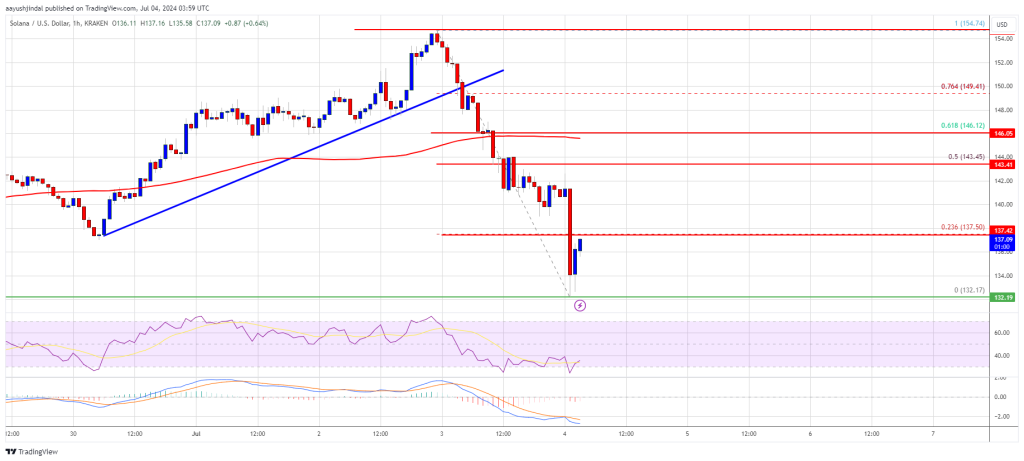
A successful close above the $143.50 resistance could set the pace for another steady increase. The next key resistance is near $150. Any more gains might send the price toward the $155 level.
More Losses in SOL?
If SOL fails to rise above the $143.50 resistance, it could start another decline. Initial support on the downside is near the $135 level.
The first major support is near the $132 level, below which the price could test $125. If there is a close below the $125 support, the price could decline toward the $112 support in the near term.
Technical Indicators
Hourly MACD – The MACD for SOL/USD is gaining pace in the bearish zone.
Hourly Hours RSI (Relative Strength Index) – The RSI for SOL/USD is below the 50 level.
Major Support Levels – $135, and $132.
Major Resistance Levels – $143.50 and $150.
]]>
- First Trust files for Bitcoin Buffer ETF with SEC, aiming to mitigate risk via options.
- Buffer ETFs gaining momentum, 139 trading on US markets, $32.54B AUM.
- Buffer ETFs don’t guarantee complete protection, or assess risks.
Financial services firm First Trust has recently submitted a filing with the US Securities and Exchange Commission (SEC) to launch a groundbreaking investment product – the First Trust Bitcoin Buffer ETF.
Unlike traditional spot Bitcoin ETFs, this innovative fund aims to provide investors with a unique risk mitigation strategy, utilizing options to safeguard against potential market downturns. Let’s delve into the details of this latest development in the cryptocurrency investment space.
First Trust’s Bitcoin Buffer ETF filing
First Trust’s move to file for the Bitcoin Buffer ETF signals a shift in the cryptocurrency investment landscape. This ETF is distinct from spot Bitcoin offerings, as it utilizes options to pursue a defined investment outcome. Acting as a buffer, it imposes a limit on potential losses during market drops.
First Trust’s ETF is structured to participate in the positive price returns of the Grayscale Bitcoin Trust or other Bitcoin-related exchange-traded products (ETPs), providing investors with a unique approach to risk management.
Rise of Buffer ETFs in the market
Buffer ETFs have been gaining traction globally, with 139 such funds currently trading on U.S. markets, amassing a total asset under management of $32.54 billion.
BlackRock, a major player in the ETF space, introduced its iShares buffer ETFs earlier this year. These funds offer investors a specified level of downside protection while capping potential upside gains. Analysts anticipate more entrants in this space with diverse strategies, contributing to the growing trend of innovative investment products aimed at addressing market uncertainties.
While the concept of buffer ETFs provides a novel approach to risk management, investors must understand that these funds do not guarantee complete protection.
First Trust’s filing emphasizes potential risks, including the risk of losing some or all invested capital. Investors should carefully evaluate the suitability of buffer ETFs for their portfolios, recognizing that these products may not be suitable for everyone, and success in providing downside protection is not guaranteed.