IONX Chain vs Cardano vs Polkadot: Which Layer-1 Offers Superior Scalability in 2026? openPR.com
Source link ]]>

The Ethereum (ETH) ecosystem is facing a mix of structural progress and market uncertainty. On one side, developers are pushing forward with a series of scalability upgrades aimed at lowering fees and expanding capacity across the network.
Related Reading: South Korea Explores Crypto Account Freezing Measure To Prevent Market Manipulation
On the other hand, large holders are using recent price strength to reduce exposure, introducing short-term selling pressure. Together, these opposing forces are building Ethereum’s near-term outlook as ETH trades above the $3,200 level.
The contrast is clear, while the protocol is absorbing more capital through staking and infrastructure improvements, parts of the market are testing how much supply and demand can absorb during a renewed rally.
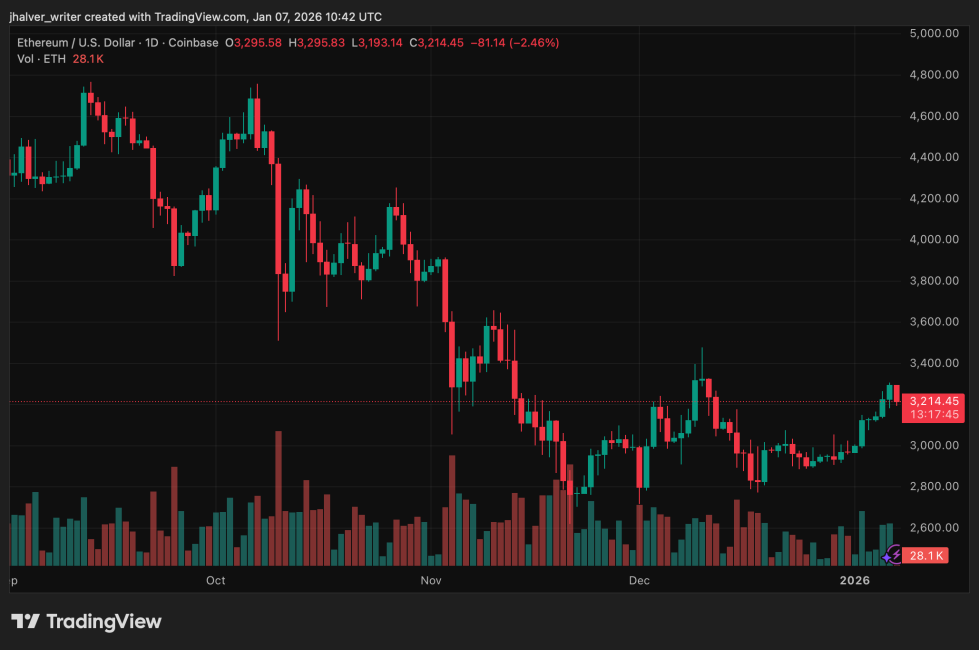
ETH's price moving sideways on the daily chart. Source: ETHUSD on Tradingview
Scalability Roadmap Moves Forward
Ethereum developers activated the second Blob Parameter-Only (BPO) hard fork this week, raising the blob limit from 15 to 21 and increasing the blob target from 10 to 14.
Blobs are temporary data containers used primarily by rollups to batch transactions more efficiently. With each blob holding 128 kilobytes, the network can now process roughly 2.6 megabytes of blob data per block.
The upgrade is part of a broader effort to scale Ethereum through layer-2 networks rather than pushing all activity onto the main chain. Since the first BPO fork in December, transaction fees on Ethereum have shown reduced volatility, reflecting lower congestion as rollups move data off-chain.
Developers are already discussing additional changes, including raising the gas limit from 60 million to 80 million, and later up to 200 million under the planned Glamsterdam hard fork in 2026. That upgrade is expected to introduce parallel transaction processing, further increasing throughput.
Ethereum’s (ETH) Staking Growth Tightens Liquid Supply
At the same time, staking activity is reshaping Ethereum’s supply dynamics. Institutional participation has increased, highlighted by BitMine’s latest deposits, which pushed its total staked ETH close to 780,000 tokens, worth over $2.5 billion.
Network-wide data indicates that more than 1.3 million ETH are waiting to enter staking, while the validator exit queue has dropped to zero. This imbalance suggests that fewer validators are choosing to exit, even amid market volatility.
As more ETH is locked into consensus contracts, circulating supply on exchanges continues to decline, potentially limiting downside pressure over the medium term.
Whale Selling Adds Near-Term Pressure
Despite these fundamentals, large holders have recently turned into net sellers. Whale wallets holding between 100,000 and 1 million ETH sold roughly 300,000 ETH over three days, valued at about $970 million.
This selling coincided with ETH’s breakout from a multi-week descending wedge, indicating that some whales are using the rally to take profits.
Related Reading: Scudo Announced: Tether’s Newest Crypto And Gold Unit – Here’s The Breakdown
While long-term holders remain largely inactive, helping to stabilize the broader structure, continued distribution by whales could slow upside momentum. Ethereum now sits at a crossroads, balancing protocol-level progress against market-driven supply pressure as traders assess whether demand can sustain the next leg higher.
Cover image from ChatGPT, ETHUSD chart from Tradingview
Editorial Process for bitcoinist is centered on delivering thoroughly researched, accurate, and unbiased content. We uphold strict sourcing standards, and each page undergoes diligent review by our team of top technology experts and seasoned editors. This process ensures the integrity, relevance, and value of our content for our readers.
Cardano Founder Stresses Scalability and Long-Term Trajectory Live Bitcoin News
Source link ]]>
Cardano Didn’t Fail On Scalability, Says Hoskinson Bitcoinist.com
Source link ]]>
Cardano Launches Hydra 1.0.0 with Major Boost in Speed and Scalability CoinCentral
Source link ]]>
Ethereum’s roadmap continues to unfold with a pivotal fork set for November, aimed at boosting scalability and streamlining efficiency across the network. With scalability long viewed as ETH’s biggest hurdle, this fork represents a critical step toward unlocking its full potential as the world’s leading smart contract platform.
Why This Fork Matters For Ethereum’s Long-Term Roadmap
Leading smart contract platform, Ethereum, is set for another important milestone this November. Sequence has highlighted on X that the Fusaka upgrade is a foundational hard fork infrastructure designed to strengthen the Ethereum Virtual Machine (EVM) while ensuring seamless compatibility for builders.
This upgrade is engineered to abstract the blockchain complexity and deliver smoother authentication and user flows across the blockchain ecosystem. The best part is that Sequence is already ahead of the curve by having the tools and infrastructure that prepare developers for Fusaka’s impact today.
While the Fusaka upgrade aims at strengthening the ETH ecosystem, Wendy J has noted that ETH has seen a notable price dip, as the SentientAGI GRID chat has flagged some activity behind the move. According to the AI platform, several 100,000 ETH transfers were recorded in the past 24 hours.
Interestingly, this kind of large-scale transfer suggests that major holders are likely either profit-taking after the run-up or repositioning their capital. Sentient Chat also listed other factors that could have contributed to the market-wide dump.
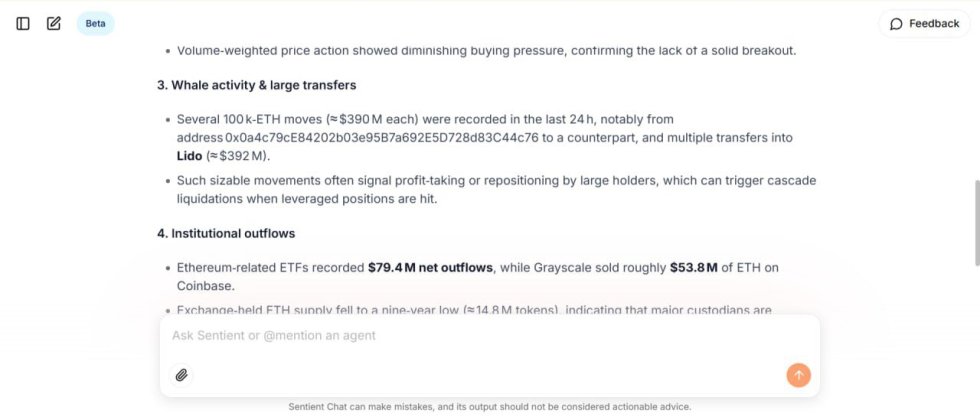
In the meantime, analyst Wendy advised the community to use Sentient Chat for any crypto-related questions. With Sentient Chat, you can instantly generate asset reports fueled by DeFi data, request trading insights tailored to current conditions, or even deploy autonomous agents to handle on-chain tasks in real time to enhance decision-making and yield optimization.
Why This Correction Looks Healthy, Not Critical
On the daily time frame, the recent correction in Ethereum has pushed the Relative Strength Index (RSI) into a critical oversold zone, a level we have not witnessed since the major accumulation phase back in July. BTCBlueWhale mentioned that there is nothing critical in this current correction. Meanwhile, back in July, ETH showed the same setup, and the price dipped into oversold territory, which retested the previous resistance level, and used that structure as a springboard for a massive rally.
Currently, the daily chart is printing a very similar scenario with trading in a comparable accumulation zone and showing a clear resistance-to-support (R/S) flip, which is a classic sign of structure holding the price strong. Layering on top of that, the setup aligns almost perfectly with the PO3 strategy.
Featured image from iStock, chart from Tradingview.com
Editorial Process for bitcoinist is centered on delivering thoroughly researched, accurate, and unbiased content. We uphold strict sourcing standards, and each page undergoes diligent review by our team of top technology experts and seasoned editors. This process ensures the integrity, relevance, and value of our content for our readers.
Solana News Today: Miners Turn to BlockDAG’s Scalability as Solana and Dogecoin Stumble AInvest
Source link ]]>
Solana News Today: Investors Bet on Scalability as BlockDAG, Solana, and Shiba Inu Challenge Ethereum’s Dominance AInvest
Source link ]]>
XRP News Today: Shiba Inu and Ripple Boost Network Scalability Amid Rising Demand AInvest
Source link ]]>
Shiba Inu Integrates Chainlink CCIP to Boost Deflation and Scalability AInvest
Source link ]]>