DOJ indicts Modesto OPC over illegal investment scheme Inquirer.net
Source link ]]>
Cardano and Ethereum Prices Slump, Investors Cash In On Thousands Per Day With RTX Referral Scheme Digital Journal
Source link ]]>
Scam Alert: The Shiba Inu (SHIB) Team Sounds the Alarm for This Fraudulent Scheme CryptoPotato
Source link ]]>
Musk Wins Dismissal of Dogecoin Pyramid Scheme Lawsuit CryptoCurrencyNews
Source link ]]>
Musk, Tesla win dismissal of Dogecoin ‘pyramid scheme’ suit InvestmentNews
Source link ]]>

- Plus Token wallets moved $63.1M ETH after three years of inactivity.
- Dormant funds, once held in Bidesk, were partially transferred to Huobi.
- The move could cause market panic; ETH is currently valued at $2,379.35.
In a dramatic development, cryptocurrency wallets linked to the notorious Plus Token Ponzi scheme have moved a staggering $63.1 million worth of Ethereum (ETH) after more than three years of dormancy.
The sudden shift of assets, which amounts to 25,757 ETH, has sparked concerns about potential market volatility.
Wallets were last active in 2021
According to on-chain data analyst EmberCN, the dormant wallets associated with the Plus Token Ponzi scheme were last active in April 2021.
On-chain data shows that the Plus Token Ponzi scheme orchestrators had moved 789,534 ETH, previously held in a “Plus Token Ponzi 2” wallet, to the Bidesk exchange through multiple addresses between June and September 2021. However, the Bidesk exchange went bankrupt at the end of 2021, and forcing the tokens to be transferred to Huobi.
Most of the 789,534 ETH tokens were sold in 2021, leaving a small part unsold. Part of the remaining tokens is what has been moved over the past two days. In total about 12 addresses have received 25,757 Plus Token-related ETH worth about $63.1 million over the past two days.
Part of these ETH were not transferred to Bidesk in 2021; part were withdrawn from Bidesk but not transferred to Huobi.
This significant movement of funds follows the scheme’s collapse and subsequent crackdown by Chinese authorities, who seized a vast array of crypto assets.
Plus Token Ponzi scheme crackdown
During the crackdown, Chinese officials confiscated approximately $4.2 billion worth of assets, including 194,775 Bitcoin (BTC), 833,083 ETH, 497 million Ripple (XRP), and 6 billion Dogecoin (DOGE), among others.
The value of these assets has surged to approximately $13.5 billion, reflecting current market prices.
The reactivation of the Plus Token Ponzi scheme-linked wallets and the potential for a future sell-off could trigger significant panic within the cryptocurrency market.
As of the latest updates, ETH’s price stands at around $2,379.35, with minimal fluctuation observed so far.
However, market observers are closely watching the situation to gauge the potential impact on Ethereum and broader crypto assets.
In a fiery critique, renowned economist Peter Schiff slammed MicroStrategy founder Michael Saylor for what he labels as the “Bitcoin pyramid scheme.” This sparring occurred in the wake of Saylor’s speech at the Nashville Bitcoin Conference 2024. During the speech, Saylor suggested that the United States should back its dollar with Bitcoin, likening the digital asset to “cyber Manhattan.”
Michael Saylor Urges US Government To Hoard More BTC
Saylor’s analogy drew historical parallels, referencing landmark acquisitions such as the Louisiana purchase and the acquisition of Alaska. He argued that these acquisitions strengthened the dollar by boosting the nation’s economic foundations. Hence, he emphasized that embracing Bitcoin could position the U.S. for future economic leadership.
“And the future of the country is in cyberspace,” Saylor proclaimed. The MicroStrategy founder added, “Bitcoin is, in essence, cyber Manhattan. The way you back the dollar is you buy Manhattan for pieces of paper and trinkets and you buy it before it’s worth hundreds of trillions of dollars.”
Saylor’s argument extended to the strategic assets already held by the U.S. government. He noted that the U.S. owns the majority of the world’s gold and controls a substantial portion of the nation’s land. The MicroStrategy founder urges a similar approach for BTC.
“The United States owns the majority of the gold in the world. The U.S. federal government owns 28% of the land in the United States,” he said. Thus, Saylor concluded his speech with a bold declaration: “The U.S. government should own the majority of the Bitcoin in the world.”
Also Read: Senator Cynthia Lummis Confirms Big Announcement In Bitcoin Conference
Peter Schiff Blames Saylor For “Bitcoin Pyramid Scheme”
Saylor’s vision of the U.S. government amassing a significant BTC reserve was met with sharp criticism from Peter Schiff. “Ironically, Michael Saylor is looking for a government #Bitcoin bailout,” Schiff wrote on X. The economist added, “He knows the Bitcoin blockchain letter is running out of chain and wants the U.S. government to become the buyer of last resort, leaving American taxpayers as the ultimate bag holders in the Bitcoin pyramid scheme.”
The debate quickly escalated when Peter Schiff was challenged to define a pyramid scheme. He responded, “A form of investment (illegal in the US and elsewhere) in which paying participants recruit more participants, with returns being given to early participants using money contributed by later ones.”
Schiff’s definition sparked further debate, with one user questioning whether any form of profitable investment could be labeled a pyramid scheme. “So then literally everything in the world is a pyramid scheme. If I buy something and sell it higher, it’s a pyramid scheme? If I buy gold and sell it higher because more people buy, it’s a pyramid scheme?” the user countered.
Peter Schiff defended his position, distinguishing traditional investments from Bitcoin. He vehemently declared that BTC doesn’t have any “yield” despite the impressive returns over the years.
Schiff stated, “No, people buy stocks for earnings and dividends, they buy real estate for rent, bonds for interest. That’s not a pyramid. Commodities like gold have value because they are used. Gold is used to make jewelry or computer chips. Bitcoin has no yield and isn’t used to make anything.”
Remarks On Bitcoin Documentary
Peter Schiff also took aim at the BTC documentary titled, “God Bless Bitcoin.” He unearthed the “biggest lie” in the documentary and doubled down on claims of BTC pyramid scheme. Schiff noted:
“One of the biggest lies told in the fake documentary #GodBlessBitcoin is that no one has an unfair advantage. That everyone in #Bitcoin is equal. As with any pyramid scheme, those who got in early at lower prices have a huge advantage over those who get in later at higher prices.”
Furthermore, he kept criticizing the recent comment by MicroStrategy’s Saylor. Schiff added, “Another whopper was Saylor claiming that if you worship energy conservation you should also worship Bitcoin, as it conserves energy. Bitcoin is the biggest waste of energy ever devised.”
Also Read: Kamala Harris Releases First Election Ad Ahead Bitcoin Conference

The presented content may include the personal opinion of the author and is subject to market condition. Do your market research before investing in cryptocurrencies. The author or the publication does not hold any responsibility for your personal financial loss.
Crypto analyst Pierre has provided insights into why $69,000 is a significant price level for Bitcoin. He suggested the flagship crypto could hit a new all-time high (ATH) if it successfully holds above that range.
A Breakout Above $69,000 Could Lead To A Bitcoin Recovery
Pierre mentioned in an X (formerly Twitter) post that Bitcoin must break above $69,000 as it would allow the crypto token to retest a range around the ATH region of $73,000. This could also open up the possibility of the flagship hitting a new ATH if it enjoys a breakout during the retest of the current ATH region.
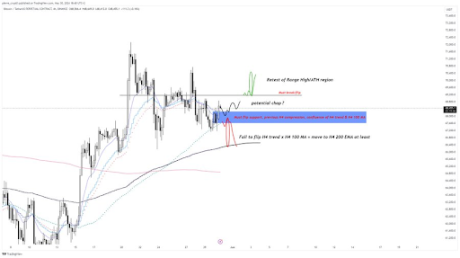
Meanwhile, Pierre outlined what needs to happen for Bitcoin to avoid declining significantly. He noted that the flagship crypto must avoid losing the range between $67,500 and $68,200 as support. He claimed that a drop below this range could lead to Bitcoin retesting the range between $65,000 and $66,500.
Crypto analyst Michael van de Poppe also shared a sentiment similar to Pierre’s, although he specifically made reference to the $70,000 price level. He claimed that BTC will likely see a new ATH once it achieves a successful breakout above $70,000. In a recent X post, he claimed that Bitcoin must hold above $66,000 and $67,000 to avoid “further downward momentum to $60,000.”
Crypto analyst Rekt Capital also suggested that Bitcoin simply needs to break above $70,000 to enter the ‘parabolic uptrend’ phase. However, it could take a while before Bitcoin achieves that successful breakout above $70,000. Arthur Hayes, the co-founder and former CEO of BitMEX, predicted that BTC will continue to range between $60,000 and $70,000 until August.
Van de Poppe suggested that it might not take that long for Bitcoin to break above $70,000. He predicted listing the Spot Ethereum ETFs could trigger a significant move for Bitcoin and altcoins. Bloomberg analyst Eric Balchunas recently predicted that these funds could go live in June or by July 4th at the latest.
A Weekly Close Above $69,000 Could Alter History
In a recent X post, Rekt Capital claimed that a weekly close above the $69,000 range “would alter the course of history.” However, he suggested it was unlikely to happen, stating that Bitcoin doesn’t “favor a breakout this early post-halving.” The crypto analyst had previously mentioned that “history suggests that this historic breakout is still several weeks away.”
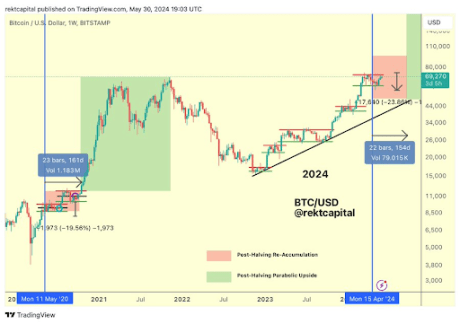
However, he added that it has become clear that Bitcoin is “only one weekly close above the range high away from entering the parabolic phase of the cycle.” Before now, Rekt Capital revealed that Bitcoin hitting a new ATH before the halving had brought about an accelerated cycle but that the flagship crypto could consolidate for longer to resynchronize with previous halving cycles.
Featured image created with Dall.E, chart from Tradingview.com

- Jamie Dimon, JPMorgan CEO, called Bitcoin a “Ponzi scheme.”
- Dimon’s criticism comes despite JPMorgan’s involvement in Bitcoin ETFs.
- Bitcoin’s recent price volatility highlights ongoing debates in the cryptocurrency market.
JPMorgan Chase CEO Jamie Dimon has once again voiced his scepticism towards Bitcoin (BTC), dubbing it a ‘Ponzi scheme’ during an interview on Bloomberg TV.
During his interview, Dimon reiterated his long-standing criticism of Bitcoin, stating that it lacks utility and legitimacy as a form of money. He described Bitcoin and similar cryptocurrencies as “simply not functional as currencies,” emphasising his belief that they are essentially Ponzi schemes disguised as technological innovation.
However, this is not the first time that the CEO is criticizing Bitocin. His scepticism towards Bitcoin is well-documented. He previously called Bitcoin a “fraud” and expressed concerns about its potential to facilitate illegal activities such as money laundering, fraud, and tax evasion due to its anonymity and lack of regulation.
JPMorgan’s involvement in Bitcoin ETFs
It’s notable that despite Dimon’s vocal criticism of Bitcoin, JPMorgan has been actively involved in the cryptocurrency space.
The banking giant has served as an Authorized Participant for BlackRock’s spot Bitcoin exchange-traded fund (ETF) and has participated in several blockchain-based projects over the years.
Furthermore, despite Dimon’s scepticism towards Bitcoin, the CEO acknowledged the potential value of certain aspects of blockchain technology, particularly those facilitating smart contracts although he maintained his stance that cryptocurrencies like Bitcoin lack inherent value as currencies, echoing his previous sentiments on the matter.
This juxtaposition highlights the nuanced approach within the banking giant towards cryptocurrency investments, even as its CEO expresses scepticism.
Bitcoin (BTC) price market reaction
Bitcoin’s market performance has been subject to fluctuations in recent times. At the time of writing, Bitcoin price was $64,741.28, after experiencing a 4.92% increase in the last day, but it was still down 8.41% over the past seven days.
Despite these fluctuations, Bitcoin’s market capitalization has recently surpassed $1.2 trillion, reflecting its continued growth and acceptance as an asset class.
UK roundup: Northumbrian Water pension scheme picks Cardano … IPE.com
Source link ]]>
✓ Share: