Cardano Under Pressure—but Massive Whale Buy Puts ADA in the Hot Seat ZyCrypto
Source link ]]>
Cardano Under Pressure—but Massive Whale Buy Puts ADA in the Hot Seat TradingView
Source link ]]>
A large investor shifted funds into tokenized gold this week, and Bitcoin felt the impact. Prices dipped while a whale quietly bought millions in XAUT, a gold-backed token, signaling a short-term move toward traditional hedges.
Related Reading
Whales Move Into Tokenized Gold
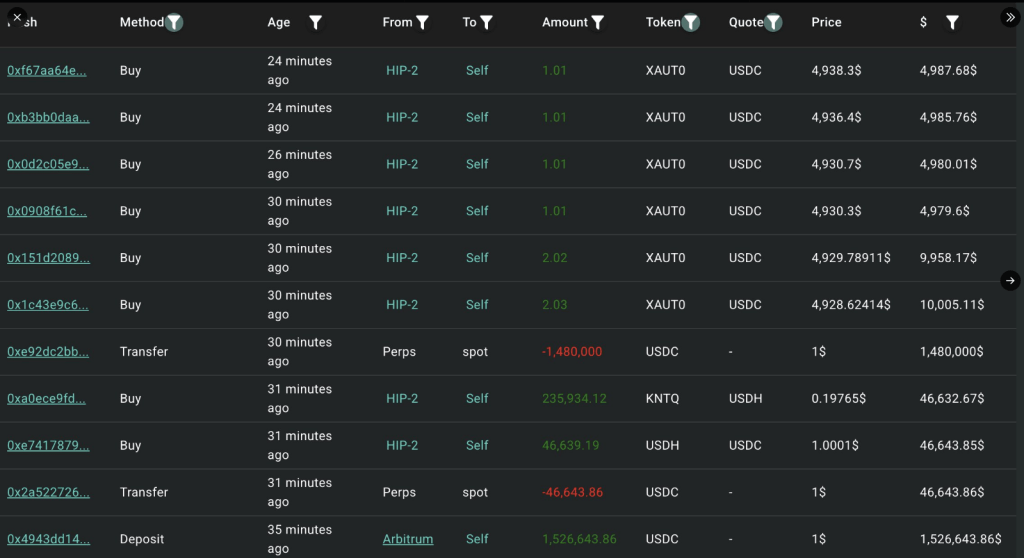
According to on-chain trackers, one address moved $1.53 million in USDC into Hyperliquid to buy XAUT. Reports note that the same wallet had earlier bought about 481 XAUT, a purchase worth roughly $2.38 million.
The address still holds close to $1.44 million in USDC, which suggests more purchases could follow. These moves were picked up on public blockchains and then flagged by analysts watching large transfers.
This kind of action can matter. When big players shuffle cash, smaller traders often take notice and hedge their bets. The shift is not proof of a long-term trend, but it shows that, at least for now, some large holders prefer gold exposure over extra crypto risk.
Whales are buying gold, not crypto.
~30 mins ago, whale 0x6B99 deposited 1.53M $USDC into Hyperliquid to buy $XAUT again.
He has already bought 481.6 $XAUT($2.38M) and still holds 1.44M $USDC, which may be used to buy more $XAUT.https://t.co/0uV2kNEiD0 pic.twitter.com/rYA09b1OEn
— Lookonchain (@lookonchain) January 23, 2026
Gold And Silver Hit Fresh Highs
Reports say gold has been moving sharply higher, with spot prices climbing close to $5,000 per ounce in global trading this week. Silver also rose above $100 per ounce, with intraday gold prints near $4,988 before settling.
Traders tie the surge to geopolitical tensions and the idea that interest rates may ease, which encourages money into metal-based stores of value.
A weaker dollar has also helped. Market chatter points to increased demand as investors seek steadier places to park capital while global politics and policy choices create more worry.
Bitcoin’s Price Action And Market Mood
Bitcoin traded around $88,653 at one stage, slipping about 1% on the day and nearly 30% below its prior cycle top. That gap is large. It has market participants questioning whether BTC will stay the go-to hedge during times of high stress. Some long-term holders remain confident. Others are watching liquidity and macro signals more closely.
Reports have disclosed renewed criticism from economist Peter Schiff, who argued that Bitcoin has underperformed versus gold since 2021.
He highlighted the opportunity cost for investors holding BTC while metals climb to record prices. Schiff wrote on social platforms that precious metals are outperforming and that this weak run for Bitcoin weakens its role as a store of value in the eyes of some.
Related Reading
What This Means For Crypto Investors
Short-term rotations like this often reflect risk preferences rather than permanent shifts. Some funds and wealthy individuals seek lower-volatility assets when headlines grow louder and policy paths look uncertain.
Others still view Bitcoin as a long-term play tied to scarcity and network effects. The current picture is a mix: metals are strong, tokenized gold is drawing attention, and crypto markets are reacting.
Featured image from Pexels, chart from TradingView

Although the recent rally appears to have briefly dipped down, the price of Ethereum is still on an upward trajectory, showcasing its resilience as a formidable digital asset. Presently, the crypto sector is undergoing a crucial shift, and ETH, once viewed as a mere digital asset, is now being considered the ideal choice for a store of value and treasury asset.
SharpLink CEO Hails Ethereum As The Treasury King
Amid Ethereum’s ongoing upward trend, a new debate is now being observed among prominent figures and institutions in the dynamic financial landscape. This debate coincides with the growing belief that ETH could be the next big thing in crypto finance.
Joseph Chalom, Co-CEO of SharpLink Gaming, has caused a stir in the cryptocurrency community after proclaiming Ethereum the superior treasury asset compared to Bitcoin, the leading digital asset. While being a Maxie on tokenization, Chalom believes both Bitcoin and Ethereum are dominating this part of the sector. “I think there is a role for Bitcoin in every single person’s portfolio, and I think there is a role for ETH,” he stated.
However, the CEO has put ETH ahead of BTC as the smarter long-term choice for corporate treasuries looking beyond simple digital reserves. Chalom’s statement implies that Ethereum is a more dynamic store of wealth for contemporary businesses due to its utility-driven ecosystem, staking yields, and rapid integration throughout decentralized finance.
One of the major reasons Chalom has hailed ETH as a better treasury asset than BTC hinges on their distinct volatility, with the altcoin having a 40% volatility. Although it is not certain, the CEO stated that the spot ETFs caused many BTC to be held without trading, leading to a decline in BTC’s volatility.
As a result, Chalom thinks ETH is an ideal store of value since it is more productive and deflationary, which are key factors to consider when building a digital treasury. Another factor that pushes ETH ahead of Bitcoin is staking. Owning and staking ETH also comes with several benefits.
According to the CEO, a staked ETH is equivalent to revenue in public companies, as they trade on valuations. Furthermore, Chalom reveals that large investors holding billions worth of ETH can go into the DeFi ecosystem and make a difference. With the massive holdings, these investors can raise the standards of DeFi by king-making protocols and creating beneficial incentive structures without necessarily taking more risk.
A Massive Portion Of ETH Staked Within The Week
Since the beginning of the week, on-chain data shows that a significant amount of Ethereum has been staked. Specifically, this large ETH staking is being carried out by the leading asset management firm, Grayscale, signaling growing institutional confidence in the network’s long-term potential.
As reported by Ted Pillows on X, Grayscale has staked over 1,161,600 ETH, valued at a whopping $5.1 billion, in the past week. According to Pillows, retail is exiting liquidity on BNB Chain memes while in Ethereum, smart money is positioning itself. “No wonder most people have lost money this cycle,” the crypto pundit added.
Featured image from Pxfuel, chart from Tradingview.com
Editorial Process for bitcoinist is centered on delivering thoroughly researched, accurate, and unbiased content. We uphold strict sourcing standards, and each page undergoes diligent review by our team of top technology experts and seasoned editors. This process ensures the integrity, relevance, and value of our content for our readers.
Cardano, Solana Set To Take A Back Seat As Payment Tokens XRP, RTX Gear Up To Explode MSN
Source link ]]>
Bonk, Floki Drive Meme Coin Gains As Dogecoin, Shiba Inu Take Back Seat Benzinga
Source link ]]>
Can Rexas Finance (RXS) Topple Cardano (ADA)? Fast-Rising Altcoin Eyeing a Seat at the Big Boys’ Table Analytics Insight
Source link ]]>
Famous Influencer Crypto Rick’s Endorsement Sends BlockDAG Soaring: Ethereum & Shiba Inu Take a Back Seat as … NewsBTC
Source link ]]>
The status of Ethereum, the world’s second-largest cryptocurrency, is shrouded in uncertainty as the US Securities and Exchange Commission probes the Ethereum Foundation.
Industry insiders believe the investigation is aimed at classifying Ether (ETH), Ethereum’s native token, as a security, a move that could significantly impact the cryptocurrency market.
Ethereum’s Regulatory Landscape: Recent Developments
This development comes amidst a flurry of activity surrounding Ethereum. Major financial institutions like BlackRock and Fidelity have applied for spot Ether ETFs, while the controversial firm Prometheum seeks to offer Ether custody under SEC oversight. However, the SEC’s recent actions cast a shadow over these efforts.
Companies subpoenaed by the SEC have disclosed that the investigation began shortly after Ethereum’s transition to a proof-of-stake model in September 2022.
The SEC, according to a report by Fortune, might view this shift as strengthening the case for Ether being a security, as proof-of-stake involves users staking their coins to validate transactions, potentially resembling an investment contract.
The SEC’s stance on Ethereum’s classification has been historically ambiguous. In 2018, then-Director of Corporation Finance William Hinman declared Ether wasn’t a security. However, the agency’s current Chair, Gary Gensler, has expressed a more skeptical view. He has suggested proof-of-stake tokens could be securities, though he’s avoided directly mentioning Ethereum.
Adding to the confusion, the SEC approved several Bitcoin futures ETFs in January 2023, while the CFTC (Commodity Futures Trading Commission) oversees Ether futures markets. This seemingly contradictory approach suggests the SEC might have a different view on Bitcoin and Ether.
Ethereum price action. Chart: TradingView
Implications of Ether’s Security Classification
Further muddying the waters is Prometheum’s move. This firm, already approved as a special purpose broker-dealer, plans to offer Ether custody as a security. Some speculate this could be a strategic maneuver to influence the SEC’s decision, potentially acting as a “Trojan Horse” for security classification.
The investigation’s outcome has major implications. Classifying Ether as a security would subject it to stricter regulations, potentially hindering its growth and impacting existing Ether futures markets. Additionally, it could discourage the approval of spot Ether ETFs, a major blow to institutional adoption.
The situation highlights the ongoing regulatory uncertainty surrounding cryptocurrencies. The SEC’s aggressive approach under Gensler appears aimed at exerting greater control over the industry. However, the lack of clear communication and potential inconsistencies within the SEC itself create confusion and hinder innovation.
The coming months will be crucial for Ethereum. The SEC’s investigation and its ultimate decision on Ether’s classification will have ripple effects throughout the cryptocurrency market. Investors and industry players eagerly await clarity, hoping for a regulatory framework that fosters responsible development within the crypto ecosystem.
Featured image from Pixabay, chart from TradingView
Bitcoin price started a downside correction from the $35,000 resistance. BTC could start a fresh increase unless there is a move below $32,800.
- Bitcoin rallied toward the $35,000 resistance before the bears appeared.
- The price is trading above $33,200 and the 100 hourly Simple moving average.
- There is a key breakout pattern forming with resistance near $34,050 on the hourly chart of the BTC/USD pair (data feed from Kraken).
- The pair could correct lower toward the $33,000 zone before it starts a fresh increase.
Bitcoin Price Corrects Gains
Bitcoin price rallied over 15% after there was speculation of spot ETF being listed DTCC. BTC surged toward the $35,000 resistance zone before the bears appeared.
A new multi-week high was formed near $35,225. Recently, the price started a downside correction below the $34,500 level. There was a move below the 23.6% Fib retracement level of the upward move from the $29,694 swing low to the $35,225 high.
Bitcoin is now trading above $33,200 and the 100 hourly Simple moving average. There is also a key breakout pattern forming with resistance near $34,050 on the hourly chart of the BTC/USD pair. The triangle support is close to the 50% Fib retracement level of the upward move from the $29,694 swing low to the $35,225 high.
On the upside, immediate resistance is near the $34,050 level. The next key resistance could be near $34,800. The main resistance is now forming near the $35,000 zone.
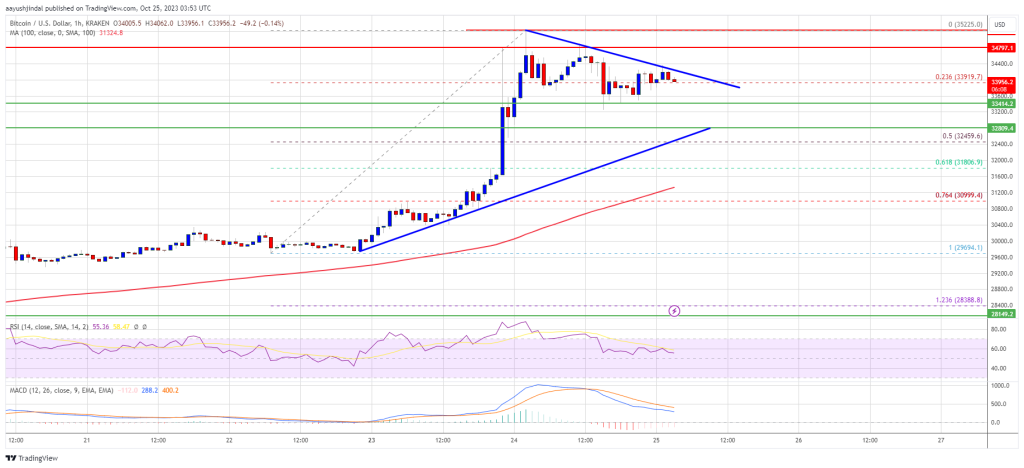
Source: BTCUSD on TradingView.com
A clear move above the $35,000 barrier might send the price toward the $36,200 resistance. The next key resistance could be $37,000. Any more gains might send BTC toward the $38,000 level in the coming days.
More Losses In BTC?
If Bitcoin fails to rise above the $34,050 resistance zone, it could continue to move down. Immediate support on the downside is near the $33,400 level.
The next major support is near the $32,800 level and the triangle trend line. If there is a move below the trend line support, the price may perhaps decline toward the $31,500 level in the coming sessions.
Technical indicators:
Hourly MACD – The MACD is now losing pace in the bullish zone.
Hourly RSI (Relative Strength Index) – The RSI for BTC/USD is now above the 50 level.
Major Support Levels – $33,400, followed by $32,800.
Major Resistance Levels – $34,050, $34,800, and $35,000.