
Vitalik Buterin says a new “fast confirmation rule” for Ethereum could give users a hard guarantee that a block will not be reverted after a single slot, or roughly 12 seconds, a change that would sharply reduce one of the network’s biggest practical frictions for exchanges, bridges and Layer-2 systems.
The proposal, described publicly by Ethereum Foundation researcher Julian Ma and endorsed by Buterin on X, is designed to narrow the gap between Ethereum’s strong security model and the slower confirmation times that still shape user experience across the ecosystem. In Buterin’s words, the mechanism “lets you get a hard guarantee that Ethereum will not revert after one slot (12 seconds). Security assumptions are (i) supermajority honest, (ii) network latency under ~3s. So one step below economic finality, but very strong for many use cases.”
New Ethereum Rule For Faster Confirmations
That distinction matters. Ethereum finality remains the chain’s strongest settlement guarantee, but it comes with a much longer wait time. Ma said the fast confirmation rule, or FCR, cuts deposit times from Ethereum mainnet to L2s and centralized exchanges to about 13 seconds, which he described as an “80-98% reduction for most L2s and exchanges.”
For users, the immediate consequence is speed. For infrastructure providers, the bigger story is efficiency. Ma argued that slow mainnet confirmation has forced exchanges, bridges and rollups to operate around delay and uncertainty, especially when handling deposits or syncing market activity across chains. “Bridging funds from Ethereum to L2s and centralized exchanges is slow. Users wait minutes when using the canonical bridges,” he wrote. “The new Fast Confirmation Rule (FCR) solves that. It reduces deposit time from Ethereum L1 to L2s or exchanges to about 13 seconds.”
He added that the rule is expected to become “the new industry standard for L2s and exchanges,” and said it can begin rolling out in the coming months without a hard fork. That is a notable design choice. Rather than introducing a consensus change that requires network-wide coordination, FCR can be activated as clients implement it, with nodes able to run the rule automatically once support is live.
Ma’s explanation frames FCR as a middle ground between today’s heuristics and Ethereum’s formal finality. Most exchanges, L2s and solvers do not wait for finality now. Instead, they rely on a block-depth rule, or “k-deep,” essentially waiting for a transaction to be buried under enough subsequent blocks. FCR takes a different route: it counts attestations rather than blocks. According to Ma, that makes it structurally faster while also giving it a provable security model that k-deep lacks.
The trade-off is explicit. A fast-confirmed block is not finalized, and the guarantee depends on stricter assumptions than finality does. FCR assumes a synchronous network, which in practice means attestations arrive within about eight seconds, and it assumes no adversary controls more than 25% of staked ETH. Finality, by contrast, is designed to hold under asynchrony and up to a 33% adversarial threshold.
Even so, Ma argued the system degrades gracefully when conditions worsen. “If the network is slow, FCR has a built-in fallback mode. Instead of fast-confirming a block within 13 seconds, it may take slightly longer,” he wrote. “As soon as sufficiently many attestations are delivered, the block is fast-confirmed. In the worst-case, FCR falls back to finality.”
That fallback is central to the pitch. The mechanism does not pretend reorg risk disappears; it claims to reduce waiting time dramatically while retaining deterministic guarantees when its assumptions hold. Ma also stressed that if those assumptions do hold, a fast-confirmed block “will be finalized with certainty.”
At press time, ETH traded at $2,319.
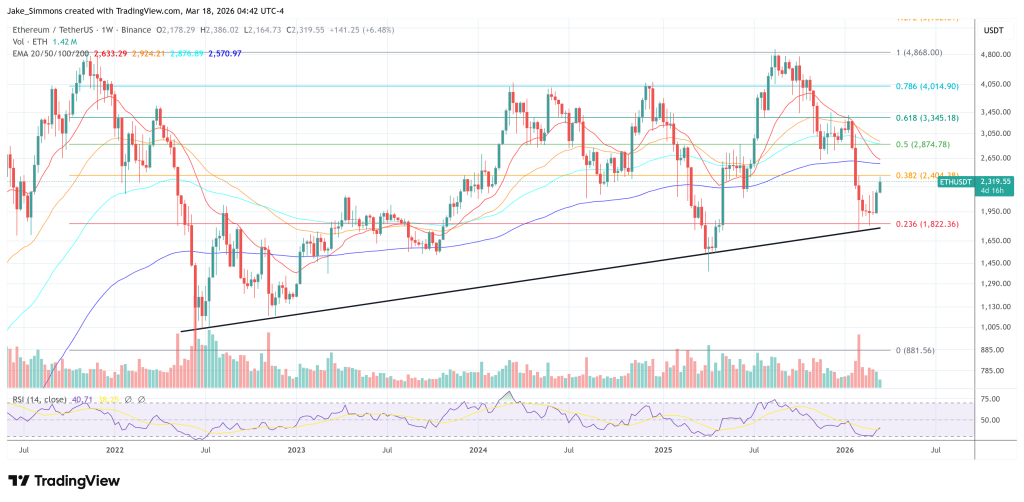
Featured image created with DALL.E, char t from TradingView.com
Editorial Process for bitcoinist is centered on delivering thoroughly researched, accurate, and unbiased content. We uphold strict sourcing standards, and each page undergoes diligent review by our team of top technology experts and seasoned editors. This process ensures the integrity, relevance, and value of our content for our readers.
Cardano Whale Loses $6M in Seconds — Here’s How To Avoid the Same ADA–USDA Mistake CCN.com
Source link ]]>
Cardano Holder Loses $6 Million in 30 Seconds ForkLog
Source link ]]>
Binance is witnessing a significant withdrawal of Bitcoins with the crypto world unstable. Amid whispers surrounding the platform, investors pulled over 5,000 BTC in just one minute, underlining the sheer magnitude of the issue. Significantly, Changpeng Zhao, Binance’s CEO, labels this incident as mere ‘fear, uncertainty, and doubt’ tactics.

— Whale Alert (@whale_alert) August 24, 2023
However, besides the one-minute wonder, a six-day streak from August 17 showed Bitcoin outflows dominating the Binance exchange. Hence, by August 22, 14,460 BTC found their way out of Binance’s reserves.
Moreover, Binance is one of many platforms seeing such massive withdrawals. Glassnode’s recent insights highlighted a 5-year low for BTC balances across all major exchanges.

BTC Balance on Exchages (Source: glassnode)
Consequently, fewer than 2.27 million BTC remain in known exchange wallets. Additionally, these shifts point to ‘HODLers’ preferring the safety of private wallets, indicating a potential reluctance to sell their holdings in the immediate future.
Fee Overhaul at Binance
Additionally, with Binance’s pivot from a zero-fee Bitcoin trading model starting September 7, the dynamics of its BTC/TUSD trading pair will undergo a significant transformation. The days of enjoying zero-maker and taker fees are ending. Moreover, while the maker fees will hold zero status, taker fees will now hinge on the user’s VIP level.
#Binance will update the zero-fee Bitcoin trading program effective from September 7, at 00:00 UTC.https://t.co/nlHvZU4ZJ0
— Binance (@binance) August 24, 2023
With Binance phasing out BUSD support in favor of TUSD, a noticeable drop in Tether (USDT) volumes came to the fore. Many seasoned traders and crypto enthusiasts see this as a pivotal moment with far-reaching market implications. Consequently, as this new crypto phase looms, all eyes remain on Binance’s subsequent moves and the overarching market aftermath.
The crypto sphere is experiencing some noteworthy shifts. The landscape is evolving with changes in trading fee structures and substantial BTC withdrawals. As these events unfold, market players and enthusiasts will watch closely, anticipating the next significant turn.

The presented content may include the personal opinion of the author and is subject to market condition. Do your market research before investing in cryptocurrencies. The author or the publication does not hold any responsibility for your personal financial loss.
Shiba Inu’s Shibarium Aims To Process Transactions in Seconds for Less Than Pennies: New Public Documenta… The Daily Hodl
Source link ]]>