As deepfakes, AI-generated simulations of real people, become increasingly sophisticated, the ability to distinguish truth from fiction online becomes ever more challenging. This growing threat to online security and trust has prompted Ethereum co-founder, Vitalik Buterin, to propose a novel defense mechanism: personalized security questions.
Explaining the vulnerability of traditional security measures like passwords and generic security questions to evolving deepfakes, Buterin highlights that his proposal relies on something artificial intelligence hasn’t fully mastered yet—the richness of human connection.
Ethereum Co-Founder’s Genius Hack To Outsmart Deepfakes
Instead of relying on easily guessable information like a pet’s name or mother’s maiden name, Buterin’s system would utilize questions based on shared experiences and unique details specific to the individuals interacting. Imagine recalling that inside joke from college or that obscure nickname your grandma gave you as a child – these personalized details would form a kind of memory maze, challenging imposters attempting to mimic someone.
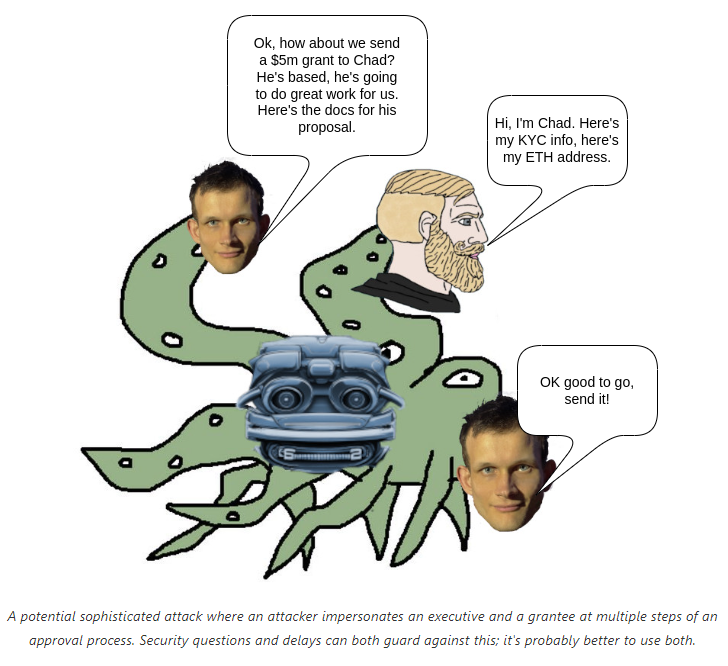
Source: vitalik.eth.limo
However, remembering the minutiae of our past isn’t always easy. Buterin acknowledges the potential for memory hiccups, but sees them as another layer of defense. The very act of recalling these obscure details adds a complexity that further deters imposters who wouldn’t have access to such personal information.
Ethereum currently trading at $2,508.7 on the daily chart: TradingView.com
Recognizing the need for a multi-pronged approach, Buterin doesn’t stop at personalized questions. He envisions a layered security system incorporating elements like pre-agreed code words, subtle duress signals, and even confirmation delays for critical ethereum transactions. Imagine each layer as a barrier, making it exponentially harder for attackers to gain access.
Deepfake Threat Spurs Urgent Solutions Inquiry
This proposal arrives at a critical time. A recent report exposed yet another deepfake attempt targeting Buterin, highlighting the urgent need for effective solutions. While experts applaud the originality and potential of his approach, questions remain.
We have seen deepfake of @VitalikButerin used to promote a wallet drainer
The scam site is strnetclaim[.]cc
Still of the video can be seen below pic.twitter.com/R8AY5CVOea
— CertiK Alert (@CertiKAlert) February 7, 2024

Challenges like securely storing these personalized questions resurface when considering their implementation. Can they be encrypted and accessed securely, without becoming vulnerable targets themselves? Scalability also raises concerns. While effective within close-knit groups or individuals with deep shared experiences, how would this method function in broader contexts or online interactions with strangers?
Furthermore, questions arise about accessibility. Could an over-reliance on memory or specific shared experiences create barriers for certain demographics or individuals who might not possess the same level of detail? Finally, with AI constantly evolving, future-proofing becomes crucial. Could sophisticated AI eventually learn to manipulate or access these memories, rendering the questions ineffective?
Only time will tell if Ethereum boss Buterin’s memory maze can outsmart the deepfakes, but one thing’s for sure: this ingenious proposal has sparked a crucial conversation about safeguarding our digital selves. In a world where even reality itself is under attack, leveraging the intricacies of human memory might just be the next frontier in the fight against sophisticated online impersonation.
Featured image from Adobe Stock, chart from TradingView
Dogecoin price grows a shield against this cohort, even as selling from it hits a historic high FXStreet
Source link ]]>
Using crypto as shield to save the country’s financial system from further collapse may not be the best solution for Russia in its ongoing invasion of Ukraine.
As Russia continues to pound the country with bombs and missiles, many expect this would deal a heavy blow on cryptocurrencies as well.
But, nope.
Bitcoin, as it turns out, has just breached the $40,000 mark while Russia’s currency sank to a record low and Moscow was hit with new economic sanctions.
Related Article | Criminal Whales Hold $25 Billion In Crypto Assets: Chainalysis Report
According to the latest data from CoinMarketCap, Bitcoin had jumped 14% over the last 24 hours to $43,163, hitting a record high since February 20.
Other cryptocurrencies also rose in value. Ethereum climbed to 10% Tuesday and reached $2,878 while Dogecoin moved up to about 6%.
Terra and Solana also experienced significant value spikes. Terra moved up by 9.5%, while Solana peaked by nearly 8%.
On Explosions And Sanctions
After Russia’s invasion of Ukraine on February 24, Bitcoin’s value sank together with other crypto.
In the first day of the occupation, the crypto market plummeted to a total of $1.6 trillion in market capitalization, roughly around 5%. An hour after the war broke, Bitcoin fell by $2,000, to $35,000.
Aside from the crypto industry, stock markets also took a beating during the ongoing crisis, with the Dow Jones Industrial Average dropping by 1.4%.
According to Arcane Research head Bendik Schei, investors are “trying to get out of the ruble” because of its “drastic devaluation after all the sanctions.”
In fact, more crypto users have been moving their assets from Bitcoin to Tether, since the latter is popularized as “stable” as the US dollar.
“This is where they find the most comfort at the moment. Under the current market conditions, I’m not surprised to see investors, at least those in Russia, seeking stablecoins… this is about saving their funds, not investing,” Schei added.
BTC total market cap at $829.280 billion in the daily chart | Source: TradingView.com
The Great Rubble Collapse
With the diplomatic tensions unfolding, western countries have frozen the assets of Russia’s central bank to make it harder for the country to counter the sanctions’ effects on their economy.
Economists are referring to the “rainy day fund,” which Moscow authorities had admitted to be its safety net for its invasion of Ukraine.
Since the US and European countries directly use international banks to enforce sanctions, Russia is trying to connect with financial institutions willing to deal with them.
Rather than relying on currency reserves to nudge the declining ruble, Russia can no longer access the funds that it keeps in US dollars.–
On Monday, Russia’s economy was already in free fall. The ruble fell to a record low, the central bank increased its benchmark interest rate to 20%, and the stock exchange remained closed.
Crypto As Shield Not Enough
According to cryptocurrency specialists, Russia’s situation is different, with the country having less room to maneuver because of the magnitude of the economic damage and its limited use of digital currencies.
Unlike other nations, Russia has been a long-standing participant in the international economic and financial market.
Around 80% of all foreign exchange transactions in Russia are in US dollars.
Cryptocurrency analysts are now saying that Russia will not be able to avoid sanctions for its invasion of Ukraine only on the basis of cryptocurrencies.
Related Article | Bitcoin Staggers After Putin’s Nuclear Deterrence Alert Warning
New sanctions against the country’s central bank were announced by the United States, the United Kingdom, the European Union, and Canada on Monday.
The US Treasury now restricts the flow of Russian foreign reserves worth $640 billion.
“It is very difficult to move massive amounts of crypto and convert it to usable currency,” Ari Redbord of TRM Labs, a blockchain intelligence firm, said.
For Russia to be able to extricate itself from the misery of the West’s sanctions, it must do more than just turn to cryptocurrencies and believe it is where it will be safe.
Featured image from Business Today, chart from TradingView.com