
Amid the growing recognition of the blockchain sector, the Ethereum network continues to be at the forefront of the growth, securing more user activity than most networks. The most recent aspect being dominated by the leading network is validator distribution, which makes it a leader in decentralized applications (dApps) activity.
Validator Distribution Strength Puts Ethereum On Top
The Ethereum network has emerged with another reason why it is considered the leading blockchain across the entire cryptocurrency sector. After a wave of demand, a significant milestone has now been reached in the evolution of Ethereum, putting the network in the spotlight once again.
In a report on the social media platform X, Everstake, a leader in global non-custodial staking infrastructure provider, revealed that the ETH network has emerged as the top blockchain in validator distribution. With validation authority distributed more fairly across participants rather than being concentrated among a few entities, this development highlights an increasing degree of decentralization.
As seen in the chart shared by Everstake, the total number of validators on the network is approximately 921,500. The ETH network is exceptionally leading in this context, with Cardano, which comes in the second position, recording a total of just 2,900 validators.
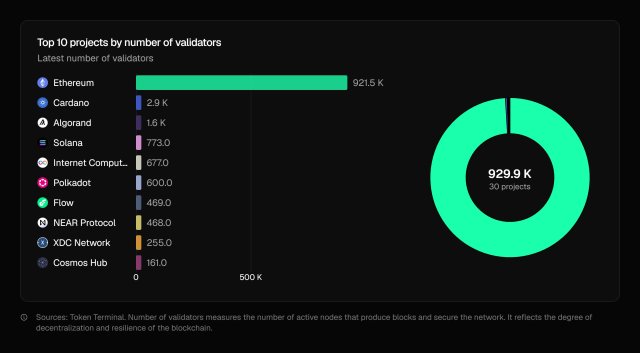
This level of validators enables the ETH network to operate at a scale that clearly sets it apart from the rest of the market. It is worth noting that this development also strengthens the network’s role as a fundamental layer for decentralized applications by bolstering its resilience and security.
At this point, different networks are persistently evolving and optimizing for their own priorities. Ethereum, on the other hand, is showing that its strength mainly relies on the breadth of participation securing the network.
Everstake stated that this degree of distribution supports long-term security and resilience in addition to decentralization. As the sector evolves, validator scale has become one of the clearest indicators of network maturity in numerous ways, but Ethereum continues to be the reference point.
ETH’s Price Set For A Massive Move
While Ethereum gains momentum, Crypto Patel has underlined that a key level will determine its next big move. In the analyst’s view, ETH’s bottom looks done for now after dropping hard from $4,800 to $1,765, wiping out almost every trader on the way down. However, the price has been slowly climbing inside a rising channel since then.
Currently, ETH’s price is positioned just below a big unfilled gap between $2,474 and $2,634, which is where the price is expected to go next. Above that is the real resistance at $2,900 and $3,050. If ETH makes a daily break and closes below $3,050, it would change the price dynamics to a full trend reversal.
On the downside, $1,800 is the key support, but losing $1,765 would mean trouble. Patel highlighted that ETH is still recovering, but has not shown serious strength yet. Thus, the expert claims it still needs to break $3,050 to confirm real strength, urging investors to be patient and wait for a clear price direction.
Featured image from Freepik, chart from Tradingview.com
Editorial Process for bitcoinist is centered on delivering thoroughly researched, accurate, and unbiased content. We uphold strict sourcing standards, and each page undergoes diligent review by our team of top technology experts and seasoned editors. This process ensures the integrity, relevance, and value of our content for our readers.

- As May 22 approaches, the crypto community is gearing up to celebrate the 15th anniversary of this legendary transaction—the first time someone verifiably used BTC to buy something in the real world.
- It sounds almost like a joke now—10,000 BTC for two Papa John’s pizzas.
- It proved that this weird internet money could do something tangible.
Think about the wildest online purchase story you’ve ever heard. Does it involve spending what’s now hundreds of millions of dollars on a couple of pizzas?
Probably not, unless you’re familiar with Bitcoin Pizza Day.
As May 22 approaches, the crypto community is gearing up to celebrate the 15th anniversary of this legendary transaction—the first time someone verifiably used BTC to buy something in the real world.
It sounds almost like a joke now—10,000 BTC for two Papa John’s pizzas.
But back in 2010, it was a groundbreaking moment. It proved that this weird internet money could actually do something tangible.
Fifteen years later, Bitcoin Pizza Day isn’t just a quirky footnote; it’s a yearly reminder of how far cryptocurrencies have come, evolving from a niche experiment into tools with real-world utility for people all over the globe.
“From two pizzas to a global financial movement, crypto’s journey has been nothing short of extraordinary—and our community has been the driving force behind it,” said Rachel Conlan, Chief Marketing Officer at Binance.
“This year, we’re marking Bitcoin Pizza Day with the biggest BTC referral giveaway in history—$5 million worth—alongside over 28 local meetups and social activations. It’s our way of honoring how far we’ve come while inviting millions more into the crypto world.”
Bitcoin Pizza Day stories demonstrating real-world crypto utility
To mark the occasion, the crypto exchange Binance recently asked its users to share how crypto has actually been useful in their own lives.
Forget the memes for a second; these stories paint a picture of cryptocurrencies solving everyday problems and creating meaningful moments, showing the practical side that Bitcoin Pizza Day first hinted at.
Take Andy from Vietnam, for example. He ran into a common travel snag in Malaysia: needing to pay a rental deposit without a local bank account.
His plan B was crypto. “I turned to crypto and planned to use Binance to make the payment,” he shared.
As it turned out, the host ended up waiving the fee because Andy promised to take good care of the place.
“While the payment was never completed,” Andy reflected, “it was still a perfect example of how versatile crypto can be in real-life situations!”
Codi, based in Dubai, shared a story about using digital assets for better value while traveling. “In 2023, I paid for a delicious Turkish kebab with USDT while visiting Turkey,” she said.
“It was incredibly convenient, and the exchange rate was much better than what my Dubai bank offered.”
For Codi, using cryptocurrency wasn’t just novel; it made the trip easier and more economical.
“Having crypto as a payment option made the whole trip feel smoother and more flexible—true worry-free travel.”
It’s not always about convenience or necessity, though; sometimes it’s about sentiment.
Mina from Algeria used her first crypto salary, earned when BNB was around $200, for a special purchase.
Thinking back, she said, “The first thing I ever bought with crypto wasn’t pizza—it was my mom’s favorite perfume. There’s something special about using crypto for something you love; it felt exciting, satisfying, and like I was part of something bigger.” She used Binance for the fast, seamless payment, adding, “My only regret? Not starting sooner!”
And then there’s Jimmy from Canada, whose story highlights how early adoption, even accidental, could turn out. Back in late 2012, when Bitcoin was just $13, he needed some BTC not for investment, but necessity.
“I just needed it to buy a textbook on compilers from an online seller who insisted on Bitcoin payment,” he explained. “I bought five whole Bitcoins on Coinbase, used a few to pay for the book, and forgot about the rest.”
It wasn’t until years later, after joining Binance, that he remembered the old account. “It sat untouched for years, and I became an accidental HODLer.”
These stories, from travel fixes to heartfelt gifts and forgotten digital wallets, show crypto’s utility extending far beyond just trading charts.
Why Bitcoin Pizza Day matters for the crypto industry
So, why all the fuss about two pizzas bought 15 years ago? Because that single transaction, initiated by programmer Laszlo Hanyecz on the BitcoinTalk forum, was the moment Bitcoin stepped out of the purely digital realm.
On May 22, 2010, after offering 10,000 BTC for pizza delivery, a fellow enthusiast named Jeremy Sturdivant took him up on it, ordering the pizzas and receiving the Bitcoin.
At the time, those 10,000 BTC were worth maybe $41. Today? Over $970 million!
But the astronomical Bitcoin price difference isn’t the main point. The real significance is that it demonstrated utility. Suddenly, Bitcoin wasn’t just lines of code anymore.
That pizza deal proved it could operate as the peer-to-peer (P2P) electronic cash system Satoshi Nakamoto had described in the original whitepaper.
It served as the first real test case for using crypto to buy actual things, and it definitely got people talking about whether it could catch on and how easy it was to use.
The story also offers a fascinating snapshot of crypto’s early days. Hanyecz, an early miner, reportedly earned his coins when mining rewards were 50 BTC per block.
This means those 10,000 BTC represented validating just 200 blocks, a feat achievable on a regular computer back then.
Contrast that with today’s massive, ASIC-powered mining operations. Sturdivant, the recipient, didn’t “HODL” his way to riches; he reportedly used the BTC for travel and games, reflecting the experimental, currency-like view of Bitcoin at the time.
Bitcoin Pizza Day, which only really gained traction around 2014 as Bitcoin’s price and public awareness grew, serves as an annual benchmark. It reminds the community of crypto’s humble origins and its incredible journey.
It’s a celebration of innovation, a nod to the early believers, and a prompt to keep working on making crypto more accessible and user-friendly—to fulfill the potential that first slice represented.
Hanyecz himself, who later bought pizza again using the Lightning Network in 2018, doesn’t seem to regret it, proud of his role in Bitcoin history.
Cardano vs Coldware: ADA Coinbase Futures Entices Institutional Liquidity, Coldware Showcases Ecosystem in 10 Days FinanceFeeds
Source link ]]>
Hydra Doom Tournament Showcases Cardano’s Unmatched Scalability CoinTrust
Source link ]]>
Cardano (ADA) and GoodEgg (GEGG) Worth In 2030: Analyst Showcases Why GoodEgg Will 5000x Before Year End NewsBTC
Source link ]]>
Shiba Inu’s Lead Developer Showcases Why SHIB Ecosystem Security Is A Top Priority ZyCrypto
Source link ]]>
2024 Conference: Shiba Inu Showcases Powerful Upgrades TronWeekly
Source link ]]>
New Crypto Showcases 300x Presale Increase, Outperforming Solana (SOL) and Dogecoin (DOGE) Crypto Reporter
Source link ]]>
Dubai Crypto Exchange Showcases Shiba Inu Token at Entrance Examiner.com
Source link ]]>
Dogecoin (DOGE) Showcases Daring Twists Worth Noting U.Today
Source link ]]>