A crypto market analyst has outlined what he describes as a straightforward mathematical method that helped identify the bottom of Bitcoin’s previous bear market. By focusing on long-term Fibonacci levels and quarterly price behavior, the analyst argues that the same structural logic that marked the 2022 bottom is now shaping Bitcoin’s next macro phase.
Simple Math That Identified The Bitcoin Price Bear Market Bottom
In an X post shared on March 8, crypto analyst Chetan Gurjar revisited a prediction he made in December 2022 regarding Bitcoin’s bear market low. While he acknowledged that the timing of the call was slightly off by a few months, he stated that the price target itself proved accurate.
Related Reading
The analysis referenced Bitcoin’s bear market bottom around the $15,000 region in late 2022, which the analyst had previously projected using this framework. His approach centers on macro Fibonacci extension levels plotted on the quarterly chart, with particular focus on the 1.618 Fibonacci level positioned near $62,084.
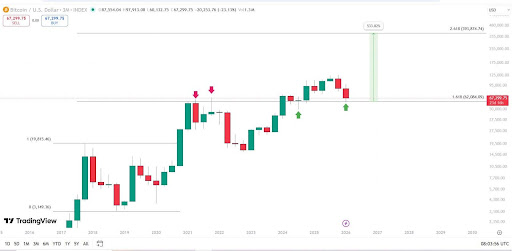
The chart accompanying the explanation highlights how Bitcoin historically reacts to this macro level. During the 2021 bull cycle, Bitcoin repeatedly failed to break and sustain price action above the 1.618 Fibonacci level. The analyst pointed to the second and fourth quarter candles of 2021, both of which were rejected at that same zone.
These repeated rejections signaled strong resistance at the time, reinforcing the significance of the level in the broader market structure. By mapping these macro levels across cycles, the analyst argues that long-term Fibonacci mathematics can help identify both extreme lows and potential expansion targets.
Quarterly Fibonacci Retest Suggests Next Macro Phase
The analyst’s latest chart interpretation suggests that Bitcoin’s relationship with the 1.618 Fibonacci level has shifted from resistance to support. After breaking above the $62,084 region on the quarterly timeframe, Bitcoin has not produced a quarterly candle close below the level since the breakout.
The chart shows two notable retests following the move. In the second and third quarters afterward, Bitcoin briefly tested the level but managed to hold above it on a closing basis. One quarterly wick even dipped below $50,000 before reclaiming the $62,084 level. As of the current quarter ending in March, Bitcoin is again trading above the same macro Fibonacci level. According to the analyst’s interpretation, this behavior represents a bullish quarterly retest.
Related Reading
The projection drawn on the chart extends toward the next Fibonacci expansion level at 2.618, which sits near $393,874. Gurjar describes this level as the minimum macro target if the structure holds. The chart also signals potential volatility, suggesting price wicks could stretch toward the $500,000 region during the expansion phase.
However, the analyst notes that deeper quarterly wicks remain possible depending on broader market conditions, including potential weakness in the altcoin market. Even with that caveat, the framework presents the current structure as a continuation pattern centered on Bitcoin holding the 1.618 Fibonacci level.
Featured image created with Dall.E, chart from Tradingview.com
Fleet Mining & Dogecoin (DOGE): Simple cryptocurrency, smarter cloud mining earnings MSN
Source link ]]>
The industry is realizing that Bitcoin was deliberately designed to prioritize simple, deterministic validation over complex on-chain execution. This design choice minimizes resource requirements, preserves decentralization, and reduces systemic risk even if it means pushing complex logic, programmability, and heavy computation to higher layers or external systems.
How Bitcoin Avoids Complex State Transitions
The fundamental limitation of Bitcoin is its inability to run heavy verification logic at a low cost, a core constraint that every BitVM-based bridge must navigate. According to the GOAT Network post on X, to address these issues, they are introducing a BitVM2 design that will ensure disputes are affordable enough to be executed under real fee conditions. The security mechanism is addressed through optimistic verification using garbled circuits (GC).
Related Reading
This operator, which is set to launch soon, publishes the garbled-circuit artifacts off-chain, while committing only the relevant labels on-chain. If the computation is correct, no on-chain action will be required. Meanwhile, if something is wrong, a challenger does not need to replay an expensive computation on-chain.
Instead, they produce a minimal fraud-proof to reveal the output “0” label that contradicts the operator’s claimed result. At that point, the on-chain step is about demonstrating a contradiction, which will reduce the cost of disputes and change the economics of security.
A practical detail in BitVM designs is that the garbled circuit size matters, and pairing heavy verification can cause bloated circuits. To avoid this, BitVM2 integrates a designated-verifier SNARK, which reduces verifier complexity so that the garbled circuits remain within realistic size limits. For end users, the implication is that the cheaper, more reliable depute paths make it harder for the bridge to stall when the fees spike.
Public Companies Are Becoming Bitcoin’s Strongest Buyers
While several projects are being introduced to improve the efficiency of Bitcoin, seasoned crypto expert and the founder of the Wealth Mastery Newspaper, Lark Davis, has revealed that many public companies are aggressively accumulating BTC. Currently, public companies collectively hold 1.09 million BTC, representing 5.1% of the total BTC supply, which is a new all-time high.
Related Reading
However, the latest major aggressive purchases have come from MicroStrategy and Metaplanet. Strategy just announced another 1,200 BTC purchase, pushing its total holdings to 672,000 BTC. Asia-based firm Metaplanet also bought an additional 4,200 BTC in December, bringing its total holdings to 35,000 BTC.
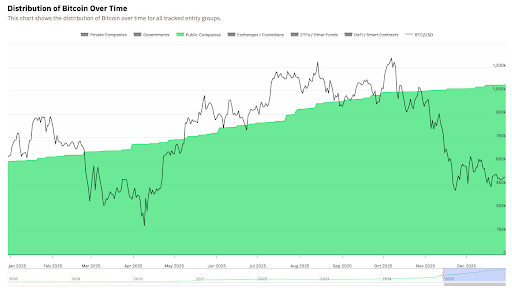
Davis pointed out that other recent purchases have come from Cango Inc., Bitdeer Technologies, and Anap Holdings. While retail investors are demonstrating weakening sentiment, public companies or institutional investors continue to stack regardless of the ongoing market.
Featured image from Pixabay, chart from Tradingview.com
Banks have mostly stayed on the sidelines when it comes to holding XRP directly, even as interest in digital assets continues to increase. That hesitation has not been due to a lack of utility or demand but to strict regulatory capital rules that made holding XRP economically impractical for regulated institutions.
However, a small adjustment in how XRP is treated under global banking rules could remove that barrier and change how banks interact with the cryptocurrency.
Why Banks Can’t Hold XRP
The main obstacle preventing banks from holding XRP has been its treatment under the global banking framework known as Basel III. Basel III is an international regulatory framework developed after the 2008 financial crisis that introduces higher quality and quantity of capital requirements in the international banking sector.
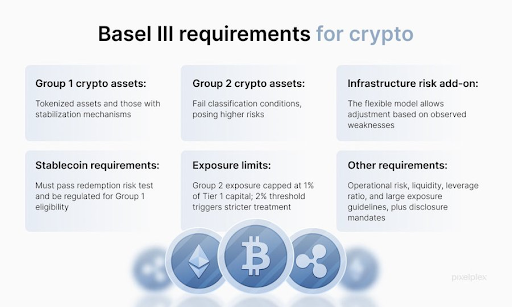
Right now, XRP currently falls into the Type 2 crypto exposure under Basel III, which is set up with rules for assets that pose higher risks. Under these rules, most cryptocurrencies, including XRP, fall into a high-risk category that carries a punitive capital requirement. Banks are required to apply a 1,250% risk weight to such assets, implying they must set aside far more capital than the value of the XRP itself.
This means that under the Basel III framework, for every $1 of XRP exposure, a bank must hold $12.50 in capital. This dynamic was recently explained by a crypto commentator with the name Stern Drew on the social media platform X.
In a post on X, Drew explained that this capital inefficiency alone accounts for years of institutional hesitation. The issue has not been demand nor technology, but the regulatory capital treatment that made holding XRP irrational from a balance sheet perspective.
The Regulatory Inflection Point
The conversation around XRP’s regulatory status is becoming increasingly important to its long-term outlook. Interestingly, Drew’s analysis goes further by pointing to what he describes as an inflection point that markets may be overlooking. Now that legal and regulatory clarity surrounding cryptocurrencies is improving, XRP could be reclassified into a lower-risk category under Basel III.
The endgame is that XRP is on a clear path to becoming a Tier-1 digital asset for global institutions, which is mostly for tokenized traditional assets and stablecoins with strong mechanisms. If that reclassification occurs, the economics will change immediately. XRP would become acceptable for direct balance sheet exposure, allowing banks to custody, deploy, and settle using the asset without the need of excessive capital.
This is not a discussion about short-term price movements but about capital mechanics that determine whether large pools of institutional money can participate in holding XRP at all. In this case, liquidity provisioning of XRP by banks would change from off-balance-sheet usage to direct institutional ownership.
Featured image created with Dall.E, chart from Tradingview.com
Can DOGE & SHIB Still Hit $10? One Can — Here’s The Simple Answer Why Yahoo Finance
Source link ]]>
Can DOGE & SHIB Still Hit $10? One Can — Here’s The Simple Answer Why Benzinga
Source link ]]>
Dogecoin, Ethereum, Litecoin: Mining Made Simple with Hashj cloud mining nerdbot
Source link ]]>
ZA Miner Introduces a Simple Approach to Dogecoin & Bitcoin Mining: Cloud Mining, No Hardware Required PR.com
Source link ]]>
How to Buy Shiba Inu Coin: A Simple Guide for Investors and Traders: Guest Post by Coinpaper.com CoinMarketCap
Source link ]]>
Staking Cardano $ADA – Quick and Simple Steps to Get Started Medium
Source link ]]>