Cardano Transaction Size Decrease Expected to Boost TPS Throughput: Trading Insights Blockchain News
Source link ]]>
Rollblock (RBLK) Announces Olympic Size Giveaway, Cardano (ADA) And Near Protocol (NEAR) Climb NewsBTC
Source link ]]>
The initial debate in the Bitcoin block size war revolved around a straightforward question “should Bitcoin undergo a hard fork to increase the block size limit from 1 MB to a larger value?” The proponents argued that raising the block size would enable Bitcoin to process more transactions, thereby reducing fees. However, this adjustment would also make it more difficult and costly to run and verify nodes, potentially centralizing the network.
The fundamental conflict highlighted Bitcoin’s identity crisis: whether it should prioritize being a low-fee transaction network akin to traditional payment processors or maintain its uniqueness as a decentralized currency free from central authority. Vitalik Buterin emphasized that an active governance structure, necessary for controversial changes like block size adjustments, could undermine Bitcoin’s core advantage of decentralization, making it susceptible to manipulation by miners, exchanges, or other large entities.
Vitaliks’ Overview Of Divergent Views: Small Blockers vs. Big Blockers
The crux of the disagreement between small blockers and big blockers lay in their governance philosophies and technical priorities. Small blockers valued the ease of running a node and maintaining decentralization, believing that Bitcoin should remain accessible to ordinary users. They feared that large players could dominate the network, compromising its decentralized ethos.
Conversely, big blockers prioritized lower transaction fees and scalability, arguing that larger blocks would keep Bitcoin affordable for users and prevent reliance on centralized layer-2 solutions. Bier portrayed small blockers as protectors of user sovereignty against powerful miners and exchanges, while Ver depicted big blockers as defenders of user affordability against entrenched, VC-funded interests like Blockstream. This ideological clash extended beyond technical specifics to a broader vision of Bitcoin’s future.
Also Read: Ethereum Price Soars Amid $40M Influx, Will The Momentum Sustain?
Lessons from Bitcoin’s Civil War and Broader Implications
Reflecting on the block size war, Buterin acknowledged merits on both sides: big blockers were correct about the need for larger blocks to prevent excessive transaction fees, while small blockers were more technically prudent and less prone to errors. The conflict underscored a recurring challenge in decentralized communities: achieving consensus without fracturing. He sighted the case of Bitcoin Cash, which split from Bitcoin to pursue larger blocks, illustrates the pitfalls of forking as a governance strategy.
Post-fork, Bitcoin Cash itself experienced further splits, highlighting the difficulty in maintaining unity and cooperation in decentralized movements. Buterin’s initiative, Zuzalu, aimed to foster constructive change in digital communities, emphasizing the need for execution over mere ideological alignment. He recommended reading both Bier’s “The Blocksize War” and Patterson and Ver’s “Hijacking Bitcoin” to grasp the significance of this pivotal moment in Bitcoin’s history and its implications for future digital nations.
Also Read: Ethereum Blockchain Version Of Bitcoin Has Presold 3.2M of 4-Million Tokens

The presented content may include the personal opinion of the author and is subject to market condition. Do your market research before investing in cryptocurrencies. The author or the publication does not hold any responsibility for your personal financial loss.
The Bitcoin block size just recorded its All-Time High (ATH) after clocking 3.97 MB amid the sustained Inscription hype.
Slipstream New Block Size Boost
According to an X post, Marathon’s new Slipstream service has broken the record for the largest-ever Bitcoin block size. The block size, which was measured in raw bytes, clocked in at 3,990.36 kB or 3.9 MB.
Notably, this figure came from the largest single transaction that was embedded in the network at that size. This transaction featured a large image inscription related to the Runestone airdrop.
Marathon’s new Slipstream service just broke the record for the largest ever Bitcoin block, measured in raw bytes, clocking in at 3,990.36 kB.
It contains the largest ever single transaction, at 3988.96 kB, a large image inscription related to the Runestone airdrop. pic.twitter.com/j8WWs69qIH
— mononaut (
/acc) (@mononautical) March 2, 2024
Blocks are batches of transactions that are first verified before being added to a public ledger. Miners are rewarded with incentives for filling blocks. The block size of all blockchains differs so ordinarily, a Bitcoin block size is typically about 1 MB while Bitcoin SV can be as high as 100 MB.
Initially, these Bitcoin blocks could carry as much as 36 MB of transaction data apiece. However, it was later reduced by Satoshi Nakamoto in 2010.
The motive behind the reduction of the block size was to mitigate threats of spam and potential denial-of-service (DOS) attacks on the network. As blocks started filling up fast, the need to break out of the 1 MB limit began to arise. The implementation of Segregated Witness (SegWit) made it technically possible to get Bitcoin size from 1 MB to 4 MB.
Implication of an Increase in Bitcoin Block Size
An increase in the block size such as the one seen by Slipstream is bound to have implications.
Per opinions from certain experts, increasing Bitcoin block size may lead to faster transactions with lower fees. Some argue that it could also lead to more transaction capacity to rival other payment systems while also boosting the flagship cryptocurrency for micropayments.
On the other hand, for a blockchain like Bitcoin which prioritizes decentralization and security, increasing its block size does not sound like a smart move to make. It is believed that it may lead to centralization and potentially jeopardize security.
This latest development on block size comes around the same time that mining difficulty hit $81 trillion. The increase in difficulty is necessary to maintain the target block time for Bitcoin. With the halving event only about two months away, it is expected that Bitcoin difficulty will increase further.


The presented content may include the personal opinion of the author and is subject to market condition. Do your market research before investing in cryptocurrencies. The author or the publication does not hold any responsibility for your personal financial loss.
Dogecoin Founder Refutes Rumors of His Wealth Size TradingView
Source link ]]>
Dogecoin Founder Refutes Rumors of His Wealth Size U.Today
Source link ]]>
Crypto ATM Market Size, Share & Trends Analysis Report 2023-2030 – Forecasts By Type (One Way, Two Way), Coin … PR Newswire
Source link ]]>

The Artificial Intelligence (AI) market is expected to continue growing in the coming years as demand from individuals and corporations rises. The most recent intelligence report on the industry showed that the market size stood at $207 billion in 2023 and that it will soar to almost $2 trillion by 2030.
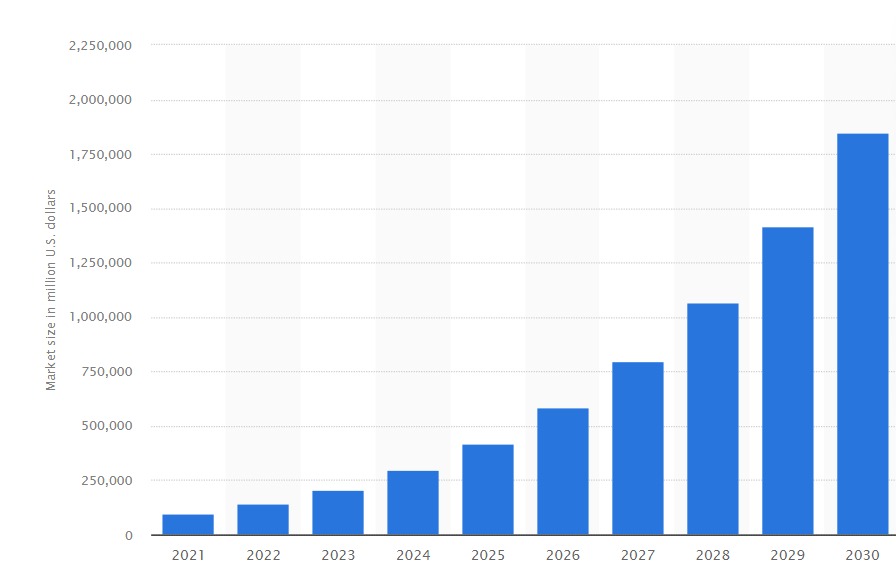
AI market to grow
The AI industry will continue growing as demand rises internationally. Analysts believe that AI models will disrupt all industries. For example, Hollywood actors and writers have gone on strike to protest the use of AI models in their work.
Many news organizations are now implementing AI in their operations. Besides, a well-trained AI model can now do a better job than most individuals. Most importantly, AI models will likely replace many financial analysts. Some quant hedge funds have found a lot of success using these models.
As a result, many companies are now investing heavily in AI. Microsoft spent over $10 billion investing in ChatGPT while Google has launched a similar platform. Apple has also built its own ChatGPT rival and is testing it internally.
Further, Elon Musk has launched xAI, a company that will build AI tools. And Nvidia, the biggest semiconductor company in the world, is building technologies that will power the AI industry.
It is unclear how the AI industry will affect the world in the future. While some analysts see it leading to job losses, others believe that it will create jobs in the long run.
AltSignals token sale continues
Meanwhile, investors from around the world are still investing in AltSignals. The token sale has now raised over $1.19 million in its second stage. This means that the developers have sold over 53% of their $2.25 million target. Each ASI token is going for 0.01875 USDT and the price will rise by 12.05% in the next stage.
AltSignals is a financial services company that is seeking to incorporate artificial intelligence in its processes. The existing product, which is highly accurate and has thousands of customers, will be upgraded with a more advanced AI one.
According to AltSignals white paper, the developers will use several advanced technologies like natural language processing (NLP) and machine learning to come up with predictions. The ecosystem will be powered by the ASI token.
For example, customers with more ASI tokens will receive more features like ActualizeAI, AltScalpPro, and discounts on all AI products. In the future, they will also be able to vote on key details in the ecosystem. You can buy the AltSignals token here.
Is it safe to buy ASI?
There are three main reasons why AltSignals will be the next big thing in the crypto industry. First, unlike meme coins that don’t have a utility, ASI has a real use in that it powers the AltSignals ecosystem.
Second, AltSignals is in industries that are growing fast: finance and AI. This year, we have seen many AI coins like SingularityNET and Fetch AI jump by more than 500%. Finally, AltSignals is a genuine company with thousands of customers and positive Trustpilot reviews.
Still, you should be cautious when investing in AltSignals and other token presales. One way to mitigate risks is to ensure that you are investing a small portion of your funds in it.
Ethereum, the world’s second-largest cryptocurrency by market capitalization, has witnessed a significant surge in its mean block size, reaching a new 1-month high. This milestone was recently announced by Glassnode, a renowned on-chain analysis platform.
The increase in block size indicates a notable improvement in Ethereum’s network capacity and transaction throughput, potentially bringing positive implications for the ecosystem.
Breaking Down The Block Size Surge
The mean block size of Ethereum has skyrocketed, surpassing the previous 1-month high recorded on May 27, 2023. Glassnode’s data reveals that the current mean block size stands at 121.4 million.

This surge highlights a substantial increase in the average data volume accommodated within individual blocks of the Ethereum blockchain.
Larger block size is indicative of Ethereum’s ability to handle more data and transactions per block, effectively enhancing the network’s capacity. With a higher average data volume in recent blocks, ETH showcases its potential for improved scalability and transaction throughput.
Ethereum’s surge in block size signifies a positive development for the ETH ecosystem, as it accommodates the growing demands and usage of the network.
What This Means For Ethereum
The surge in Ethereum’s mean block size holds several implications for ETH and its community. Firstly, it signifies the network’s continued growth and adoption. As more participants engage with the Ethereum blockchain, the increased block size demonstrates the platform’s ability to handle a higher volume of transactions, leading to enhanced efficiency and reduced congestion.
Moreover, the surge in block size also contributes to improved transaction throughput. With larger block sizes, more transactions can be included in each block, resulting in faster confirmation times and smoother user experiences.
This development is crucial for applications built on the Ethereum network, such as decentralized finance (DeFi) protocols, non-fungible token (NFT) marketplaces, and various other decentralized applications (dApps). It enables them to process a greater number of transactions within a given timeframe, fostering better scalability and usability.
Additionally, Ethereum’s increased block size may have a positive impact on gas fees. Gas fees, which are transaction fees on the Ethereum network, can be influenced by block size. A larger block size allows for the inclusion of more transactions, potentially alleviating congestion and reducing gas fees. This could lead to a more cost-effective and accessible environment for users and developers utilizing the Ethereum ecosystem.
Meanwhile, Ethereum has shown a possible brewing uptick in the past week. The second crypto asset by market capitalization has surged 2.3% in the past week. Over the past 24 hours, ETH has seen a 1.1% gain.
At the time of writing, Ethereum currently trades at $1,851. Ethereum’s trading volume has, however, ranged between $3 billion and $5 billion in the past seven days indicating a possible accumulation. Regardless, in the past 24 hours, ETH has had a trading volume of $5.5 billion.
-Featured image from Shutterstock, Chart from TradingView
Bitcoin prices might be firmer when writing on May 4, rallying above $29,000 and breaking above local resistance levels in lower time frames. But the Mean Transaction Size, based on the 7-day moving average, is at a 3-year low, according to Glassnode, a blockchain analytics firm.
Bitcoin’s Mean Transaction Size Crashing
The Mean Transaction Size relays the average transaction size over a given period. It can be used as a lead to gauge the level of activity. Typically, the higher the demand for BTC, the better the prices.
Considering the decentralized nature of public networks, including Bitcoin, transactions are packed in blocks before being confirmed and added to the longest chain.
The size of each Bitcoin block is fixed at 1 MB; therefore, the number of transactions that can be packed in a block directly depends on the size of each transaction. On average, BTC transactions can be between 300 and 400 bytes. Coupled with the set transaction processing time of roughly 10 minutes, transaction sizes, and by extension, the block size cap, directly impacts the network’s throughput.
A notable observation is that the mean transaction size in Bitcoin has been rapidly falling over the past few weeks. There was a sharp expansion from late January 2023 when the mean transaction size rose from around 590 to 1,195 in mid-February.
It then see-sawed in the following weeks, falling from 1,192 in late March to 820 in early April. It crashed to 467.949 on May 2, the lowest in three years.
#Bitcoin $BTC Mean Transaction Size (7d MA) just reached a 3-year low of 467.949
Previous 3-year low of 468.425 was observed on 02 May 2023
View metric:https://t.co/PJ0bkLTuVs pic.twitter.com/WNZE2VmaOM
— glassnode alerts (@glassnodealerts) May 4, 2023
Blame The Ordinals
The initial expansion in late January could be attributed to the launch of the Bitcoin Ordinals platform. The portal allows individuals to attach files, including texts, images, and videos, to Satoshis. Afterward, these files are stored in Bitcoin blocks after being confirmed by miners.
Because each file is unique and exists as a transaction, every Ordinal stored in a Bitcoin block has been compared to non-fungible tokens (NFTs), though they are not technically NFTs. And Dune data shows that over 3.5 million inscriptions have been added to the Bitcoin network.
However, while the number continues to rise, there is a marked shift in the types of files attached. In the early days of the Bitcoin Ordinals, there were more images, which were bigger than texts and other files, such as audio or applications.
Over the months, this has changed, and there are more text inscriptions. Texts are smaller in size than, for example, images or videos.
As such, this might explain the rapid drop in the mean transaction size based on the 7-day moving average, especially over the last few weeks from April 2023.
Feature Image From Canva, Chart From TradingView
✓ Share: