The crypto market is currently navigating through a turbulent phase, particularly for Ethereum, which has seen a significant downturn of nearly 15% in its value over the past week.
Amid this negative price performance, Peter Schiff, a well-known economist and a skeptic of cryptocurrencies, has chosen to add salt to the wounds by projecting a stark prediction for ETH. According to Schiff, Ethereum could plummet to as low as $1,500, marking a substantial decline from its current levels.
Related Reading
Shiff’s Bearish Outlook And Community Reaction
Schiff’s prediction comes when Ethereum is trading below the previous crucial support of $3,000 mark, a sharp 30% fall from its peak above $4,500 in March.
This decline coincides with heightened speculation surrounding the potential launch of an Ethereum spot exchange-traded fund (ETF), which seems to have triggered a premature sell-off among investors instead of propelling the price.
Schiff’s commentary suggests that the market’s response to the ETF rumors has been to liquidate positions rather than hold, adding further downward pressure on Ethereum’s price.
He expressed his view on Elon Musk’s social media platform, X, stating, “It looks like those buying the Ethereum ETF rumors couldn’t wait for the fact to sell,” indicating a market driven by speculation rather than sustained investment confidence.
While Schiff’s bearish outlook has garnered attention, it has also sparked a mix of skepticism and agreement within the crypto community. Users have expressed varying opinions on social media platforms, with some questioning the technical basis of Schiff’s $1,500 target.
Others humorously noted that Schiff’s pessimistic predictions often come at market bottoms, suggesting his views might inadvertently signal a buying opportunity. For instance, one user remarked on the irony of Schiff’s timing, indicating that his bearish predictions could contradict market sentiment indicators.
thx for your inputs
you do realize you only become relevant on this side of twitter as a bottom signal lol
youre like those acoustic wif kids who had a stroke on stage the wif party as a top signal
— agent pretzel (@agent_pretzel) July 5, 2024
Ethereum Faces Critical Juncture
Ethereum is experiencing a significant downturn, trading at $2,975—a 4.2% drop over the past day. This decline and Bitcoin’s similar trajectory have led to a 4.1% reduction in the global cryptocurrency market cap, erasing more than $200 billion in value.
According to Coinglass, this downturn has triggered substantial losses for traders, with 207,020 liquidations in the past day, totaling $576.53 million. Ethereum-related liquidations account for $134.58 million, predominantly from long positions.
While Peter Schiff’s outlook may seem too pessimistic amid these market conditions, another voice in the crypto analysis sphere, Inspo Crypto, offers a slightly more moderate view.
He notes that Ethereum’s price has fallen to early May levels and suggests that the next 8-hour trading window could be crucial in determining the market’s direction.
Related Reading
If Ethereum can rise above these levels, it might potentially ease the bearish trend. However, failure to reach the $3,170 mark (which it already has) could lead to further declines, possibly down to $2,700, exacerbating losses across the altcoin market.
$ETH has broken down below $3,170. The next 8 hours (1D candle) will show whether the bulls have given up or not. If the price retraces back above, we should consider this a deviation. But if $ETH instead retests the lower trend channel next at $3,170 unsuccessfully, it could… pic.twitter.com/1msfKQBf2v
— InspoCrypto (@InspoCrypto) July 4, 2024
Featured image created with DALL-E, Chart from TradingView
Crypto Market News: Despite recent industry demand for political entry, JP Morgan CEO Jamie Dimon is said to be not running for office any time soon, according to latest Bloomberg report. It is widely known that the CEO is not a big fan of the crypto market and the ecosystem around it. Recently, he had hinted about “one day serving public office,” which sparked a demand that he should probably run for president. Nevertheless, this can be seen as a relief for the digital assets industry participants.
Also Read: Apple Store Down Ahead Of WWDC, iOS 17, AR/VR Headset Expected To Be Unveiled
It was billionaire investor Bill Ackman who first suggested that Dimon could be the ideal face to run for the US presidential post. Earlier, CoinGape reported that having anti-crypto leaders like Dimon could be a major blow even as many leaders are supporting the cause for having clear regulation during campaign debates in the lead up to the US presidential election 2024.
Jamie Dimon Not Running For Office
Although it not entirely clear as to whether the political aspirations are put on hold for now or forever, a company spokesperson said the Wall Street bank CEO has no plans to run for office. Joe Evangelisti, a JP Morgan spokesperson, clarified that Dimon was not looking to make a political move. It may be recalled that the CEO called Bitcoin “a modern day fraud” while recognizing the capabilities of blockchain technology. According to the Bloomberg report, the spokesman said,
“As he has said in the past, Jamie has no plans to run for office. He is very happy in his current role.”
Meanwhile, further consensus among lawmakers is desperately needed to gain regulatory clarity around crypto ecosystem in the United States, in the lead up to the election year.
Also Read: Crypto Firm Integrates ChatGPT To Enhance Risk Detection, How AI Can Help Prevent Fraud?

AD

The presented content may include the personal opinion of the author and is subject to market condition. Do your market research before investing in cryptocurrencies. The author or the publication does not hold any responsibility for your personal financial loss.
Dogecoin (CRYPTO: DOGE) co-creator Billy Markus has applauded a Reddit poster for his comments that the “infinite inflation” arguments made against the meme cryptocurrency may be overblown.
What Happened: Markus took to Twitter to express his appreciation for the post on the Reddit forum “r/CryptoCurrency,” praising the Reddit user for his “research and math.”
See Also: How To Buy Dogecoin (DOGE)
It amuses me that, in order to fit in with the circle-jerk and give actual information and not be downvoted to oblivion, the author is forced to caveat everything with negative comments about DOGE whether or not they really believe them.
How to break into an echo chamber 101.
— Shibetoshi Nakamoto (@BillyM2k) August 27, 2021
The Reddit post by the user with the handle “u/JustDownInTheMines” noted that the percentage rate of Dogecoin created over the next few years will continuously decline since only a fixed number of 10,000 coins will always be added every minute.
Dogecoin will eventually drop to around 3% inflation in eight years and fall further, he added.
The user, u/JustDownInTheMines, said he wasn’t “not a fan” of Dogecoin and didn’t “recommend” it to people but that it’s important to “get every side of an argument.”
The Reddit user posed the question of whether the wider cryptocurrency community over-hypes the “infinite inflation argument” and whether Dogecoin’s token economics works for its use-case as a day-to-day transactions-enabler that competes with fiat currencies, rather than act as a store of wealth.
Why It Matters: Dogecoin often gets flake from within the cryptocurrency community over it being a high-inflation cryptocurrency, compared to a cryptocurrency like Bitcoin (CRYPTO: BTC), which is deflationary in nature.
However, Dogecoin’s supporters like Markus, Dallas Mavericks owner Mark Cuban and Tesla Inc. (NASDAQ:TSLA) CEO Elon Musk have defended Dogecoin’s infinite supply, saying it gives the cryptocurrency an advantage over Bitcoin and Ethereum (CRYPTO: ETH). They have also called for Dogecoin’s increased use in retail transactions.
In fact, the Shiba Inu-themed coin’s acceptance as a payment option by companies has gained momentum this year.
Kraft Heinz Co. (NASDAQ:KHC) subsidiary Oscar Mayer joined the companies capitalizing on the meme cryptocurrency’s popularity after its Dogecoin-themed hot dogs sold for $15,000 in an auction on eBay Inc. (NASDAQ:EBAY) earlier this month.
Price Action: Dogecoin is down 5.2% during the last 24 hours, trading at $0.2686 at press time.
Read Next: Dogecoin ‘Millionaire’ Plans To Go ‘All In’ On This Crypto Next
For more than a century, the stock market has been the undisputed leading wealth creator. While it may not surpass the returns of gold, housing, or bonds every year, it’s delivered the highest average annual return of these investment vehicles over the very long run.
But over the past decade, cryptocurrencies have stormed the investing scene and become a formidable challenger to stocks. In fact, some of the most widely followed digital currencies have produced five-and-six-digit percentage returns. This includes the “people’s currency,” Dogecoin (CRYPTO:DOGE), which galloped higher by 27,000% in a six-month stretch between early November 2020 and early May 2021.

Image source: Getty Images.
Dogecoin lacks a competitive edge
But not everyone is on board with the ascendance of cryptocurrencies. I consider myself a full-blown crypto skeptic. I don’t own any digital currencies, have no near-term plans to buy any, and believe the market to be in a massive bubble that’s in dire need of a shakeout.
Of all the digital currencies investors could put their money to work in, Dogecoin is the most baffling. That’s because it doesn’t do anything particularly well. In other words, if you want a network and tethered token to replace the existing financial infrastructure, it better offer clear-cut advantages. Dogecoin doesn’t offer any of that.
In no particular order:
- Dogecoin’s transaction fees are considerably higher than most popular cryptocurrencies.
- The average time needed to validate and settle transactions is slower than many of the same networks that have lower (or nonexistent) transaction fees.
- The average number of daily transactions completed on Dogecoin’s blockchain recently declined to a three-year low, demonstrating weak adoption.
- It has virtually no real-world use, with only a little over 1,400 mostly obscure business accepting it as payment.
I don’t see a future where Dogecoin plays a meaningful role in a transacting capacity.
This trio of cryptocurrencies has a more exciting future than Dogecoin
However, I do find a number of digital currencies and blockchain projects in the crypto space to be exciting. To reiterate, “exciting” doesn’t mean go out and buy it right now. As I stated, I believe the crypto market is wildly overvalued given how little functionality it’s thus far demonstrated in the real world. But given plenty of time, these following three cryptocurrencies could be success stories — and will almost certainly have run circles around Dogecoin.
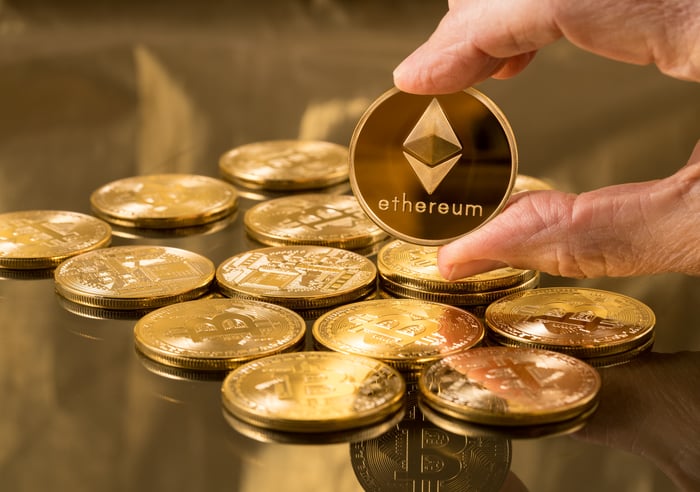
Image source: Getty Images.
Ethereum
I know I’m not going to win any points for originality here, but that’s not my intent, anyway. Ethereum (CRYPTO:ETH), the second-largest cryptocurrency by market cap, is arguably the most exciting digital currency.
The big selling point for Ethereum has long been its use of smart contracts. These are protocols that verify, facilitate, and enforce the negotiation of a contract. For instance, if two parties agree that a certain action should be executed when conditions are met, smart contracts can handle that. This might mean executing the wishes of a will many years down the line when a grandchild reaches a certain age, or perhaps reordering supplies for a business once a certain percentage of an item has sold.
For the time being, Ethereum is getting a lot of buzz due to its role in decentralized finance, or DeFi. DeFi aims to use smart contracts on a financially focused blockchain to bypass the financial intermediates that have the potential to slow transactions down or deny them entirely. But it’s Ethereum’s nonfinancial applications, and how it could streamline supply chains, that has me excited.
Notably, the Enterprise Ethereum Alliance has more than 100 members, each of which is focused on promoting the use of the Ethereum network. While some of these EEA members are banks — note that I’m not discounting the role Ethereum’s Ether token could play in the future — it’s far more telling that a large number of these businesses are in the tech sector or focused on logistics. This includes FedEx, Microsoft, SAP, and Advanced Micro Devices, to name a few.
Having the blockchain network with the greatest chance of real-world adoption makes Ethereum the no-brainer digital currency to monitor.
Image source: Getty Images.
Stellar
Something a bit more off the radar than Ethereum that has me excited is Stellar (CRYPTO:XLM). Stellar is the 22nd-largest crypto by market value ($8.4 billion), as of Sept. 1.
While Ethereum piqued my interest for its nonfinancial applications, Stellar and its Lumen coin are intriguing for its potential in the payments space.
With existing infrastructure, it can take up to one week to validate and settle a cross-border payment. Meanwhile, on Stellar’s blockchain, more than 180 different fiat currencies can be converted to Lumens, sent across oceans, and be completely validated and settled within a matter of seconds. What’s more, Stellar claims to be able to handle up to 3,000 transactions per second. For some context, that’s still a ways away from payment kingpin Visa, which can process up to 24,000 transactions per second. But compared to Dogecoin (40 transactions/second), Stellar offers serious validation and settlement advantages.
Despite this efficiency, fees to transact on Stellar are microscopic. The average transaction costs 0.00001 Lumen, equating to an average fee per transaction of approximately $0.000004. Put another way, it would take about 250,000 transactions for a user to rack up the equivalent of about $1 in fees. That’s insanely cheap given how effective this network could be.
The last thing to note about Stellar is that it’s garnered big-name project partners. In particular, Stellar partnered with IBM four years ago to facilitate blockchain-based international payments for a dozen major banks in the South Pacific region. Strictly speaking about the financial capabilities of blockchain, Stellar is a name to watch.

Image source: Getty Images.
Cardano
A third exciting cryptocurrency that appears to have a much brighter future than Dogecoin is Cardano (CRYPTO:ADA). Cardano is likely no stranger to crypto enthusiasts, as its ADA token has performed incredibly well, with a gain of more than 3,700% over the trailing year.
What strikes me as particularly interesting about Cardano is the transparency provided by its developers, and the clearly defined layered approach those developers are undertaking to further decentralize the network, improve adoption, and broaden the spectrum of use for blockchain technology.
Last year, Cardano’s developers launched the Shelley upgrade, which ultimately increased the number of nodes network participants could run. Since this upgrade was released, Cardano’s network has seen average transaction volume grow from between 1,000 and 3,000 transactions daily in 2019 to between 24,000 and 42,000 daily in 2021. While some of this is assuredly tied to the outperformance of its ADA coin, it’s also a clear sign of development yielding increased adoption.
However, what folks are really excited about is the Goguen update, which is expected to become mainstream this month. Goguen will incorporate smart contracts on Cardano’s blockchain, thereby opening up financial and nonfinancial applications for this top-performing cryptocurrency. Following Goguen, developers will be focused on improving the scalability of the network.
To reiterate, once more, my intrigue surrounding Cardano isn’t an endorsement to go out and buy the ADA token right now. But the transparent development process presented by Cardano hasn’t gone unnoticed. It’s definitely worth keeping an eye on as blockchain projects vie for real-world experience.
This article represents the opinion of the writer, who may disagree with the “official” recommendation position of a Motley Fool premium advisory service. We’re motley! Questioning an investing thesis — even one of our own — helps us all think critically about investing and make decisions that help us become smarter, happier, and richer.
]]>