What Solana and Cardano Failed to Fix, Zero Knowledge Proof (ZKP) Token Just Solved – Experts Project 6000x ZyCrypto
Source link ]]>

Ethereum co-founder Vitalik Buterin said the network has effectively “solved” the blockchain trilemma: decentralization, consensus, and high bandwidth, arguing that the missing ingredients are now live on mainnet or within reach as zero-knowledge Ethereum virtual machines (ZK-EVMs) move toward production use.
In a Jan. 3 post on X, Buterin framed the moment around two technical developments: PeerDAS, which he said is now live on Ethereum mainnet, and ZK-EVMs, which he described as being at an “alpha stage” with “production-quality performance” while “remaining work is safety.”
“These are not minor improvements; they are shifting Ethereum into being a fundamentally new and more powerful kind of decentralized network,” Buterin wrote. “To see why, let’s look at the two major types of p2p network so far.”
Buterin drew a contrast between early peer-to-peer systems that could scale throughput but lacked agreement on shared state, and blockchains that achieved robust consensus but paid for it with constrained bandwidth. He pointed to BitTorrent as a model of decentralized distribution without consensus, and to Bitcoin as a model of decentralization and consensus that keeps bandwidth low because “it’s not ‘distributed’ in the sense of work being split up, it’s replicated.”
Ethereum Will Solve The Blockchain Trilemma
The claim, in Buterin’s telling, is that Ethereum is entering a third category. “Now, Ethereum with PeerDAS (2025) and ZK-EVMs (expect small portions of the network using it in 2026), we get: decentralized, consensus and high bandwidth,” he said. “The trilemma has been solved — not on paper, but with live running code, of which one half (data availability sampling) is on mainnet today, and the other half (ZK-EVMs) is production-quality on performance today — safety is what remains.”
Buterin cast this as the culmination of a multi-year roadmap rather than a sudden breakthrough. He described it as a “10-year journey,” pointing back to early data availability sampling research and noting that ZK-EVM efforts began around 2020. The arc of his argument is that data availability sampling changes what a decentralized network can safely publish and verify at scale, while ZK-EVMs change how nodes can validate execution, shifting validation toward proof-based verification as the technology matures.
Looking ahead, Buterin laid out an approximate timeline for how he expects the vision to roll out over the next four years. In 2026, he expects “large non-ZKEVM-dependent gas limit increases” tied to BALs and ePBS, alongside what he described as the first opportunities to run a ZK-EVM node.
From 2026 through 2028, he anticipates a sequence of changes, gas repricings, adjustments to state structure, moving execution payloads into blobs, and other steps, aimed at making higher gas limits safe. Between 2027 and 2030, he expects “large further gas limit increases,” with ZK-EVMs becoming “the primary way to validate blocks on the network.”
He also flagged what he called a “third piece” of the puzzle: distributed block building. The long-term goal, he wrote, is a world where “the full block is never constituted in one single place,” though he stressed it “will not be necessary for a long time.” The nearer-term focus is distributing “meaningful authority in block building,” either through in-protocol mechanisms—he floated expanding FOCIL as a primary transaction channel—or through out-of-protocol systems such as distributed builder marketplaces.
For Buterin, distributing block building is not just an engineering preference but a risk and fairness question: he argued it would reduce the chance of “centralized interference with real-time transaction inclusion,” while creating “a better environment for geographical fairness.”
At press time, ETH traded at $3,164.
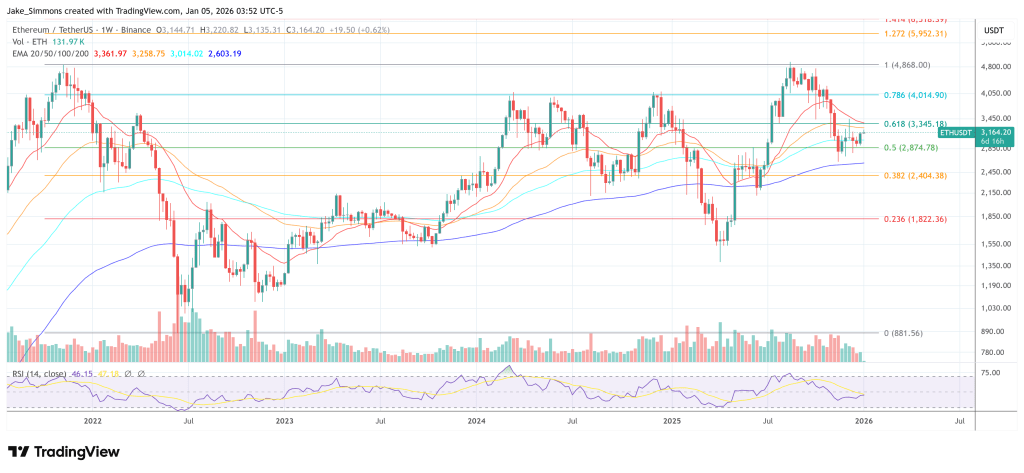
Featured image from YouTube, chart from TradingView.com
Editorial Process for bitcoinist is centered on delivering thoroughly researched, accurate, and unbiased content. We uphold strict sourcing standards, and each page undergoes diligent review by our team of top technology experts and seasoned editors. This process ensures the integrity, relevance, and value of our content for our readers.
Elon Musk Foresees Drop In Bitcoin, Dogecoin Prices If Dollar Inflation Solved: ‘What Matters Is The Ratio…’ Benzinga
Source link ]]>
Cardano’s NFT Metadata Challenge Solved by Paima Studios CoinTrust
Source link ]]>
In the 8-year history of Ethereum, there have been multiple mysteries that have made their way to the mainstream. However, one of the most popular of these is an ETH wallet that participated in the Ethereum ICO back in 2014 which has not seen any kind of activity since then.
Dormant Ethereum ICO Wallet Stumps Investors
In February 2023, X (formerly Twitter) user @jconorgrogan took to the platform to reveal a curious Ethereum wallet. This wallet, according to Conor, was the only ETH wallet that had participated in the ICO in 2015 and had not carried out any transactions since then.
The mystery behind the wallet further grew when community members discovered that it was carrying a total of 250,000 ETH. Records show that the wallet had bought this massive stash of ETH in 2014 for $75,000 and the value of the investment has since appreciated to over $470 million. Yet it has not been claimed, nor has the owner sold any coins.
One of the most mysterious addresses in all of crypto:
-Bought $75k worth of ETH at the ICO in ’14
-Completely untouched wallet; has never made a single transaction
-Wallet now worth $400M+, a 5333x
-Received $6.5M in airdrops just by hodling (a 87x on initial investment alone) pic.twitter.com/wBpw9pQcAB— Conor (@jconorgrogan) February 26, 2023
Not only had the wallet seen its initial investment grow exponentially, but it had also made millions of dollars in airdrops alone. Conor revealed that the wallet had received upwards of $6.5 million in airdrops, which, on its own, was already an 87x return on the original investment.
Following this first post, there were a number of theories for what might have made the investor not move any of the coins. These ranged from losing the private keys to the holder probably dying or in prison. However, Conor has finally uncovered the real story behind this wallet.
ETH remains firmly above $1,800 | Source: ETHUSD on Tradingview.com
Estonian Banking Magnate Loses Keys To ETH Wallet
Nine months after the initial tweet was made, Conor provided an update with an answer to who owns the $470 million ETH wallet and why they had not made any transactions. Like many speculated, it was actually a case of lost keys but the owner of the wallet was even more interesting.
Conor posted a screenshot of an interview with the founder of Estonian LHV Bank, Rain Lohmus, where he admitted that he had actually lost access to his Ethereum wallet holding 250,000 ETH. However, Lohmus doesn’t seem too phased by this given that he said he had not really tried to recover the wallet.
One mystery solved: This address (which now holds $450M of crypto) belongs to Rain Lohmus, founder of LHV Bank
Unfortunately he lost his keys and can’t access these 100s of millions. If you can help him recover them somehow, he’s willing to split them with you https://t.co/wYLAU9gKzb pic.twitter.com/0A1nIjFSyn
— Conor (@jconorgrogan) November 6, 2023
The LHV Bank founder also revealed that he is unable to solve the issue and get back his ETH. So he is open to sharing offers from anyone who believes that they will be able to access the wallet. On his own though, Lohmus’ plan is “to build Rain Lohmus as an AI and see if he can get his memories back.”
Nevertheless, the millionaire doesn’t seem too disturbed by this. “I don’t like things that result in zero or one. You can spend ten years on it, and it might end up with zero; it might end up with you solving a problem, but I prefer to do things where progress is visible on a daily basis.”

Key Takeaways
- Avalanche is the world’s fifteenth biggest cryptocurrency by market cap
- John Nahas, Vice President of Business Development at the firm behind Avalanche, Ava Labs joins the podcast
- He chats through launching so recently (2020), the bull and bear markets, attempting to solve the blockchain trilemma, Avalanche’s energy output, tribalism in crypto, regulation and more
The industry of cryptocurrency has not been around a long time. Bitcoin is the grandparent of the space, and yet it only launched thirteen years ago.
But even within this young industry, Avalanche stands out for its youth. Launched in late 2020 as the crypto bull market was beginning to rage, it has swiftly established itself among the top projects. Today, it’s the fifteenth biggest coin by market cap.
On the latest episode of the CoinJournal podcast, I interviewed John Nahas, Vice President of Business Development at Ava Labs, the creator of Avalanche.
We discussed the rollercoaster ride that has been crypto over the last couple of years, and how it was to launch into such an auspicious market environment. Of course, we also then chatted about the recent bear market and how this has been for the project, as well as crypto as a whole.
One thing I enjoyed: pouring cold water on the toxic tribalism that crypto has a soft spot for. I’ve written extensively about this partisan attitude, the “my coin is better than your coin” attitude that crypto has. This maximalism is something that irks John too, as he quickly dispelled the “ETH killer” narrative that has been floated about for Avalanche and other blockchains in the space.
We talked about the technical of Avalanche, and why John believes it has solved the blockchain trilemma. John also touched on the energy side of things, a sort of add-on to the trilemma which has only grown louder in recent years, with certain cryptos coming under pressure for their large energy bills.
We also discussed the grey area that is regulation, and specifically for Avalanche, how staking could be affected. John stressed the recent penalties against Kraken were for failures to properly disclose, rather than against the act of staking itself.
These are just a few of the bigger topics which we covered. If you are interested in Avalanche, feel free to listen.
Listen to the podcast on various platforms here:
Listen on Spotify here:
Follow Avalanche: @AvalancheAvax
Find out more at www.avax.network/community
Follow Ava Labs: @AvaLabsOfficial
Follow John @SJohh_Nahas
Popular cryptocurrency Dogecoin creator Billy Markus aka Shibetoshi Nakamoto, on Tuesday, took a dig at the United States government’s currency policy. Launching a two-sided attack on the US government, Markus claimed that the government printed three trillion dollars in 2020 and asked why it didn’t solve world hunger. Apart from the indication of rising inflation in the country, the statement also questioned the recent row which featured United Nations representatives claiming that billionaires could solve world hunger.
“The us government printed 3 trillion dollars in 2020 so I’m not sure why world hunger isn’t solved,” the Dogecoin creator tweeted. His comment came after Tesla CEO and Dogecoin investor Elon Musk took a jibe at the UN relating to a world hunger claim. Last week, David Beasley, the director of the UN’s World Food Programme, in an interview with CNN claimed that the ‘ultra-wealthy’ to stop world hunger by donating a sum to the program. He had specifically mentioned Musk and Amazon founder Jeff Bezos, two of the richest men on the planet.
the us government printed 3 trillion dollars in 2020 so I’m not sure why world hunger isn’t solved
— Shibetoshi Nakamoto (@BillyM2k) November 2, 2021
However, Elon Musk on Sunday while replying to a Twitter user who claimed that USD 6 billion would be just 2 per cent of Tesla CEO’s net worth, took a jibe at the WFP. He claimed that he will sell Tesla stocks and donate the sum if the UN could describe “exactly” how the donation would solve world hunger. Following the event, Billy Markus aka Shibetoshi Nakamoto has now put out a statement taking a jibe at the US government regarding the same. Apart from ‘solving the world hunger’ claim, Markus’ statement also questioned the rising inflation in the US. The cryptocurrency community have always been sceptical of the governments printing more currency and have often spoken against the same.
If WFP can describe on this Twitter thread exactly how $6B will solve world hunger, I will sell Tesla stock right now and do it.
— Elon Musk (@elonmusk) October 31, 2021
What is Dogecoin?
Dogecoin is a cryptocurrency that was originally formed in 2013. The face of DOGE was the dog Shiba Inu, who became popular as the DOGE meme. It literally became a ‘meme cryptocurrency’. However, Dogecoin grew in popularity because of the community surrounding it was massive and they basically made DOGE look like the money of the future. More than anything, DOGE helped to spread awareness about the value and importance of blockchain technology and cryptocurrency among millions of people worldwide. Today, Dogecoin has become one of the most popular cryptocurrencies currently trading at Rs. 21.61.
Image: AP/ Unsplash
Today we’ll be discussing just what kind of impact that “Metaverse” systems will have on the world. Are we close to a Ready Player One scenario? We’ll be discussing Bitcoin and green energy. Is there any correlation? Finally, where is all the Ethereum going? Exchanges are running out. What does this mean for the ETH price?
Don’t forget to check out our guests’ socials!
Rice TVx:
https://www.youtube.com/c/RICETVx/videos
Tweets by RiceTVx
Crypto Stache:
https://www.youtube.com/c/CryptoStache
Tweets by CryptoStache
Mega Crypto:
https://www.youtube.com/c/MegaCrypto/featured
Tweets by bugrasukas
Intro music by Gregario Franco. Song – Nacht
https://gregoriofranco.bandcamp.com/
**NEW CRYPTO GIVEAWAY**
We’re giving away 5 ETH when the Bitsquad community breaks 5 million total across all platforms!  https://gleam.io/QoxHy/5-eth-to-5-million-giveaway
●▬▬▬▬▬▬▬▬▬▬▬▬▬▬▬▬▬▬▬▬▬▬▬▬▬▬▬▬●
Connect with Me & the BitSquad!
Join the BitSquad http://t.me/BitSquad
Join the BitBoy Lab http://discord.BitBoy.Live
Join BitSquad Traders http://t.me/BitSquadTraders
Join Me on Twitter https://twitter.com/Bitboy_Crypto
Join Me on Instagram https://www.instagram.com/bitboy_crypto
Join Me on TikTok https://www.tiktok.com/@BitBoyCrypto
●▬▬▬▬▬▬▬▬▬▬▬▬▬▬▬▬▬▬▬▬▬▬▬▬▬▬▬▬●
ByBit, Market Cipher, Ledger, TokenMetrics, Crypto.com & more!
Find deals on hardware wallets, trading indicators, exchanges & more.
Find Crypto DEALS https://bitboycrypto.com/deals
●▬▬▬▬▬▬▬▬▬▬▬▬▬▬▬▬▬▬▬▬▬▬▬▬▬▬▬▬●
All of our videos are strictly personal opinions. Please make sure to do your own research. Never take one person’s opinion for financial guidance. There are multiple strategies and not all strategies fit all people. Our videos ARE NOT financial advice.
source