Cardano Founder Hoskinson: Cardano and Bitcoin Are Both Sound Money CoinCentral
Source link ]]>
Cardano Founder Charles Hoskinson Defends ADA As Sound Money The Coin Republic
Source link ]]>
Why a 10x Run for Shiba Inu (SHIB) and a 21530% Surge for Rexas Finance (RXS) Aren’t as Crazy as They Sound The Tribune
Source link ]]>
Worse Than 2008’ – Cardano, Pepe, Hedera, XRP on Edge as Experts Sound Financial Crisis Alarm BanklessTimes
Source link ]]>
Dogecoin ETFs Aren’t as Crazy as They Sound, Analysts Say Decrypt
Source link ]]>
Ethereum (ETH) which is addressed as ultra-sound money due to its deflationary supply method, now appears to be facing new challenges that have prompted some analysts to question whether this narrative still holds.
A prominent crypto analyst, Thor Hartvigsen, recently highlighted this issue in a detailed post on X, where he discussed the current state of Ethereum’s fee generation and supply dynamics.
Is ETH No longer Ultra-Sound money?
Hartvigsen pointed out that August 2024 is “on track to be the worst month in terms of fees generated on the Ethereum mainnet since early 2020.” This decline is largely attributed to the introduction of blobs in March, which allowed Layer 2 (L2) solutions to bypass paying significant fees to Ethereum and ETH holders.
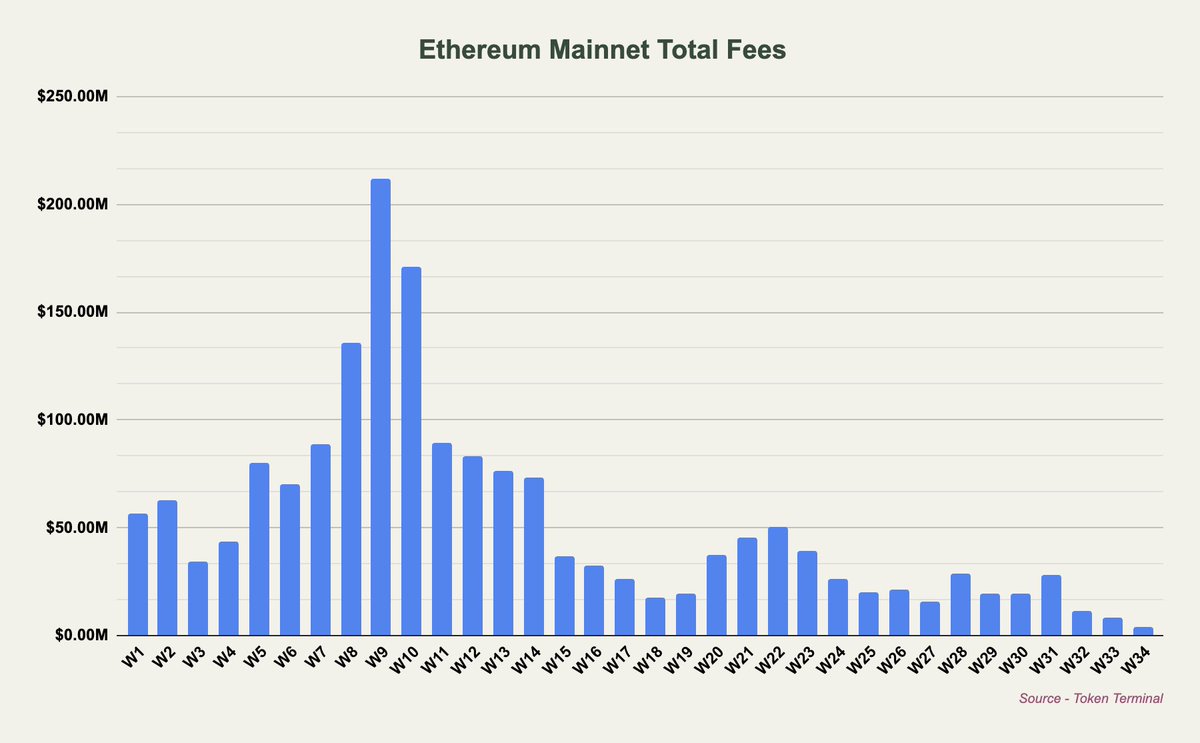
As a result, much of the activity has shifted from the mainnet to these layer two (L2) solutions, with most of the value being captured at the execution layer by the L2s themselves.
Consequently, Ethereum has become net inflationary, with an annual inflation rate of approximately 0.7%, meaning that the issuance of new ETH currently outweighs the amount being burned through transaction fees.
Hartvigsen disclosed the impact of this on Non-Stakers and Stakers: According to the analyst, non-stakers primarily benefit from Ethereum’s burn mechanism, where base fees and blob fees are burned, reducing the overall supply of ETH.
However, with blob fees often at $0 and the base fee generation decreasing, non-stakers are seeing less benefit from these burns. At the same time, priority fees and Miner Extractable Value (MEV), which are not burned but rather distributed to validators and stakers, do not benefit non-stakers directly.
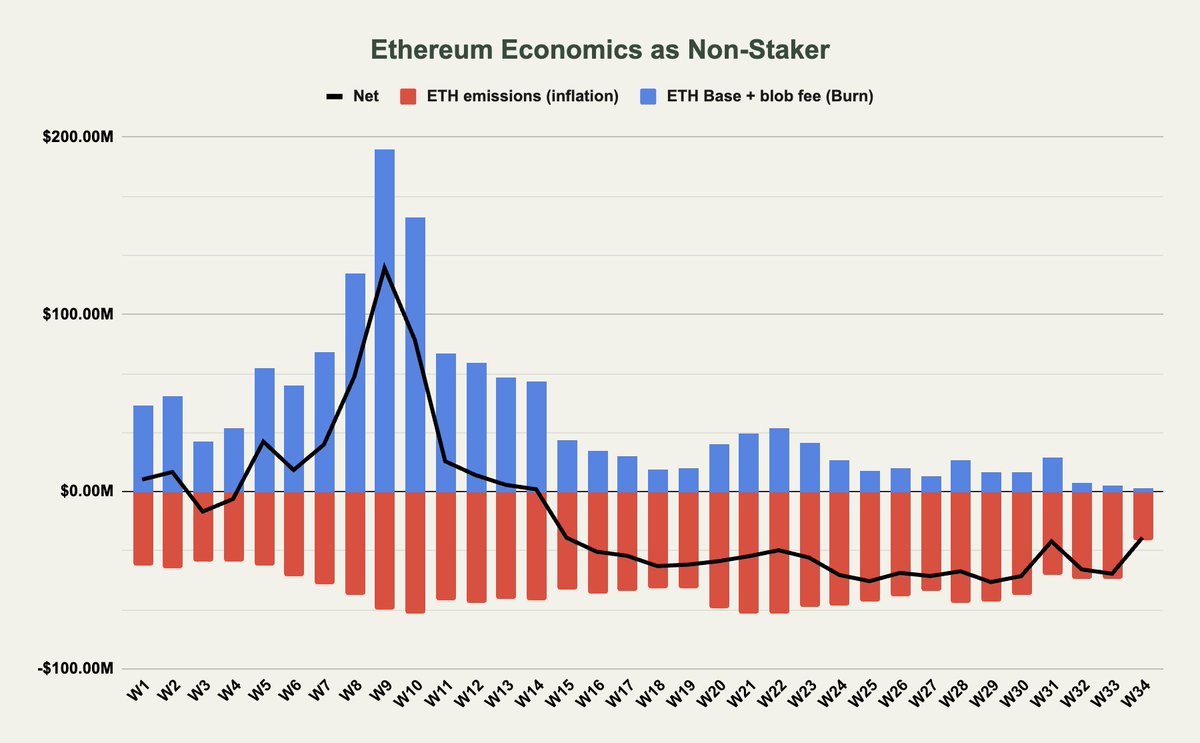
Additionally, the ETH emissions that flow to validators/stakers have an inflationary effect on the supply, which negatively impacts non-stakers. As a result, the net flow for non-stakers has turned inflationary, especially after the introduction of blobs.
For stakers, the situation is somewhat different. Hartvigsen revealed that stakers capture all the fees, either through the burn or via staking yield, meaning that the net impact of ETH emissions is neutralized for them.
However, despite this advantage, stakers have also seen a significant drop in the fees flowing to them, down by more than 90% since earlier this year.
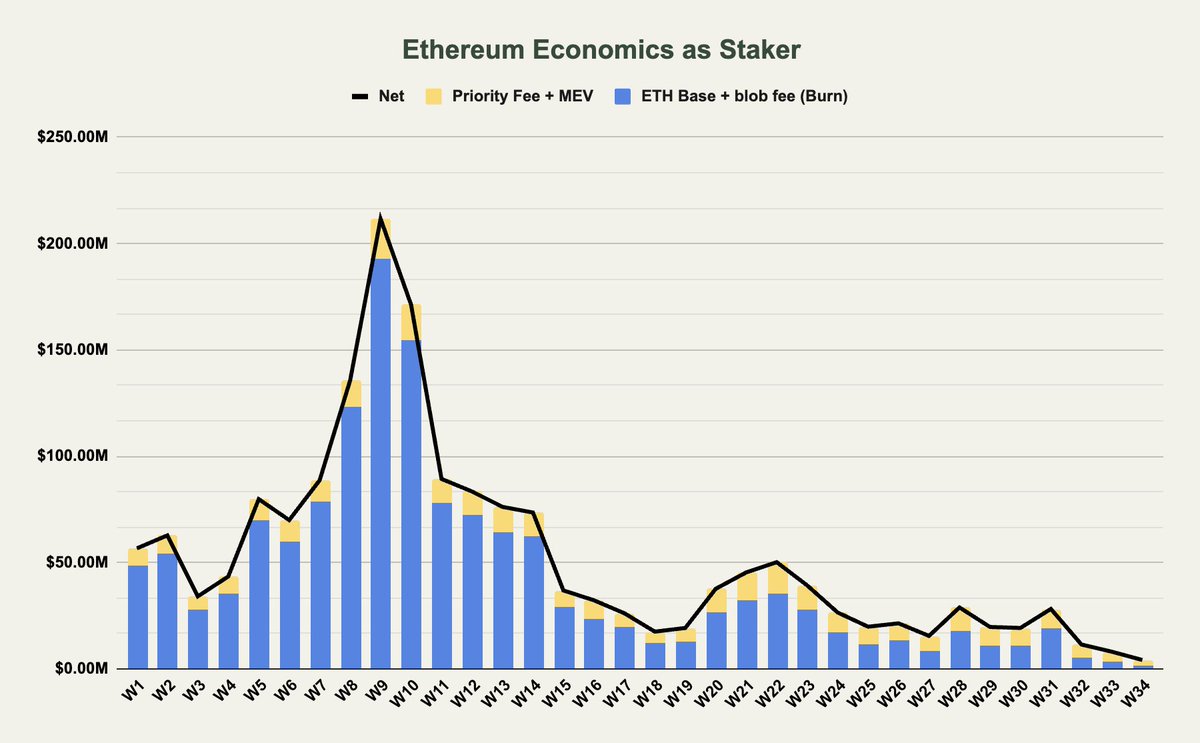
This decline raises questions about the sustainability of the ultra-sound money narrative for Ethereum. To answer that, Hartvigsen sated
Ethereum no longer carries the ultra sound money narrative which is probably for the better.
What’s Next For Ethereum?
So far, it is quite evident with the current trends that Ethereum’s ultra-sound money narrative may no longer be as compelling as it once was.
With fees decreasing and inflation slightly outpacing the burn, Ethereum is now more comparable to other Layer 1 (L1) blockchains like Solana and Avalanche, which also face similar inflationary pressures, says Hartvigsen.
Hartvigsen notes that while Ethereum’s current net inflation rate of 0.7% per year is still significantly lower than other L1s, the decreasing profitability of infrastructure layers like Ethereum may necessitate a new approach to maintaining the network’s value proposition.
One potential solution the analyst discussed is increasing the fees that L2s pay to Ethereum, though this could pose competitive challenges. Concluding the post, Hartvigsen noted:
Zooming out, infra-layers are in general unprofitable (study Celestia generating ~$100 in daily revenue), especially if viewing inflation as a cost. Ethereum is no longer an outlier with a net deflationary supply and, like other infra-layers, require another way to be valued.
Featured image created with DALL-E, Chart from TradingView
Millionaire Status Sound Good In 2024? Check Out Pushd’s (PUSHD) Presale; Litecoin (LTC) And Shiba Inu (SHIB … Crypto Reporter
Source link ]]>
Will meme coins like Shiba Inu get beaten by technically sound … Analytics Insight
Source link ]]>
Cardano (ADA) is “silently positioning itself as the most sound, secure, & scalable blockchain,” according to Dan Gambardello, Founder of Crypto Capital Venture, on Thursday (May 12). On May 12, Gambadello, who has long been a huge fan of this blockchain and is a respected member of the ADA community, told his over 225K Twitter followers:
#Cardano is silently positioning itself as the most sound, secure, & scalable blockchain.$ADA
— Dan Gambardello (@cryptorecruitr) May 12, 2022
Earlier today (May 14), he tweeted that “we are watching #Cardano blockchain explode with innovation” and went on to say that “one project which acts as a community-run launchpad is now playing a big role in that innovation.” He was referring to Cardashift (CLAP), “a community-run launchpad that raises funds, builds and accelerates startups that are solving social and environmental issues.”
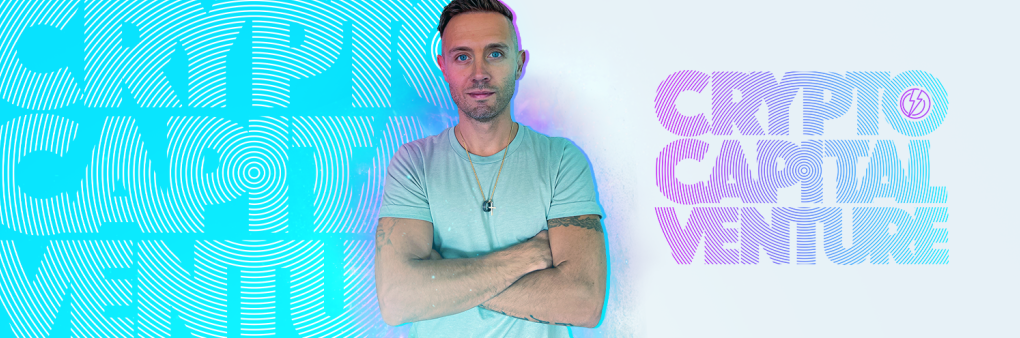 Dan Gambardello
Gambadello also hosts the well-known YouTube channel “Crypto Capital Venture.”
Charles Hoskinson, Co-Founder, and CEO of IOG produced a video on his YouTube channel on April 12 that provided an update on many topics of interest to ADA HODLers.
On February 1, John Woods, Director of Cardano Architecture at IOG, published a blog post, in which he introduced pipelining:
“Pipelining is just one of the pillars supporting Cardano’s scaling this year. Combined, all these changes will lead Cardano to a position where it is faster than its competitors, and a highly competitive platform for decentralized finance (DeFi) this year.“
As you may recall, back in March, Hoskinson said on Twitter that many DeFi Apps are waiting for the Vasil Hard Fork combinator (HFC) event, and when that happens, we should grow even more impressive to see in Cardano TVL.
What most also don’t understand is that many Cardano DApps are waiting for the Vasil hardfork in June to launch to benefit from pipelining. So it seems we ain’t seen nothing yet on TVL https://t.co/mMHxwRrF96
— Charles Hoskinson (@IOHK_Charles) March 12, 2022
By the way, just in case you were wondering why the June Hard Fork was called “Vasil” on December 10, 2021, Hoskinson explained that he was going to pay tribute to his Bulgarian friend and Cardano ambassador Vasil Dabov who received recently died, naming the June Hard Fork after him. Dabov was a blockchain consultant, a Haskell practitioner, and an experienced ginkgologist.
DISCLAIMER: The Information on this website is provided as general market commentary and does not constitute investment advice. We encourage you to do your own research before investing.
Join CoinCu Telegram to keep track of news: https://t.me/coincunews
Follow CoinCu Youtube Channel | Follow CoinCu Facebook page
Harold
CoinCu News
Original Source: https://news.coincu.com/88893-dan-gambardello-calls-cardano/
Disclaimer: Cardano Feed is a Decentralized News Aggregator that enables journalists, influencers, editors, publishers, websites and community members to share news about the Cardano Ecosystem. User must always do their own research and none of those articles are financial advices. The content is for informational purposes only and does not necessarily reflect our opinion.