Bitcoin price extended its decline below $73,500. BTC is now consolidating losses but faces many hurdles near $75,500.
- Bitcoin is attempting to recover but struggling to clear hurdles.
- The price is trading below $75,000 and the 100 hourly simple moving average.
- There is a bearish trend line forming with resistance at $75,200 on the hourly chart of the BTC/USD pair (data feed from Kraken).
- The pair might dip again if it trades below the $72,000 and $71,200 levels.
Bitcoin Price Dips Further
Bitcoin price failed to remain stable above the $75,000 zone. BTC extended its decline below the $74,000 and $73,500 levels. The bears were able to push the price below $72,500.
A low was formed at $71,532, and the price is now consolidating losses. The current price action is negative below the 23.6% Fib retracement level of the recent downward move from the $76,866 swing high to the $71,532 low. There is also a bearish trend line forming with resistance at $75,200 on the hourly chart of the BTC/USD pair.
Bitcoin is now trading below $75,000 and the 100 hourly simple moving average. If the price remains stable above $72,000, it could attempt a fresh increase. Immediate resistance is near the $72,850 level. The first key resistance is near the $74,200 level.
A close above the $74,200 resistance might send the price further higher. In the stated case, the price could rise and test the $75,000 resistance or the 61.8% Fib retracement level of the recent downward move from the $76,866 swing high to the $71,532 low.
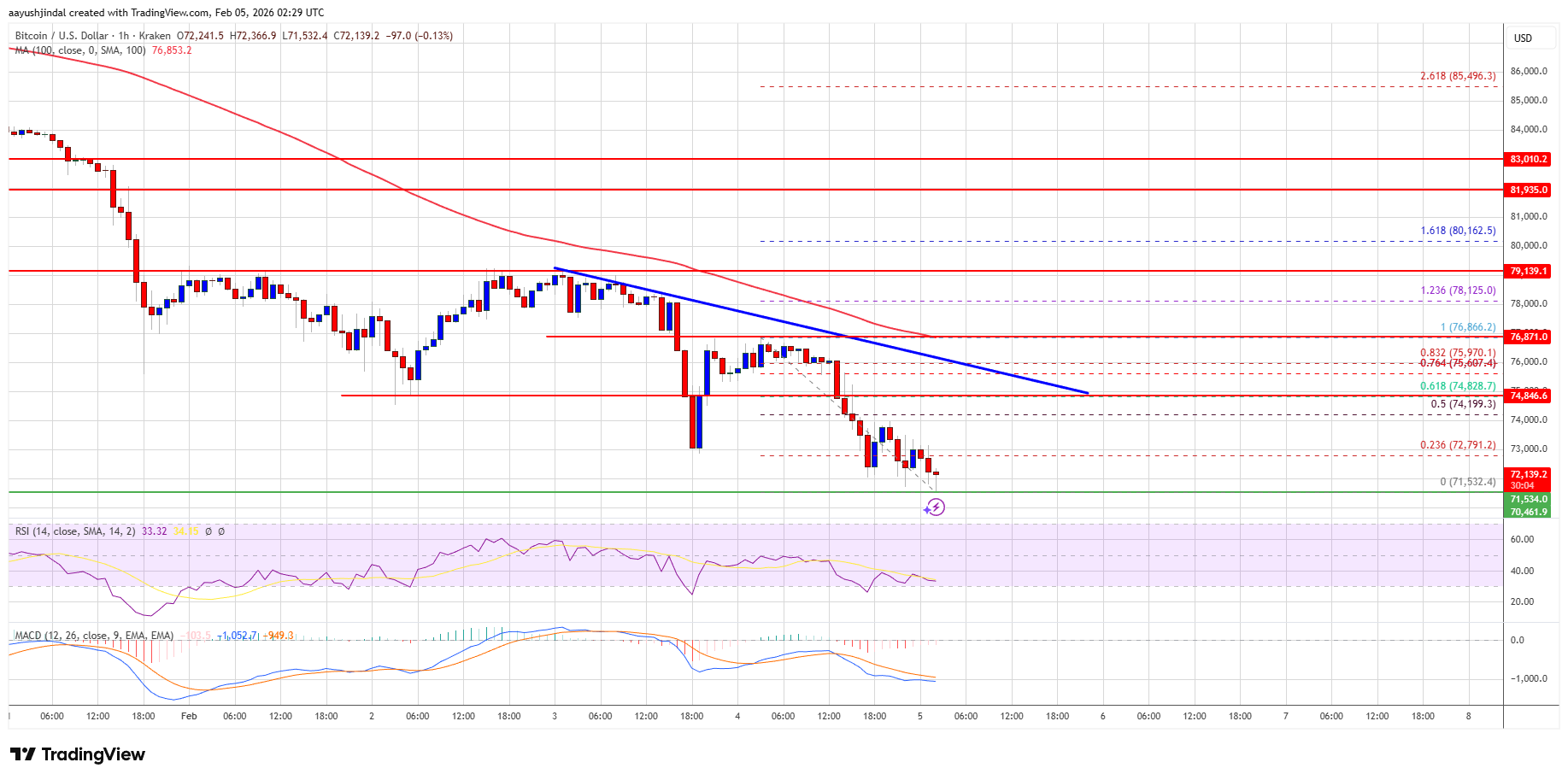
Any more gains might send the price toward the $75,500 level and the trend line. The next barrier for the bulls could be $76,850 and $78,000.
Another Decline In BTC?
If Bitcoin fails to rise above the $75,000 resistance zone, it could start another decline. Immediate support is near the $72,000 level. The first major support is near the $71,200 level.
The next support is now near the $70,500 zone. Any more losses might send the price toward the $70,000 support in the near term. The main support now sits at $68,000, below which BTC might struggle to recover in the near term.
Technical indicators:
Hourly MACD – The MACD is now gaining pace in the bearish zone.
Hourly RSI (Relative Strength Index) – The RSI for BTC/USD is now below the 50 level.
Major Support Levels – $72,000, followed by $71,200.
Major Resistance Levels – $72,850 and $74,200.

Ethereum continues to struggle to regain bullish momentum as apathy and persistent selling pressure dominate the broader crypto market. Price action remains subdued, with ETH failing to sustain moves above key resistance levels, reinforcing the perception that investors are still cautious.
Many analysts argue that the market has yet to fully reset, pointing to weak risk appetite, declining liquidity, and a lack of strong spot demand. As a result, Ethereum, like most major assets, remains trapped in a consolidation phase marked by hesitation rather than conviction.
Despite this gloomy backdrop, a growing group of optimists believes Ethereum could be approaching a cyclical bottom. Their view is based less on short-term price action and more on structural and behavioral signals that tend to emerge during late-stage bearish phases. One of the most notable developments comes from on-chain data.
According to data from Arkham shared by Lookonchain, Bitmine acquired another 32,938 ETH worth approximately $97.6 million just a few hours ago. Bitmine is a large institutional Ethereum-focused entity known for accumulating ETH at scale and deploying it across staking and long-term strategies rather than short-term trading. With this latest purchase, Bitmine now holds roughly 3.357 million ETH, valued at around $10 billion, making it one of the largest known Ethereum holders.
Bitmine Deepens Long-Term Commitment
Ethereum’s near-term price action remains fragile, but institutional behavior continues to diverge from market sentiment. Over the past few hours, Bitmine staked an additional 118,944 ETH, worth approximately $352.16 million, according to data from Arkham reported by Lookonchain. This move follows Bitmine’s recent spot accumulation and reinforces its long-term positioning strategy rather than a short-term speculative approach.

Staking at this scale effectively removes a significant amount of ETH from liquid circulation, tightening available supply on exchanges. Unlike transfers to centralized platforms, staking reflects a high-conviction view that prioritizes yield generation and long-term network participation over immediate liquidity.
For analysts tracking structural supply dynamics, this behavior contrasts sharply with the current price trend, which continues to show limited bullish follow-through.
Despite these developments, the broader market remains unconvinced. Ethereum has struggled to reclaim key resistance levels, and momentum indicators still point to weakness. As a result, analysts are increasingly divided when assessing the outlook for 2026.
Some interpret ongoing institutional accumulation and staking as early positioning ahead of a longer-term recovery cycle. Others caution that macro uncertainty, muted demand, and persistent risk aversion could keep ETH range-bound or under pressure for longer than expected.
In this context, Bitmine’s actions stand out as a signal of long-term confidence, but not necessarily an immediate catalyst. For now, Ethereum’s price remains weak, while the strategic behavior beneath the surface continues to quietly reshape the supply landscape.
Ethereum Remains Range-Bound Below Key Resistance
Ethereum continues to trade in a consolidation range after failing to reclaim higher levels, with price hovering around the $3,000 zone. The chart shows ETH capped below the declining 100-day and 200-day moving averages, which now act as dynamic resistance around the $3,400–$3,600 area. This alignment reinforces the broader bearish structure that has been in place since the November breakdown.
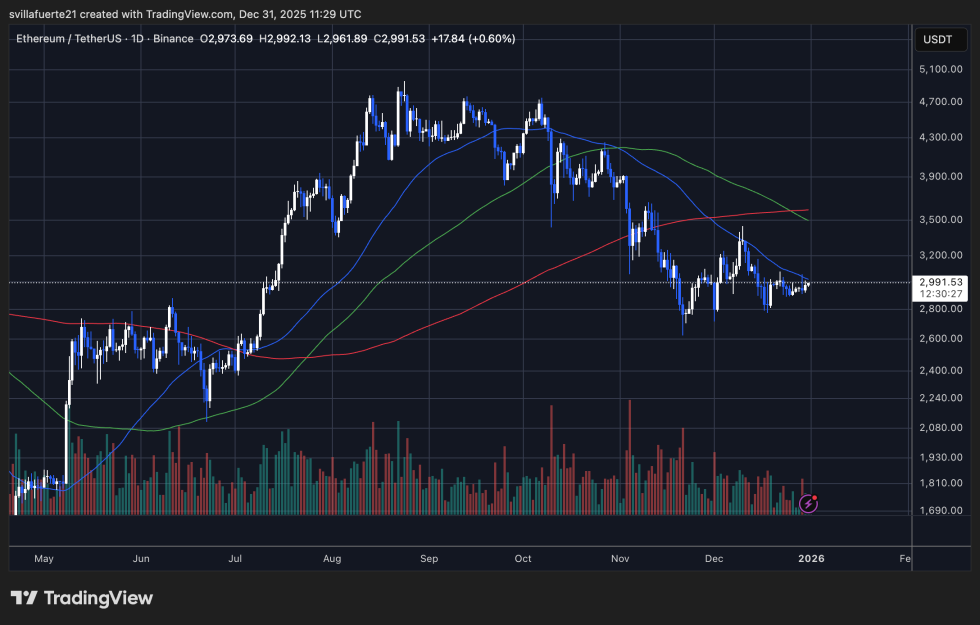
After peaking near the $4,800 region earlier in the cycle, ETH entered a clear downtrend, marked by lower highs and expanding sell-side volume during corrective phases. The sharp sell-off into late November pushed the price toward the $2,800 area, where buyers stepped in to defend support. Since then, Ethereum has stabilized but failed to generate sustained upside momentum, suggesting demand remains cautious rather than aggressive.
Volume has declined noticeably during recent rebounds, indicating a lack of strong conviction from buyers. This behavior is typical of late-stage corrective phases, where price compresses while market participants wait for clearer signals. As long as ETH remains below the 200-day moving average, upside attempts are likely to face selling pressure.
On the downside, the $2,800–$2,900 zone stands out as a key support area. A clean break below this range would increase the risk of a deeper retracement. Conversely, reclaiming $3,300 with strong volume would be the first sign that Ethereum is transitioning out of its current corrective structure.
Featured image from ChatGPT, chart from TradingView.com
Editorial Process for bitcoinist is centered on delivering thoroughly researched, accurate, and unbiased content. We uphold strict sourcing standards, and each page undergoes diligent review by our team of top technology experts and seasoned editors. This process ensures the integrity, relevance, and value of our content for our readers.
Ethereum is trading at critical levels after a period of heightened volatility that has left traders and investors on edge. The price has been swinging between key resistance and support zones, reflecting a market torn between optimism for another leg higher and caution over potential short-term corrections. While sentiment remains divided, on-chain data paints a more confident picture behind the scenes.
Related Reading
According to recent reports, large holders and institutions continue to accumulate ETH, reinforcing the idea that the current market uncertainty may be viewed by many as an opportunity rather than a threat. At the same time, staking activity remains consistently strong, signaling long-term conviction among Ethereum’s most committed participants. The ongoing rise in staked ETH highlights confidence in the network’s security, yield potential, and role as a foundation for decentralized finance.
As Ethereum hovers near decisive price levels, the market appears to be preparing for a breakout in either direction. Whether the next move favors bulls or bears, one thing is clear — Ethereum’s fundamentals remain resilient, and the persistent accumulation by major players could serve as a powerful anchor for the next major trend once market sentiment aligns.
Grayscale Stakes Ethereum: A Strong Signal Of Confidence
According to Lookonchain, Grayscale (ETHE and ETH ETF) has staked an additional 857,600 ETH, worth approximately $3.83 billion, once again signaling major institutional conviction in Ethereum’s long-term potential. This move underscores the growing alignment between traditional finance and blockchain infrastructure, as large-scale players continue to embrace Ethereum’s proof-of-stake model not just as an investment, but as a yield-generating and network-participating strategy.
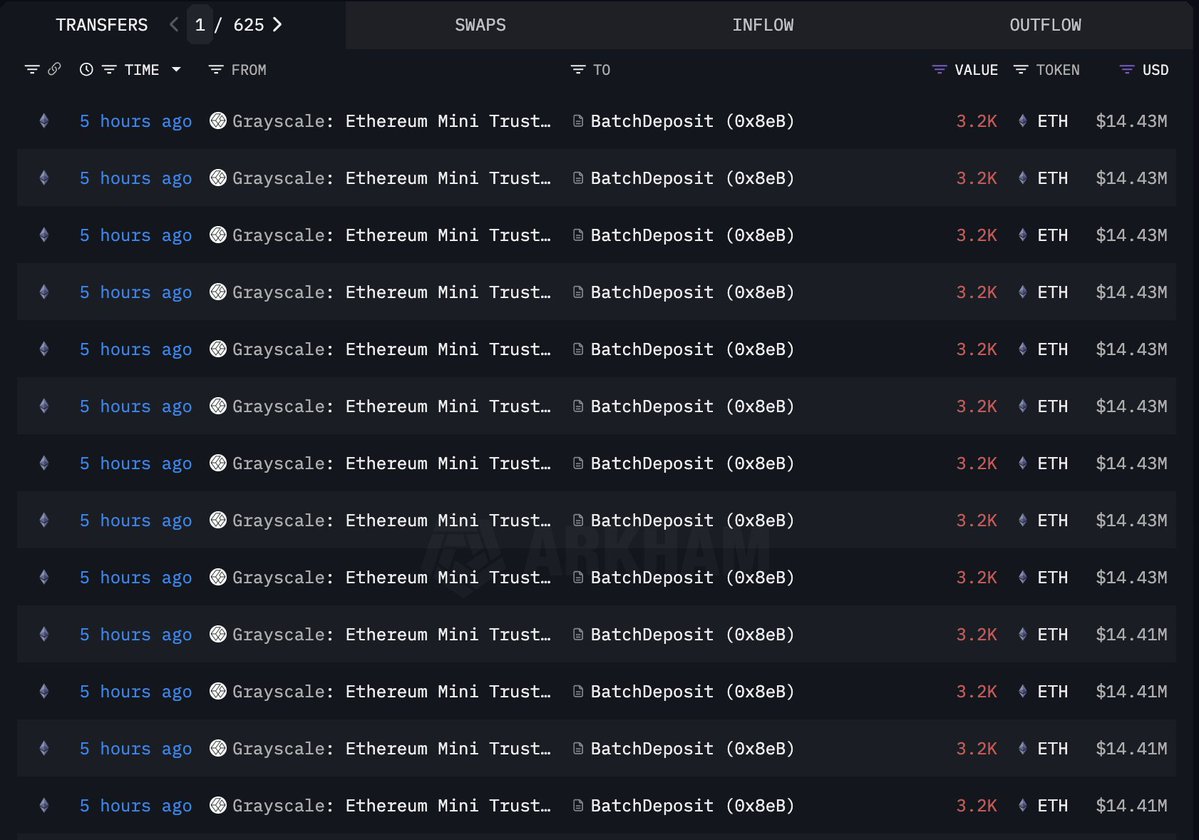
This massive staking operation carries several implications for the market. First, it effectively reduces circulating supply, since staked ETH is locked and cannot be easily sold. This dynamic strengthens Ethereum’s deflationary pressure, especially in a context where network activity and gas usage remain elevated. At the same time, the scale of this move reveals increasing institutional participation in Ethereum’s ecosystem, suggesting that the asset is being viewed less as a speculative instrument and more as digital infrastructure — a key component of the emerging tokenized economy.
From a market perspective, this decision comes during a period of volatility and consolidation, where Ethereum’s price action has struggled to establish a clear direction. However, such sustained institutional staking serves as a stabilizing force, reflecting confidence that the asset’s intrinsic value continues to grow regardless of short-term fluctuations.
In essence, Grayscale’s renewed staking push reinforces Ethereum’s position as the institutional cornerstone of DeFi and Web3, even as market sentiment remains mixed. If accumulation trends persist and network fundamentals hold strong, Ethereum could be preparing for a significant breakout in the coming weeks — supported not by retail speculation, but by deep, long-term capital positioning itself for the next phase of the cycle.
Related Reading
Price Action Detail: Bulls Defend Key Support Levels
Ethereum is currently trading around $4,340, showing signs of stabilization after a volatile session that saw a sharp rejection near $4,700. The 4-hour chart reveals that ETH has retraced toward its 200-period moving average, a critical dynamic support zone that often acts as a pivot point for market direction. Despite the recent dip of nearly 2%, the broader structure remains constructive, as long as bulls can maintain the price above the $4,300–$4,250 range.
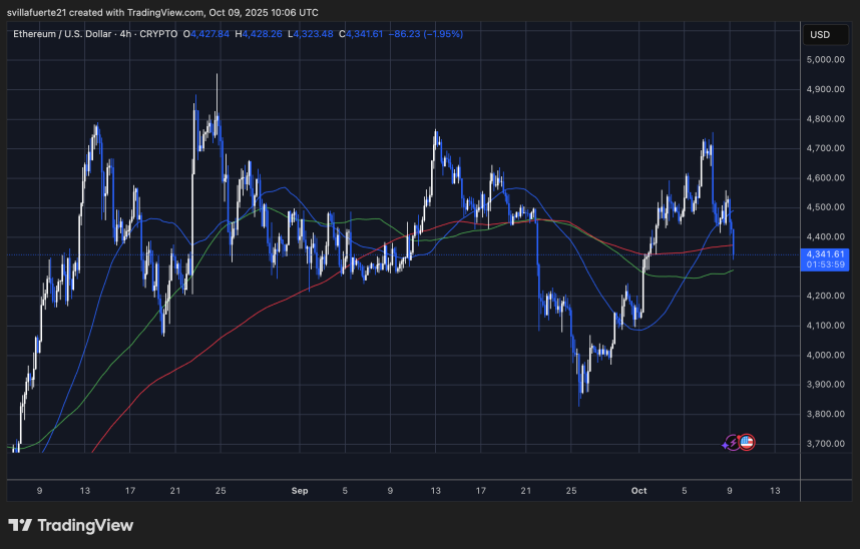
This area coincides with a key confluence of the 50-, 100-, and 200-period moving averages, suggesting that the current pullback could simply be a technical retest before another attempt to reclaim the $4,500 zone. A confirmed bounce from this region could set the stage for Ethereum to regain momentum and potentially retest the $4,700–$4,800 resistance range in the coming days.
Related Reading
However, if selling pressure intensifies and ETH closes below $4,200, the market could see an extended correction toward $4,000 or even $3,850, where previous consolidation occurred. Overall, while volatility persists, Ethereum continues to display resilience supported by strong on-chain accumulation and institutional staking — factors that reinforce the broader bullish narrative despite short-term market fluctuations.
Featured image from ChatGPT, chart from TradingView.com
Ethereum (ETH) is trading at critical levels after a sharp rally from $3,800 to $4,700 in just a few days, marking one of its strongest moves in recent months. The swift rebound highlights renewed strength from bulls, who now appear firmly in control of the market’s short-term direction. As ETH approaches key resistance zones, analysts are closely watching whether the second-largest cryptocurrency can sustain its momentum and confirm a breakout above the current range.
Related Reading
This impressive move is not just driven by market sentiment but also by robust on-chain fundamentals. Institutional participation in Ethereum continues to rise, with inflows from funds and treasuries steadily increasing over the past weeks. Meanwhile, staking activity remains high, suggesting that long-term investors are showing confidence in ETH’s network security and yield potential despite volatility in broader markets.
The combination of growing institutional demand and sustained staking confidence provides a solid foundation for Ethereum’s next phase of growth. If bulls maintain control and price holds above $4,500, analysts believe ETH could be gearing up for another leg higher, potentially entering a new expansion cycle as the broader crypto market follows Bitcoin’s renewed bullish momentum.
Grayscale Stakes $150M in Ethereum
According to onchain data from Lookonchain, Grayscale (ETHE and ETH ETF) staked 32,000 ETH, worth approximately $150.56 million, earlier today. This move represents one of the largest institutional staking transactions in recent weeks and signals growing confidence among major players in Ethereum’s long-term value proposition. The decision to allocate such a significant amount of ETH to staking underscores the continued institutional belief in Ethereum’s dual role as both a technology platform and a yield-generating asset.
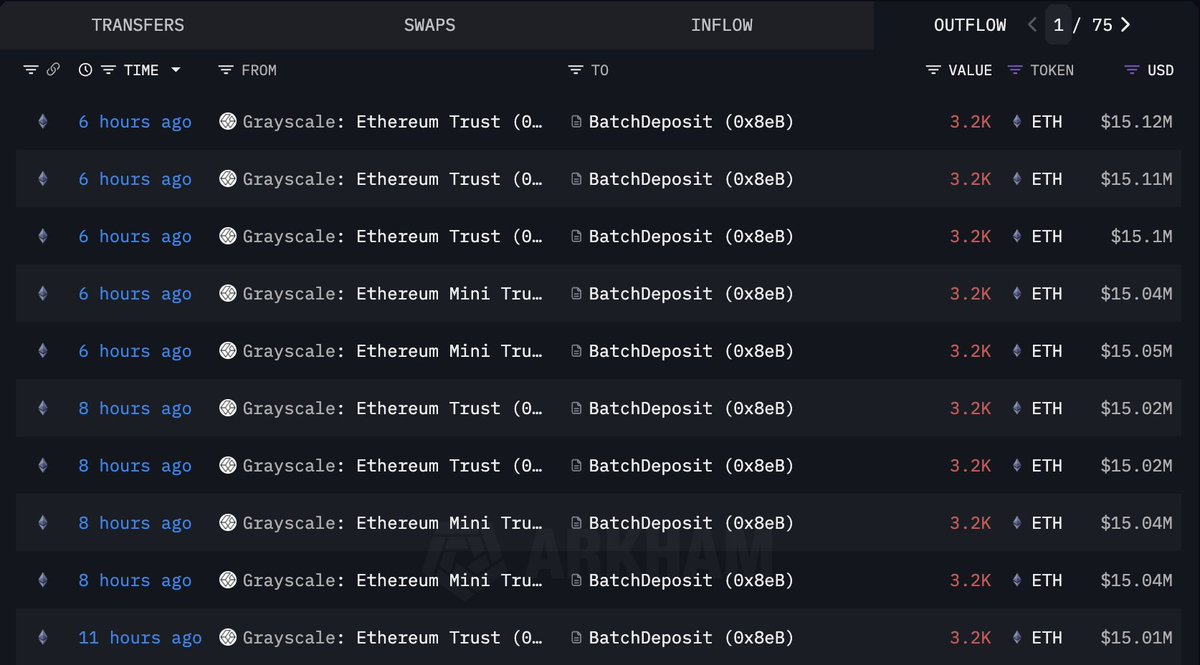
Staking Ethereum locks coins within the network, effectively reducing liquid supply while contributing to network security and stability. When large holders like Grayscale commit such capital, it demonstrates conviction in the sustainability of Ethereum’s staking economy and its role within future financial infrastructure. Analysts interpret this as a strong bullish signal, especially amid rising institutional demand for tokenized assets and DeFi exposure built on the Ethereum network.
Moreover, Grayscale’s move aligns with the broader trend of institutional staking growth, where funds and asset managers increasingly leverage staking yields as an alternative income strategy. This reinforces Ethereum’s position as the backbone of decentralized finance and a key component of institutional crypto portfolios.
Combined with renewed bullish sentiment across the crypto market, Grayscale’s staking decision adds weight to the narrative that Ethereum remains undervalued relative to its fundamental strength and adoption. If momentum sustains, this event could mark the beginning of a new accumulation phase — one driven not by speculation, but by institutional conviction in Ethereum’s evolving economic and technological dominance.
Related Reading
Bulls Regain Momentum Above $4,600
Ethereum is currently trading around $4,688, showing renewed bullish strength after a sharp recovery from the $3,800 region earlier this month. The chart highlights a clear upward structure, with ETH reclaiming both the 50-day and 100-day moving averages, confirming a short-term trend reversal. Buyers have regained control, and the price now approaches the critical resistance zone between $4,700 and $4,800, which previously marked a major rejection area in late August.
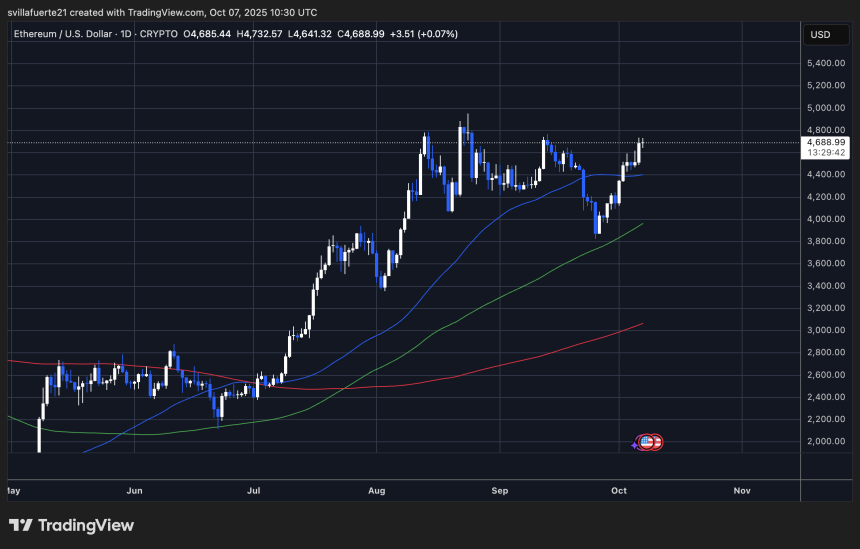
A decisive daily close above $4,700 could pave the way for a test of $5,000, potentially leading to a new phase of price discovery if momentum holds. The sustained higher lows since late September further indicate accumulation rather than distribution, suggesting that investors are positioning for continuation rather than taking profits.
Related Reading
From a broader perspective, Ethereum’s recent surge coincides with Bitcoin’s move above all-time highs and growing institutional participation. This correlation, combined with Grayscale’s recent 32,000 ETH stake, reinforces the bullish case for ETH’s medium-term outlook. However, short-term traders should monitor the $4,400 support, as a breakdown below this level could delay further upside. Overall, Ethereum’s technical structure looks strong, with clear momentum and market confidence returning as it eyes another breakout attempt.
Featured image from ChatGPT, chart from TradingView.com
Bitcoin News Today: Cardano Hovers at $0.85 as $1.00 Threshold Looms with High Stakes AInvest
Source link ]]>
Ethereum is once again in the spotlight as institutional demand continues to shape the market’s direction. After weeks of bullish momentum that pushed ETH into fresh all-time highs, the price is now consolidating below this level, holding above critical support zones. Despite the short-term slowdown, Ethereum remains one of the strongest players in this cycle, with clear evidence that big money is flowing in.
Arkham Intelligence has revealed a striking onchain development: a whale just purchased $2.5 billion worth of ETH within hours and immediately staked the entire position through a single contract. The timing of this move highlights how aggressive accumulation is aligning with Ethereum’s rise as the dominant chain for DeFi and institutional exposure. While retail traders often react to volatility, whales and institutions tend to position themselves strategically after major reversals, validating the broader uptrend.
The market now faces an important test. With ETH consolidating just below its highs, investors are asking whether this wave of whale activity will be enough to trigger a continuation toward $5,000—or if the market first needs a deeper correction before resuming its bullish phase.
Whale Accumulation Reinforces Ethereum’s Strength
According to Arkham Intelligence, a massive whale has executed one of the largest onchain moves of this cycle—buying $2.55 billion worth of ETH from Hyperunit and staking it all through a single staking contract. Arkham even asked on X: “Will he keep buying?”—a question that perfectly captures the mood among traders and analysts.
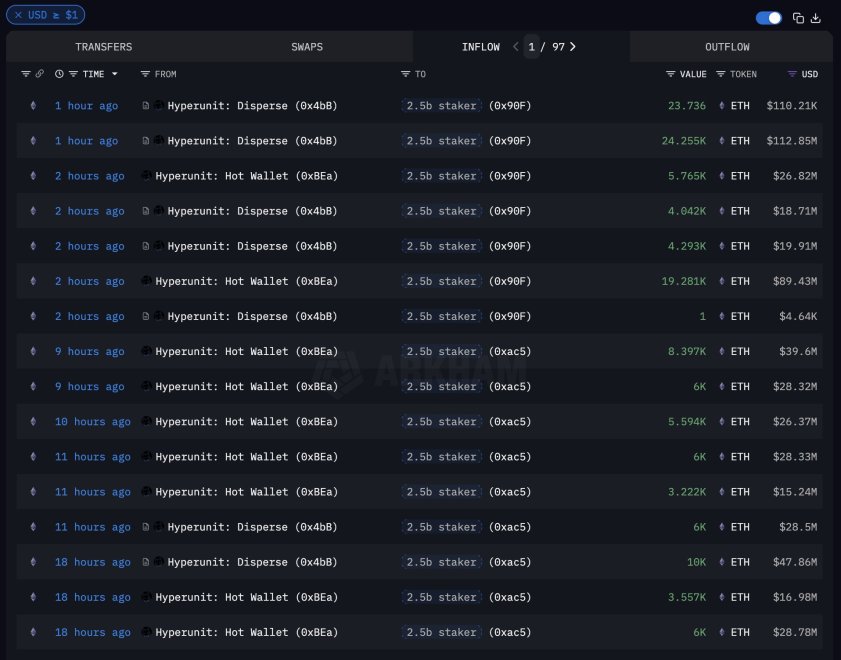
This type of accumulation is not just about size, but timing. Ethereum has been holding firm above critical support levels even as Bitcoin faces difficulties sustaining momentum near its highs. BTC has repeatedly tested demand around the $110K–$115K zone, signaling buying exhaustion, while ETH’s resilience suggests relative strength. Analysts are beginning to argue that the market is witnessing a capital rotation phase, with some large investors favoring ETH and altcoins as Bitcoin consolidates.
What makes this event even more notable is that the whale staked the entirety of the purchase, demonstrating a long-term conviction rather than a short-term speculative trade. Staking locks coins out of circulation, reducing sell-side pressure and reinforcing Ethereum’s fundamental value.
The broader implication is clear: if whales continue this level of aggressive positioning, Ethereum could not only sustain its gains above $4,400 but also extend its rally toward the symbolic $5,000 mark. Meanwhile, Bitcoin’s inability to push higher may cement ETH as the outperformer in the short to mid-term.
ETH Showing Strength Around Key Levels
Ethereum’s daily chart shows the asset holding above the $4,400 level, a critical support zone following days of high volatility. After recently reaching new highs close to $4,900, ETH faced a sharp pullback, but buyers have so far defended this level, suggesting it could act as a strong base for the next move.

The price structure remains bullish overall, with ETH trading well above its 50-day ($3,837), 100-day ($3,184), and 200-day ($2,634) moving averages. This alignment of the moving averages reflects sustained bullish momentum, though the steep climb of recent weeks has increased the risk of volatility. The wick rejections near $4,900 indicate that sellers are taking profits at higher levels, but demand near $4,400 is keeping ETH from deeper corrections.
For bulls, reclaiming $4,700 and pushing back toward $4,900 will be critical for resuming the uptrend and potentially targeting the psychological $5,000 level. On the downside, a breakdown below $4,400 could expose ETH to further declines, with secondary support near $4,200.
Ethereum remains in a strong uptrend, but the market is entering a decisive phase where either consolidation above $4,400 prepares the ground for continuation, or a deeper correction unfolds before the next rally.
Featured image from Dall-E, chart from TradingView
Editorial Process for bitcoinist is centered on delivering thoroughly researched, accurate, and unbiased content. We uphold strict sourcing standards, and each page undergoes diligent review by our team of top technology experts and seasoned editors. This process ensures the integrity, relevance, and value of our content for our readers.
Cardano Whales Quietly Increasing Stakes In Remittix Ahead Of Anticipated Launch: What Do They Know? CoinCentral
Source link ]]>

- World Liberty Financial just bought 3,473 ETH for $13 million.
- The Ethereum (ETH) was staked on Aave to earn DeFi yield.
- WLFI coin launch expected within six to eight weeks.
In a bold move that underscores its deepening involvement in decentralised finance, World Liberty Financial has acquired 3,473 ETH valued at $13 million.
The acquisition was followed swiftly by staking the assets on Aave, a leading DeFi protocol.
This strategic manoeuvre not only strengthens the firm’s crypto position but also signals its intention to actively participate in Ethereum-based income-generating platforms.
The $13 million ETH staking deepens World Liberty Financial’s DeFi strategy
The purchase, executed through multiple wallet addresses, was conducted at an average price of $3,743 per ETH, according to blockchain data from Arkham Intelligence reported by Lookonchain.
Following the latest purchase, World Liberty Financial’s total ETH holdings now stand at approximately 73,616 ETH, which is currently valued at around $275.9 million.
Trump’s World Liberty(@worldlibertyfi) just spent 13M $USDC to buy 3,473 $ETH at $3,743 again!
World Liberty has bought a total of 73,616 $ETH($275M) at an average price of $3,272, with an unrealized profit of $33M+.https://t.co/0qWkRUhTQb pic.twitter.com/WG1zpl3PJC
— Lookonchain (@lookonchain) July 23, 2025
The move comes amid a period of renewed institutional interest in Ethereum, with World Liberty Financial positioning itself firmly among the major players betting big on ETH.
Once acquired, the ETH was promptly staked on Aave, one of the largest decentralised lending and borrowing platforms in the DeFi space, indicating a clear strategy to go beyond holding crypto assets passively and instead generate yield through DeFi staking.
Ethereum (ETH) rallying as institutional inflows rise
World Liberty Financial’s timing appears calculated, especially seeing that the ETH market has witnessed notable inflows recently, particularly from institutional investors.
Sharplink Gaming, another company with strong crypto ties, recently added $250 million worth of ETH to its holdings, pushing its total ETH portfolio to a staggering $1.3 billion.
This reflects a wider sentiment shift, with Ethereum emerging as the digital asset of choice for institutions looking to capitalise on its long-term potential.
On the derivatives front, spot Ethereum ETFs registered a net inflow of $533.9 million on July 22 alone. In contrast, spot Bitcoin ETFs saw a $67.9 million net outflow during the same day.
This shift in institutional preference likely contributed to Ethereum’s growing appeal among strategic investors like World Liberty Financial.
At the time of the acquisition, Ethereum (ETH) was trading around $3,686, with prices fluctuating between $3,650 and $3,758 in the past 24 hours.
Over the last seven days, ETH has gained 16%, with a 62% surge over the past month.
Notably, Ethereum’s strong market performance is helping boost the valuation of crypto portfolios heavily exposed to the asset.
WLFI coin launch set to follow
This aggressive ETH accumulation is not happening in isolation. World Liberty Financial is also gearing up to launch its native WLFI coin.
According to a statement by the project team, the WLFI token will begin trading within the next six to eight weeks.
The project emphasises that the launch is being carefully timed and backed by strategic partnerships, smart coin unlocking mechanisms, and broader ecosystem planning.
The WLFI coin is expected to serve as a key pillar in the company’s broader crypto ambitions.
By combining Ethereum (ETH) staking strategies with an imminent token launch, World Liberty Financial is signalling its intent to compete at a higher level within the DeFi and digital asset space.

Renowned market analyst Egrag Crypto has shared another puzzling XRP price prediction stating the altcoin is at a major technical crossroads. This development follows a resilient price performance in the past week during which XRP gained by 2.07% as the broader crypto market stands bullish despite the announcement of new US trade tariffs.
Ascending Wedge Signals Incoming Volatility — Which Way Will XRP Break?
In an X post on April 5, Egrag Crypto issued a dual price forecast on the XRP market based on the potential implications of a forming Ascending Broadening Wedge pattern. Also known as the megaphone pattern, the chart formation signals increasing volatility and investor indecisions. It looks like a widening triangle with two diverging trendlines, as seen in the chart below.
The Ascending Broadening Wedge presents high unpredictability and offers a 70% chance of a downside breakout and a 30% probability of an upside breakout. However, despite this statistical bias, the analyst postulates the chances of an upside remain valid if certain conditions are met.
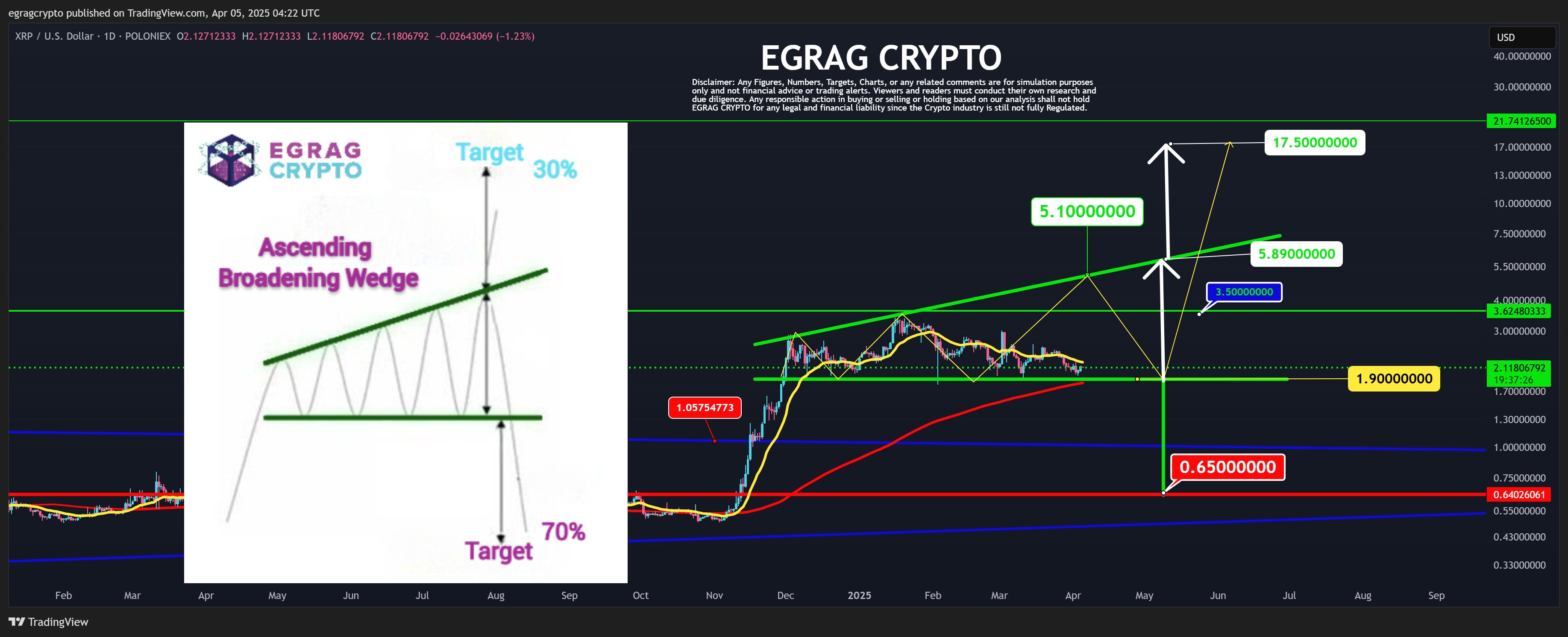
According to the analyst, XRP must first close above $3.50 for a bullish scenario to start taking shape. In doing so, the altcoin would surpass the local peak of the current bull cycle and confirm intentions of an upward momentum. Following this move, XRP bulls should then aim for the $5 range—another key resistance level that could determine the asset’s next major move.
Interestingly, Egrag explains that a failure to convincingly close above $5 would only be a critical development that completes the formation of the Ascending Wedge Pattern and increases the likelihood of a breakout. If this rejection occurs, XRP is expected to retest the $1.90 area and make a second push toward the $5, this time breaking through and closing above $6.
Egrag states the breakout above $6 would validate the bullish run and likely spark a surge toward double-digit territory with a potential target at $17.50 based on the Ascending Wedge Pattern. However, should XRP bulls fail to meet these conditions or follow this sequence, the historical 70% chance of a breakdown points to a downside target of around $0.65.
XRP Price Overview
At the time of writing, XRP trades at $2.14 reflecting a price gain of 0.60% in the past day. Meanwhile, the token’s trading volume is down by 62.92% in the past day indicating a fall in market engagement and a declining buying pressure following the recent market gain. In making any significant uptrend, XRP bulls must first reclaim the following resistances at $2.47 and $2.61 while avoiding any slip below the $2 support zone.
]]>Smaller cryptocurrencies like Dogecoin and Solana face high stakes post-election Dimsum Daily
Source link ]]>