Shiba Inu Price Prediction: Bulls Step In – Is SHIB Ready to Rally? Coinpedia
Source link ]]>
They say journalists never truly clock out. But for Christian, that’s not just a metaphor, it’s a lifestyle. By day, he navigates the ever-shifting tides of the cryptocurrency market, wielding words like a seasoned editor and crafting articles that decipher the jargon for the masses. When the PC goes on hibernate mode, however, his pursuits take a more mechanical (and sometimes philosophical) turn.
Christian’s journey with the written word began long before the age of Bitcoin. In the hallowed halls of academia, he honed his craft as a feature writer for his college paper. This early love for storytelling paved the way for a successful stint as an editor at a data engineering firm, where his first-month essay win funded a months-long supply of doggie and kitty treats – a testament to his dedication to his furry companions (more on that later).
Christian then roamed the world of journalism, working at newspapers in Canada and even South Korea. He finally settled down at a local news giant in his hometown in the Philippines for a decade, becoming a total news junkie. But then, something new caught his eye: cryptocurrency. It was like a treasure hunt mixed with storytelling – right up his alley!
So, he landed a killer gig at NewsBTC, where he’s one of the go-to guys for all things crypto. He breaks down this confusing stuff into bite-sized pieces, making it easy for anyone to understand (he salutes his management team for teaching him this skill).
Think Christian’s all work and no play? Not a chance! When he’s not at his computer, you’ll find him indulging his passion for motorbikes. A true gearhead, Christian loves tinkering with his bike and savoring the joy of the open road on his 320-cc Yamaha R3. Once a speed demon who hit 120mph (a feat he vowed never to repeat), he now prefers leisurely rides along the coast, enjoying the wind in his thinning hair.
Speaking of chill, Christian’s got a crew of furry friends waiting for him at home. Two cats and a dog. He swears cats are way smarter than dogs (sorry, Grizzly), but he adores them all anyway. Apparently, watching his pets just chillin’ helps him analyze and write meticulously formatted articles even better.
Here’s the thing about this guy: He works a lot, but he keeps himself fueled by enough coffee to make it through the day – and some seriously delicious (Filipino) food. He says a delectable meal is the secret ingredient to a killer article. And after a long day of crypto crusading, he unwinds with some rum (mixed with milk) while watching slapstick movies.
Looking ahead, Christian sees a bright future with NewsBTC. He says he sees himself privileged to be part of an awesome organization, sharing his expertise and passion with a community he values, and fellow editors – and bosses – he deeply respects.
So, the next time you tread into the world of cryptocurrency, remember the man behind the words – the crypto crusader, the grease monkey, and the feline philosopher, all rolled into one.
The current price range of Bitcoin may not relay much, but a change in ownership structure is taking place under the surface.
Related Reading
On-chain data from CryptoQuant shows that one cohort of market participants is stepping back from exchange activity at a pace not seen in nearly a year, while another is quietly rebuilding at a scale that demands attention.
Whale Inflows On Binance Fall To Multi-Month Lows
The 30-day sum of whale inflows to Binance has fallen massively in recent days, falling to $2.96 billion as of the latest CryptoQuant data, the first reading below $3 billion since June 2025.
The drop in exchange inflow is a departure from the elevated inflow levels that characterized the entire period between February and early March, when the same metric was consistently tracking above $6 billion and briefly touched $8 billion.
That detail matters because exchange inflows from whales are an intent to sell or reposition. When these flows begin to dry up, it shows that large players are no longer rushing to offload their supply.
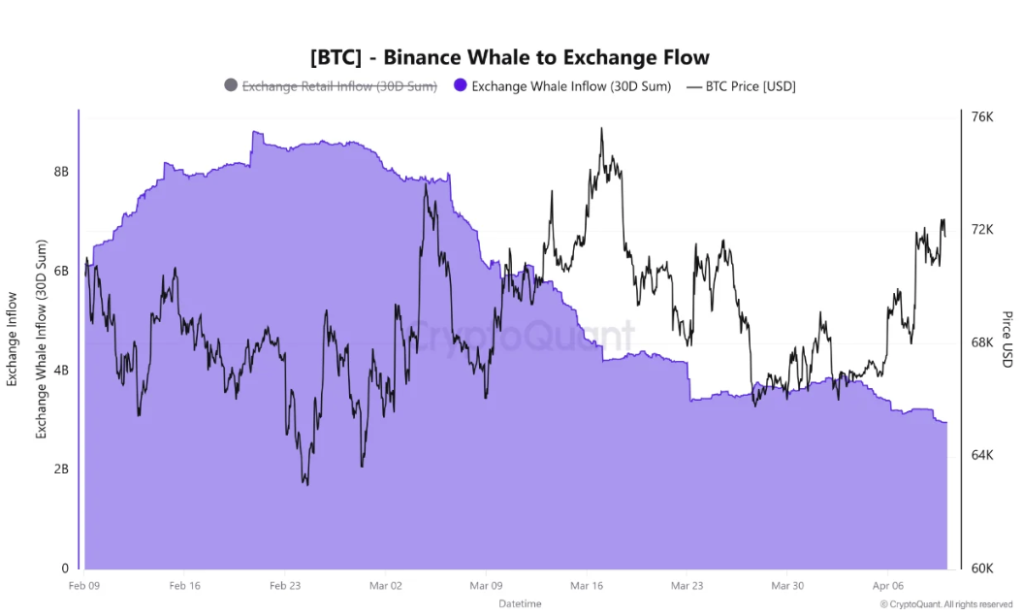
BTC- Binance Whale To Exchange Flow
At the same time, long-term holders are rebuilding exposure at scale. This exposure can be seen through the 30-day realized cap change for this group. This metric captures the value of coins being absorbed into long-term storage, and its reading reached as high as $49 billion on April 9.
That contrast is clearly visible in the behavior of short-term holders, whose realized cap change has dropped to -$54 billion. This is the third time since early March that short-term holders have registered losses exceeding $50 billion on a 30-day basis.
This data shows that reactive participants are exiting positions under pressure, while longer-term investors are buying more into that weakness and tightening supply.
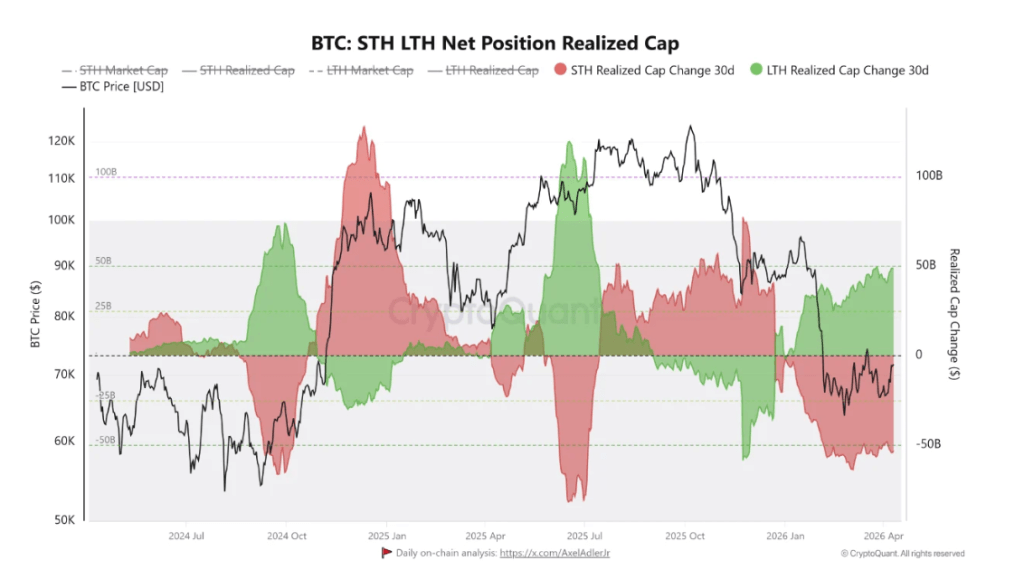
BTC: STH LTH Net Position Realized Cap
The Setup For A Squeeze Is Building
Speaking of tightening supply, data from the derivatives market is showing a signal as to how there might be an incoming short squeeze. The impression across derivatives and spot metrics is a market where bearish sentiment has become heavily concentrated in leveraged positions, while physical supply is migrating off crypto exchanges.
Funding rates across all major exchanges came in at -0.0118% on April 10 and -0.0101% on April 11, two consecutive sessions of strongly negative readings. Negative funding has become the dominant regime since late March, and throughout April the metric has remained in negative territory without a single positive flip.
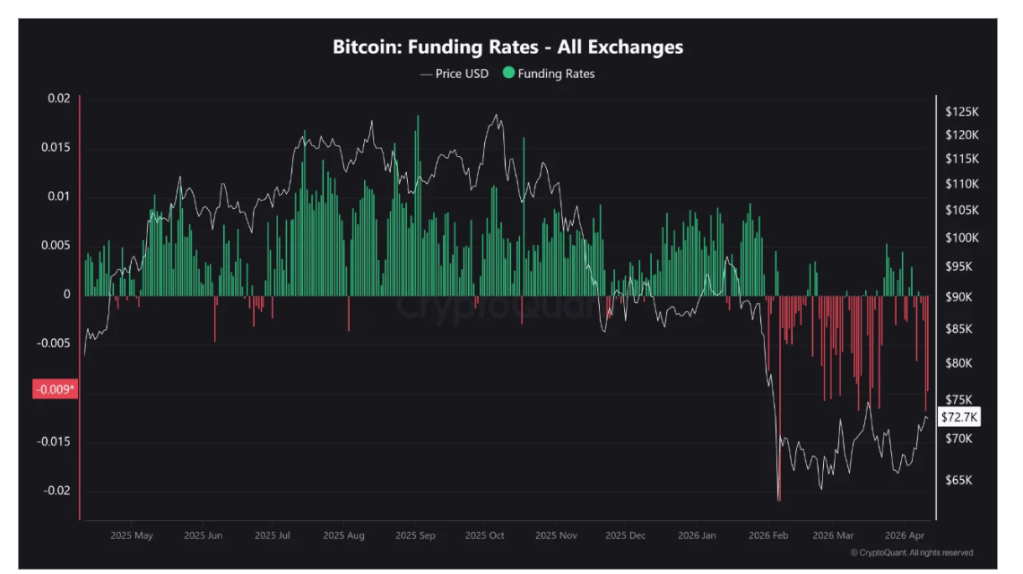
The negative funding means short positions are paying longs to maintain their bearish exposure, and short positions are becoming overcrowded. At the same time, open interest climbed from around $21.87 billion on April 6 to $24.37 billion by April 10. Rising open interest alongside persistently negative funding is a characteristic signature of leveraged short accumulation.
Meanwhile, spot supply continues to tighten up. Many coins are being moved off crypto exchanges, and exchange netflows recorded about 7,900 BTC in outflows over April 9 and 10 combined.
Related Reading
Off-exchange, the 30-day change in OTC desk balances has turned negative, which is a sign that institutions or large buyers are absorbing supply outside of visible market infrastructure.
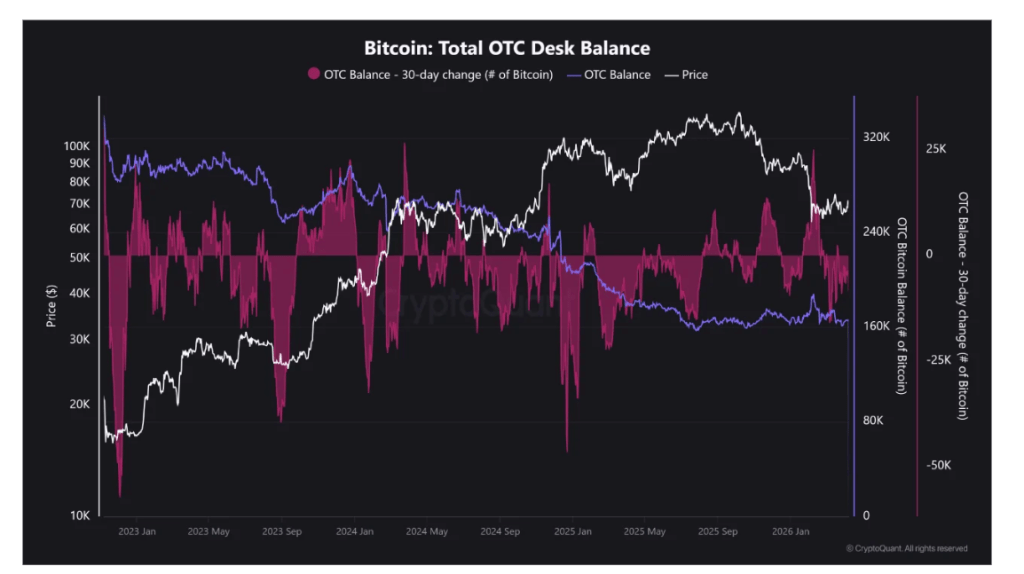
Bitcoin Total OTC Desk Balance
Featured image from Unsplash, chart from TradingView
Dogecoin Takes First Step Toward Quantum Resistance With Mainnet Test Coinpaper
Source link ]]>

Key takeaways
- ETH is up by less than 1% and now trades above $2,050.
- The bulls defended the $2,000 support level, with further upward movement on the card.
Ethereum is up by less than 1% at the time of writing on Friday, halting the bearish performance that gripped the market on Thursday. The coin could rally higher in the near term as buyers have stepped in over the past few hours.
Onchain data paints a mixed picture for Ether
ETH is trading above $2,050 at press time, but onchain data paint a mixed picture for the top altcoin. Over the past week, investors across different cohorts have cracked under pressure.
According to the onchain data, wallets with a balance of 10K-100K, which have been major buyers throughout the recent downtrend, offloaded 340K ETH between March 24-30.
However, the wallets flipped back to buying on Tuesday, scooping 270K ETH across the past two days.
On the other hand, wallets with 100-1K and 1K-10K ETH continued distribution, scaling down their holdings by roughly 200K ETH over the past week.
In addition to that, US spot ETH exchange-traded funds (ETFs) have also posted a similar trend. The ETFs have recorded only two days of inflows over the past two weeks of trading, indicating a bearish bias.
Ethereum Price Forecast: Bulls defend the $2k psychological level
The ETH/USD 4-hour chart is bullish and efficient as Ether recorded its first monthly gain in six months.
At press time, ETH is trading at $2,062. Its near-term bias remains mildly bullish as ETH is trading below the 20- and 50-day Exponential Moving Averages (EMAs), which cap advances at around $2,080 and $2,160.

The Relative Strength Index (RSI) reads 53, slightly above the neutral level, while the MACD has stabilized around the midline, both indicating a growing bullish momentum.
If the recovery persists, the bulls would face immediate resistance at $2,108, followed by $2,389 and then $2,746. A daily close above $2,108 would be the first step to ease pressure and expose the higher resistance band toward the 100-day EMA and $2,389.
However, if the sellers regain control, ETH would test the initial support at $1,911, followed by $1,741 and $1,524.
If ETH continues to trade below $2,108, it risks drifting back toward the $1,700 area in the near term.
Step Aside Dogecoin, Shiba Inu and PEPE Coin: The Next 1,000% Meme openPR.com
Source link ]]>
Cardano Whales Add $82M in ADA as Retail Traders Step Back BanklessTimes
Source link ]]>
Crypto investment funds have now recorded a fifth straight week of net outflows, wiping roughly $4 billion from investor coffers over that span.
Related Reading
That steady removal of capital has been paired with a sharp fall in trading activity, signaling that many holders are standing on the sidelines rather than buying dips.
Trading Volume Hits Multi-Month Low
According to a CoinShares report published Monday, crypto funds saw $288 million in net outflows last week, bringing the five-week total to roughly $4 billion.
Weekly trading volumes also fell to about $17 billion, the lowest level since mid-2025, highlighting a slowdown in market activity even as prices have recently stabilized.
Fewer transactions were recorded across major investment products, reflecting a quieter stretch for the market compared with earlier periods of heavier trading.
Regional Flows Paint A Split Picture
Reports note the US led withdrawals, while parts of Europe and Canada added fresh money. The US recorded $347 million of outflows, while Europe and Canada together showed net inflows of close to $60 million.
Digital asset investment products recorded US$288M in outflows last week.@Bitcoin remains the key proponent of this negative sentiment, seeing US$215M in outflows. @ethereum saw the second largest outflows totalling US$36.5M. Minor inflows were seen in XRP @Ripple (US$3.5M),… pic.twitter.com/HFWIxVAZgO
— CoinShares (@CoinSharesCo) February 23, 2026
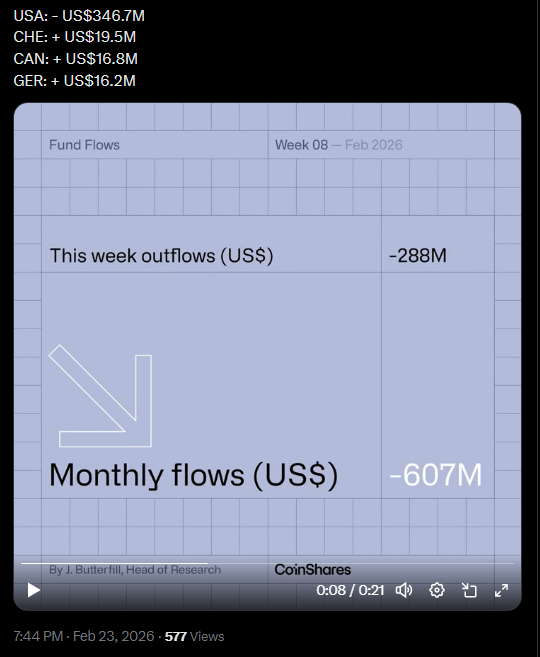
Countries such as Switzerland, Canada, and Germany were among those adding funds. That split shows that not all investors view the market the same way right now. Some see value at lower prices; others are trimming exposure until clearer signs appear.
Bitcoin Remains The Main Focus Of Selling
Bitcoin accounted for the largest single-asset outflows, with about $215 million removed last week. At the same time, instruments that profit from falling prices received renewed interest, with short-Bitcoin products taking in around $5.5 million.
A fair amount of recent liquidations was tied to Bitcoin moves, driven by traders who had large positions and saw prices move against them. Some positions were forced closed. That pushed volatility up in the short term.
Ethereum and a handful of other coins also saw money leave, though a few assets attracted small inflows. XRP, Solana, and Chainlink each gained minor sums relative to the overall outflow.
These were selective bets rather than broad rotations back into risk assets. Investment managers who moved into specific tokens appeared to be making tactical, not broad, commitments.
Sidelined Capital Is Waiting
Reports say much of the market’s strength depends on outside cash returning. Right now, many potential buyers are waiting for clearer signals from the macro side — interest rates, big economic reports, and policy hints from regulators.
Without sustained buying, price bounces are more likely to be brief technical recoveries than full trend changes.
Related Reading
A Pause More Than A Collapse
This is not a market breakdown. It is a pause, according to analysts. Participation has dropped and that creates a fragile environment. If macro sentiment shifts and more buyers step in, flows could reverse quickly.
Until then, expect choppy moves, low volume, and a market that reacts strongly to each new piece of news.
Featured image from Vecteezy, chart from TradingView

- Step Finance, SolanaFloor, and Remora Markets halt operations after hack.
- STEP token collapses, while Remora tokens remain redeemable.
- SOL breaks key $77 support as bearish trend dominates amid high volatility.
Step Finance, a leading DeFi aggregator and portfolio dashboard on Solana, has announced an immediate shutdown following a major security breach.
The Step Finance hack reportedly drained over 260,000 SOL from the platform’s treasury, leaving the project unable to recover financially.
Alongside Step Finance, two affiliated platforms, SolanaFloor and Remora Markets, are also winding down operations.
Today we are announcing that Step Finance, SolanaFloor, and Remora Markets will be winding down all operations.
Following the hack at the end of January we explored every possible path forward, including financing and acquisition opportunities.
Unfortunately, we were unable to…
— Step
(@StepFinance_) February 23, 2026
Market reaction
The news has sent shockwaves through the Solana community.
Token holders are reeling from the impact, particularly STEP token investors, whose asset has collapsed nearly 100% since the breach.

Remora Markets’ token holders, however, may be able to redeem their rTokens for USDC, as these assets remain fully backed.
Step Finance has also announced plans for a buyback program for eligible STEP holders based on a pre-hack snapshot.
The shutdown highlights the fragility of some projects in the Solana DeFi ecosystem.
It also underscores the broader risk of centralised treasury management, even within decentralised finance platforms.
Solana price reaction
The price of Solana (SOL) has shown noticeable weakness in the wake of these developments.
Over the past 24 hours, SOL has dropped below $77, a level that had previously served as key support.
Despite this, Solana’s trading volumes remain robust, reflecting heightened activity as investors reassess positions.
Derivatives data indicate growing bearish sentiment with rising long liquidations and a long-to-short ratio falling below 1, suggesting that shorts currently dominate the market.
Funding rates in futures markets have also turned negative, reinforcing the downward pressure on SOL.
In addition, institutional players appear to be taking a measured approach, as US spot SOL ETFs see modest inflows.
This accumulation hints that some investors see the recent dip as a potential buying opportunity, even amid broader uncertainty.
SOL price forecast
While some institutional support exists, SOL faces immediate technical hurdles and key levels that could determine its next direction.
SOL’s technical indicators signal a cautious outlook.
Notably, the cryptocurrency is trading below both its 50-day and 200-day EMAs, signalling a bearish trend, and the Relative Strength Index (RSI) is near oversold levels, suggesting momentum is heavily skewed toward sellers.

As a result, traders should watch the $75 mark closely as it represents a critical support level.
If this level fails to hold, SOL could see further downside toward the $63-51 range, according to Coinlore’s analysis.
On the upside, a rebound would need to overcome resistance near $91, with a more significant recovery targeting $102.
Short-term volatility is, however, likely to remain high given the recent ecosystem shocks, and investors should pay attention to both price action and on-chain metrics to gauge the resilience of SOL amid these challenges.

Heightened volatility in the market continues to keep the price of Ethereum below the $2,000 mark, capping every attempt towards the upside. During the persistent downward price action, a divergence has emerged among ETH investors, with large holders selling while smaller holders are buying.
Ethereum Whale Selling Meets Retail Accumulation In Market Split
Ethereum’s ongoing waning price action is taking its toll on investors, as evidenced by their current activity and sentiment. Following the downward trend, a notable divergence in investors’ behavior is developing, causing large and small holders to move in separate directions.
Looking at the report from Santiment, a leading market intelligence and on-chain data analytics platform, large investors are pushing toward the sell side, while small investors are leaning towards the buy side. Even as retail and grassroots investors enter the market to purchase, this divergence raises the possibility that major holders often regarded as whales or institutional-grade participants may be locking in profits or repositioning.
The current selling activity is observed among wallet addresses holding at least 1,000 ETH, which in this case are considered high-tier holders. Meanwhile, buying activity is taking place among wallet addresses holding less than 1 ETH, flagged as low-tier investors.
Before now, these high-tier holders were collectively holding more than 75% of Ethereum’s total supply. However, after the dumping of about 1.5% of the supply since Christmas, their holdings are now below the level. Such redistribution phases have the potential to alter the market structure by shifting supply from concentrated hands to a wider base.
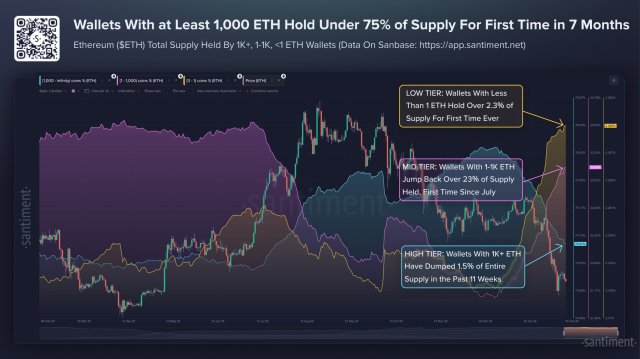
According to data from Santiment, mid-tier investors (those holding between 1 and 1,000 ETH) have also been steadily buying the altcoin. This persistent buying has pushed their collective holdings back to over 23% of the total supply for the first time since July 2025.
For smaller holders and low-tier investors, ETH accumulation has been rising, bringing their collective stash to 2.3% of the overall supply, marking the highest level ever. Santiment highlighted that these wallet addresses are likely growing due to ETH staking.
Staking ETH Now Takes More Time
As Ethereum staking grows, the process is now taking more time than ever. Milk Road shared on X that investors are expected to wait for 71 days and 11 hours to stake ETH. Recently, Ethereum staking reached 30% of the total supply, locking up 36.8 million ETH valued at a whopping $72 billion.
The 4.1 million ETH queue suggests that demand to stake is at an all-time high while the altcoin’s price sits below $2,000. Meanwhile, the exit queue is essentially nonexistent by comparison, with just 75,872 ETH leaving. Such a trend is an indication of conviction, not yield farming behavior. When people lock up $74B during a price dip, it means they are settling in, instead of speculating. “Watch that queue, it’s a sentiment indicator,” Milk Road added.
Featured image from iStock, chart from Tradingview.com
Editorial Process for bitcoinist is centered on delivering thoroughly researched, accurate, and unbiased content. We uphold strict sourcing standards, and each page undergoes diligent review by our team of top technology experts and seasoned editors. This process ensures the integrity, relevance, and value of our content for our readers.