
- Japan’s 40-year bond yield rose to 3.774% on Thursday.
- Five-year CDS spreads reached 21.73 basis points on 20 November.
- GDP contracted in Q3 2025 and inflation reached 3% in October.
Japan’s new stimulus package is setting off sharp reactions across global markets, with the yen sliding to its weakest point against the US dollar since January 2025 and long-term bond yields rising to record levels.
The cabinet approved a 21.3 trillion yen package on Friday, the largest since the COVID-19 period, and the announcement immediately shifted expectations in currency, bond, and crypto markets.
The scale of the support and the pressure on Japan’s finances are now pushing investors to reconsider how they assess global risk, particularly as liquidity conditions evolve.
Economic reset
The package focuses on easing price pressures, supporting growth, and strengthening defence and diplomatic capacity.
Local government grants and energy subsidies form a key part of the plan, and households are expected to receive around 7,000 yen in benefits over three months.
The government also aims to lift defence spending to 2% of GDP by 2027.
The supplementary budget is expected to pass before the end of the year, although the ruling coalition currently holds only 231 of 465 Lower House seats.
The support comes during a period of weakening growth.
Japan’s GDP fell 0.4% in the third quarter of 2025, equal to a 1.8% annualised contraction.
Inflation has remained above the Bank of Japan’s 2% target for 43 months and reached 3% in October 2025.
Policymakers expect the new measures to lift real GDP by 24 trillion yen and generate a total economic impact near 265 billion dollars.
Rising market pressure
The fiscal boost has intensified concerns about long-term debt sustainability and market stress.
Five-year credit default swaps on Japanese government bonds reached 21.73 basis points on 20 November, the highest level in six months.
The country’s 40-year bond yield rose to 3.697% immediately after the announcement and climbed further to 3.774% on Thursday.
Every 100-basis-point increase in yields raises annual government financing costs by about 2.8 trillion yen, which has drawn attention to the strain on public finances over time.
Nikkei reports lingering caution about the continued use of fiscal stimulus beyond emergencies, adding another layer to investor concerns.
This debate has become more relevant as the yield curve shifts and Japan’s borrowing costs rise.
These movements are also important for the 20 trillion dollar yen-carry trade. Investors typically borrow yen at low rates and invest in higher-yielding markets overseas.
A mix of higher yields and sudden currency moves can force unwinding.
Historical data show a 0.55 correlation between yen-carry trade reversals and S&P 500 declines, which adds another source of volatility.
Yen reaction
The yen dropped sharply after the stimulus announcement, prompting speculation about future currency stability and the potential for intervention.
October exports rose 3.6% year on year, but the increase was not enough to ease concerns about broader economic pressure.
The scale of fiscal support and the persistence of inflation have become central factors in how global markets interpret Japan’s next steps.
Crypto shift
These conditions are feeding directly into crypto markets.
A weaker yen tends to drive Japanese investors toward alternative assets, including Bitcoin, especially during periods of rising liquidity.
Experts have noted that Japan’s decision adds to a global environment that already includes potential US Federal Reserve easing, Treasury cash movements, and continued liquidity support from China.
Together, these factors are creating conditions that could lift crypto demand into 2026.
At the same time, higher long-term yields pose a risk.
If yen-carry trades unwind quickly, institutions may be forced to sell assets, including Bitcoin, to meet liquidity needs.
Bitcoin, Ether, Solana, Cardano, XRP Bulls Await Mega Buying Spree from Trump’s $2000 Stimulus Checks ZyCrypto
Source link ]]>
Dogecoin Surges 6% as Trump Promised $2K Stimulus Brings Back 2021-Era DOGE, SHIB Rally Vibes Yahoo Finance
Source link ]]>
$5,000 in Dogecoin for Every American? 2025 Crypto Stimulus Plan Stuns Experts! LKO Uniexam.in
Source link ]]>
Bitcoin price has crossed the brief $68,000 mark today for the first time since July 29, indicating a growing market confidence. In addition, it also comes amid reports of Japan’s possible announcement of its upcoming stimulus package, which will surpass last year’s level. Notably, amid this, popular crypto market expert Peter Brandt predicts BTC to hit a new ATH next.
Bitcoin Price Hits $68K As Japan Weighs On Big Stimulus
Bitcoin price has soared past the $68K mark today, sparking market optimism. The surge in the crypto is driven by a recent Reuters report that Japan plans to unveil a massive stimulus package, exceeding last year’s $87 billion injection.
Notably, this move, aims to bolster the country’s economy, with Deputy Chief Cabinet Secretary Kazuhiko Aoki confirming the package will surpass previous measures. The stimulus is expected to boost consumption, investment, and wage growth, addressing Japan’s economic challenges.
Meanwhile, this development has bolstered market confidence, with many other positive trends appearing to be supporting the BTC rally. For instance, the rising institutional interest, as evidenced by the soaring BTC adoption of Metaplanet, MicroStrategy, and others, recently, also fueled market confidence.
On the other hand, the robust US Spot Bitcoin ETF inflow also fueled market spirit. According to Farside Investors data, the US Spot BTC ETF has recorded an influx of over $926 million just the starting two days of this week.
Peter Brandt Predicts BTC To Hit A New ATH
Renowned crypto market analyst Peter Brandt has boosted market confidence with a bullish BTC price analysis. In a recent X post, Brandt shared a chart indicating BTC could reach $73,734. He noted an “inverted expanding triangle” pattern has a 50% chance of achieving its measured target.
However, Brandt emphasized understanding timing and asymmetry between reward and risk, cautioning critics that a 50% probability is significant in trading. This prediction follows BTC recent surge to $68K, fueling hopes of further growth. Besides, Brandt’s forecast aligns with rising investor confidence, potentially driving BTC’s value higher.
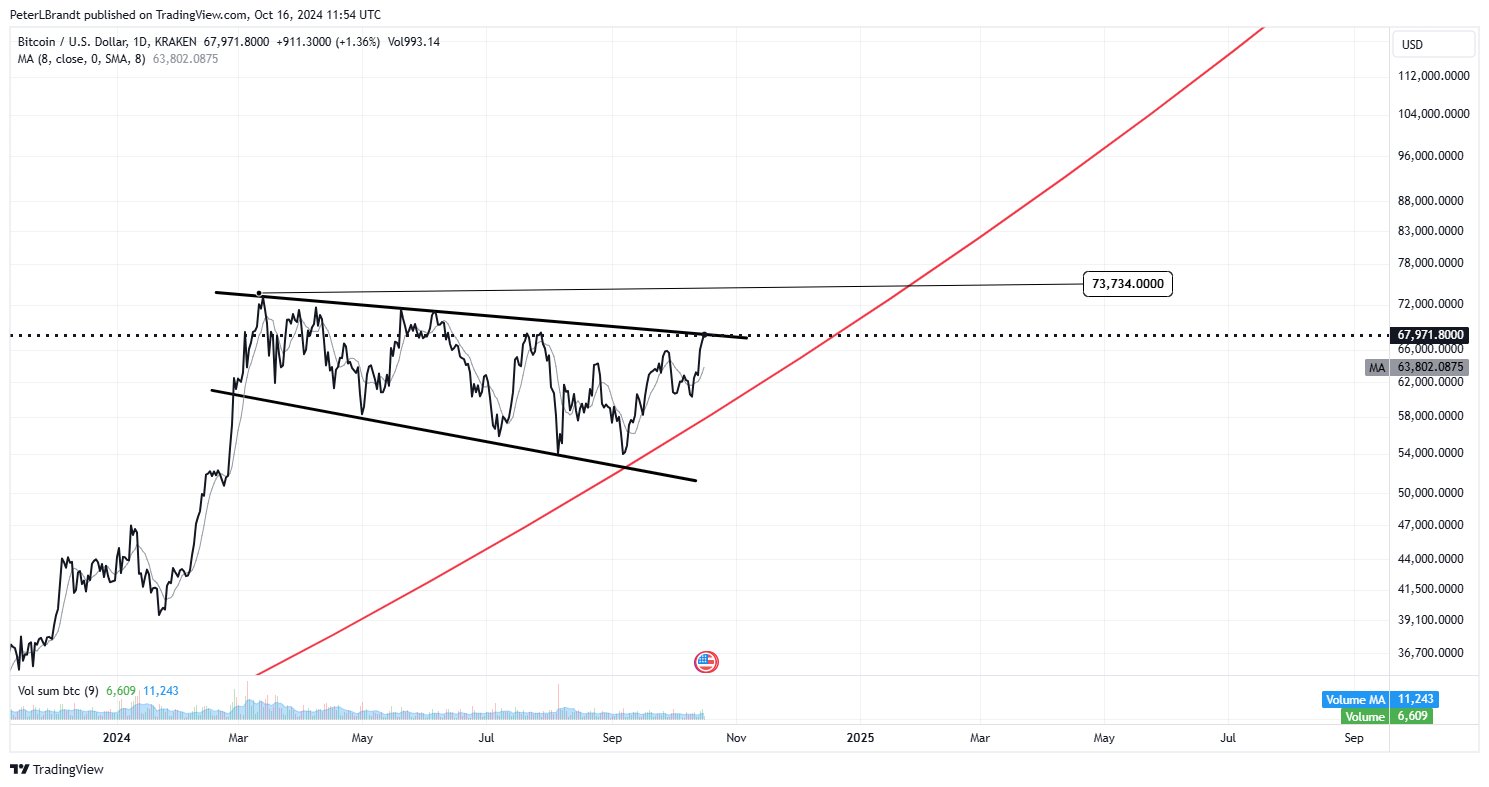
Meanwhile, the latest BTC price showed that the crypto has fallen below the $68,000 mark, and traded at $67,951.21. Notably, the crypto has touched a high of $68,375.29 recently, indicating a growing confidence of the investors. Furthermore, according to CoinGlass data, BTC Futures Open Interest showed an increase of 5%, indicating strong market confidence.
Apart from these bullish trends, a recent Bitcoin price prediction also hints that the crypto could cross the $87,000 mark in an “Uptober” rally. Simultaneously, the prediction also showed that the crypto could cross the $95,600 mark by November 2024.

Rupam Roy
Rupam is a seasoned professional with three years of experience in the financial market, where he has developed a reputation as a meticulous research analyst and insightful journalist. He thrives on exploring the dynamic nuances of the financial landscape. Currently serving as a sub-editor at Coingape, Rupam’s expertise extends beyond conventional boundaries. His role involves breaking stories, analyzing AI-related developments, providing real-time updates on the crypto market, and presenting insightful economic news.
Rupam’s career is characterized by a deep passion for unraveling the complexities of finance and delivering impactful stories that resonate with a diverse audience.
Disclaimer: The presented content may include the personal opinion of the author and is subject to market condition. Do your market research before investing in cryptocurrencies. The author or the publication does not hold any responsibility for your personal financial loss.
The BTC price has come under strong selling pressure once again diving to the support of $58,900 levels on news of hotter-than-expected US CPI inflation data. Although Bitcoin has bounced back to $60,600 levels at press time, legendary trader Peter Brandt predicts the possibility of a 75% correction from here. Investors still remain hopeful for a China stimulus of $283 billion coming this weekend.
BTC Price Can Drop 75% From Here
Renowned trader Peter Brandt brought to the attention of the Bitcoin community an important historical trend. In his post on the X platform, Brandt highlighted the concept of “market analogs,” pointing out that it has been 30 weeks since Bitcoin (BTC) reached its all-time high (ATH).
As per Brandt, whenever the BTC price failed to make a decisive new ATH within this timeframe, during the previous instances, it faced a significant decline of over 75%. Thus, if the historical pattern repeats, there’s enough possibility of another such decline ahead.
Hey Bitcoiners
Are you familiar with the concept of “market analogs?”
Here is something to think about
It has been 30 weeks since $BTC made an ATH
Whenever has not made a decisive new ATH within this time length a 75%+ decline has occurred pic.twitter.com/CUyK4C2W93— Peter Brandt (@PeterLBrandt) October 11, 2024
Peter Brandt’s recent observation spooked some Bitcoin enthusiasts stating how he’s been wrong during his prediction in 2023. Responding to this, Brandt wrote: “I am always amused by people who confuse a market observation with a market opinion. Drivers who cannot turn their heads in both directions always end up in an accident”.
Note that just two days before the renowned traded made a Bitcoin price prediction of $130,000 level within the next year.
However, the market sentiment is currently bearish at this moment against the much-anticipated ‘Uptober’ rally. Also, spot Bitcoin ETFs have seen three consecutive days of outflows showing that the institutional sentiment is waning in the wake of of rising US CPI for September and hotter-than-expected inflation.
Furthermore, the notion of a strong Bitcoin halving year isn’t playing out so far as per the historical trends. Thus, the BTC price is staring at the longest consolidation in history, in a halving year.
285 days have passed in 2024. If there is no #Bitcoin bull market within the next 14 days, this will mark the longest sideways in a halving year in history. pic.twitter.com/JWHkgHC27C
— Ki Young Ju (@ki_young_ju) October 11, 2024
Will $283 Billion China Stimulus Help?
The latest Bloomberg report suggests that China is preparing for another $283 billion stimulus by this week in order to shore up its economy and boost consumer confidence. Analysts are hoping that China’s finance minister will announce this stimulus in a briefing on Saturday. The Chinese stocks witnessed strong rally after a week of holiday, however, have been quickly losing momentum thereby raising speculations of another fiscal China stimulus.
The focus of any fiscal package will signal the government’s economic direction, following years of debt-driven growth through investments, particularly in real estate and infrastructure, regardless of the package’s size. Speaking on the matter, Pushan Dutt, professor of economics at INSEAD said:
“The stimulus should be multi-year and targeted to households and not restarting the real estate investment-led growth story. It is the focus of the stimulus rather than the size that is important.”
While the Chinese stock market soared in October, the BTC price didn’t meet expectations. It seems that the stimulus measures have been sucking out liquidity from the crypto market and moving to the Chinese market. Thus, the next China stimulus might not be as bullish for Bitcoin and altcoins moving ahead.


Bhushan Akolkar
Bhushan is a FinTech enthusiast with a keen understanding of financial markets. His interest in economics and finance has led him to focus on emerging Blockchain technology and cryptocurrency markets. He is committed to continuous learning and stays motivated by sharing the knowledge he acquires. In his free time, Bhushan enjoys reading thriller fiction novels and occasionally explores his culinary skills.
Disclaimer: The presented content may include the personal opinion of the author and is subject to market condition. Do your market research before investing in cryptocurrencies. The author or the publication does not hold any responsibility for your personal financial loss.
Bitcoin, Ethereum, Dogecoin Trade Lower As China Stimulus Deters Hopes: ‘Perspective Is Key, Bitcoin Is Doing Great,’ Says Trader Benzinga
Source link ]]>
Dogecoin (DOGE) Surges 6% as Chinese Stimulus Boosts Crypto Markets FX Leaders
Source link ]]>
Bitcoin price is consolidating near $64K as bulls and bears fight near the inflection point, with fundamental and technical analysis setting the stage for a rally to $100K. In a major news impacting Bitcoin, China’s central bank announced broad monetary stimulus measures and rate cuts to boost the economy.
Can Bitcoin Price Hit $100K As China Boosts Global Markets
People’s Bank of China (PBoC) Governor Pan Gongsheng announced on September 24 several measures to revive China’s economy amid concerns that the 2024 growth target of around 5% might be out of reach. It includes a 50 bps cut in the reserve requirement ratio, a 20 bps cut in key short-term interest rates, and monetary stimulus, reported Reuters.
The PBoC also plans to lower borrowing costs on up to $5.3 trillion in mortgages and relax rules for second-home purchases. This has boosted the Shanghai Stock Exchange by more than 4% in a day. Stock markets globally are in green today on cues from the Chinese stock market. However, Bitcoin price shows volatility amid buying in stock markets.
“This is the most significant PBOC stimulus package since the early days of the pandemic,” said Capital Economics analyst Julian Evans-Pritchard.
Russia Uses Crypto To Trade With China
Another trigger for Bitcoin price hitting $100K is the recent switch by Russian authorities to crypto to pay for trade with China. Moscow Times reported that Russia will pay China in cryptocurrency for war supplies.
As CoinGape earlier reported, Russian authorities have planned the first group of importers to be allowed to pay for Chinese goods in digital currencies under an experimental legal regime. These included electronics manufacturers, some members of the Russian Chamber of Commerce and Industry, and several banks.
The primary goal is for the BRICS Group, a bloc of countries with some of the world’s leading economies. Member countries of this group are focused on challenging the dominance of USD.
Bitcoin Price Gains Upside Pressure
After the 5o bps Fed rate cuts, the market shows optimism for new ATH for Bitcoin price. Experts believe the next wave of Bitcoin rally will not be driven by net inflows in spot Bitcoin ETFs. It will support the existing upward trend rather than lead the movement. The next bull market is driven by macro and technical factors.
Wall Street giants, analysts, and financial experts have predicted an average Bitcoin price rally to $100K-$150K this cycle. Bitcoin price chart is also forming a cup-and-handle pattern, which shows that a breakout could result in a massive bullish rally. But, Bitcoin needs to break above $67K and consolidate for a rally to $100K.
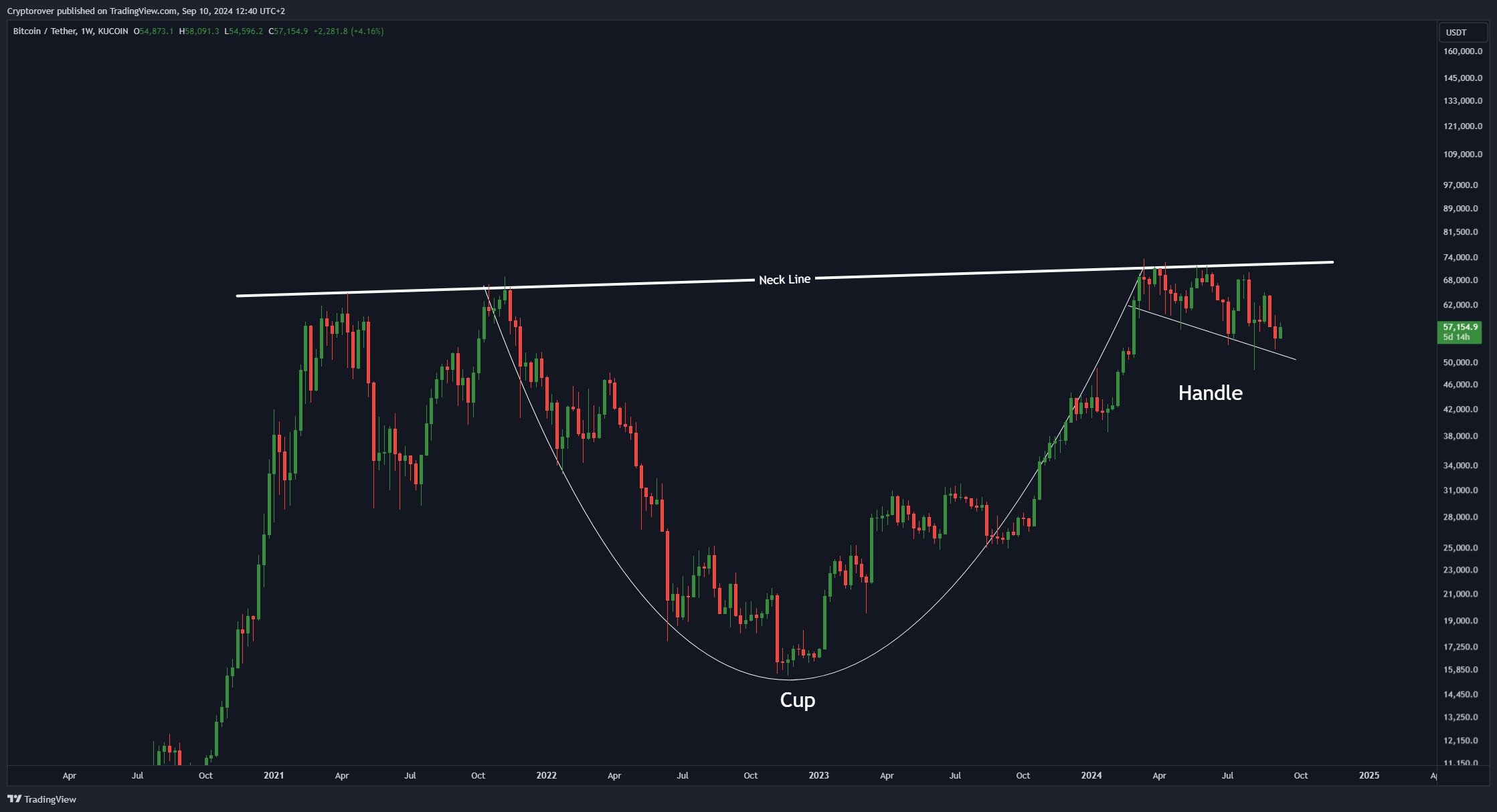
BTC price jumped 1% in the past 24 hours, with the price currently trading at $63,670. The 24-hour low and high are $62,737 and $63,944, respectively. Furthermore, the trading volume has decreased further by 7% in the last 24 hours, indicating a decline in interest among traders.

Varinder Singh
Varinder has 10 years of experience in the Fintech sector, with over 5 years dedicated to blockchain, crypto, and Web3 developments. Being a technology enthusiast and analytical thinker, he has shared his knowledge of disruptive technologies in over 5000+ news, articles, and papers. With CoinGape Media, Varinder believes in the huge potential of these innovative future technologies. He is currently covering all the latest updates and developments in the crypto industry.
Disclaimer: The presented content may include the personal opinion of the author and is subject to market condition. Do your market research before investing in cryptocurrencies. The author or the publication does not hold any responsibility for your personal financial loss.
If You Invested Your 3 Stimulus Checks In Bitcoin, Dogecoin, Ethereum, Here’s How Much You’d Have Today Benzinga
Source link ]]>
✓ Share: