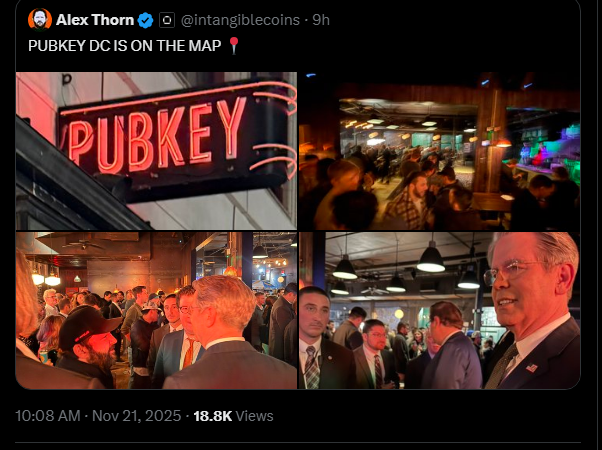
A surprise appearance by US Treasury Secretary Scott Bessent at the opening of a Bitcoin-themed bar in Washington, DC, has drawn sharp attention from both crypto supporters and cautious observers.
Related Reading
According to reports, Bessent stopped by Pubkey during its launch event, a move that many in the Bitcoin community read as a visible sign of warmer relations between parts of government and the crypto sector.
Pubkey Visit Raises Eyebrows And Cheers
Pubkey, a venue that bills itself as Bitcoin-friendly, has grown from a New York outpost into a small chain. Reports have disclosed that the New York location once hosted US President Donald Trump, who reportedly paid in Bitcoin during a previous visit.
The Washington opening, where Bessent appeared unannounced, triggered a flurry of online reaction. Some community figures called the moment historic. Others urged caution, saying public appearances do not automatically translate into policy shifts.
Had to do a second buy today using my “it was so obvious” framework.
Having the Secretary of the Treasury at the Pubkey DC launch seems like a moment I could easily look back on and say “wow, it was all so obvious”.
Stack Sats and chill. https://t.co/8uPWEqLJ9y pic.twitter.com/Dew1A4gkFZ
— Ben Werkman (@BenWerkman) November 21, 2025
Policy Signals And Concrete Talk
Based on reports, Bessent has been public about ideas that place Bitcoin on the government agenda. He has spoken about the GENIUS Act and has discussed ways the Treasury could use seized Bitcoin to seed a Strategic Bitcoin Reserve in a budget-neutral manner.
In an interview dated March 7, 2025, he suggested the Treasury was exploring options that would avoid immediate sales of seized crypto and instead look for ways to keep BTC on the books. That shift in tone is being watched closely by traders and policy watchers alike.
Community Reaction Was Fast
Ben Werkman, a crypto fund CIO, said the event felt like a “moment” for the industry. Another industry figure, Steven Lubka, called it the sign many had been waiting for.
At the same time, analysts warned about reading too much into a single photo op. One trader noted that market moves are driven by many forces, and that symbolic gestures often take time to matter for prices. Short-term traders may ignore signals like this, while longer-term holders may file them away.
What This Means For Markets And Lawmakers
If the Treasury takes steps to pause sales of seized BTC and to test ways of holding coins, the move could change how institutional players view the asset class.
But reports also remind readers that policy ideas meet legal and budget tests before they become real. Lawmakers and regulators will have to weigh the proposal. The public nature of Bessent’s visit, though, makes the discussion harder to treat as private or theoretical.
Related Reading
A Moment, Not A Promise
The image of a cabinet official mingling at a Bitcoin bar is powerful. It gives the community talking points. Yet, officials and experts say more formal steps are required before the visit becomes policy.
For now, the appearance stands as a public sign of interest, backed by statements and proposals that are still in play. Bitcoin’s supporters will note the visibility. Critics will watch for the paperwork.
Photo illustration by Slate. Photos by vvelda@ymail.com/Flickr and Wavebreakmedia/iStock/Getty Images Plus, chart from TradingView
A large, dormant Bitcoin wallet moved a massive amount of coins to an exchange on Thursday, rattling traders and reigniting debate about where big holders stand.
Related Reading
According to on-chain data, a Satoshi-era wallet that had not moved funds for 13 years transferred roughly 12,000 BTC — about $1.4 billion at current prices — in a set of transactions that landed on an exchange ledger.
Whale Moves Stir Markets
Reports have disclosed that the transfers came as Bitcoin hovered near a key price band. The coin fell about 2% after the activity, a quick reaction as traders guessed the funds might be put up for sale.
BREAKING
SATOSHI ERA WHALE JUST SOLD 12,000 $BTC AFTER 13 YEARS OF HODLING.
HE MADE A MIND BLOWING $1.4 BILLION – ONE OF THE MOST PROFITABLE ON-CHAIN SALES EVER.
MASSIVE CRYPTO SELL-OFF INCOMING?? pic.twitter.com/NvCo9mamzT
— 0xNobler (@CryptoNobler) November 13, 2025
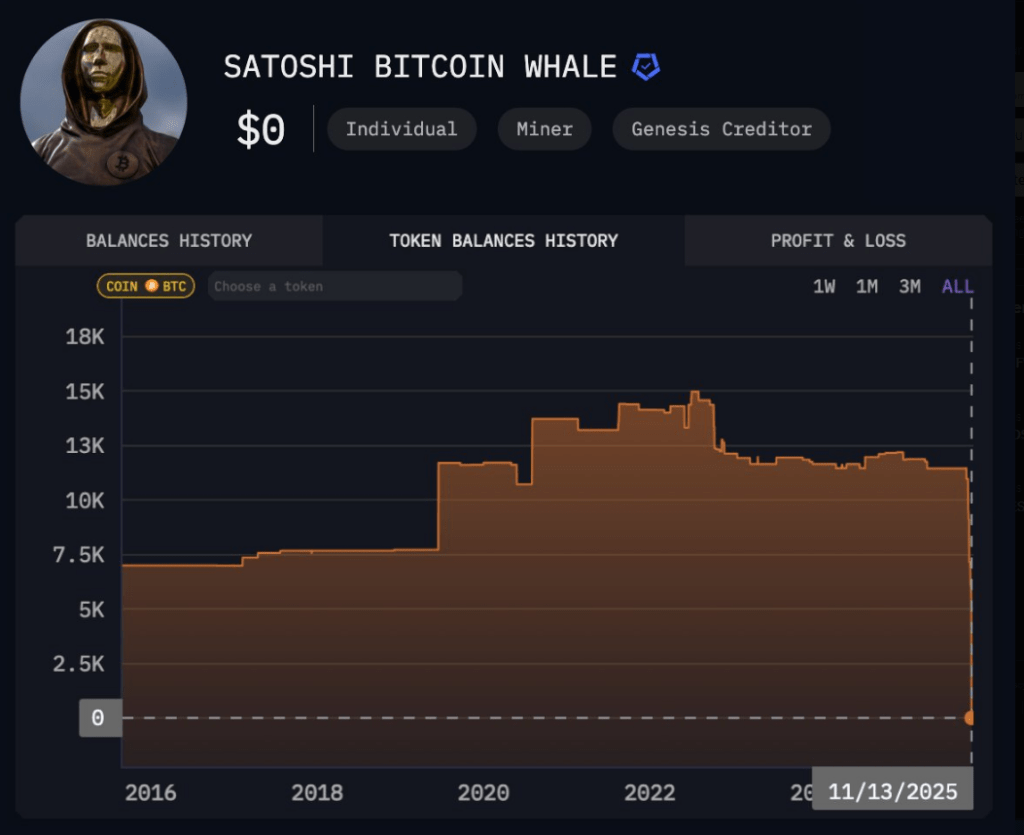
Some market watchers warned that if larger sell orders hit exchanges, positions using borrowed money could be forced to close, which would make price moves sharper.
Others said the market’s mood was more nervous than panicked; large transfers often spark anxiety even when no immediate sale follows.
Technical Pressure Around Resistance
Prominent analyst Ted commented that Bitcoin is facing stiff resistance around $104,000–$105,000. According to his view, holding above $105,000 could encourage renewed buying and push prices toward $107,000.
If that fails, he warned that the next clear support sits near $100,000. Traders will watch order books and exchange flows closely in coming sessions to see whether the transferred coins are converted to fiat or simply shifted between wallets.
Long-Term Holders Take Profits
Based on reports from Chris Kuiper, CFA, the broader selling pressure appears driven more by long-term holders than by panicked sellers.
Kuiper pointed to the share of Bitcoin that has remained inactive for one year or longer. That metric usually climbs in slow markets and drops sharply during fast rallies.
This time, the decline has been gradual. The pattern suggests steady profit-taking over time rather than a sudden exodus.
“Who is selling?”
Is the number one question I’ve been getting regarding #bitcoin‘s continued price pressure against a backdrop of visible buying (by ETPs, corporations etc.)
I’m not unique in suggesting it’s the long-term holders (or HODLers).
But one data point that gives… pic.twitter.com/9PVoolrtwm
— Chris Kuiper, CFA (@ChrisJKuiper) November 12, 2025
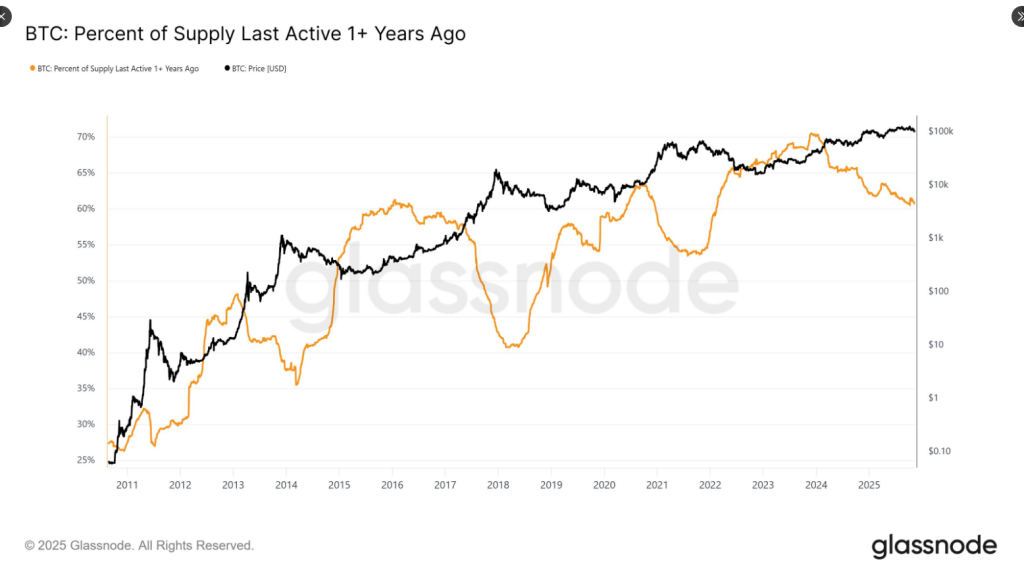
Market observers say gradual sales fit a maturing market where older holders lock in gains without trying to time a perfect top.
Where past cycles saw abrupt moves from large dormant wallets, the current trend looks more measured. That does not rule out short-term volatility, but it changes how traders interpret big transfers.
Related Reading
For now, the market’s next moves will likely be set by a mix of on-chain flows and how price behaves around the $104,000–$105,000 area.
Short-term traders will react to exchange data. Long-term investors may watch the inactive-supply metric and adjust plans more slowly.
The transfer of 12,000 BTC is a big piece of information. How traders act on it will determine whether this becomes a headline event or just another moment in Bitcoin’s long rise.
Featured image from Unsplash, chart from TradingView

Vitalik Buterin has waded into Bitcoin’s long-running dispute over “spam” policy and node software philosophy, amplifying a blistering post by Bitcoin developer Gregory Maxwell that frames the controversy as a clash between open, market-driven neutrality and what he calls populist calls for censorship. “Greg Maxwell defends a principled commitment to freedom and open market-based resource allocation against the populist desire to censor the Current Hated Thing,” Buterin wrote on X, quote-tweeting BitMEX Research’s summary of “fighting talk” in the “Core v Knots” debate.
Buterin Takes A Stance: Supports Bitcoin Core
The immediate spark was a fresh message from Maxwell—posted “Today at 06:40:27 PM” on Bitcointalk—responding to pressure on Bitcoin Core maintainers to ship code perceived as filtering or degrading disfavored transaction types. Maxwell argues that Bitcoin Core’s position, “going all the way back to Satoshi, AFAICT,” is that “Bitcoin is a system secured by economics and self interest.” In his telling, proposals associated with Bitcoin Knots and its advocates amount to building “weapons that can be used against Bitcoin,” a direction he insists Core contributors will not take.
Maxwell’s post is unsparing about both the substance and tone of the current push to constrain on-chain activity. “The knots vision of Bitcoin seems to be a system (in)secured by altruistic hope and populist theocracy—by cancel culture and paper straw bans,” he writes, adding that such campaigns “are really popular on social media and (I expect) a big fail in the real world.”
He acknowledges widespread distaste among Core regulars for “NFT/shitcoin traffic,” but says that commitment to permissionless use must override aesthetic preferences: “Core’s commitment to individual freedom, self determination, and related principals is great enough that they recognize that some wasteful or stupid traffic is the cost of an open system, and that speculative small improvements related to ‘spam’ aren’t worth risking properties that underlie Bitcoin’s entire reason for existence.”
The through-line of Maxwell’s argument is that the project must not bend to “would-be censors” merely because they are “loud and obnoxious,” deploy legal threats, or invite government action. Instead, contributors will “route around them by using and improving Bitcoin just as they would with the weapons of any other attacker.”
He emphasizes that Bitcoin Core is not a vendor optimizing for customers, but a group building a network they themselves want to use: “The people who work on Bitcoin do so for themselves— to create and protect a system they want to use. They’re not making a product for customers… Everyone is invited to share in the benefits of their work if you want what they’ve created, sure. But they’re not going to work against their own interest in a open system secured by economics and resistant to human influence because of popular outcry.”
That “not a product for customers” line quickly became a flashpoint. “Everyone who runs Core IS a customer. This is the dumbest thing I’ve ever read,” X user BaconBitz objected. Buterin, who had elevated the exchange earlier, pushed back on that framing with a terse aesthetic defense: “No, it’s a paragraph written by someone who understands that a good protocol is a work of art.”
Maxwell also ties today’s agitation to a broader cultural reaction against the popularity of on-chain experiments. In his post, he argues that “filter fundamentalism is a thing at all” largely because of “the popular success of NFT/shitcoin bullshit,” and offers a pointed aside about Luke Dashjr’s long-standing advocacy for what Maxwell characterizes as “personal transaction morality police.”
In a characteristically caustic turn, he suggests that advocacy recently “picked up a little traction” not just because of sentiment shifts but also funding dynamics, alleging “he got handed millions in charity investment after becoming an involuntary no-coiner, and now can pay people to work with him and promote his positions since few would previously do it voluntarily.”
The backdrop to all of this is the practical question of what, if anything, Bitcoin Core should do at the code level to address surges in block space demand stemming from inscriptions, NFTs, or other fads that critics label “spam.” Maxwell’s answer is unequivocal: permissionless design and economic incentives are the defense, not discretionary filters.
“It’s nothing new that there is a sizable portion of the population that understand ‘I disapprove of what you say, but I will defend to the death your right to say it’ and a sizable (and vocal!) portion that don’t understand it or don’t agree with it.” In that spirit, he warns against meeting censors “half way” and rejects the idea that threats of state action should steer protocol stewardship.
At press time, Bitcoin traded at $111,567.

Featured image created with DALL.E, chart from TradingView.com
Editorial Process for bitcoinist is centered on delivering thoroughly researched, accurate, and unbiased content. We uphold strict sourcing standards, and each page undergoes diligent review by our team of top technology experts and seasoned editors. This process ensures the integrity, relevance, and value of our content for our readers.
XRP Price Forecast — Ripple Gains Traction Post-Crash, Shiba Inu Stirs Interest In Top Altcoins TechFinancials
Source link ]]>
Polygon Climbs Back to $0.92; Dogecoin Stirs Memecoin Market; Lyno AI Emerges as September’s Best Presale. Crypto Economy
Source link ]]>
Bitcoin (BTC) Price News: Bitcoin, Ether (ETH), XRP, DOGE Lag Stocks, VIX Stirs up Some Nerves CoinDesk
Source link ]]>
New AI-Backed DeFi Asset Manager Stirs Market Buzz; A Strong Contender Against XRP and Cardano? The Crypto Update
Source link ]]>
VeChain Targets $0.15 & Dogecoin Stirs Buzz, But Unstaked’s $0.009545 Presale Might Be 2025’s Biggest AI Breakout! CoinCentral
Source link ]]>
Reason to trust

Strict editorial policy that focuses on accuracy, relevance, and impartiality
Created by industry experts and meticulously reviewed
The highest standards in reporting and publishing
Strict editorial policy that focuses on accuracy, relevance, and impartiality
Morbi pretium leo et nisl aliquam mollis. Quisque arcu lorem, ultricies quis pellentesque nec, ullamcorper eu odio.
Strategy chairman Michael Saylor, a vocal promoter of Bitcoin, stoked renewed chatter among crypto circles with his recent enigmatic tweet. Thursday’s message stating merely “Bitcoin is Calling” left many asking if a forthcoming significant purchase looms.
Related Reading
Strategy’s Shopping Spree On Bitcoin Goes Unabated In The Face Of Market Uncertainty
The company recently acquired 3,450 Bitcoin at a price of $285 million. This was done after a short one-week break from their consistent acquisition pattern. Strategy has been steadfast in its aggressive acquisition strategy despite the fact that nearly all of its crypto acquisitions since November 18 have been made at higher-than-current market prices, according to reports.

Image: Open Access Government
Saylor’s post might be a tease regarding another future purchase, given his history of sending such sarcastic remarks ahead of new acquisitions. The post also appeared to urge his 4.2 million followers to purchase BTC, which he has frequently called “the future of money.”
Bitcoin is Calling. pic.twitter.com/0jo19Qbr5q
— Michael Saylor (@saylor) April 17, 2025

Bitcoin Bet Pays Off With Massive Stock Gains
Strategy’s shares have trounced the performance of America’s largest technology stocks, Saylor’s Wednesday filing showed. The crypto-focused firm has posted an astonishing 130% gain over the last year. These returns more than dwarf the returns of Tesla (57%), NVIDIA (30%), Apple (17%), Meta (4%), and Alphabet (2%).
There is a @Strategy to beat the Magnificent 7. pic.twitter.com/TlD57hW0w0
— Michael Saylor (@saylor) April 15, 2025

Some top tech firms actually lost value during the same period. Amazon and Microsoft saw drops of 2% and 7% respectively. These comparisons highlight the significant rewards Strategy has reaped from its heavy crypto investment strategy.
Saylor Continues Bold Bitcoin Claims
The chairman of Strategy has issued some provocative comments on BTC in recent weeks. Only two weeks ago, he asserted that the price volatility of the top crypto asset actually proves its utility instead of constituting a disadvantage.
When someone brought up Bitcoin’s link with risky assets, Saylor contended this is so because Bitcoin is “the most liquid, salable, and accessible asset on the planet.”
A day earlier than that remark, he underscored Bitcoin’s singular status among commodities by noting that there are no tariffs on it. His remark highlighted its digital nature and liquidity as central to what makes it functionally decentralized.
Saylor has established himself as one of Bitcoin’s most vocal proponents. His tweets tend to center on the fact that there are only 21 million coins in existence, which he recently referred to as “the most important number in finance.” He has also likened Bitcoin to chess, although the meaning behind this comparison wasn’t elaborated in coverage.

Image: Blockzeit
Related Reading
The chairman’s most recent statement comes as Strategy maintains its focus of continuing to buy Bitcoin for the long term, no matter what happens in the short term.
With the company’s shares outperforming technology giants and Saylor’s ongoing public support, most crypto observers are now looking to see if another significant purchase of crypto comes after his cryptic “calling” tweet.
Featured image from Getty Images/Joe Raedle, chart from TradingView
Why Dogecoin Is Falling: Price Plunges Over 20% as Massive Transfer Stirs Fears Finance Magnates
Source link ]]>