Wyckoff Analysis (WA) aims to understand why prices of stocks and other market items move due to supply and demand dynamics. It typically is applied to any freely traded market where larger or institutional traders operate (commodities, bonds, currencies, etc.). In this article we will apply WA to the cryptocurrency Storj ($STORJ) to make a forecast for approximate future events.

Storj Price Data from MEXC Futures | Source: STORJUSDT.P on tradingview.com.
Link to the raw image: https://www.tradingview.com/x/BGsOkzGM
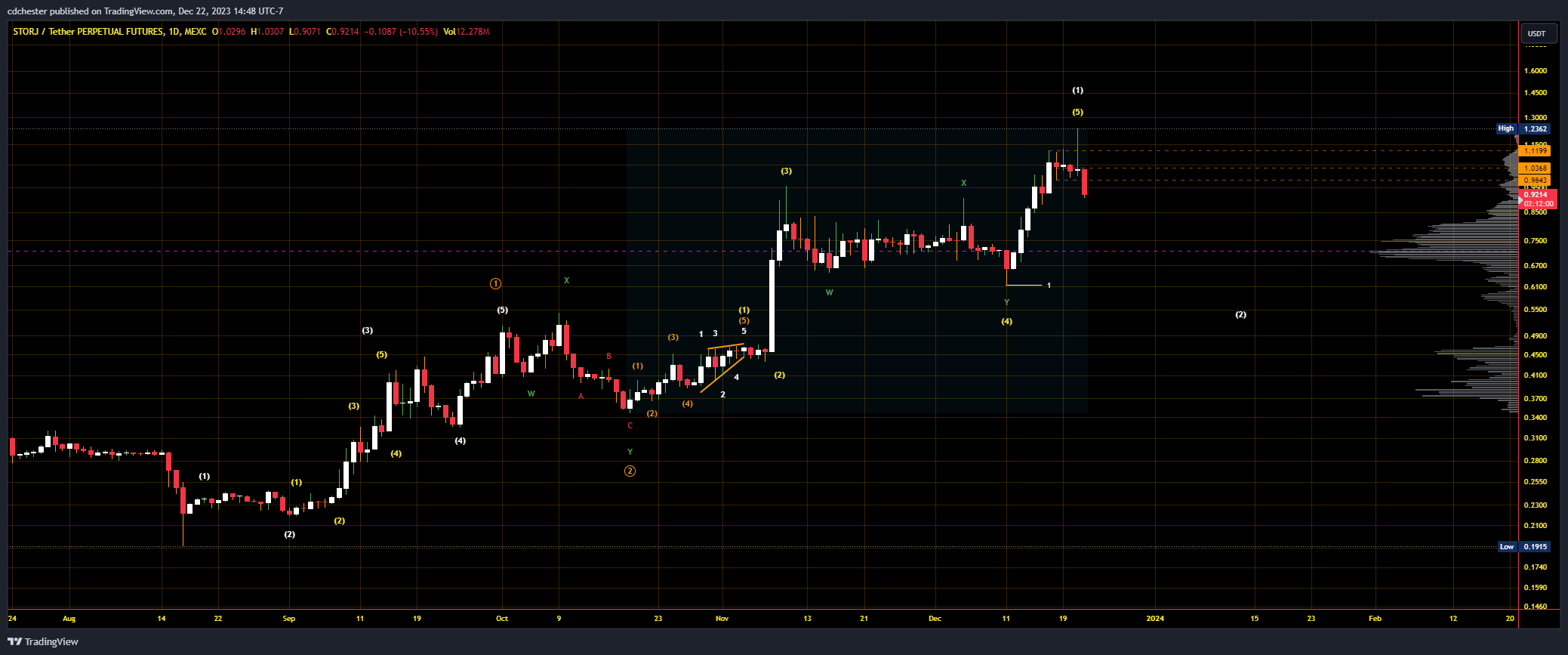
Storj is currently in Phase E of a Wyckoff Distribution Schematic #1. StockCharts says this about Phase E in their article on the Wyckoff Method:
Phase E depicts the unfolding of the downtrend; the stock leaves the TR and supply is in control. Once TR support is broken on a major SOW, this breakdown is often tested with a rally that fails at or near support. This also represents a high-probability opportunity to sell short. Subsequent rallies during the markdown are usually feeble. Traders who have taken short positions can trail their stops as price declines. After a significant down-move, climactic action may signal the beginning of a re-distribution TR or of accumulation.
The trading range for Storj was $1 – $1.12 and it has concretely fallen below that. From the picture below a major SOW has occurred, more so pointing to a Distribution occurring. This also coincides with our analyst’s Elliott Wave (EWT) view on Storj. They predict a small rally as Storj continues to fall in its Wave 2. The majority of the liquidity (per its relevant Volume Profile) is between the 38.2% and 61.8% LFR at $0.56 and $0.76 respectively. A liquidity cluster is typically expected between these LFRs in EWT leading us to the think a Wave 2 correction is happening. Additionally, the cluster is in the price range of the subwave 4, an EWT guideline.
Storj Price Data from MEXC Futures | Source: STORJUSDT.P on tradingview.com.
Link to the raw image: https://www.tradingview.com/x/dD8hv9Aj
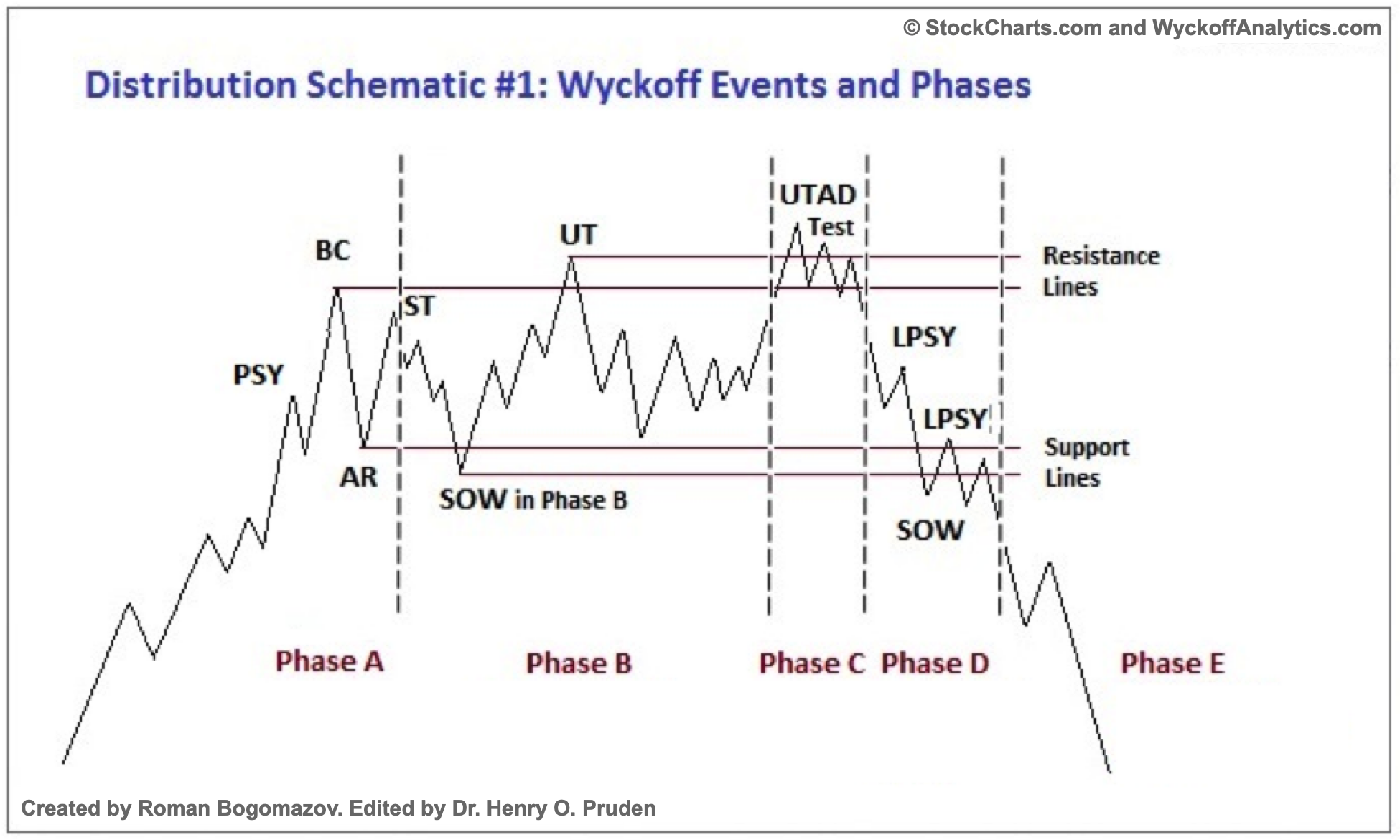
Below is the typical schematic for a Wyckoff Distribution Schematic #1.
Wyckoff Distribution Schematic #1 | Source: StockCharts.com
Glossary
All quotes are from the first link in Supplemental Reading.
Preliminary Supply (PSY) – “where large interests begin to unload shares in quantity after a pronounced up-move”
Buying Climax (BC) – large operators selling their shares while the public buys them at a premium during a period of huge demand
Automatic Reaction (AR) – “With intense buying substantially diminished after the BC and heavy supply continuing, an AR takes place”
Secondary Test (ST) – when “price revisits the area of the SC to test the supply/demand balance at these levels”
Upthrust After Distribution (UTAD) – “a definitive test of new demand after a breakout above TR resistance”
Test – where larger traders “test the market for supply throughout a TR”
Sign of Weakness (SoW) – “a down-move to (or slightly past) the lower boundary of the TR, usually occurring on increased spread and volume”
Last Point of Supply (LPSY) – “exhaustion of demand and the last waves of large operators’ distribution before markdown begins in earnest”
Elliott Wave Theory (EWT)
“A theory in technical analysis that attributes wave-like price patterns, identified at various scales, to trader psychology and investor sentiment.”
Source: “Elliott Wave Theory: What It Is and How to Use It” by James Chen (2023)
Logarithmic Fibonacci Retracement (LFR) – A measured correction at certain Fibonacci ratios on a semi-log scale.
Logarithmic Fibonacci Extensions (LFE) – A measured rally at certain Fibonacci ratios on a semi-log scale.
Supplemental Reading
“The Wyckoff Method: A Tutorial” by Bogomazov & Lipsett
“Reaccumulation Review” by Bruce Fraser (2018)
“Jumping the Creek: A Review” by Bruce Fraser (2018)
“Distribution Review” by Bruce Fraser (2018)
“Introduction to Point & Figure Charts” from StockCharts
“P&F Price Objectives: Horizontal Counts” from StockCharts
“The Wyckoff Methodology in Depth” by Rubén Villahermosa (2019)
“Wyckoff 2.0: Structures, Volume Profile and Order Flow” by Rubén Villahermosa (2021)
“Elliott Wave Principle – Key To Market Behavior” by Frost & Prechter (2022)
Disclaimer: The article is provided for educational purposes only. It does not represent the opinions of NewsBTC on whether to buy, sell or hold any investments and naturally investing carries risks. You are advised to conduct your own research before making any investment decisions. Use information provided on this website entirely at your own risk.
Although cloud storage was a great innovation, it lacked backup protection and was controlled by a central authority. However, with blockchain technology, secure, cost-effective, and decentralized storage platforms have been launched. Storj and Filecoin belong to this category of platforms.
Filecoin was founded in 2017 by Protocol Labs but the mainnet was launched in 2020 to serve as a platform for data storage and retrieval. It uses a proof-of-storage consensus mechanism which is made up of proof of replication and proof of spacetime to validate operations on the network. It occupies the second layer of the Interplanetary File System (IPFS). FIL is used to settle transactions.
Storj was founded in 2017 by Storj Labs on the Ethereum network as an easy-to-use and affordable cloud storage platform. It makes use of farmers and renters; farmers provide storage space, and renters buy this space from them. Data are stored on the network using a sharding mechanism. STORJ serves utility purposes for payment and rewards.
While Filecoin can store and distribute data, Storj can only store them. Storj was developed majorly for developers, but Filecoin supports a market for trading raw data. Moreover, Storj promises durable data storage. Of the two, Filecoin is more decentralised; Storj is both centralised and decentralised.
Both support transactions between their service providers and users. Filecoin is made of a free match market where clients and data providers can freely interact. Whereas, Storj uses a market maker model where clients pay the platform to get their data services. Both don’t charge migration costs; Storj accepts payment directly from users, while Filecoin uses its blockchain to solve service and settlement matters.
Filecoin uses an EC algorithm, whereas Storj depends on the Ethereum blockchain. In a world continually embracing decentralisation, Filecoin provides decentralised storage services. FIL is worth $23.69 right now with a market cap higher than STORJ with over $3.5 billion, showing that it’s experiencing mainstream adoption.
While it would make a great investment, you should do proper research before investing. Deal wisely and only invest spare cash.
-
Storj price on Sunday spiked to set a new 7-month high of $2.9000.
-
However, profit-takers swooped on Monday pushing the price down to $1.8643.
-
Storj coin now has a fully diluted market cap of $788 million.
On Monday, the STORJ:USD price pulled back nearly 3% from Sunday’s close as profit-takers swooped in cash out on the weekend rally. The price of the open-source cloud storage platform’s native coin spiked to set a new 7-month high of about $2.9000 before easing later to close at about $2.0292.
Storj is a decentralised network of nodes that hosts and securely stores user data through advanced encryption. Storj was launched in late 2018 as a peer-to-peer encrypted cloud storage platform.
Is the pullback an opportunity to buy?
Storj’s Sunday spike was a reaction to the general market movement after the Office of the Comptroller of the Currency issued Anchorage with a first federal charter for a crypto bank. The quick pullback suggests there is nothing fundamentally specific to Storj that helped drive its price higher.
Therefore, the Storj:USD price could continue to pull back in the coming days unless a significant catalyst emerges. The Storj price has been relatively choppy in recent trading sessions, albeit in a gently ascending channel formation.
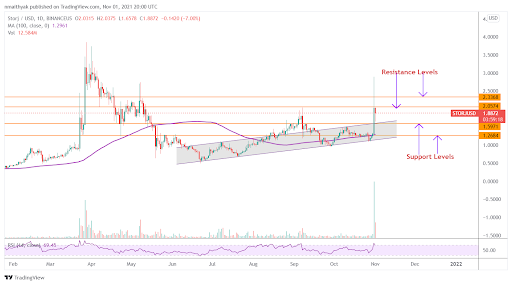
Therefore, investors could target potential pullback profits at about $1.5971 or lower to $1.2684. On the other hand, if a new catalyst emerges, sparking a rebound, Storj could find solid resistance at about $2.0574, or higher at $2.3368.
In summary, with Storj still trading in overbought conditions after the recent spike, a downward movement looks more likely in the coming days.
SHIBA Inu coin, Storj and Pyr soared following a Metahero drop, which the cryptocurrency seems to have bounced back from.
Pyr is up a significant 33.73 percent, at $19.73, while stock in Storj went up by 26.41 percent.
Metahero was priced at $0.1228, which is in keeping with slow, steady growth over the last month, marked by occasional drops.
Shiba Inu reached an all-time high of $0.00008845 on Thursday, October 29th.
As Facebook rebrands to “Meta”, MANA is taking over the crypto world. MANA skyrocketed to $4.33 on Saturday, a 164 percent gain.
The rise appears to come after Facebook CEO Mark Zuckerberg announced “metaverse” — a virtual reality work for users to play games and socialize.
Shiba Inu has rallied an amazing 800 per cent this month, hitting a record high of $0.00008870.
Meanwhile Bitcoin is down by 1.25% and has been on a steady decline throughout Sunday morning.
On Wednesday, Bitcoin fell from a 24 hour high of $63,064 to $58,500 Wednesday morning. But early on Thursday, it was back above $61,000, according to CoinBase.
Read our cryptocurrency live blog for the latest news and updates…
-
FINANCIAL RISKS OF ADOPTING BITCOIN
Proponents of El Salvador’s decision have hailed the move as the progressive future of money.
Critics, however, have derided it as little more than a publicity stunt by Bukele.
More troublingly, they say the move poses substantial financial risks to ordinary Salvadorians and their country, as cryptocurrency is an infamously volatile market.
-
ADOPTING BITCOIN AS CURRENCY HAS ‘HUGE POTENTIAL’
Maggie Wu, the CEO of blockchain venture capital firm Krypital Group, says challenges in Bitcoin adoption do exist, but told Forbes she’s optimistic about its future.
“I believe that Bitcoin adoption is conceivable, especially in the relatively small developing countries with inadequate monetary systems where the recognition of digital currencies there is relatively high,” she said.
“The blockchain-related infrastructure that can carry digital currencies in most Central and South American countries and regions is not complete, including wallets, exchanges, etc. This is also the direction of our investment focus.”
“We think there is huge potential and value here for fostering crypto adoption throughout the region.”
-
COULD BITCOIN REPLACE THE DOLLAR? CONTINUED
Leading lights in the Bitcoin community say it is not far from overtaking the value of all the silver in the world and will “easily” have over a billion users within the next five years.
With national currencies currently being devalued by central banks through money printing and Bitcoin’s inbuilt cap of 21 million coins, they argue we may be on the cusp of “hyperbitcoinization”.
-
COULD BITCOIN REPLACE THE DOLLAR?
Bitcoin could be poised to overtake the dollar by 2030 as the world’s reserve currency, some experts in the soaring cryptocurrency believe.
The digital money hit its all-time high against the US dollar on Wednesday when a single Bitcoin was trading for nearly $67,000.
-
HOW MUCH HAS THE VALUE OF BITCOIN CHANGED?
Bitcoin has jumped 26 percent in the past month.
Some of gains can be attributed to Gary Gensler, chair of the US Securities and Exchange Commission, repeating his support for Bitcoin exchange-traded funds (ETFs).
Instead of buying Bitcoin directly, the move means you invest in futures contracts.
-
LITECOIN VS. BITCOIN, CONTINUED
Like most cryptocurrencies, Litecoin uses blockchain technology for processing and recording transactions.
While Litecoin is smaller, it is a quicker and cheaper alternative when compared to Bitcoin.
-
LITECOIN VS. BITCOIN
Litecoin, which was established in 2011 by Google engineer Charlie Lee, operates similarly to Bitcoin.
Mr Lee on occasions refers to Litecoin as the “silver to Bitcoin’s gold.”
The two cryptocurrencies act similarly in how their global payment operations are set up. Both are not controlled by financial institutions.
-
WILL LITECOIN HIT $500? CONTINUED
Odds are this helped give Litecoin a boost as well.
In 12 months’ time, the price of Litecoin could exceed $255, according to Wallet Investor.
But near the end of 2026, Wallet Investor sees Litecoin exceeding $557.
-
WILL LITECOIN HIT $500?
Litecoin exploded to $412.96 early – the closest it has ever gotten to the $500 mark.
But it has dropped since.
While China has banned all cryptocurrency transactions, big brother Bitcoin has gained on recent favorable news coming from the U.S.
-
SOLANA SCALABILITY, CONTINUED
Myron Jobson, personal finance campaigner at Interactive Investor, told The Sun: “The collection of 10,000 artworks reported sold out in under 10 minutes. Each piece was ‘minted’ using the SOL token.”
He added that “there’s a sentiment among crypto evangelist that Solana has strengthened its status as credible challenger to Ethereum as the blockchain of choice for building decentralized applications.”
-
‘MILESTONE SCABILITY TEST’
Solana is on the rise following a “milestone scalability test” last month.
It hosted the “Degenerate Ape Academy”, a collection of digital artworks (NFT) on Solanart, a marketplace on the Solana network.
-
WHAT IS ROBINHOOD? CONTINUED
Unlike many discounted brokers, the company does not offer individual retirement accounts.
The bulk of Robinhood’s revenue comes from order flow.
-
WHAT IS ROBINHOOD?
The Robinhood platform operates as a discounted brokerage that offers commission-free trading.
Specifically, users can trade exchange-traded funds (ETFs), individual stocks (including American depositary shares), and options.
You can also trade Robinhood’s stock thanks to the company recently going public at a $1.2billion valuation.
-
THE POTENTIAL TO BECOME RICH
The early success of the crypto may sound promising to those looking to rake it in.
-
BITCOIN PREFERENCE GROWS
With the cryptocurrency soaring, more are preferring Bitcoin as currency.
-
RISKS OF ROBINHOOD, PART THREE
In July, the platform was also ordered to pay nearly $70million in fines and compensation for misleading customers and outages.
If you are seeking a discount broker and are looking to open an IRA account, you can check out the following platforms: Vanguard, Fidelity, TD Ameritrade, Merrill Edge, among others.
-
RISKS OF ROBINHOOD, PART TWO
For investing individual stocks, make sure you check company reports, Securities and Exchange Commission (SEC) filings, broker notes, and press releases so you can make the best decisions for your money.
Another risk when choosing Robinhood along with other brokers is that they can restrict trading when there’s unusual activity.
In fact, Robinhood faced some outrage earlier this year when it restricted trading on meme stocks including GameStop and AMC.
-
RISKS OF ROBINHOOD
When it comes to risks, investing alone is one because you’re not guaranteed to generate a profit and the value of your assets could fall.
If you’re choosing Robinhood so you can trade stocks and cryptocurrencies – then the game gets even riskier.
Cryptocurrencies are not only difficult to understand but even tougher to predict when bearish trends in the market will take place.
For example, cryptocurrency was thriving this year up until Elon Musk said that Tesla was halting the acceptance of payments in Bitcoin.
Since then, the crypto spaced has endured volatility.
-
WHAT IS NUCYPHER? CONTINUED
This allows users to share private data with a number of others in a secure way.
Holders of its token NU can stake their tokens through the network to run a node, which is responsible for creating and sending information.
Interestingly, NuCypher token is an ERC-20, which means it is built on Ethereum.
-
WHAT IS NUCYPHER?
NuCypher was founded by Michael Egorov MacLane Wilkison in 2015, but it wasn’t until 2019 when the public testnet for NuCypher’s network launched.
NuCypher specifically operates as a decentralized key management system that uses blockchain technology.
-
WHAT ARE ALTCOINS, CONTINUED
Simon Peters, crypto-asset analyst at eToro, said: “They build on the success of bitcoin by slightly changing the rules, economics or use cases to appeal to different users.”
“Altcoins vary greatly in their use cases and practical application. They typically have a form of technology they underpin or provide a liquidity solution to a product or service.”
-
WHAT ARE ALTCOINS?
Altcoin stands for alternative coin, a type of virtual currency that uses the so-called blockchain to allow secure transactions.
Altcoin is a category of cryptocurrency rather than a currency itself, and there are more than 900 different altcoins available.
-
BITCOIN LATINUM ANNOUNCES LISTING ON TOP CRYPTO EXCHANGE
Bitcoin Latinum (LTNM) is gaining momentum, as it announced today that it plans to be listed on HitBTC Exchange, which is a top crypto exchange.
The official trading is expected to begin at the end of this year.
Bitcoin Latinum was developed on behalf of Bitcoin Latinum Foundation, by Monsoon Blockchain Corporation.
The cryptocurrency is expanding its global acceptance, with HitBTC exchange being the seventh exchange to list Bitcoin Latinum.
-
LITECOIN VS. BITCOIN, CONTINUED
Like most cryptocurrencies, Litecoin uses blockchain technology for processing and recording transactions.
While Litecoin is smaller, it is a quicker and cheaper alternative when compared to Bitcoin.
-
LITECOIN VS. BITCOIN
Litecoin, which was established in 2011 by Google engineer Charlie Lee, operates similarly to Bitcoin.
Mr Lee on occasions refers to Litecoin as the “silver to Bitcoin’s gold.”
The two cryptocurrencies act similarly in how their global payment operations are set up. Both are not controlled by financial institutions.