Michael Saylor’s Strategy might be gearing up for another round of Bitcoin acquisitions. Market data reveals that Strategy’s Strech STRC ATM facility has attracted a liquidity of over $1.76 billion in the current week. Ad Ad Strategy’s STRC Bags Enough Funds to Buy 23,934 BTC According to STRC ATM tracker on Bitcoin Quant, the fund
The post Strategy’s STRC Raises Enough Capital to Buy Another $1.76B in Bitcoin appeared first on CoinGape.
]]>Strategy’s STRC stock has become the most liquid preferred stock as demand for the Bitcoin-backed security continues to rise. This development comes just as crypto traders predict that Michael Saylor’s company bought over 1,000 BTC this week, with the stock’s at-the-market (ATM) program likely contributing to the latest purchase. Saylor Announces Milestone For STRC Stock
The post Just-in: Strategy’s STRC Becomes Most Preferred Liquid Stock appeared first on CoinGape.
]]>MSTR stock price is up today, recording modest gains alongside Bitcoin, which rose as high as $71,000. Experts now point to possible upside for MSTR stock despite rising bearish bets, driven by rising Strategy short interest. Analyst Predictions on MSTR Stock Price According to expert Yimin, MSTR stock is currently facing resistance near its 50-day
The post Expert Predicts MSTR Stock Rally To $180 Even as Strategy’s Short Interest Surges appeared first on CoinGape.
]]>The first federally chartered crypto bank in the United States, Anchorage Digital, has announced its current holdings of Strategy perpetual preferred stock STRC. This news comes as the MSTR stock continues to drop in price. Anchorage Buys Into Strategy’s STRC Stock The crypto bank announced its holdings of Strategy perpetual preferred stock on its balance
The post First Crypto Bank Anchorage Adds Strategy’s STRC Stock to Portfolio as MSTR Value Sinks appeared first on CoinGape.
]]>Strategy’s executive chairman, Michael Saylor, and CEO, Phong Le, assured that its Bitcoin accumulation strategy remains intact despite rising unrealized losses. During the earnings call after reporting $12.4 billion in Q4 losses, management indicated that liquidation risk would only emerge if Bitcoin fell to $8,000. Strategy to Buy More Bitcoin: Michael Saylor and CEO Phong
The post Strategy’s Michael Saylor, CEO Phong Le Assure More Bitcoin Buy, No Liquidations Until $8K appeared first on CoinGape.
]]>MSTR stock is showing signs of a short-term bottom as investor attention across social platforms continues to fade. Social metrics covering the period from September 23 to December 23, 2025 show weakening engagement even as the stock faced a deep price correction. According to Santiment report, social volume and social dominance indicators for MSTR have
The post MSTR Bottom In? Santiment Flags Hidden Indicator as Crypto Traders Bet on Strategy’s MSCI Delisting appeared first on CoinGape.
]]>The largest corporate Bitcoin treasury Strategy’s (previously MicroStrategy) key metric mNAV has slipped to its lowest ever. It follows a more than 8% drop in MSTR stock price despite announcing a massive 10,645 BTC purchase worth $950 million. Strategy’s mNAV Slips to 1.10 as Bitcoin Tanks to $85K MicroStrategy’s mNAV, a ratio of enterprise value
The post Strategy’s mNAV Slips to Lowest Ever as MSTR Stock Falls 8%, Will Michael Saylor Sell Bitcoin? appeared first on CoinGape.
]]>When Strategy disclosed its acquisition of more than 10,000 Bitcoin worth $1 billion, market watchers anticipated an immediate rally. Instead, Bitcoin’s price barely moved. The muted response was not a reflection of weak demand but the result of how the purchase was executed. In response to the confusion surrounding the stagnant price action, Quinten Francois explained the mechanics behind the transaction, clarifying why such a large buy left no visible impact on the chart.
The Invisible Plumbing Behind Institutional Bitcoin Accumulation
On 9 December 2025, Andrew Tate questioned why a massive 10,000 BTC buy failed to nudge the market. The answer, as analyst Francois explained, lies in the operational backbone of over-the-counter (OTC) desks—an ecosystem designed to absorb billion-dollar flows while keeping price action stable. These desks operate entirely outside exchanges. When a firm wants thousands of BTC, nothing is executed against the real-time order book. Instead, OTC operators start sourcing supply quietly from large holders looking to offload position size.
Related Reading
This pipeline includes deep private liquidity that retail traders never see: miners selling block rewards, VCs rotating out of token allocations, market makers rebalancing inventory, and even corporate treasuries restructuring reserves. None of these trades appear on exchange feeds. According to Francois, they do not trigger volatility, sweep liquidity pools, or create the upward pressure that retail investors typically expect from large buys.
More critically, Francois notes that these transactions do not occur in a single block. A 5,000–10,000 BTC order is never filled all at once. Instead, OTC desks spread procurement over days or even weeks, accumulating inventory piece by piece. Only when enough matched supply is gathered do they finalize the transaction, resulting in a smooth settlement with no visible footprint on price charts.
Why No Price Rally Emerges From Shadow-Side Demand
Shadow-side demand refers to large-scale institutional buying that occurs entirely outside public exchanges. These hidden transactions do not trigger price rallies because OTC infrastructure is designed to prevent slippage, volatility, and market distortion. Institutions acquiring strategic size deliberately avoid pushing prices higher, while liquidity providers are incentivized to maintain stability. By keeping trades off public exchanges, both sides protect execution quality and preserve overall market integrity.
Related Reading
A rally only emerges when open-market demand exceeds visible liquidity. In this case, the demand never hit the open market. OTC desks tap private channels first and only touch exchanges if supply dries up—and that is considered a last resort. If enough sellers are found privately, no exchange-side buying occurs at all.
This is why public charts often show sell pressure but rarely show institutional demand. The buys happen in the shadows, the sells appear on-chain, and the price remains anchored. Strategy’s $1 billion allocation did not fail to move the market; it was intentionally engineered not to.
Featured image created with Dall.E, chart from Tradingview.com
Bitcoin’s (BTC) sharp drop this week triggered renewed anxiety across the crypto market. However, Michael Saylor’s latest post indicates Strategy’s commitment to its massive BTC reserve remains firm. Saylor Reaffirms Strategy’s BTC Commitment Amid Downturn With BTC price down almost 9% in the last week, Saylor’s post saying, “I won’t back down” shows his company’s
The post ‘I Won’t Back Down,’ Michael Saylor Reinforces Strategy’s Bitcoin Mission appeared first on CoinGape.
]]>Bitcoin fell sharply over the past week, sliding almost 15% and moving beneath the $100,000 and $95,000 marks to trade around $90,300, Wednesday.
Related Reading
According to company disclosures, Michael Saylor’s Strategy bought an extra 8,178 BTC for $835.6 million at about $102,171 apiece during the downturn. That move has drawn fresh attention because some of those newest coins are already underwater.
Strategy’s Holdings And Recent Buys
Reports have disclosed that Strategy now holds 649,870 BTC, equal to roughly 3.2% of the circulating supply. The firm says it paid about $48 billion for those coins. At current prices, the holding’s market value sits near $59.38 billion, leaving an overall paper gain of 22% or about $11 billion.
Strategy has acquired 8,178 BTC for ~$835.6 million at ~$102,171 per bitcoin and has achieved BTC Yield of 27.8% YTD 2025. As of 11/16/2025, we hodl 649,870 $BTC acquired for ~$48.37 billion at ~$74,433 per bitcoin. $MSTR $STRC $STRD $STRE $STRF $STRK https://t.co/HI1TeYOvQ9
— Michael Saylor (@saylor) November 17, 2025
Yet CryptoQuant’s breakdown finds that roughly 40% of Strategy’s stash is now showing unrealized losses, a result of the company’s recent buying activity pushing newer lots above today’s market price.
The newest 8,178 BTC purchase is already down around 10.5%, costing the company roughly $88 million on paper in a matter of days.
Reports also show Strategy made three separate buys earlier this month: smaller blocks recorded on the third and the 10th of November, bringing November’s total to 9,062 BTC for $931.1 million. At current market levels those November tokens are worth about $827 million, a drop of just over 11% since the buys.
Saylor’s Portfolio Turns Red?
He announced the purchase of 8,178 BTC at an average price of $102,171, about 10% above current market levels.
This recent bitcoin move puts ~40% of Strategy’s 649,870 BTC holdings in the red, with only 60% still in profit. pic.twitter.com/hii0BmV95P
— CryptoQuant.com (@cryptoquant_com) November 18, 2025
Short-Term Losses Amid Long-Term Gains
While parts of the position sit in the red, Strategy’s longer-term position remains positive. The company’s overall profit ratio of 22% is well above the deep losses it faced from mid-2022 into early 2023, when as much as 75% of its holdings were showing losses and the portfolio was down about 33%, equal to roughly $1.32 billion in paper losses then.
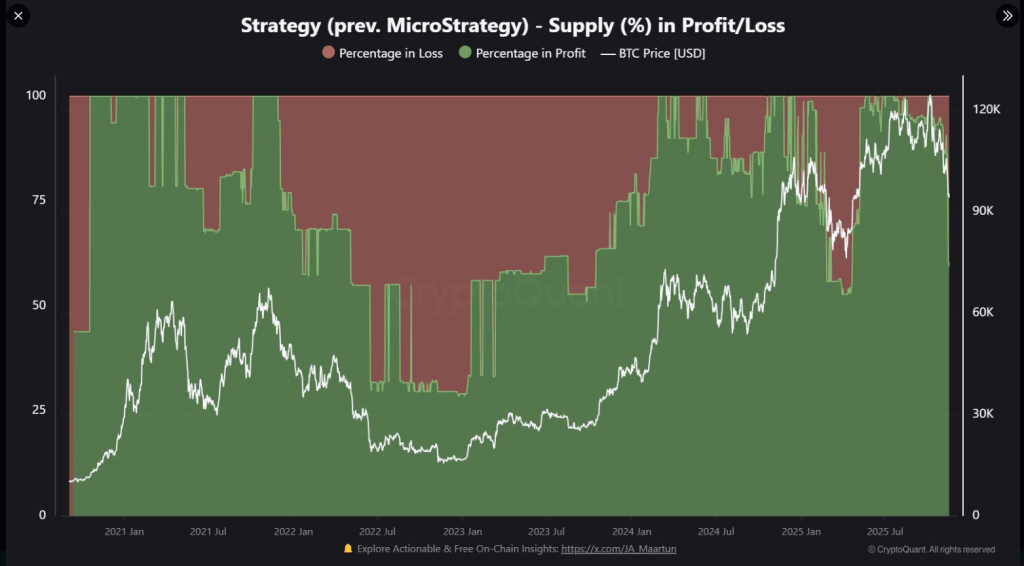
Early last month Strategy had a peak profit ratio near 68% with gains calculated at about $32 billion, showing how swings can be large on both sides.
According to filings, Saylor treats dips as chances to add coins, and this latest buying fits that pattern. Not every market participant agrees.
A Fraud?
Peter Schiff, a well-known gold investor, criticized Strategy’s rising average cost, which he says—at about $74,433 per BTC—has been moving closer to the market value and could limit upside if prices fail to rebound.
Schiff said on Sunday that Strategy Inc.’s focus only on Bitcoin is “a fraud.” He also challenged Michael Saylor to a live debate at Binance Blockchain Week in Dubai this December.
Schiff argued that the company’s recent gains mainly come from the rising Bitcoin price. He warned that if people lose confidence in Bitcoin, the company’s finances could be in trouble.
Related Reading
What This Means For Investors
For outside observers, the takeaway is straightforward: even the biggest holders can have portions of their inventory in loss when markets fall.
Strategy’s newer purchases have reduced the firm’s tidy headline returns, but they did not wipe out the overall gain. Reports suggest the company is still sitting on a sizable paper profit.
Short-term results for those November buys look poor. Long-term results will depend on future price moves.
Featured image from Gemini, chart from TradingView