Bitcoin drifted under $83,000 on Thursday as market focus shifted toward how liquidity is stacked on exchanges. Reports say a mix of big orders and tight ranges has left traders feeling boxed in.
Some analysts warn that a break under a key level could spark sharper selling, while others point to concentrated buy orders that might cushion a drop.
Related Reading
Order-Book Pressure And Liquidity
According to trading-room data, one group or a cluster of large accounts appears to be shaping short-term moves by placing big bids and offers in the order book.
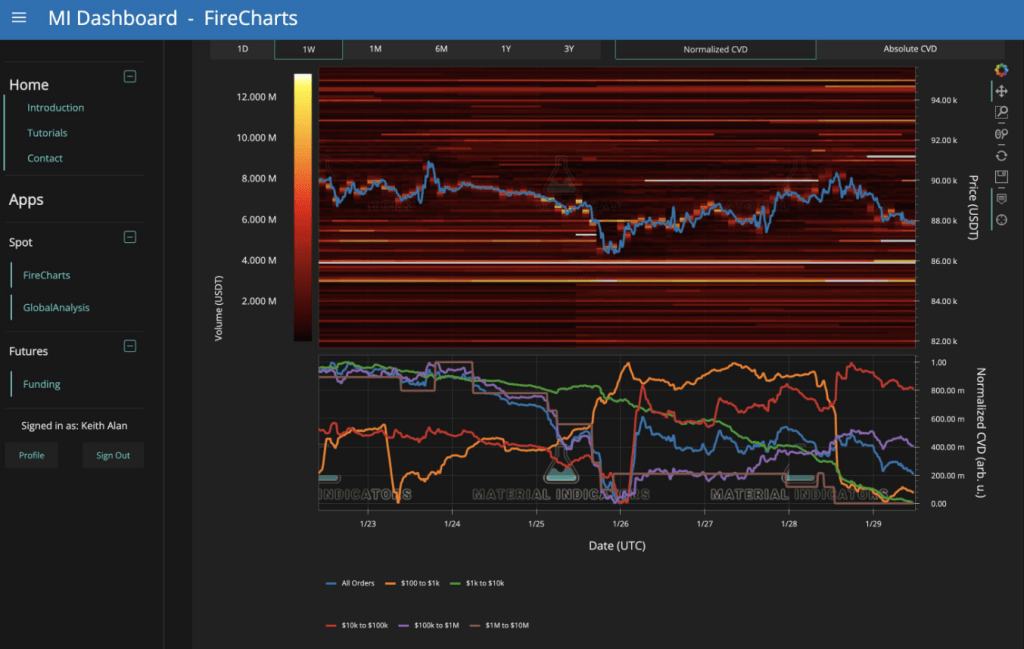
This can keep price stuck in a narrow band. Material Indicators’ research flagged a pattern where bids are clustering around $85,000 to $87,500 — a zone that could act like a floor for now.
The idea is simple: by piling up liquidity at certain prices, large players can get fills on their orders or discourage quick recoveries before options expiry.
Market participants say this kind of behavior can trap less-experienced traders who react to sudden moves. At times, the pressure seems deliberate; at other times, it may be a byproduct of many traders aiming for the same levels. Either way, the result has been choppy price action and rising tension in the book.
FireCharts shows $BTC price is being suppressed by one entity using a liquidity herding strategy to push price lower, potentially to get their own bids filled, or possible to keep price pinned in the lower end of this range before Friday’s options expiry.
A significant amount of… pic.twitter.com/c63miAxBkh
— Material Indicators (@MI_Algos) January 29, 2026
Whales, Wyckoff And The Spring Idea
Reports note that a group of traders using Wyckoff-style thinking expects a “spring” — a drop below recent lows that then leads to a strong bounce as heavy hands buy at lower prices.
Pseudonymous analysts have pointed to $86,000 as a strong buy wall provided by large orders. One commentator shared charts showing how a quick dip under $80,000 could serve as the spring before a rebound.
Some traders view this pattern as part of accumulation. Others see it as a risky setup that could widen losses if support fails. The truth may sit between those views: both accumulation and the risk of a flush are possible in a tense market.
Bitcoin Price Action
Bitcoin has been moving in a tight range after failing to hold above $90,000. Price slid near $82,300 as fresh worries about monetary policy and world events hit risk assets.
Volatility has been low at times and then spikes quickly, which makes trading tricky. Buyers have stepped in at certain levels, but they have not yet forced a clear break higher.
Geopolitics And Fed Moves
Reports say rising tensions in parts of the Middle East and talk about a new Federal Reserve chair pick have added to uncertainty.
Some investors fear tighter policy would drain liquidity from markets and weigh on crypto. Market chatter has even mentioned US President Donald Trump in relation to political shifts that could influence economic policy.
Safe-haven flows into other assets have been seen when headlines worsen, and those moves have pulled money away from riskier holdings.
Related Reading
Key Levels To Watch
Traders should watch the $83,000–$85,000 zone closely. A daily close below $86,000 would be read by many as a negative sign and could open the door to deeper selling. On the flip side, sustained buying at those levels could set up a rally if big liquidity holders decide to lift offers.
For most people, patience and clear stop rules matter right now, because the market is being pushed by both order-book tactics and outside news, and either factor can shift price fast.
Featured image from Unsplash, chart from TradingView
Dogecoin Price Suppression: Analyst Reveals The Channel That Is Holding Price Back From Reaching $0.3 Bitcoinist.com
Source link ]]>
Cardano Foundation Accused of Internal Politics and Growth Suppression, Hoskinson Responds Crypto News Flash
Source link ]]>
Marc Zeller, founder of the Aave Chan Initiative (ACI), has called for the dissolution of the Ethereum Foundation. This came following a recent transaction suggesting that the Foundation was again looking to sell the ETH top.
Ethereum Foundation Should Be Dissolved After Purge And Verge Upgrades
In an X (formerly Twitter) post, Zeller remarked that the Ethereum Foundation should be defunded and dissolved once the Purge and Verge upgrades are delivered. The crypto founder suggested that the Foundation’s budget was too outrageous, as he questioned what the foundation needed an annual budget of $100 million for. He added that the Geth team receives a “meagre” pay despite the “critical work” they perform in the Ethereum ecosystem.
Zeller’s comments were in direct response to an X post by the Ethereum Foundation’s Executive Director, Aya Miyagotchi, in which she revealed that the Foundation’s recent deposit of 35,000 ETH ($94.07 million) into Kraken was part of their treasury management activities. She stated that the Ethereum Foundation has an annual budget of $100 million and that most of this money is for grants and salaries.
She suggested that the Ethereum Foundation has always had to sell a significant amount of their Ethereum holdings because some of the recipients of the grants and salaries can only accept fiat. Meanwhile, she also revealed why they were just carrying out such treasury activity, noting that they had been unable to do so before due to regulatory complications.
The regulatory complication she was referring to is the US Securities and Exchange Commission’s (SEC) investigation into whether ETH was a security, although this investigation was eventually closed.
As expected, the Ethereum Foundation’s deposit of $94 million worth of ETH into Kraken sparked fears of a massive sell-off, which could significantly impact ETH’s price. However, Miyagotchi assured the community that they weren’t looking to sell all those tokens at once. She said, “There will be planned and gradual sales from here on.”
The Foundation’s Budget Is Not Sustainable
Crypto researcher Ignas noted that the Ethereum Foundation will spend all its ETH holdings in eight years if it continues to work with an annual budget of $100 million. Data from the on-chain analytics platform Arkham Intelligence shows that the Foundation holds 273,776 ETH ($748.88 million). Ignas added that if the Foundation wants to fund its operations for much longer, it will need ETH’s price to rise or start staking its ETH tokens to earn yields.
The crypto researcher also revealed that most of the Ethereum Foundation’s expenditures are on grants. According to their 2021 financial report, which seems to be their most updated report, only 10% of the Foundation’s expenditures went to salaries and maintaining the Foundation. In line with this, Zeller called for the Ethereum Foundation to cut “all” the grants from their budget.
Featured image created with Dall.E, chart from Tradingview.com
Dogecoin Co-founder Criticizes Trump for Free Speech Suppression, Biden for Tax Policies BeInCrypto
Source link ]]>
After Biden, Now Trump Gets Slammed By Dogecoin Co-Creator — Tells Elon Musk, Free Speech Suppression ‘St Benzinga
Source link ]]>
Cardano Creator Warns SEC Lawsuit Against Binance Is Part of Crypto Suppression Efforts, Says End Goal Is a CBDC The Daily Hodl
Source link ]]>