The LUNC community has received a proposal from Genuine Labs, a group of experienced developers who aim to contribute to the Terra Classic ecosystem, something that could help revive the USTC and LUNC tokens.
What The Latest LUNC Proposal Is About
According to the proposal titled ‘Genuine Labs Terra Classic Development Proposal,’ the developers who boast extensive experience in Cosmos stacks aim to work with L1 teams to improve the IBC Hooks and Packet Forward Middleware (PFM) features. They will also enhance the “end-to-end testing and interchain testing for the fee tax charging mechanism.”
These plans, if implemented, apparently come with a lot of benefits for the Terra Classic ecosystem. For one, the IBC Hooks is said to be capable of enhancing liquidity and cross-chain DeFi applications. IBC-hook token transfers will also help facilitate direct dApp interaction. Meanwhile, the PFM will enable multi-hop transfers and robust interchain applications.
Improving and integrating testing mechanisms also comes with its benefits. This will ensure that the tax mechanism is efficient and reliable and developers will be able to simulate real-world scenarios for thorough testing. Lastly, implementing this will also help accelerate development in the Terra Classic ecosystem.
If the proposal gets approved, Genuine Labs will carry out these plans in two phases. The developers also mentioned that implementation will last for for six weeks and will cost $16,000. So far, most validators seem to be in support of the proposal, as 57.32% of the total votes cast have voted in support of it.
The quorum is, however, yet to be met as just over 8% of those meant to vote have actually voted. Voting for the proposal will end on December 30. Therefore, there is still enough time for the proposal to scale through.
LUNC price at $0.00015 | Source: LUNCUSDT on Tradingview.com
Update On The Plan To Burn 800 Million USTC
Bitcoinist had previously reported the LUNC community’s proposal to burn 800 million USTC from the Luna Classic treasury. Voting on the proposal had begun, and then, it looked more likely than not that the proposal was going to scale through. However, things have taken a drastic turn since then.
Data from the voting forum shows that more validators have voted against the proposal since then. In fact, some of these validators have gone as far as voting against the proposal with their veto power. This is significant as the veto votes currently stand at 24.55% of the total votes cast so far, and the veto threshold is 33.40%.
Validators seem to be against this move due to the legal repercussions. This proposal was said to have legally absolved them, but they might still not think so and are choosing to be cautious. Voting ends on December 27, and it will be interesting to see how that plays out.
Featured image from Block Builders, chart from Tradingview.com
Disclaimer: The article is provided for educational purposes only. It does not represent the opinions of NewsBTC on whether to buy, sell or hold any investments and naturally investing carries risks. You are advised to conduct your own research before making any investment decisions. Use information provided on this website entirely at your own risk.
A Terra Classic community member with the X handle Rexyz has kicked against burning USTC tokens to enable the stablecoin to recover its dollar peg.
According to the X post made on September 18, Rexyz outlines an alternative solution that may lead to USTC being re-valued $1 as well as push Terra Classic (LUNC) price to reach the $1 price mark.
Since the collapse of the Terra ecosystem in 2022, the USTC stablecoin has lost its dollar peg and now trades at 98.8% below the $1 mark.
Following this catastrophic event, members of the Terra Class community have continued to submit various proposals to burn more USTC contains as a deflationary mechanism that could result in the stablecoin recovering its dollar peg.
Currently, the Terra Classic community is voting on a proposal that aims to direct the Binance exchange to start burning 50% of USTC every month. It is believed that if the world’s biggest exchange aids in reducing the circulating supply of USTC, it could significantly boost the token’s rise to $1.
A Reverse Split Is More Efficient Than Buring Tokens, Community Member Says
According to Rexyx, burning USTC tokens may not be the best way of regaining the stablecoin’s dollar peg. The Terra Classic community member explains that there are currently 9.8 billion USTC tokens in circulation, and users will need to burn massive amounts of USTC to record any significant rise in value.
LUNC to reach $1?

Its a long post, but this ‘could’ rescue #TerraClassic, $LUNC and $USTC at speed.
Why I think burning $USTC is maybe not the best use of your money.
Currently there is nearly 9.8bn $USTC minted, to make a real difference to the price you need to…
— Rexyz (@RexYellerBelly) September 18, 2023


Alternatively, Rexyz proposes that the Terra community implements a reverse split of the USTC token, which leads to a revaluation of the stablecoin, albeit at some investment cost.
In this proposal, Rexyz gives an example, stating that if 100 USTC is the current equivalent of $1, a 100/1 reverse split would convert 100 USTC to just one USTC token, which will now be valued at $1. Through this mechanism, USTC holders retain their holdings’ current value, and there is no need to burn more tokens.
However, Rexyz notes that a reverse split would erase all existing network debt. This means that USTC investors will have to forfeit whatever losses incurred during the collapse of the Terra ecosystem.
Could A USTC Reverse Split Rescue The Terra Classic Ecosystem?
Interestingly, Rexyz also stated that the revaluation of the USTC token could initiate a recovery of the Terra Classic network. The community member explained that once USTC regains its dollar peg and the LUNC-USTC swap mechanism is tested with the implementation of improved capital controls, investors can start burning trillions of LUNC.
Related Reading: USTC Surprises With Nearly 60% Rally – What’s Going On?
Rexyx believes this will lead to a massive rise in LUNC’s value, and the altcoin may even record new all-time highs. Rexyz advises the Terra community to implement the reverse split of USTC and “pin” their hopes of recovering past losses by investing in LUNC, which also lost 99.9% of its market value in 2022.
However, the Terra classic community member states this initiative should executed upon research and approval by the relevant experts.
USTC trading at $0.012 on the hourly chart | Source: USTCUSDT chart on Tradingview.com
Featured image from Analytics Insight, chart from Tradingview

-
Terra Luna Classic price crawled back on Thursday.
-
The number of LUNC holders has been stable.
-
USTC price soared by over 20%.
Terra Luna Classic price crawled back on Thursday as investors reacted to the strong comeback of USTC. It rose to a high of $0.00017, which was slightly above this week’s low of $0.00016. LUNC’s price is about 71% below the highest level this year.
USTC price rebounds
Terra Luna Classic is a community-operated cryptocurrency that is the remnant of Terra’s collapse. It differs from Terra Luna, which was unveiled by Do Kwon as part of Terra 2.0.
LUNC has been in the spotlight in the past few months as the number of holders has remained steady. Data shows that despite the bad reputation, the number of LUNC holders is at an all-time high. According to LUNC Burner, there are now 12,090 unique addresses in LUNC. This is significantly higher than last month’s low of 11,590.
These buyers are likely attracted to the token for its speculation purposes. These holders believe that the token will stage a major comeback if the broad cryptocurrency market rebounds. There are now over 880 billion bonded tokens,
Meanwhile, the number of Terra Luna Classic that is being burned is rising. More than 34.2 billion LUNC tokens has been burned since May. As a result, the total supply has been reduced to 6.8 trillion tokens.
Terra Luna Classic price is crawling back as Terra Classic USD stablecoin is rebounding. According to Binance, USTC price has soared by more than 20% in the past 24 hours. It rose to a high of $0.024, which was the highest level since November 11.
USTC is a former stablecoin that was the nerve center of Terra’s ecosystem. Its de-pegging led to the collapse of Terra and its ecosystem, as we wrote here. At the time, USTC holders in DeFi protocols like Anchor Protocol saw their investments evaporate.
LUNC price prediction
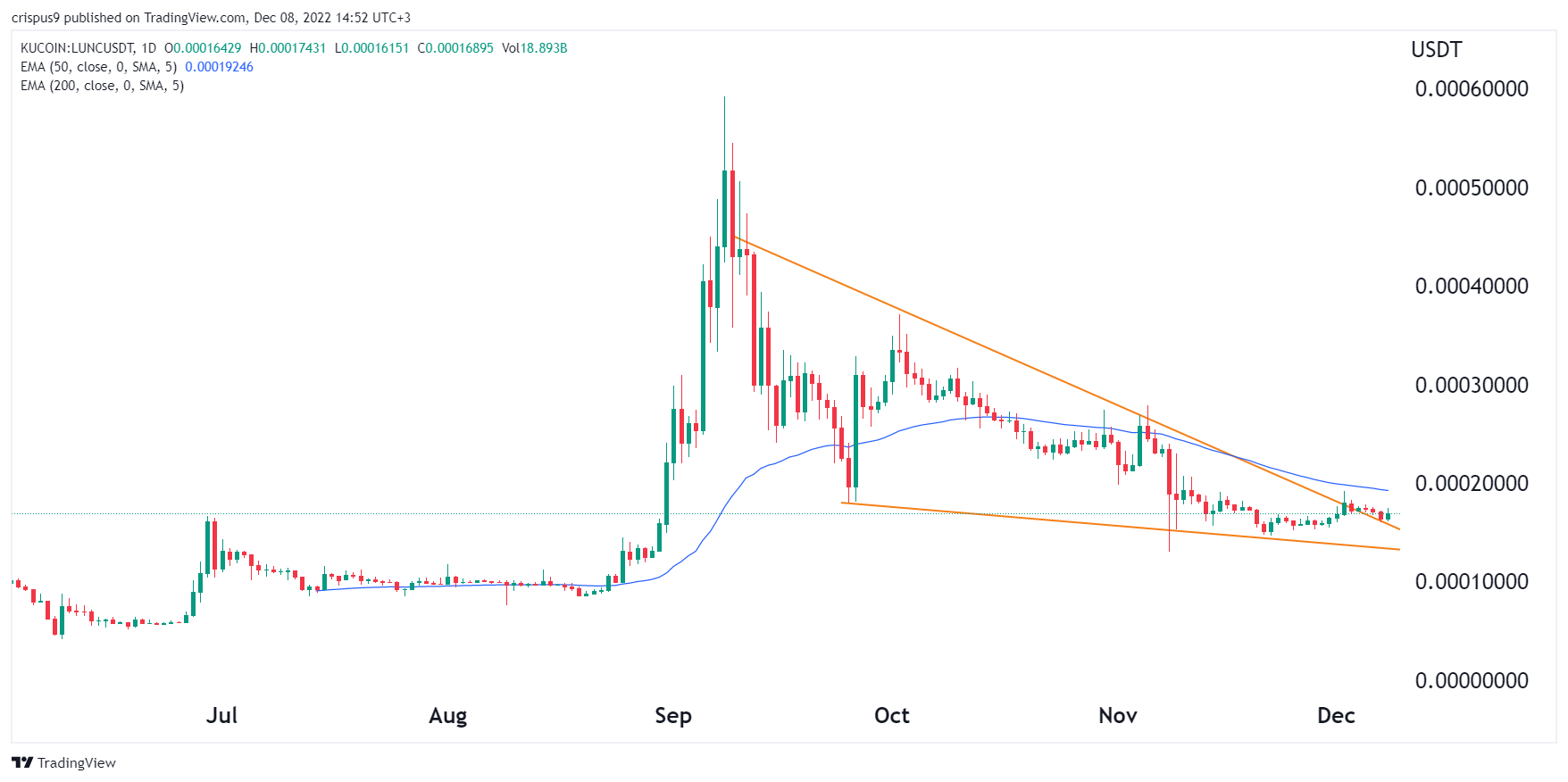
The daily chart shows that Terra Luna Classic price has been in a steep sell-off in the past few months. Along the way, the coin has formed a falling wedge pattern that is shown in orange. In price action analysis, this pattern is usually a bullish sign,
LUNC has moved below the 25-day and 50-day moving averages while the Average True Range (ATR) has dropped, which is a sign of low volatility. Therefore, Terra Luna Classic price will likely have a bullish comeback in December as speculation increases.
How to buy Luna Classic
As LUNC is such a new asset, it’s yet to be listed on major exchanges. You can still purchase LUNC using a DEX (decentralised exchange) though, which just means there are a few extra steps. To buy LUNC right now, follow these steps:
1. Buy ETH on a regulated exchange or broker, like eToro ›
We suggest eToro because it’s one of the world’s leading multi-asset trading platforms, an exchange and wallet all-in-one with some of the lowest fees in the industry. It’s also beginner-friendly, and has more payment methods available to users than any other available service.
2. Send your ETH to a compatible wallet like Trust Wallet or MetaMask
You’ll need to create your wallet, grab your address, and send your coins there.
3. Connect your wallet to the 1Inch DEX
Head to 1Inch, and ‘connect’ your wallet to it.
4. You can now swap your ETH for LUNC
Now that you’re connected, you’ll be able to swap for 100s of coins including LUNC.
LUNC price remained in a consolidation phase on Thursday even as the Terra Classic USD bounced back. Terra Luna Classic was trading at $0.00025, where it has been in the past few days. This price is about 61% below the highest level in September.
Terra Luna Classic retreats
LUNC price has been in a tight range as investors focus on the new burn rate mechanism that was passed by community members.
In a vote, members decided to reduce the LUNC burn rate of transactions from 1.2% to 0.2%. The burn rate is a mechanism that helps to boost the value of a cryptocurrency by reducing the total supply. As such, it will take about 30 years to burn 10 billion LUNC coins.
This vote was important because most holders of the token participated in the vote. About 83% of all holders voted, which is a remarkable figure.
According to LUNC Burner, over 22 billion LUNC tokens, equal to 0.32% have been burned in the past few months. On Thursday, the total burned coins were about 242k coins. As a result, the number of circulating supply has dropped to over $6.5 trillion. Meanwhile, the ratio of bonded and non-bonded tokens has moved to 10.6%.
Meanwhile, the number of total LUNC addresses has been in a slow downward trend. There are now over 11,718 total addresses, which is lower than the all-time high of 11,846.
Terra Classic Dollar has also wavered as investors focus on the ongoing recovery of the Terra Classic USD. The former stablecoin, USTC, has risen by more than 13% in the past 24 hours. It was trading at $0.039, which is significantly lower than its key level of $1.
LUNC price forecast
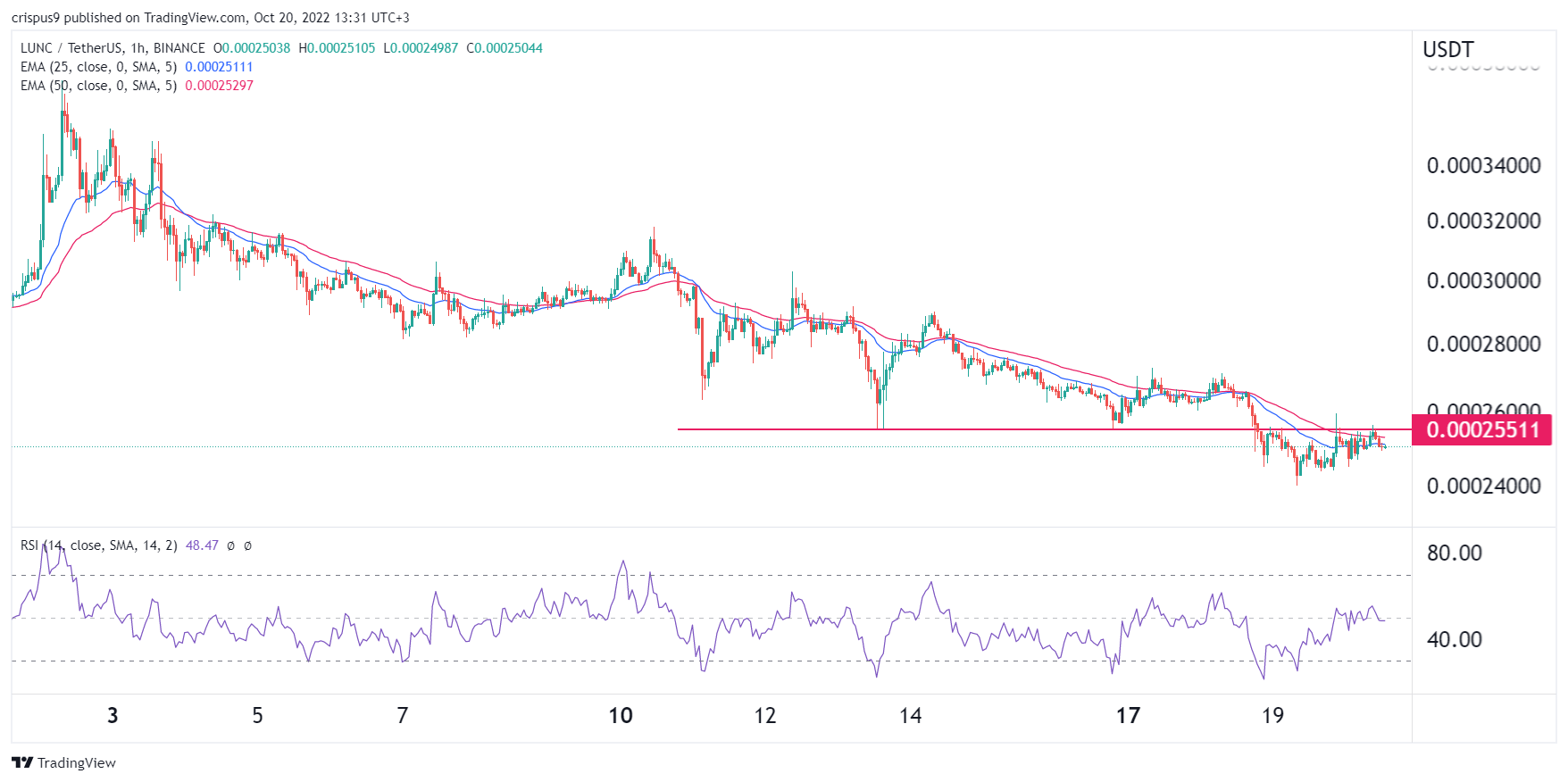
So, is it safe to buy Terra Luna Classic? The hourly chart shows that the LUNC price has been in a strong bearish trend in the past few weeks. The coin is hovering at the 25-day and 50-day moving averages while the Relative Strength Index (RSI) has moved above the neutral point. It has formed a bullish divergence pattern.
Therefore, the coin will likely continue falling as sellers target the next key support level to watch will be at $0.00024. A move above the resistance level at $0.00026 will invalidate the bearish view.
Anchor Protocol price surged to the highest level since September 23 as cryptocurrencies associated with Terra surged. ANC, which has been delisted by several exchanges, rose to a high of $0.1054, which was about 27% above the lowest level on Monday.
Terra ecosystem surges
Anchor Protocol was a pivotal platform for Terra’s ecosystem. It was a DeFi platform that acted like a bank. It allowed people to deposit funds and then earn rewards in form of interest. At its peak, the platform had over $20 billion in total value locked (TVL).
All this came crumbling down in March as Terra USD crashed. UST was an algorithmic stablecoin that powered Anchor’s ecosystem. Therefore, the network crashed when the stablecoin lost its peg.
Anchor Protocol price went parabolic on Monday as cryptocurrencies associated with Terra bounced back. For example, Terra Luna Classic jumped by more than 50% from its lowest level on Monday. Similarly, Terra Luna 2.0 rose by over 20% while Terra’s stablecoin jumped.
It is unclear why these coins rose considering that Monday was a tough day for Terra’s ecosystem. In a statement, South Korea’s prosecutors said that they had requested Interpol to issue a red alert on Do Kwon, the founder of Terra.
These prosecutors accuse Kwon and other associates of circumstantial evidence of escape since he left Singapore a few weeks ago. Also, they took issue with his claim that he was cooperating with prosecutors in different jurisdictions. Primarily, they accused Kwon with crimes related to capital markets laws.
In the past few months, Anchor Protocol and other cryptocurrencies associated with Terra have had occasional pump and dumps. This is one of the reasons why the ANC price jumped sharply on Monday. Still, many traders will find it difficult to trade Anchor since it has been delisted in several exchanges.
Anchor Protocol price prediction
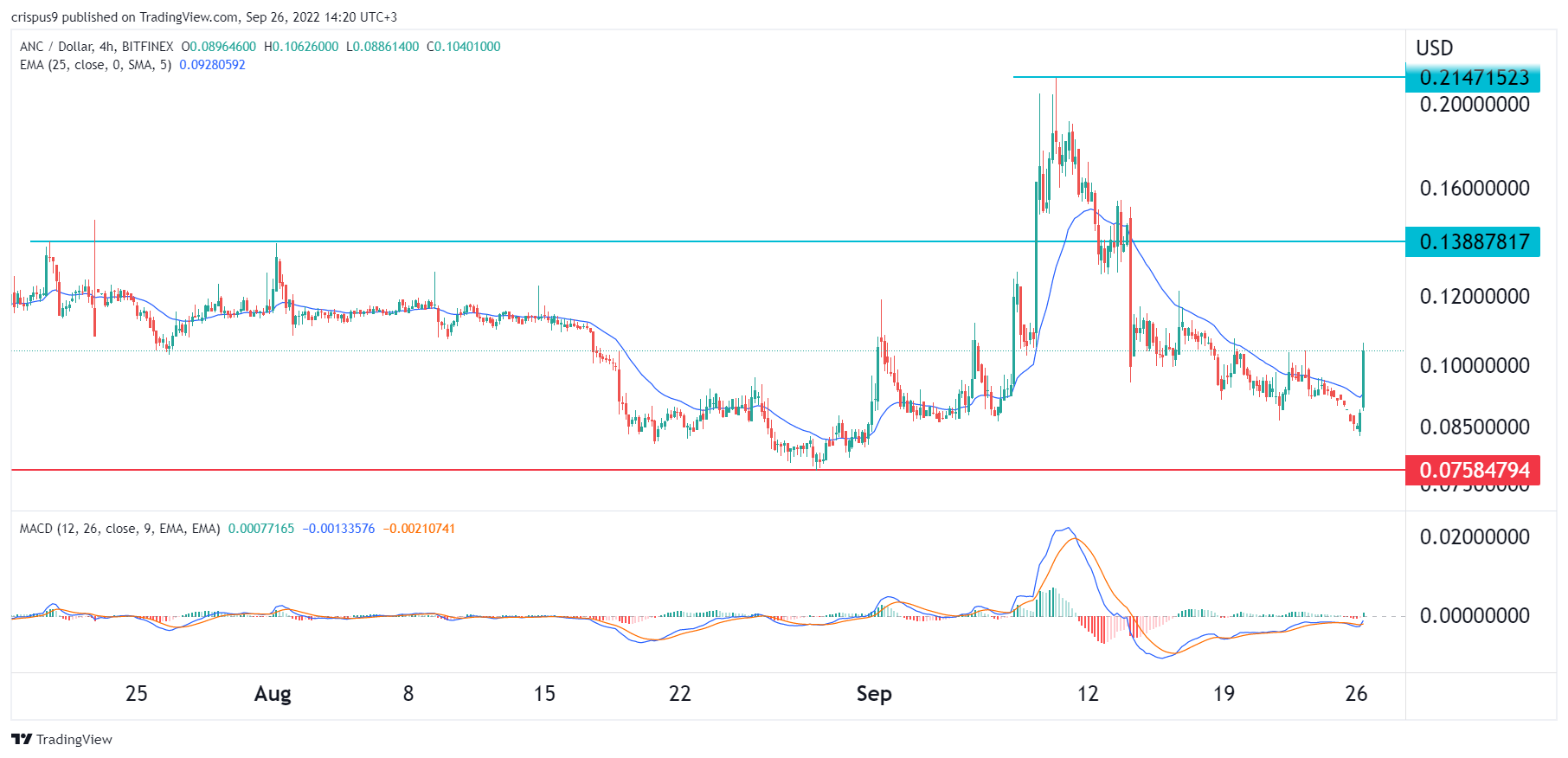
The four-hour chart shows that the ANC price has been in a bearish trend in the past few days. This saw it crash from this month’s high of $0.2147 to a low of $0.083. It then went parabolic on Monday as Terra and USTC price rebounded.
Anchor has moved above the 25-day moving average while the MACD has formed a bullish divergence pattern. Therefore, there is a likelihood that the coin will continue rising as buyers target the next key resistance point at $0.12.
Anchor Protocol price went parabolic on Thursday as investors cheered the strong performance of cryptocurrencies associated with Terra. The ANC token jumped to a high of $0.12, which was the highest level since August 9. It has jumped by over 65% from its lowest level in August of this year.
Why is ANC price soaring?
Anchor Protocol was the biggest part of Terra’s ecosystem. It was a platform that allowed people to deposit Terra USD stablecoin and earn exceptional returns. In most periods, the platform had APY of over 20%. ANC was the native token for Anchor Protocol’s ecosystem.
At its peak, Anchor Protocol was one of the biggest decentralized finance (DeFi) platforms in the world with a total value locked (TVL) of over $17 billion. All this came crumbling down in May when Terra USD lost its peg leading to the collapse of Terra’s ecosystem.
Since then, no activity has been going in Anchor Protocol. By design, it only worked with Terra USD, whose price crashed from $1 to below $0.0001. At the same time, several cryptocurrency exchanges like FTX decided to delist ANC.
Anchor Protocol price has staged a strong recovery in the past few days because of the strong price action in Terra’s ecosystem. In the past few weeks, Terra Classic USD (USTC) has surged to a high of $0.08. And according to CoinMarketCap, its total market cap has jumped to over $458 million.
Similarly, Terra Classic has jumped by more than 100% in the past seven days, giving it a market cap of over $3 billion. The new version of the coin known as LUNA has also rebounded. Other coins in Terra’s ecosystem like Mirror Protocol and Astroport have also risen.
Some analysts believe that this rebound of Anchor Protocol price is part of a pump and dump scheme since the coin is thinly traded.
Anchor Protocol price prediction
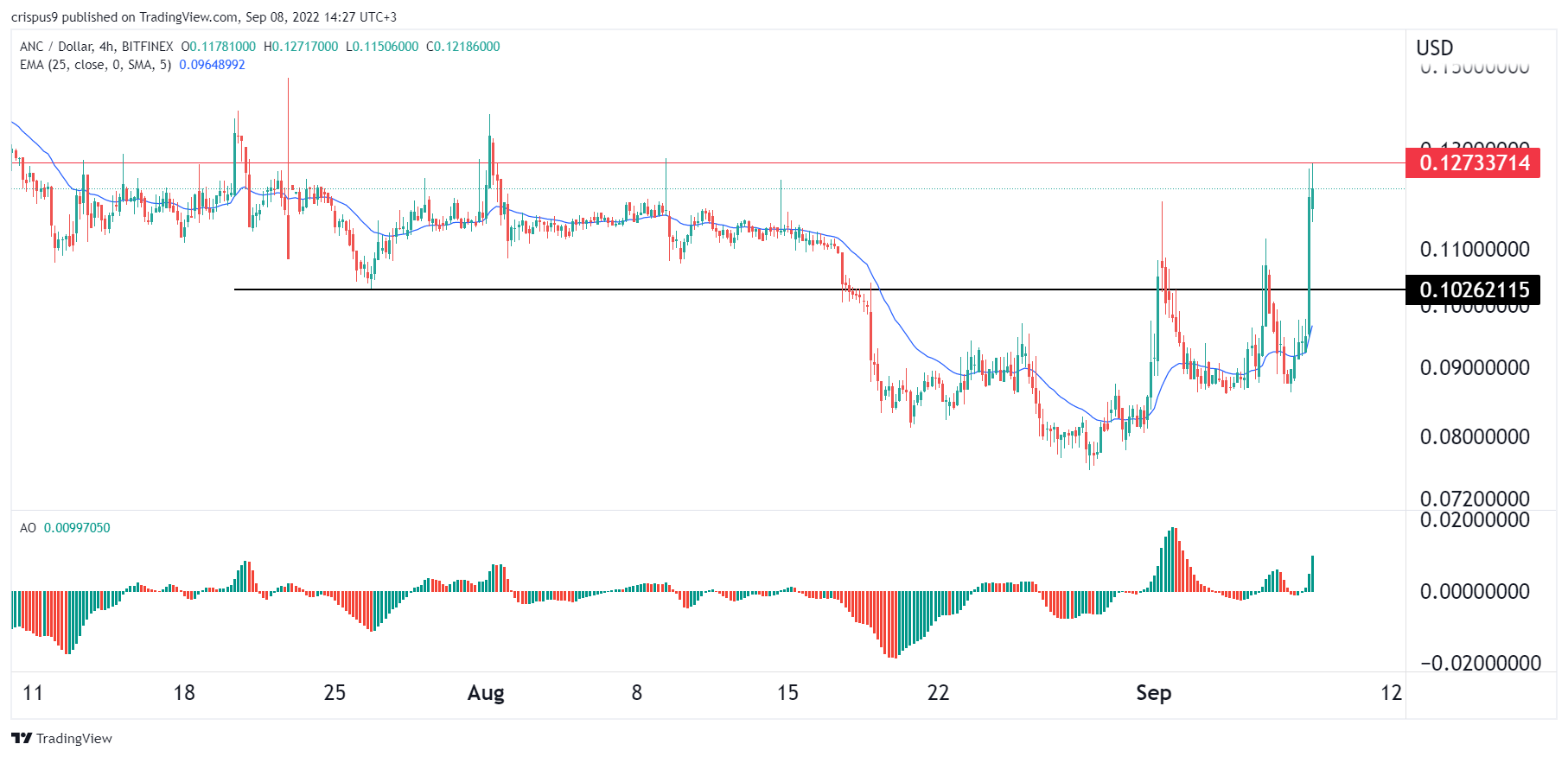
The four-hour chart shows that the ANC price has been in a strong bullish trend in the past few days. Along the way, the coin has managed to move above the important resistance level at $0.1026, which was the lowest level on July 21. As it rose, Anchor Protocol moved above the key resistance at $0.1120 and $0.1187.
It has also moved above the 25-day and 50-day moving averages while the Awesome Oscillator has moved above the neutral point. Therefore, the coin will likely keep rising as FOMO sets in. This could see it soar to a high of $0.15.
Bitcoin slid back down under the US$20,000 mark late afternoon in Asia, with the rest of the top 10 tokens by market capitalization turning lower. Terra’s fallen cryptocurrency surged, likely due to LUNA Classic’s recent network upgrade.
See related article: Markets: Bitcoin edges up; U.S. stocks, bonds post worst returns in 5 decades
Fast facts
- Bitcoin fell 1.87% in the past 24 hours to US$19,894.88 at 4 p.m. in Hong Kong. Ether dropped 2.72% to US$1,542.83, according to data from CoinMarketCap.
- Most other tokens in CoinMarketCap’s top 10 fell, with Solana losing 3.37%, Dogecoin 3.17% and Binance Coin 3.37%.
- The global crypto market cap slipped 1.87% in the past 24 hours, positioned at US$970.85 billion at 4 p.m. Hong Kong time.
- Asia equity markets also declined. The Shanghai Composite Index lost 0.54%, Hong Kong’s Hang Seng Index 1.79%, and Tokyo’s Nikkei 225 index 1.53%.
- Terra Classic (LUNC), the original crypto token of the Terra-LUNA blockchain that collapsed back in May, surged 57.04% in 24 hours, to post a seven day gain of 138.48% to US$0.0002426.
- The rally comes amid the latest v22 update to the network on Aug. 27, which added staking and token-burning in LUNC.
- Terra’s now-defunct stablecoin TerraClassicUSD (USTC) also jumped 37.64% in the last 24 hours to trade at US$0.03603.
See related article: What in crypto hell just happened to all your money?
Key Insights:
- Bitcoin and Ethereum are consolidating at their respective lows of $20k and $1.2k.
- Shiba Inu led the fall for the altcoins with a 7% decline in 24 hours.
- In an interesting turn of events, TerraUSD Classic is making headway in the crypto market.
While the rest of the market made no specific move, one of the biggest cryptocurrencies in the world exhibited some semblance of a downfall. On the other end of the spectrum was Terra Luna Classic’s 100%+ rally.
Shiba Inu Dips in Bearish Waters
After striking out a solid rally throughout this week, Shiba Inu impressed the investors recovering by 53.32% in the same duration, but the following two days ruined the recovery significantly.
SHIB declined over the next two days, losing out on 13.57% of the recovery it witnessed in June.
Investors are now concerned as to where could the meme coin be headed over the next few days, and by the looks of it, a downtrend might be the answer since price indicators are heavily signaling the same.
The Parabolic SAR, although is currently exhibiting an uptrend, it is actually preparing for a downtrend.
Once the white dots of the indicator change their position from underneath the candlesticks to above the candlesticks, the downtrend should be in effect.
And the chances of the same happening are increasing by the day as the increasing bearishness of the MACD is leading SHIB towards a bearish crossover. This could push SHIB below $0.00001018, which it has been lingering in throughout June.
Terra LUNA Classic To Rise Again?
Probably not, but the rise still managed to surprise investors around the world after the original Terra, now Terra Classic’s stablecoin, for some reason, suddenly started rallying today.
Although the buildup came over the span of the last five days, the breakthrough rise occurred yesterday.
In a single day, the stablecoin shot up by 153% at its peak, bringing the week-long rally to 588%. However, trading at $0.04, USTC is completely useless for any and everyone.
The new Terra LUNA 2.0, on the other hand, is still stuck under $3 but managed to close above $2.5 after a 13% single-day rise.