After a disappointing performance during the week, the price of Bitcoin has continued its sluggish action over the weekend. According to data from CoinGecko, the premier cryptocurrency has been hovering around the $102,000 level over the past 24 hours.
While this current choppy price action seems like an improvement from the severe downturn witnessed in recent days, it doesn’t particularly bring calm to the world’s largest cryptocurrency. Interestingly, the latest on-chain data suggests that the Bitcoin price might still be at risk of further correction in the coming days.
Why BTC Price Might Find Bottom Around $95,000
In a November 8 post on the social media platform X, on-chain analyst Burak Kesmeci predicted the local bottom for the price of Bitcoin. According to the crypto pundit, the flagship cryptocurrency could fall to as low as $95,000 before seeing relief and perhaps rebounding to new price highs.
Related Reading
The relevant metric here is the Realized Price of Unspent Transaction Output (UTXO) age bands, which evaluate the holding pattern of different investor classes through their different realized prices. The UTXO age bands metric tracks the average price at which Bitcoin holders purchased their coins compared to how long they’ve held the assets.
The age bands under focus in Kesmeci’s analysis are the 1-week to 1-month group (green line) and the 1-month to 3-month cohort (purple line), which offer insight into short-term holders’ behavior and overall market sentiment. According to the on-chain analyst, the green line has crossed below the purple line three times in 2025.
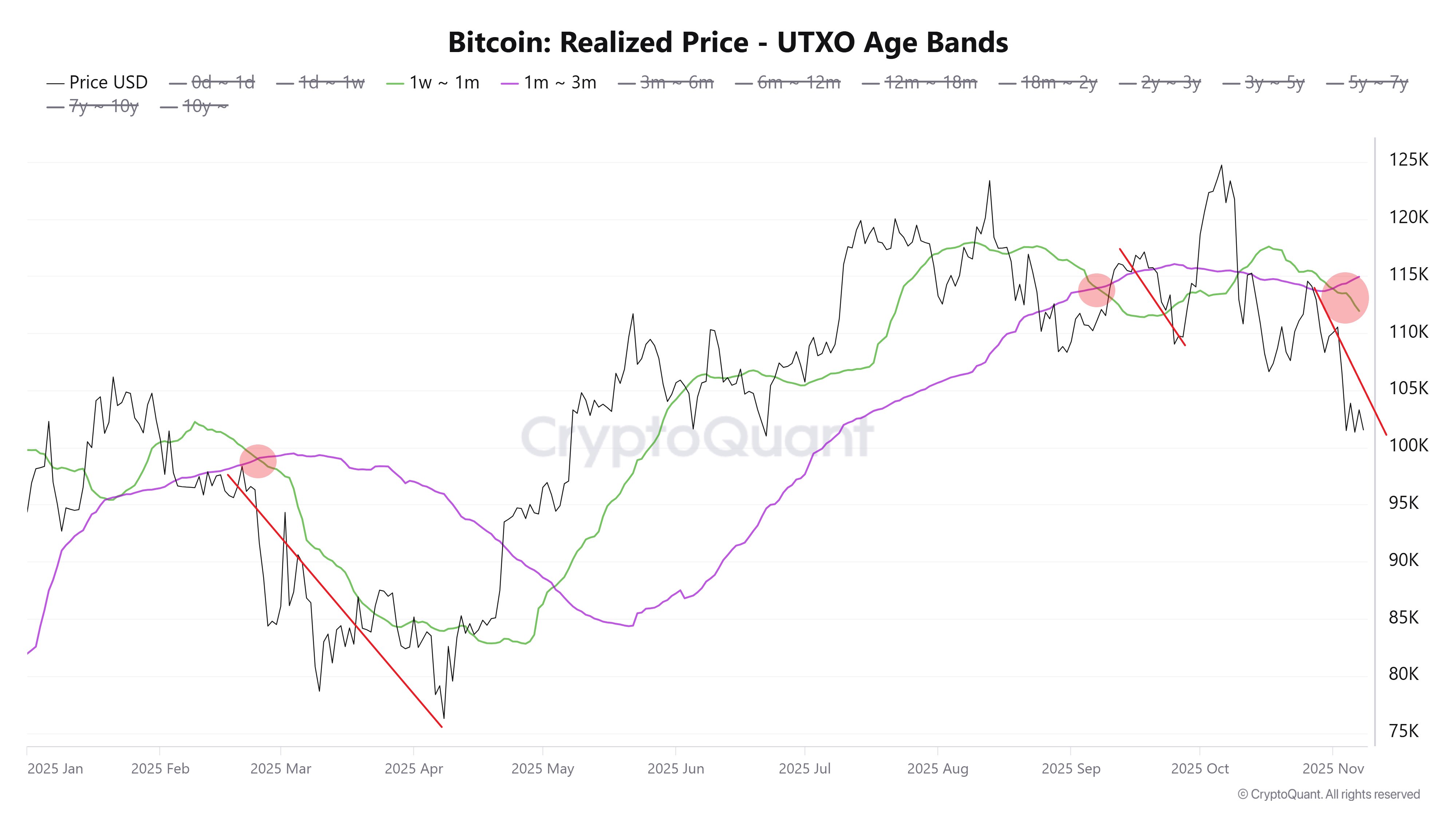
Kesmeci noted that this cross often preceded short-term corrections, including the ones seen on February 24 ($99,000 to $76,000) and September 8 ($117,000 to $109,000). Similarly, this cross occurred on November 1, with the Bitcoin price falling from $110,000 to $99,000.
Furthermore, the average dip suffered by the Bitcoin price on these three occasions stands at around 13.3%, with a 45-day consolidation period. Based on this historical pattern, Kesmeci expects the Bitcoin price bottom to form around the $95,000 and $96,000 region after the most recent crossing of the 1-week to 1-month band below the 1-month to 3-month band.
Kesmeci concluded:
In short, long-term investors are in the red, and this is an undesirable situation for a bull cycle. However, if history repeats itself, Bitcoin may “catch its breath” once more in this region and prepare the ground for a new rise.
Bitcoin Price At A Glance
As of this writing, the price of BTC stands around $102,440, reflecting a nearly 1% decline in the past day.
Related Reading
Featured image from iStock, chart from TradingView
According to the latest on-chain data, Bitcoin has been witnessing an interesting change in its holder behavior, further intensifying the bullish speculation in the market.
Bitcoin UTXO Count Declines As Price Surges
In a Quicktake post on CryptoQuant, market analyst CryptoOnchain revealed that long-term Bitcoin investors seem to be changing their investment strategy by increasingly holding on to their coins. This on-chain observation is based on the Bitcoin UTXO Count metric, which tracks the total number of individual unspent transaction outputs on the blockchain.
Related Reading
For context, an unspent transaction output is an amount of a cryptocurrency (in this case, Bitcoin) that has been received by an address, but has not yet been used as input for a new transaction.
CryptoOnchain shared that this on-chain metric has been on a steady decline since January 2025. In the post, the crypto analyst pointed out that the UTXO count recently reached about 166.6 million, the lowest point seen since April 2024.

Since the Bitcoin UTXO reached a peak of approximately 187.5 million in January, it has witnessed a contraction of up to 11% — an event which CryptoOnchain interprets as a clear sign of network consolidation.
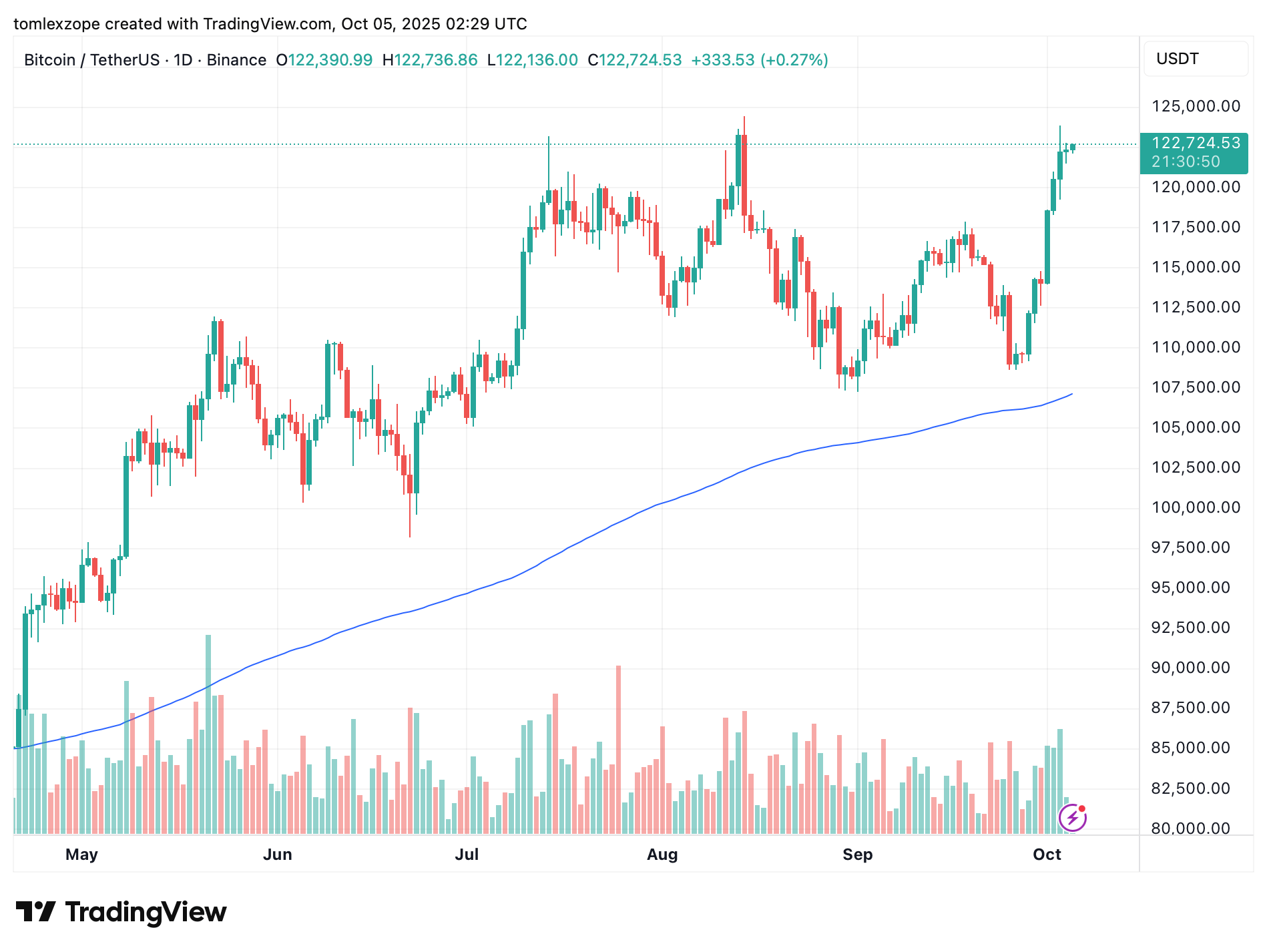
Interestingly, this decline seen with unspent transaction output contrasts with Bitcoin’s price action. While the UTXO has maintained a steady bearish structure, Bitcoin’s value has continued to ascend. The flagship cryptocurrency saw a price growth from about $99,000 to its current market price of around $122,000.
This “inverse relationship” is one that the online pundit explained to be a “classic hallmark of a maturing market.”
Why The Decline And What To Expect
A decreased UTXO count could be a result of several underlying factors, including that long-term holders are choosing to hold their coins rather than selling for profit. Owing to this “hodling” behavior, it can be said that the market is starting to gain maturity.
Also, CryptoOnchain explained that low UTXOs could indicate reduced transactions within the Blockchain. By extension, this could mean that fewer sales are going on, which translates to reduced selling pressure on price.
Also, a lower UTXO count points to increasing network efficiency. As users aggregate smaller UTXOs into larger ones, they optimize the blockchain space, leading potentially to a less congested network.
Ultimately, the simultaneous decline in Bitcoin’s UTXO and its price increase paints an exciting picture for the cryptocurrency’s future. This combination signals that the premier cryptocurrency is at a reaccumulation phase, meaning that investors are strategically positioning themselves in expectation of the next significant upward move.
As of this writing, the price of BTC stands at about $122,720, showing an over 1% growth in the past day.
Related Reading
Featured image from iStock, chart from TradingView
The apex of Cardano: a pragmatic approach to UTxO and staking Invezz
Source link ]]>

- Stacks’ sBTC gains traction with UTXO, SNZ, Jump Crypto as early adopters.
- With this adoption, the demand for sBTC has tripled capacity in under 24 hours.
- The sBTC unlocks Bitcoin DeFi, with withdrawals set to start in March 2025.
A new wave of institutional adoption is sweeping through the Bitcoin ecosystem as Stacks, a prominent Bitcoin Layer 2 solution, celebrates the rapid uptake of its decentralized, Bitcoin-backed asset, sBTC.
Leading the charge among early sBTC adopters are industry heavyweights UTXO Management, SNZ, and Jump Crypto, signalling strong confidence in sBTC’s potential to unlock decentralized finance (DeFi) utility for Bitcoin holders worldwide.
UTXO Management, a key player with its venture arm backing top Bitcoin companies and its liquid fund 210k Capital deploying resources across public and private markets, has embraced sBTC as part of its Bitcoin strategy.
Jump Crypto, a division of the renowned Jump Trading Group, brings its expertise as a quantitative trading firm and infrastructure builder to the table. Saurabh Sharma of Jump Trading notes, “sBTC fosters a more dynamic and interconnected financial landscape.”
SNZ, a crypto-native investment firm with a footprint in Hong Kong, Singapore, and the US, continues its legacy of supporting Bitcoin innovation. It was an early backer of Stacks and other public blockchains in Asia.
Other notable participants include CMS Holdings, an active investor in Bitcoin scaling ventures; RootstockLabs, a pioneer behind the Rootstock sidechain; Sypher Capital, with its focus on generating native Bitcoin yield; and Asymmetric Research, a security partner to major protocols like Solana and Wormhole.
Together, these institutions underscore sBTC’s broad appeal across the crypto ecosystem, from trading and investment to technical development and security.
The rising enthusiasm for sBTC
Launched on the Stacks mainnet in December 2024, sBTC has quickly positioned itself as a game-changer in the tokenized Bitcoin landscape, enabling programmable smart contracts and transactions secured by Bitcoin’s robust infrastructure.
The enthusiasm for sBTC was evident from the start, with its initial capacity cap filled by a roster of influential depositors, prompting a second cap raise that tripled availability on February 25th.
Remarkably, this expanded capacity was fully subscribed in under 24 hours, reflecting surging demand from institutions, wealth managers, builders, and retail investors alike.
Among the standout sBTC use cases driving this momentum is Zest, a fast-growing application that has already captured nearly 40% of the sBTC within the protocol, showcasing the asset’s immediate usability and appeal.
For Bitcoin enthusiasts, sBTC represents a bridge between the cryptocurrency’s unparalleled security and the dynamic possibilities of DeFi.
Unlike traditional staking or locking of Bitcoin on its base layer, sBTC activates capital by enabling a wide range of financial applications, from yield generation to lending and decentralized exchanges.
Alex Miller, CEO of Hiro, a developer tooling company within the Stacks ecosystem, emphasized the sBTC’s transformative potential stating that the growing adoption of sBTC provides essential liquidity for developers building and scaling applications.
Notably, the rise of sBTC comes amid a broader surge in Bitcoin Layers, which have seen their total value locked (TVL) soar by over 460% in the past year, climbing from approximately $500 million in 2024 to $2.8 billion by February 2025, according to CoinGecko data.
This growth reflects a growing recognition among Bitcoin (BTC) holders that Layer 2 solutions like Stacks can enhance functionality without compromising the core principles of security and decentralization.
With tokenized Bitcoin assets now accounting for 1.67% of BTC’s circulating supply, the highest level since October 2022, sBTC is poised to play a central role in this evolving narrative.
Looking ahead, Stacks is preparing to roll out withdrawal functionality for sBTC in March 2025, a milestone that will further solidify its utility. As the leading Bitcoin Layer 2 by developer traction and market cap, Stacks is driving a movement to transform Bitcoin’s $1 trillion in passive capital into a fully programmable, productive asset.
With support from top staking providers, custodians, and ecosystems like Solana and Aptos, sBTC is not just connecting Bitcoin to DeFi—it’s paving the way for a future where all roads in crypto lead back to Bitcoin.
Bitcoin’s consolidation below $68,000 extended throughout this week, with bulls holding steady above the $66,000 support level. Although the cryptocurrency hasn’t seen a significant push to the upside, its ability to avoid a deeper correction means that Bitcoin remains on track to end October on a bullish note.
Related Reading
In support of this outlook, a crypto analyst has highlighted an emerging trend in Bitcoin’s UTXO metric, which suggests a looming breakout in the crypto’s price.
UTXO In Loss Reaches Highest Point Ever
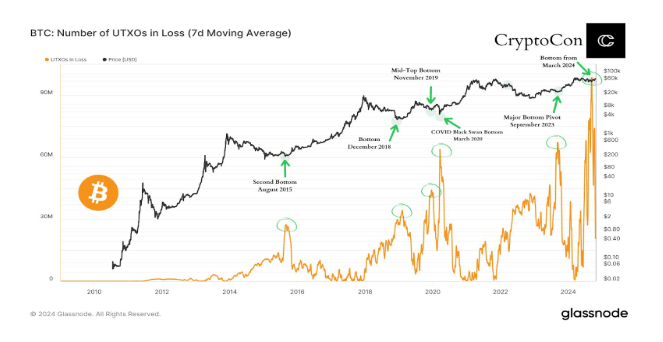
The number of Bitcoin UTXO in losses recently reached a new peak on September 11, 2024, surpassing levels last seen during the COVID-19 crash in 2020 and the September 2023 market bottom.
This metric, known as Unspent Transaction Output (UTXO), refers to the amount of Bitcoin that remains unspent in a Bitcoin wallet after a transaction. When UTXO is measured in loss, it reflects the number of Bitcoin holdings that would currently sell at a loss compared to the last transaction price from the Bitcoin wallet.
According to Glassnode data, the number of UTXO in losses spiked massively in September to surpass previous numbers, indicating that a significant portion of active Bitcoin addresses are underwater. However, while this may appear to signal bearish sentiment at first glance, history has shown this isn’t the case.
As pointed out by crypto analyst CryptoCon, major spikes in UTXO loss don’t come right before terrible price action, but they mostly come at the end of it. Keeping this trend in mind, the new peak in September most likely was an inflection point for Bitcoin’s price action for the rest of the year.
What Does This Mean For Bitcoin Price?
Past data reveals a consistent pattern: when UTXO in loss reaches extreme highs, Bitcoin’s price is often near a reversal. For instance, during the COVID-19 crash in March 2020, UTXO in loss spiked significantly, followed by a strong rally that led Bitcoin to new all-time highs in the following months.
The last time the UTXO in loss spiked massively was in September 2023, serving as the forerunner for the latest bull market cycle which kicked off in October 2023. This run culminated in a new all-time high for Bitcoin in March 2024, effectively showcasing spikes in the UTXO in loss as a signal of positive market momentum.
If history were to repeat itself, the September spike in the UTXO loss numbers could also signal a market bottom, which in turn opens up the stage for a rally in the rest of the year.
Related Reading
Interestingly, Bitcoin’s price action has been notably positive since this new peak in UTXO in loss. At the time, Bitcoin was trading around $57,000. Since then, it has experienced a considerable rally, inching closer to the $70,000 price level.
At the time of writing, Bitcoin is trading at $66,720.
Featured image from Pexels, chart from TradingView
Cardano Revolutionizes Bitcoin’s UTXO Model with Smart Contracts Geeks World Wide
Source link ]]>
Cardano combines Bitcoin’s UTXO with the EUTXO accounting … Crypto News Flash
Source link ]]>