Cardano Needs This Level to Confirm End of Consolidation in Valid 1-2 Wave Pattern Bitget
Source link ]]>
Weekly Bullish Shiba Inu Reversal Wedge Valid as SHIB Back at Yearly Demand Zone Bitget
Source link ]]>
Businesses in the crypto-friendly country of Japan are now looking at ways to boost Bitcoin adoption. One of Japan’s largest e-commerce platforms Mercari stated that it will start accepting Bitcoin payments on its platform starting June 2024.
Mercari Subsidiary to Accept Bitcoin Payments
As reported by Nikkei, the company will facilitate Bitcoin transactions through its Tokyo-based cryptocurrency subsidiary, Melcoin.
Melcoin will be responsible for converting all Bitcoin payments into Japanese yen. This means that while buyers have the option to pay with BTC, vendors will receive the equivalent amount in fiat currency. Notably, Mercari will refrain from displaying prices in Bitcoin, maintaining the listing of items for sale in Japanese yen.
Despite not denoting prices in Bitcoin, customers will have the flexibility to select BTC as a payment method when conducting transactions on the Mercari platform. This move signals a notable embrace of cryptocurrency within the Japanese e-commerce landscape.
Established in 2013, Mercari has evolved into Japan’s largest community marketplace platform. As of July 2023, the company reported an impressive user base of 22 million monthly users. Mercari has also been actively expanding its footprint in international markets, with a particular focus on Europe.
In recent months, Mercari has ventured into the cryptocurrency space by introducing various crypto-related products. Notably, the company launched the Mercari Bitcoin crypto trading service. This service enables users to engage in the buying and selling of Bitcoin using the proceeds generated from their sales on the Mercari platform.
Furthermore, Mercari’s platform incorporates a loyalty points system, intricately linked to its crypto trading arm. This innovative integration allows Mercari users to exchange their accumulated loyalty points for Bitcoin, further bridging the gap between traditional e-commerce and the world of cryptocurrencies.
Japanese Businesses Offering Gateway for Crypto

The presented content may include the personal opinion of the author and is subject to market condition. Do your market research before investing in cryptocurrencies. The author or the publication does not hold any responsibility for your personal financial loss.

- Solana rallied in 2023 but failed to break above the horizontal resistance
- A bullish case remains valid unless the price moves below the 2022 lows
- If it breaks above horizontal resistance, Solana may trade above $40
Cryptocurrency investors must be thrilled with the 2023 price action. After all, Bitcoin bounced from last year’s lows, triggering a similar move in other major cryptocurrencies.
Solana followed suit.
The price more than doubled this year, rising from $10 to over $25 in what appeared to be a clear bullish breakout.
However, after trading above $26 in January, the market failed to build on the bullish trend. Instead, a consolidation started, bringing doubts to bullish traders.
The best way to clear such doubts is to look at the bigger picture. As the chart below shows, it is difficult to build a bullish case while the market holds below horizontal resistance.
However, the 2022 lows remain in place, so one can build a bullish scenario as long as the market does not dip below those lows.
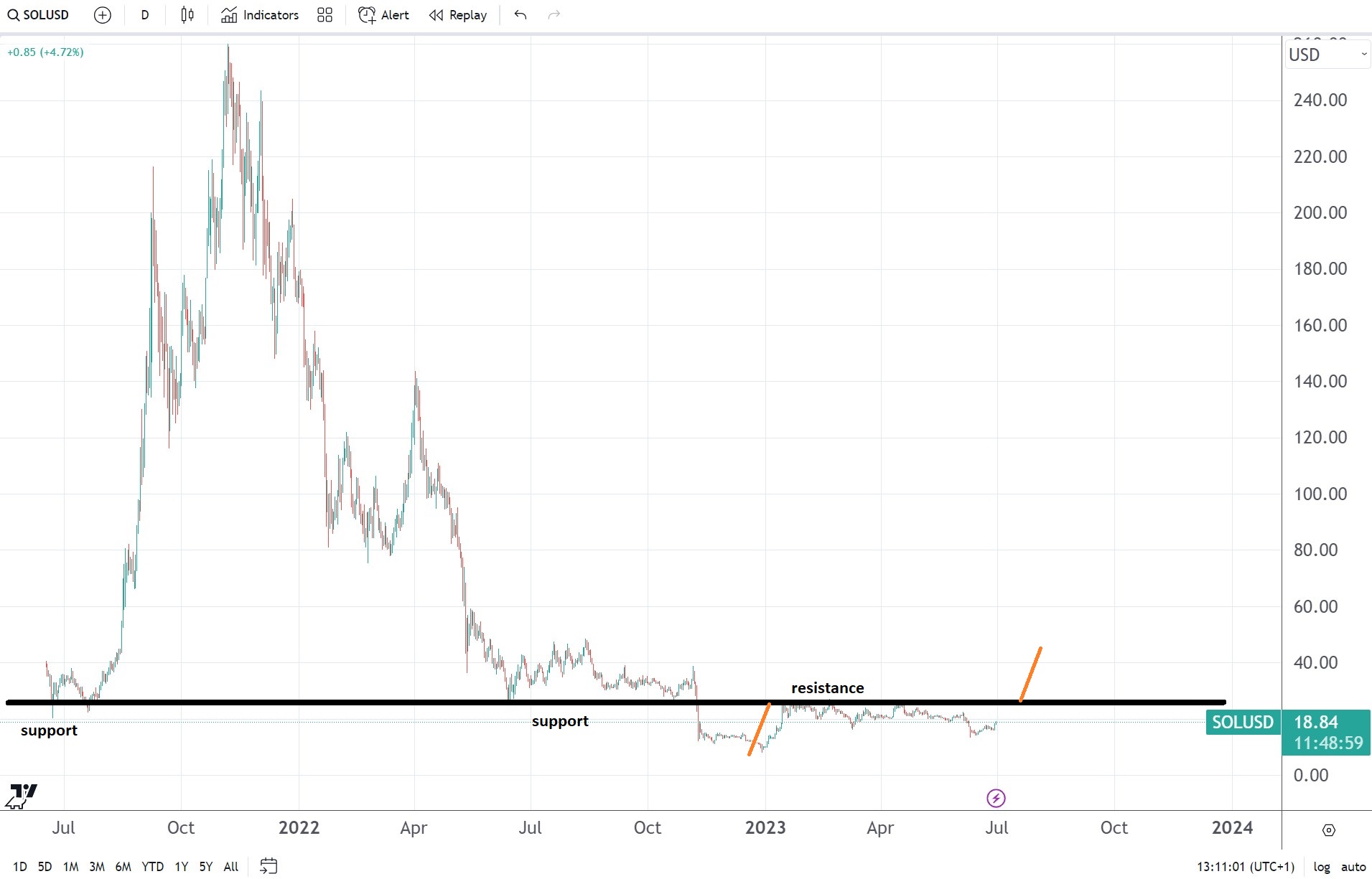
A break above horizontal resistance should trigger more gains
Solana’s price remains bearish while below horizontal resistance. However, a break above it implies more strength ahead.
That is especially true if the US dollar’s weakness resumes. So far in 2023, the dollar traded with a mixed tone.
But as the Fed is on pause, renewed weakness will bode well for cryptocurrencies and for Solana.
A daily close above horizontal resistance opens the gates for a move above $40. If the Fed believes that the US inflation data follows the right path, the dollar should weaken in the year’s second half.

- Polkadot hodlers are underwater
- A bullish scenario remains valid if the lows hold
- A move above $7 should lead to more gains
It has been a tough period for long-term holders of Polkadot. The DOT/USD exchange rate has moved South relentlessly after peaking at $56 in late 2021.
From $56 to $5, it was a straight decline. It took only one year for Polkadot to frustrate bulls.
And even now, as cryptocurrencies have rallied in 2023, one should be scared looking at the daily chart. After all, the bounce from the lows looks so small when interpreting the bigger picture that it is difficult to find a bullish argument.
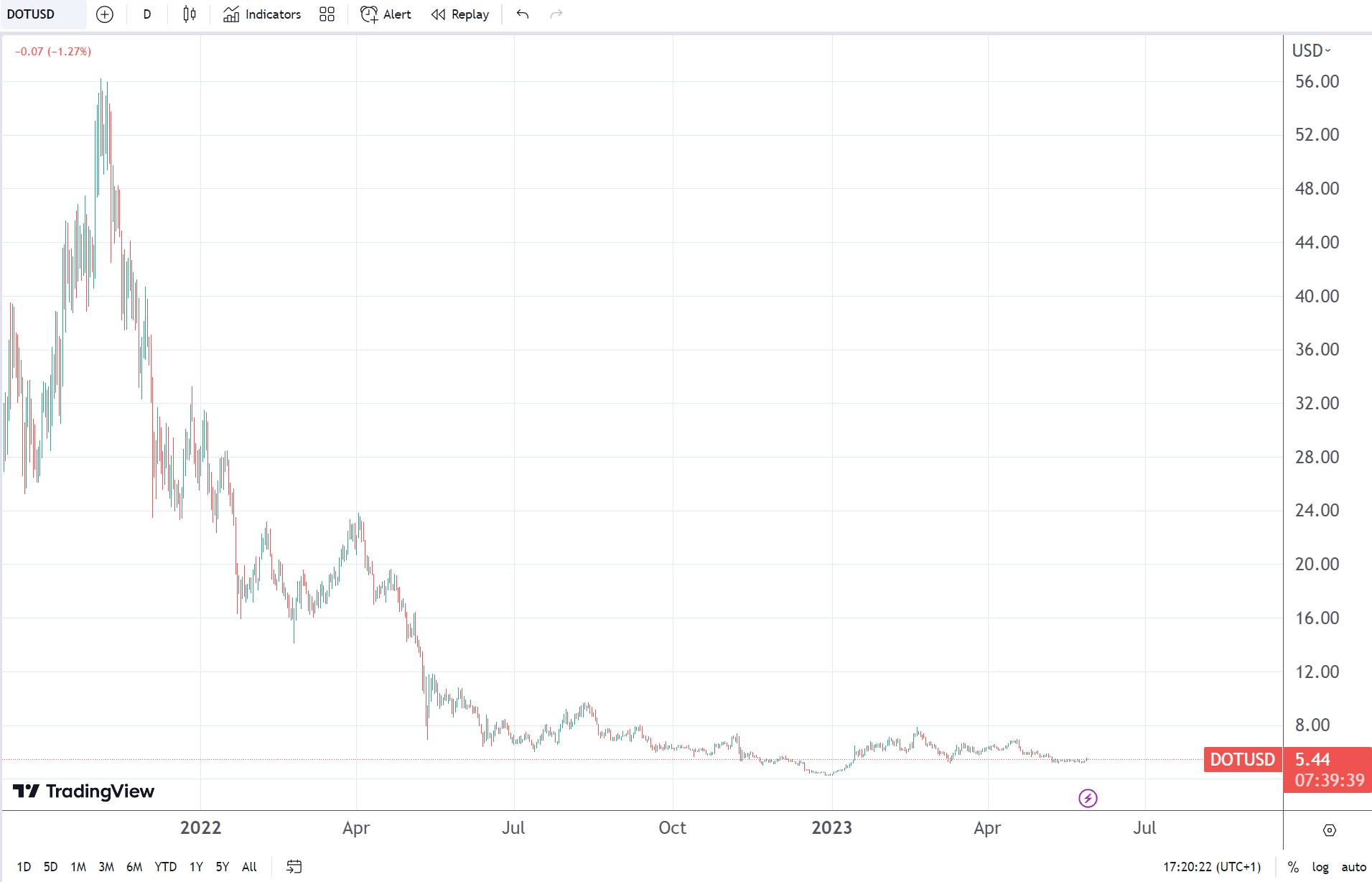
Polkadot should overcome $7 resistance area for bulls to be in control
Zooming in, one may see the 2023 rally that brought back optimism in the cryptocurrency market. Sure enough, Polkadot already gave back more than half of its YTD gains.
But the invalidation level for a bullish scenario still holds. Effectively, it means that the recent price action might be nothing but a correction part of a bigger-degree bullish trend.
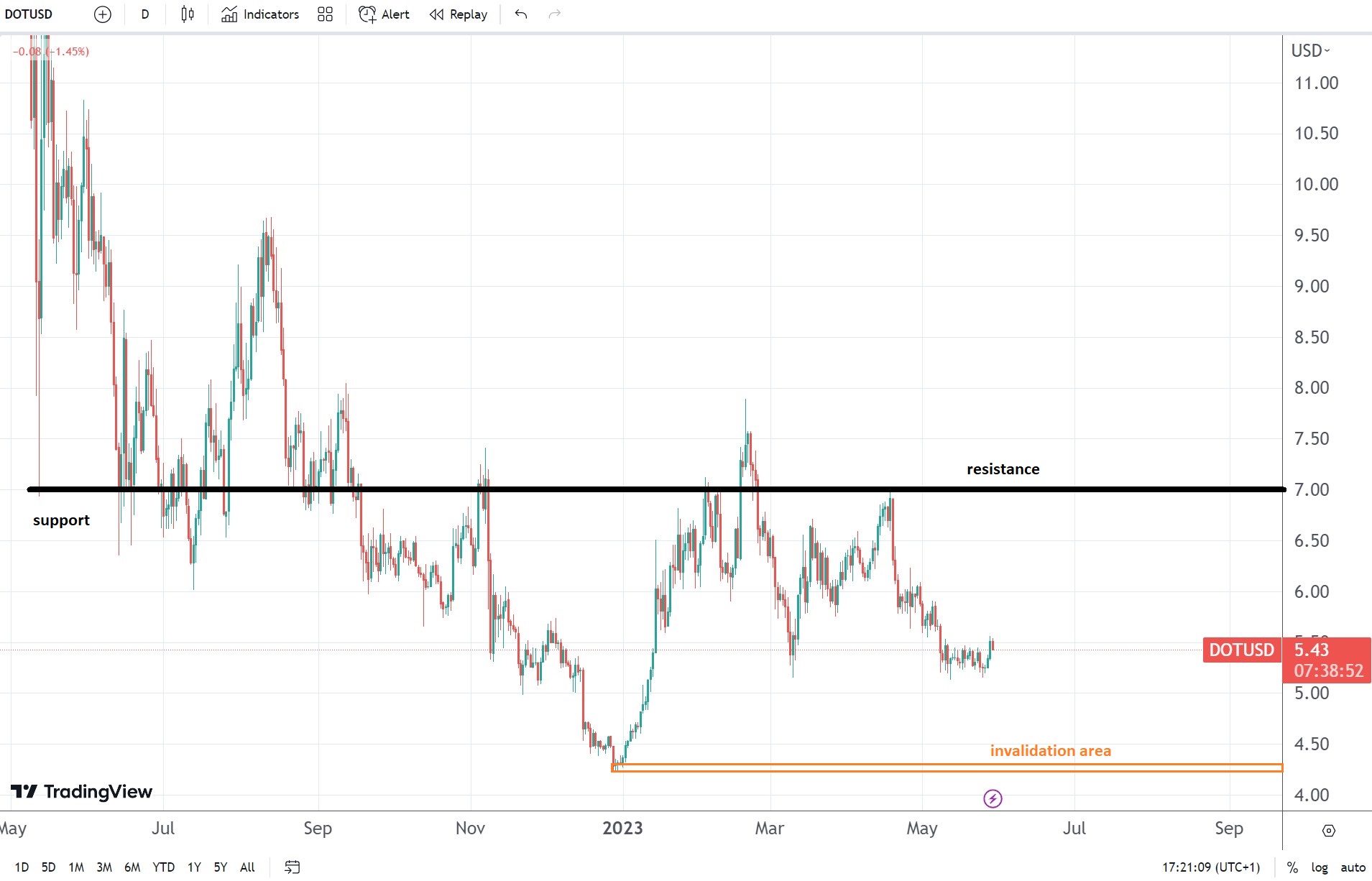
The Elliott Waves theory states that an impulsive move (i.e., the one that began at the start of the year) is followed by a corrective structure, an a-b-c.
This a-b-c that corrects a bullish trend should have two waves moving in the opposite direction (i.e., waves a and c), and one that moves in the main trend’s direction.
It means that one may easily say that the move from the 2022 lows is an impulsive structure, and the decline from the 2023 highs is the a-b-c. In this case, the implications are bullish for Polkadot and bearish for the US dollar.
However, only a move above the pivotal $7 level would cement the bullish Elliott Waves scenario. Until then, bulls might wish for the price action to hold above the invalidation area shown on the chart above.

- Solana’s price action remains bearish while below $40
- A series of lower highs is still valid
- Only a bullish break above $40 invalidates the bearish sentiment
Designed to support smart projects and decentralized apps, Solana was launched in the first quarter of 2020. What followed was one of the most impressive rallies in the cryptocurrency market’s history.
Sure enough, the pandemic did help, as people were literally throwing money into any project that had something to do with online businesses. Also, governments and central banks flooded the financial system with cheap money, so speculation reached extreme levels in the cryptocurrency market and the stock market.
As such, at its peak in November 2021, Solana’s performance against the US dollar has reached 18640.78%. It traded above $225, but the drop was as impressive as the rise.
It now trades around $20, well below its all-time highs. However, in terms of performance since inception, it delivered remarkable results, as even at the current levels the price is up over 1500% since launch.
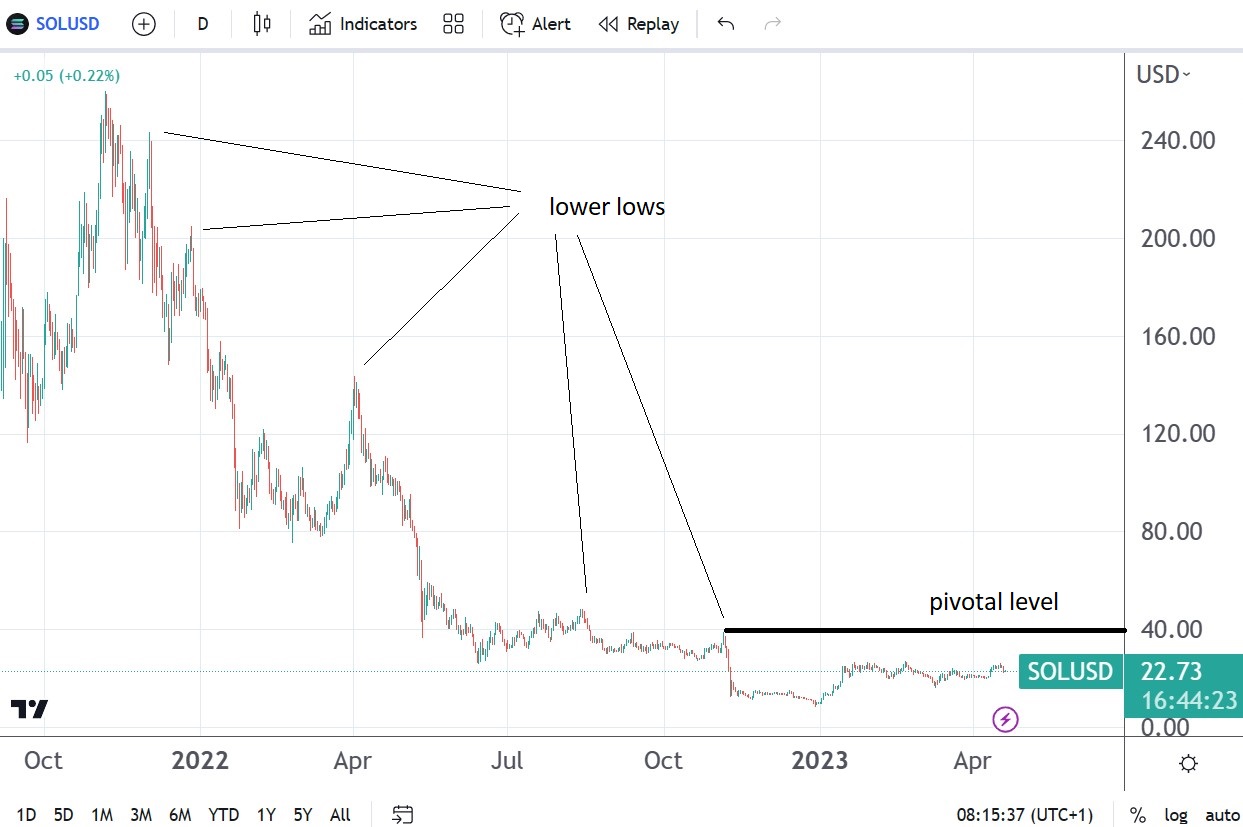
Bearish sentiment remains while below $40
In 2023, the cryptocurrency market bounced from its recent lows. Led by Bitcoin, other cryptocurrencies followed.
Solana bounced from the lows when other cryptocurrencies bounced – at the end of 2022. Since then, it rallied sharply, but nevertheless, the bearish bias persists while below $40.
Traders should focus on the series of lower lows that remains intact. Therefore, while below $40, the chances are that the 2023 rally is nothing but a bear market rally. Such rallies are known to be aggressive and misleading.
Summing up, bulls may want to wait for Solana to trade above $40 again before establishing a long position. Otherwise, the risk is that the lows will be tested sooner rather than later, as bears will keep pressuring the market.
Director of research at D.A. Davidson Gil Luria comments on the state of crypto and Dogecoin nose dive.
Mark Cuban said Saturday that Dogecoin, the meme coin promoted by Elon Musk and originally created as a joke, could “grow as a valid payment mechanism” in the future.
The Dallas Mavericks owner has touted cryptocurrencies, decentralized finance, and non-fungible tokens in recent months, even going so far as to make his franchise the first to accept payment through Dogecoin in March.
“The Mavericks have decided to accept Dogecoin as payment for Mavs tickets and merchandise for one very important, earth shattering reason, because we can! Because we can, we have chosen to do so,” Cuban said in March. “So we will take Dogecoin, today, tomorrow and possibly forever more.”
ELON MUSK CLARIFIES STANCE ON CRYPTOCURRENCIES AS PRICES FALL
Critics of Dogecoin have seized on the fact that it has a theoretically infinite supply, as opposed to Bitcoin’s limited supply. Cuban addressed this issue Saturday, arguing that since new Dogecoins are minted on a fixed schedule, Dogecoin could be a viable cryptocurrency.
“Doge has ‘deterministic inflation’ meaning the amount of inflation is defined,” Cuban tweeted Saturday.
The price of Dogecoin is up nearly 10,000% just this year, going from $.005405 per Dogecoin on Jan. 1 to 0.510966 on Saturday, according to Coindesk.
That rise has been driven in large part by Tesla CEO Elon Musk, who said Thursday that he is working with developers of Dogecoin “to improve system transaction efficiency.”
Musk ruffled some feathers in the crypto space this week when he announced that Tesla would no longer be accepting Bitcoin as payment due to environmental concerns.
“We are concerned about rapidly increasing use of fossil fuels for Bitcoin mining and transactions, especially coal, which has the worst emissions of any fuel,” Musk tweeted Wednesday. “Cryptocurrency is a good idea on many levels and we believe it has a promising future, but this cannot come at great cost to the environment.”
CLICK HERE TO READ MORE ON FOX BUSINESS
Cuban seemed to take issue with Musk’s about face, tweeting that the Mavericks would continue accepting cryptocurrencies “because we know that replacing Gold as a store of value will help the environment.”
Bitcoin’s (BTC) price looks exhausted after testing the $45,000 mark on Tuesday. The U.S Consumer Price Index (CPI), rose to 7.5% on a yearly basis in January 7% beating the market expectation of 7.3%. As a result, the US Dollar Index (DXY) firmly trades above the 95.0 level.
- Bitcoin (BTC) price consolidates near $45K on Thursday.
- The price soared 38% from the January lows of $32,933.3.
- BTC hovers above 50 SMA still advocating for the current uptrend continuation.
BTC retreated from the higher levels in initial reaction to the US CPI data. As of writing, BTC/USD is trading at $43,362.67, down 2.33% for the day. The current market cap stands at $822,735,328,002 as per the CoinmarketCap.
US-based independent research firm Fsinsight reported that Bitcoin could rise by almost 500% and could test $200,000 in the second half of the year.
Is correction on cards!
On the daily chart, Bitcoin’s (BTC) price has seen a remarkable recovery from the lows made on January 24 at $32,933.33. However, investors are a bit exhausted near the descending trend line from the highs of $69,000. Moving further, the formation of the consecutive ‘Doji’ candlesticks near the highs indicates indecision among buyers.

BTC taking some positive clues from the placement of the 50 SMA (Simple Moving Average) at $42,674.90.
The Daily Relative Strength Index (RSI) holds near 64, still far from the overbought zone indicating that the market still has the scope of further upside reaction.
A sustained buying pressure would breach the bearish slopping line while aiming for $48,000. Next market participants will try to take out the $52,000 horizontal resistance line.
On the other hand, if the price breaks below the 50-SMA then sellers could test the psychological $40,000 level followed by the low of February 3 at $36,259.01.
Disclaimer
The presented content may include the personal opinion of the author and is subject to market condition. Do your market research before investing in cryptocurrencies. The author or the publication does not hold any responsibility for your personal financial loss.
About Author

For more than a century, the stock market has sat atop the investment pedestal. Although the broad-based S&P 500 doesn’t top bonds, gold, or housing every year, it’s delivered the highest average annual return over the very long run.
But over the past couple of years, cryptocurrencies have, as a whole, left the stock market eating their dust. Since the pandemic low for the stock market in March 2020, the aggregate value of all cryptocurrencies has grown 19-fold to about $2.64 trillion, as of Nov. 17. Although crypto’s “Big Two,” Bitcoin (CRYPTO:BTC) and Ethereum (CRYPTO:ETH), have played a big role in this nominal value increase, no digital currency has turned heads over this period quite like meme coin Shiba Inu (CRYPTO:SHIB).

Shiba Inu-inspired coins have been especially popular in 2021. Image source: Getty Images.
Here’s how Shiba Inu investors fetched life-altering gains
Shiba Inu made its trading debut on Aug. 1, 2020 and has been nothing short of a rocket ship ever since. Last month, SHIB tokens hit an all-time high of $0.00008841 per token. Nominally, this might not sound like much, but it represented a gain of more than 17,300,000% since its debut. As of Nov. 17, SHIB was up close to 10,000,000% since Aug. 1, 2020.
If you’re asking yourself how such mammoth returns are possible in a short time frame, the following catalysts might help explain this monster move.
First, we’ve clearly witnessed the fear of missing out (FOMO) coming into play. With investors having witnessed Bitcoin gallop to an 8,000,000,000% gain (that’s 8 billion percent) in 11 years and four months, they’re constantly looking for the next coin that’ll head to the moon. Considering that life-altering gains are possible in the crypto arena, investors have been more than willing to chase highfliers without regard to recent returns.
To build on this point, Shiba Inu’s community has done a top-notch job of keeping SHIB on the radar of a variety of social media platforms. Shiba Inu is one of the most searched cryptocurrencies in the United States.

Image source: Getty Images.
As for something a bit more tangible, Shiba Inu has benefited from more cryptocurrency exchanges listing SHIB for trading. To keep with the theme here, more listings equate to better liquidity, increased awareness, and a larger community. Growing the Shiba Inu community has, thus far, been critical to pushing SHIB tokens higher.
The July 2021 launch of decentralized exchange ShibaSwap has played a role, too. ShibaSwap is helping to boost liquidity and, more importantly, allows for staking. Aside from earning passive income with staking, hodlers will be encouraged to hold their SHIB for longer periods of time.
Tesla Motors‘ CEO Elon Musk has done his part in Shiba Inu’s moonshot as well. The world’s richest person adopted a Shiba Inu-breed dog this summer and had been known to tweet Shiba Inu-themed memes prior to this adoption. Any time Musk makes even the vaguest reference to Shiba Inus on Twitter, it’s taken as a sign to pile into SHIB.
Finally, there’s something of a buy bias built in the crypto market that SHIB has benefited from. With few avenues to short-sell lesser-known or lesser-traded digital currencies, the crypto market has been able to thrive.

Image source: Getty Images.
Shiba Inu is headed for the doghouse
Yet in spite of this laundry list of catalysts that have, thus far, sent Shiba Inu to the moon, there’s an equally long list of valid reasons investors should take their money and not look back. Here are seven reasons to sell Shiba Inu right now.
1. Community is not a measure of success
To begin with, people are putting too much faith in the idea of community-building. While it’s generally viewed as a positive to grow the number of SHIB hodlers, community takes a back seat to actual utility. What I’m seeing on social media is a community focused on hyping SHIB’s token price and paying little if any attention to what the long-term use case might exist. In other words, “community” as a catalyst equates to nothing more than self-interest-based hype.
2. There’s virtually no real-world utility
That leads to the next valid reason to sell Shiba Inu coin: There’s virtually no real-world use case. According to online business directory Cryptwerk, only 137 merchants worldwide currently accept SHIB tokens as a form of payment. Even with Shiba Inu landing its first major merchant this month, the use case represents a minute fraction of the more than 500 million entrepreneurs worldwide. Outside of a cryptocurrency exchange, there’s simply no use for SHIB.
3. It features a particularly short holding period
Another chief concern that should send hodlers running for the exit is the median hold time for SHIB tokens. Based on data from leading cryptocurrency exchange and ecosystem Coinbase Global, the typical median hold time for SHIB is a laughably low 20 days. Although this figure has been rising since the launch of ShibaSwap, it still implies that a lot of “investors” are nothing more than momentum chasers, if not day-traders. Sentiment can shift on a dime in the cryptocurrency space, and it’s evident that most Shiba Inu hodlers aren’t planning to be here for the long haul.

Image source: Getty Images.
4. It lacks any desirable differentiation
Arguably the most damning thing about Shiba Inu is its lack of a competitive edge and differentiation. Shiba Inu is an ERC-20 token built on the Ethereum blockchain. This means payments with SHIB are potentially constrained by congestion on Ethereum’s network. It also means Shiba Inu users are paying substantially higher fees when making transfers or purchases than with a number of other popular coins.
There’s simply nothing about Shiba Inu that stands out and would coerce businesses to say, “We have to accept this token!”
5. There are no tie-ins with Elon Musk
A fifth valid reason to sell Shiba Inu coin is that the buzz surrounding Elon Musk’s tweets has absolutely no tangible connection to SHIB or the community.
Elon Musk holds three cryptocurrencies in his portfolio: Bitcoin, Ethereum, and Dogecoin, the direct rival to Shiba Inu, and a coin inspired by the Japanese Shiba Inu dog breed. Whether or not Musk tweets about his own Shiba Inu or posts a meme containing Shiba Inus, he’s not making reference to SHIB and is certainly not involved in its development.
6. The Robinhood catalyst isn’t panning out
Yet another reason to consider heading for the exit is Shiba Inu’s Robinhood (NASDAQ:HOOD) listing failing to come to fruition. Even though a Change.org petition to list SHIB on the popular online trading platform has garnered more than 500,000 signatures, Robinhood CEO Vlad Tenev noted during the company’s third-quarter conference call that:
The regulatory environment in terms of new coins and lending products and crypto is uncertain and evolving. And we’re having to… carefully evaluate whether we can add new coins in a way that’s safe for customers and in line with regulatory requirements.
Translation: SHIB may not find its way onto Robinhood anytime soon.
7. History is not SHIB’s friend
Last, but not least, history is pretty clear that a massive correction awaits Shiba Inu. When I examined other payment coins that had delivered five- and six-digit percentage gains over a relatively short time frame, I found that they all eventually lost between 93% and 99% of their value within 26 months (or less) of hitting their peak. Though SHIB has shed almost half its value since hitting its high on Oct. 27, history would suggest there’s a lot of downside yet to come.
This article represents the opinion of the writer, who may disagree with the “official” recommendation position of a Motley Fool premium advisory service. We’re motley! Questioning an investing thesis — even one of our own — helps us all think critically about investing and make decisions that help us become smarter, happier, and richer.
]]>
✓ Share: