Cardano (ADA) ZK Smart Contracts Go Live on Mainnet, Google Backs Midnight Validator Infrastructure openPR.com
Source link ]]>
Cardano: The Only Chain Without Validator Barriers Live Bitcoin News
Source link ]]>

Amid the waning cryptocurrency market, the Ethereum blockchain continues to display notable resilience, proving its position as a leader in the blockchain sector. The blockchain is experiencing significant growth, especially the ETH’s Validator network, which underscores its robust reliability and stability.
A Pillar of Stability For The Ethereum Network
Ethereum is not just becoming a settlement layer for on-chain finance; it is also becoming a secured blockchain for its numerous validators. Even with a volatile crypto condition, hindering price and network growth, the ETH validator network appears not to be affected by the bearish phase.
The Ethereum validator network is demonstrating remarkable strength, highlighting the robustness of the blockchain’s proof-of-stake architecture. In an X post, Charles Allen, a market expert and the Chief Executive Officer (CEO) of Nasdaq, has shed light on why the ETH’s validator network is demonstrating robust strength.
Charles Allen’s perspective on the subject is primarily based on the significant demand for becoming a validator. Over the past few weeks, the expert highlighted that there has been a rise in demand to become a validator and stake ETH.
Furthermore, staking withdrawals have seen a substantial drop along with the rise in validator demand, indicating a notable shift in the landscape. With a 1 month period, staking withdrawals have fallen to about a one-day wait. Interestingly, concerns about congestion or forced exits are lessened by the shorter exit queue, which suggests a better balance between validators joining and departing the network.
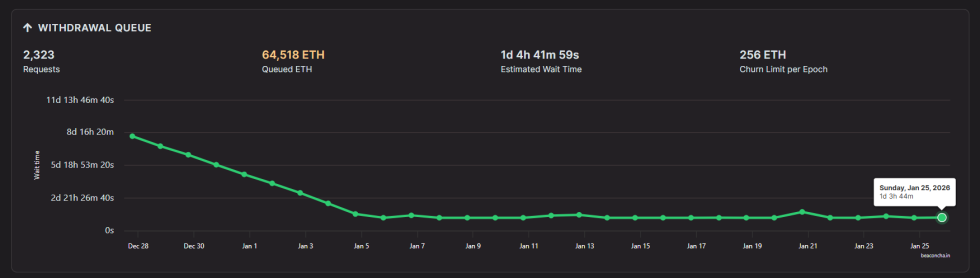
While withdrawal wait times have dropped to roughly a single day, the deposit queue has grown to more than 54 days. Such a growth reflects a strong validator interest and signals a surge of new capital waiting to enter the leading network. As more ETH becomes available for staking, the rising deposit backlog highlights the tightening of the liquid supply and the increased dedication to network security.
In simple terms, the expert stated that multiple companies and individuals wish to stake ETH rather than sell it. Allen added that this is considered a robust signal for network security and validator participation.
Bitmine Is Not Slowing Down On ETH Staking
Companies and individuals’ interest in staking Ethereum rather than selling it is largely evidenced by Bitmine Immersion Technologies’ massive staking activity lately. Broke Doomer on X reported that the largest ETH treasury holding company recently committed another $341 million worth of ETH to staking.
The chart shared by the crypto expert shows that the company conducted the transfer in a series of transactions within a single day. Following this latest move, Bitmine’s overall staking holdings are now positioned at more than 2.33 million ETH valued at a staggering $7 billion.
With this massive number of ETH, more than half of the company’s ETH holdings are currently locked and earning interest. Doomer classifies this adoption as a sign of conviction building among large entities or firms over the next few years. “You don’t do that if you’re bearish. You do that when you’re building conviction for the next few years,” the expert stated.
Featured image from Unsplash, chart from Tradingview.com
Editorial Process for bitcoinist is centered on delivering thoroughly researched, accurate, and unbiased content. We uphold strict sourcing standards, and each page undergoes diligent review by our team of top technology experts and seasoned editors. This process ensures the integrity, relevance, and value of our content for our readers.
Cardano Price Eyes $0.6 as Top Validator Spotlights Key Decentralization Advantage The Coin Republic
Source link ]]>
A recent slashing of Ethereum from different validators has reignited the debate around staking models, with many pointing to Cardano’s more resilient structure as a key differentiator. While Ethereum’s system penalizes validators for downtime or misbehavior, Cardano’s staking approach avoids such risks, offering delegators security without the fear of losing funds.
Why Simplicity And Resilience Are Cardano’s Key Advantages
On September 10, a slashing of 11.7 ETH from 39 Ethereum validators highlights the advantages of Cardano’s staking structure. Crypto analyst Dori has highlighted on X the fundamental differences in staking requirements and risks between the two networks. On Ethereum, it is structurally impossible to stake 0.1 ETH directly on ETH, but an individual must stake a minimum of 32 ETH and operate a validator node themselves.
However, platforms have been built on Ethereum to allow staking with as little as 0.1 ETH, and liquid tokens are issued. The critical difference is that, due to the slashing mechanism, Ethereum’s structure carries the risk of a cascading collapse. This has given rise to platforms like Ankr and Lido Finance, which pool ETH from many users, run validators, and issue liquid staking tokens such as ankrETH and stETH to solve the problem of locked-up funds.
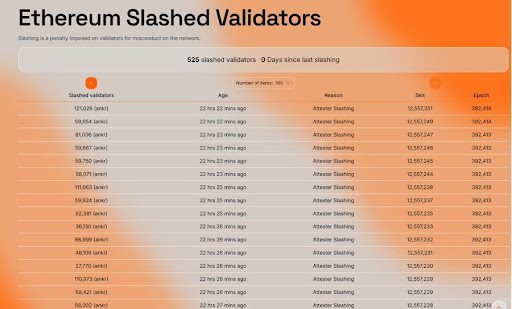
In this incident, an operational mistake by the operators of 39 validators led to a slashing penalty of 11.7 ETH, which is worth approximately $52,000. If a larger slashing event were to occur, it could lead to the de-pegging of the liquid staking tokens, potentially triggering a cascading collapse as DeFi ecosystem protocols built upon them.
On Ethereum, iquid staking platforms were developed to remove obstacles to staking, and liquid tokens were distributed to address the issue of lock-ups. In contrast, Cardana’s staking model allows anyone to stake as little as 10 ADA in a stake pool without worrying about slashing. There are no lock-up periods, and a user’s staked funds are never at risk of being lost, even if their chosen stake pool misbehaves.
Fundamentally Different Approaches To Staking
Cardanians (CRDN) also stated that a critical flaw in Ethereum’s staking model has been exposed, highlighting the fundamental advantages of Cardano’s design. The data shows that the Ethereum staking exit queue has hit an all-time high, forcing users who unstake their ETH to wait an estimated 46 days to get their funds back.
However, Cardano’s ADA staking model offers a fundamentally different experience, with liquid staking and no entry or exit queues. When a user stakes their ADA, the funds remain in their wallet and are always available for use or transfer, and earn rewards without being locked up. “The design is fundamentally better,” the expert noted.
]]>The Daily: Dogecoin’s ETF debut, ‘Solana season’ brewing, Ethereum validator exits, and more The Block
Source link ]]>
Ethereum staking validator Everstake has announced that the validator exit queue has reached its highest point in one year. The expert further explained why this development might be a positive for the ETH ecosystem.
Ethereum Validator Exit Queue Reaches New High
In an X post, Everstake stated that the Ethereum validator exit queue has reached its highest level in over a year, representing approximately 520,000 ETH, which is equivalent to $1.9 billion at current prices. The validator noted that this queue will take around 19 days to fully clear. He further explained that this exit queue tracks how many validators are leaving Ethereum’s staking system.
This typically raises concerns about a huge sell-off being imminent from these validators. However, Everstake assured that the surge in the validator queue is not a sign of fear or collapse. Instead, the expert claimed that it is a shift, whereby these validators are more likely to exit and restake, optimize, or rotate operators than leave the ETH ecosystem.
Meanwhile, Everstake admitted that there is still the possibility that these validators may want to lock in profits, especially seeing as the Ethereum price just recently surged to a six-month high. He noted that it is natural to assume that some stakers are preparing to sell, which could create short-term sell pressure and potentially cause ETH to correct.
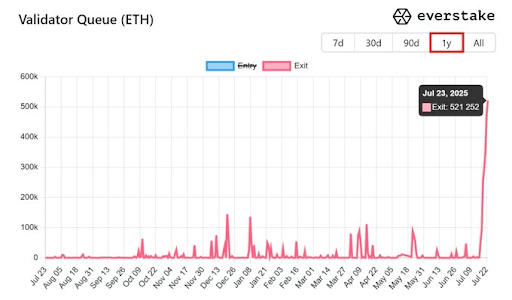
However, on the other hand, the validator remarked that Ethereum is seeing record ETF demand, with billions of dollars in net flows since the beginning of this month. As such, BlackRock, Fidelity, and other ETH ETF issuers could match this potential sell pressure with similar buying pressure.
Everstake also declared that this development with the validator exit queue is a “sign of health” and the freedom to move. He claimed that activity like this shows how mature ETH staking has become, with the protocol doing what it was designed to do. He added that this is what decentralization looks like.
ETH ETFs Record Inflows For 15 Consecutive Days
SoSo Value data shows that the Ethereum ETFs have now recorded 15 consecutive days of net inflows. This follows the net inflow of $231.23 million that they recorded on July 24. These funds currently hold $20.70 billion in net assets, representing 4.59% of Ethereum’s market capitalization.
The significant inflows into these funds support Bitwise CIO Matt Hougan’s theory that ETH will soon witness a demand shock. He stated that this demand will come from the ETFs and corporate treasuries, predicting that they could purchase up to $20 billion of ETH in the next year.
At the time of writing, the Ethereum price is trading at around $3,630, up over 1% in the last 24 hours, according to data from CoinMarketCap.
Featured image from Getty Images, chart from Tradingview.com
Editorial Process for bitcoinist is centered on delivering thoroughly researched, accurate, and unbiased content. We uphold strict sourcing standards, and each page undergoes diligent review by our team of top technology experts and seasoned editors. This process ensures the integrity, relevance, and value of our content for our readers.
Cardano Founder Teases Chang Hard Fork Launch as Validator Upgrades Near 70% Threshold ZyCrypto
Source link ]]>
- Cardano ready for Chang hard fork after latest validator node release Cointelegraph
- Cardano investors set to control $14bn blockchain as Chang hard fork begins DLNews
- 17 Billion Cardano (ADA) in 24 Hours, What’s Happening? U.Today
- Cardano and Two Additional Altcoins Showing Higher Chances of Liquidation-Fueled Rallies, According to Analytics Firm Santiment The Daily Hodl
- Cardano Sets Stage For Chang Hard Fork With Node Upgrade Bitcoinist
- Cardano Validators Begin Migration In Preparation for Chang Hard Fork The Defiant – DeFi News
- Market Analysts Projects 2095% Upsurge for Cardano As Peak Price Target for This Bull Run The Crypto Basic
- Cardano Enters Chang Hard Fork Era With Node 9.1.0 Upgrade CoinGape
- Is Cardano’s price recovery sustainable? Key indicators to watch are… AMBCrypto News
Cardano Prepares for Chang Hard Fork with New Validator Node Crypto Times
Source link ]]>