Despite Bitcoin’s inception over a decade ago with Satoshi Nakamoto’s vision of facilitating peer-to-peer electronic cash transactions, its current usage mirrors its early days. The Bitcoin (BTC) transactions are circulating at a pace reminiscent of 13 years ago. This revelation comes from CryptoQuant CEO Ki Young Ju, who highlighted the stagnation in Bitcoin’s velocity.
Bitcoin Velocity Stagnates
Ju noted that the trend indicates a shift towards the digital gold narrative rather than widespread adoption for daily transactions. The concept of Bitcoin as “Digital Gold” has gained traction. Hence, institutions are increasingly holding onto the cryptocurrency as a store of value rather than utilizing it for frequent transactions.

The velocity of Bitcoin transactions, depicted in a chart shared by Ki Young Ju, stands at a level similar to that of 2011. This reflects a long-standing trend of sluggish movement in the Bitcoin ecosystem. Though the Bitcoin velocity spiked several times in these 13 years, it’s now back to the 2011 levels, according to CryptoQuant.
Nick Tomaino, a former Coinbase executive, recalled the early days of Bitcoin adoption. He noted that Coinbase initially raised significant funding under the premise that Bitcoin would revolutionize payments and spur the creation of new applications. However, the reality differed as the platform onboarded merchants like Overstock to accept Bitcoin, but the long-term viability of Bitcoin payments proved elusive.
Tomaino’s insights shed light on the challenges faced by Bitcoin as a payment method. It also emphasizes the lack of a compelling business case for Bitcoin payments in the face of emerging alternatives like Ethereum and decentralized applications. Moreover, he highlighted how Ethereum’s inception changed the entire crypto payments game.
Also Read: Bitcoin Notes $2B Inflows But Ethereum Steals The Spotlight, Here’s Why
Limitations Of BTC Payments
Zach Rynes, a Chainlink community liaison, delved deeper into the technical limitations of Bitcoin for payments. He particularly highlighted Bitcoin’s lack of programmability compared to Ethereum and other blockchain platforms. Rynes highlighted two crucial issues: volatility risk and payment accuracy, both of which are critical for merchants considering cryptocurrency payments.
Rynes explained that smart contract capabilities of Ethereum allow for seamless conversion of crypto assets into stablecoins. Hence, it mitigates volatility concerns for merchants. Additionally, Ethereum’s programmability enables automatic validation of payment amounts. This reduces the burden of manual reconciliation for incorrect payments.
In contrast, Bitcoin’s UTXO-based architecture presents hurdles for implementing similar functionalities directly on its blockchain. While Lightning Network offers potential solutions for validation issues, challenges persist in managing liquidity and scalability. This limits its effectiveness in addressing Bitcoin’s payment shortcomings.
Furthermore, Rynes’ analysis underscores the complexity of Bitcoin payments. It also emphasizes the necessity for pragmatic solutions to accommodate merchant requirements while maintaining decentralization and non-custodial principles.
Despite the backlash from Bitcoin maximalists, Rynes maintains that acknowledging Bitcoin’s limitations in payment processing is essential for driving innovation. However, Bitcoin maximalists also see a hope in the rise of BTC payments as the Layer 2 network is making great progress toward the target. Nonetheless, Layer 1 BTC payments might not go mainstream anytime soon.
Also Read: How Bitcoin Will Benefit From End Of US-Saudi Petrodollar Deal

The presented content may include the personal opinion of the author and is subject to market condition. Do your market research before investing in cryptocurrencies. The author or the publication does not hold any responsibility for your personal financial loss.

Amid the 2023 bear market, one can’t help but reflect on the game-changing moments that have shaped this industry.
The ‘DeFi Summer’ of 2020 was a turning point in the blockchain industry, as CryptoSlate remembers. This season saw the debut of several DeFi projects, signaling the dawn of a new era in finance. DeFi’s evolution during this period didn’t just make waves; it catalyzed a paradigm shift, positioning itself as the bold trailblazer of this unprecedented movement.
Having been around in concept since 2015 through projects such as MakerDAO, DeFi experienced a monumental surge during the bull run of 2021, redefining traditional finance and making its mark as a significant player in the market. Yet, today, with token prices down up to 90% as we navigate the murky waters of the current bear market, we look at the velocity of DeFi adoption and the impact of market cycles on adoption.
DeFi TVL analysis by chain since 2017
Against this backdrop, our analysis focuses on data collected from 2018 to 2023, with an emphasis on adoption across chains such as Ethereum, Tron, BNB Chain (BSC), Arbitrum, Polygon, Optimism, Avalanche, Mixin, Pulse, Cronos, Solana, Cardano, and Osmosis.
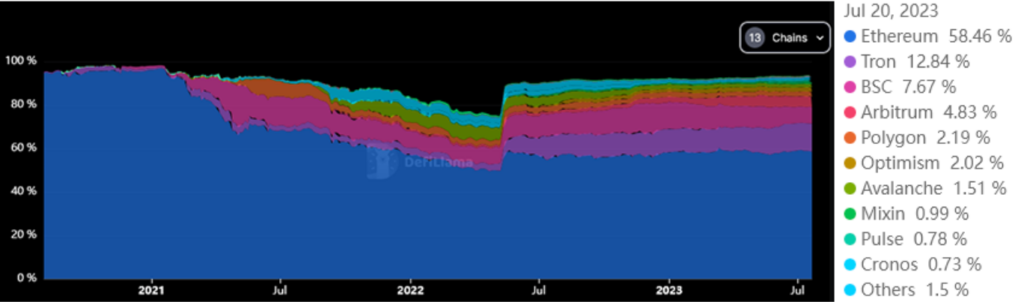
The table below shows the chains analyzed, the date the chain reached its all-time high for TVL (as tracked by DefiLlama,), the time it took to get its all-time high since launch (velocity), its all-time high (ATH), and the current TVL.
| Chain | Activity start* | ATH Date | ATH TVL | Velocity | Current TVL |
|---|---|---|---|---|---|
| Ethereum | November 2017** | November 2021 | $108.92B | 1280 days | $25.73B |
| Tron | August 2020 | November 2021 | $6.74B | 470 days | $5.69B |
| BSC | October 2020 | May 2021 | $21.94B | 186 days | $3.36B |
| Arbitrum | August 2021 | May 2023 | $2.53B | 614 days | $2.12B |
| Polygon | October 2020 | June 2021 | $9.89B | 249 days | $0.97B |
| Optimism | July 2021 | August 2022 | $1.15B | 393 days | $0.92B |
| Avalanche | February 2021 | December 2021 | $11.41B | 302 days | $0.66B |
| Mixin | December 2021 | June 2022 | $0.59B | 182 days | $0.44B |
| Pulse | May 2023 | May 2023 | $0.49B | 5 days | $0.34B |
| Cronos | November 2021 | April 2022 | $3.22B | 145 days | $0.32B |
| Solana | March 2021 | November 2021 | $10.03B | 236 days | $0.31B |
| Cardano | January 2022 | March 2022 | $0.33B | 81 days | $0.18B |
| Osmosis | June 2021 | March 2022 | $1.83B | 253 days | $0.13B |
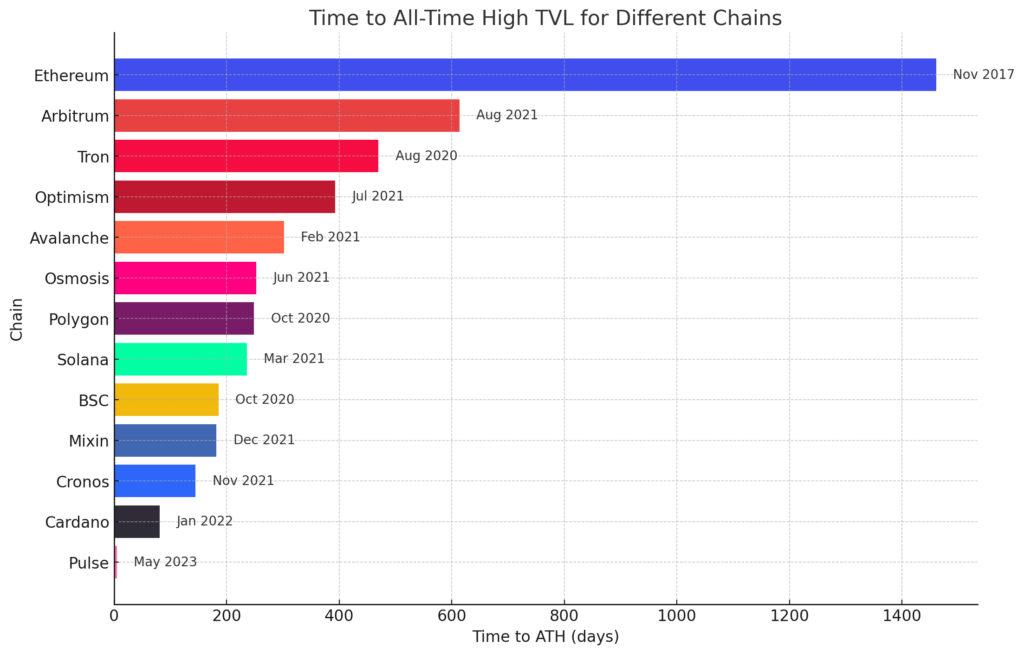
The chart below visualizes the velocity of each chain in reaching its all-time high in TVL. The DeFi pioneer, Ethereum, has technically had DeFi activity since 2017, and thus it stands out as the slowest adoption, given its all-time high was not reached until Nov. 2021.
Interestingly, November 2021 coincides with the all-time high for Bitcoin and likely impacted DeFi on Tron and Solana, which also saw peaks at this time.
Bitcoin adjusted velocity
As Bitcoin is seen as a barometer for the overall health of the cryptocurrency market, the velocity of DeFi adoption was adjusted based on Bitcoin’s price at each chain’s DeFi launch.
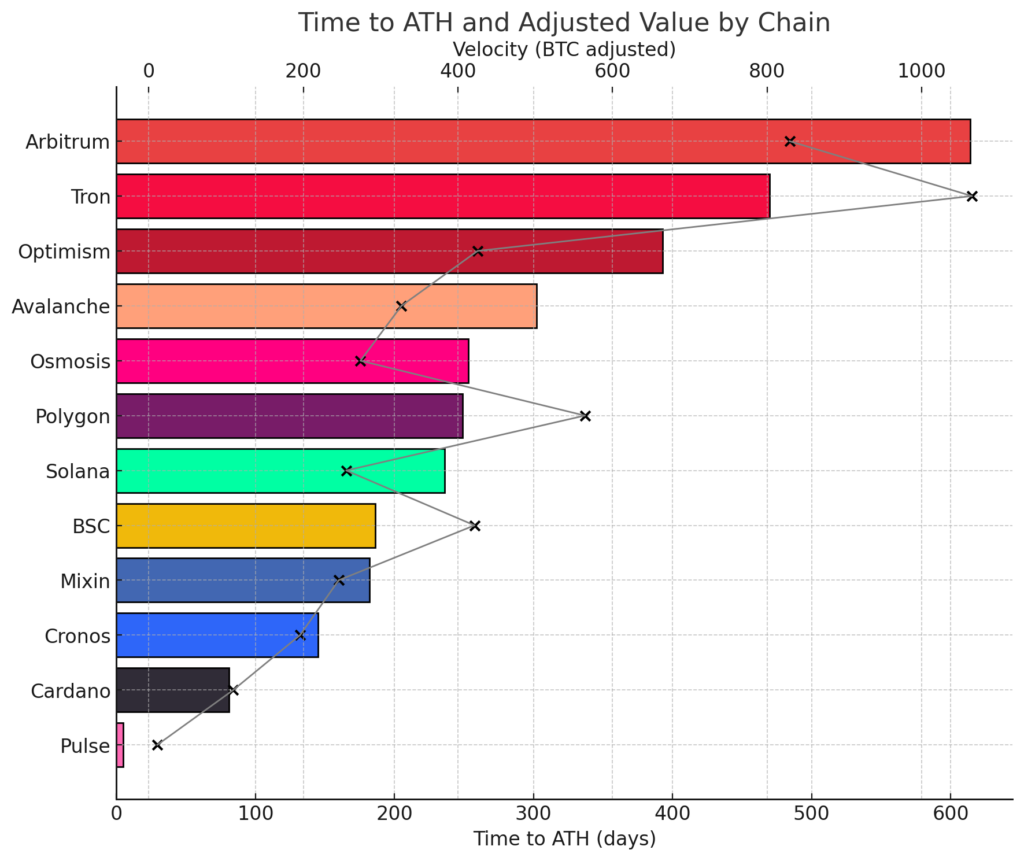
CryptoSlate cross-referenced the price of Bitcoin with the all-time high data to create a Bitcoin-adjusted velocity (BaV) for each chain.
The chart below’s grey line and plot points represent the BaV for each chain. The chart reveals that the DeFi ecosystems of Tron, Polygon, and BSC were all positively impacted by Bitcoin’s price and the supporting bullish sentiment of the market.
Analysis of chain velocity
Ethereum was removed from the above chart for readability as it recorded a massive 7,936 velocity score compared to the next closes, with Tron at 1,065 and Arbitrum at 829.
With the bear market factored in, Pulse’s velocity reduced, giving it a score of just 10.98, as it reached its ATH in just 5 days. The next lowest was Cardano at 109, some ten times greater.
Using the BaV metric, it appears the best-performing chains were Pule, Cardano, Cronos, Solana, and Osmosis. While Ethereum, Tron, and Arbitrum stood out as having the slowest velocity.
The diverse trajectories of DeFi adoption across different blockchain networks underscore the importance of timing, market conditions, and the inherent advantages of being an early mover in the space. However, as the remarkable case of Pulse shows, even newcomers can achieve rapid growth with the right factors aligning.
Understanding the data
The speed at which you reach the all-time high in TVL is a complex metric. Some may argue that the faster you go up, the quicker you come down, and that is definitely the case for some chains.
However, the fundamental factors under analysis here concern momentum and adoption. Further, all the projects listed recorded at least $330 million locked, with most over $1 billion. These are not projects with low market cap and low liquidity.
The projects analyzed in this article are critical to identifying the strengths and weaknesses of the historical DeFi onboarding process. The average time it took for a chain to reach its ATH was around 338 days, meaning, outliers aside, most chains take almost a year to peak in DeFi activity.
* Launch date refers to the date of the first data tracked by DefiLama for each chain**
** Using MakerDAO’s DAI launch as the date for the Ethereum DeFi launch and data according to CoinmarketCap’s historical data.
*** Additional data included due to DefiLlama 2020 cut-off date.
✓ Share: