
Ethereum could reprice to $15,000 in 2026 as traditional finance accelerates into tokenization, stablecoins, and bespoke Layer 2 blockchains built on Ethereum, according to Vivek Raman, CEO and co-founder of Etherealize.
In a Jan. 5 guest post, Raman framed 2026 as the point where ETH shifts from a decade-long credibility build to a commercial deployment era, arguing that “from 2026 onward – Ethereum will become the best place to do business,” as regulatory posture, institutional precedent, and infrastructure maturity converge.
Institutions Will Tokenize On Ethereum
Raman’s core claim is that tokenization is moving from proof-of-concept into scaled product deployment, with Ethereum increasingly serving as the base layer institutions choose when the assets are high value and the operational requirements are strict. He describes tokenization as a business-process upgrade that collapses assets, data, and payments onto shared infrastructure, and he leaned heavily on the idea that once institutions experience the efficiencies, they will not revert.
“Tokenization upgrades entire business processes by digitizing assets, data, and payments onto the same infrastructure,” Raman wrote. “Assets (like stocks, bonds, real estate) and money will be able to move at the speed of the Internet. This is an obvious upgrade to the financial system that should have happened decades ago; public global blockchains like Ethereum enable this today.”
The post cites examples of institutional tokenization activity on Ethereum, including money market fund initiatives from JPMorgan and Fidelity, BlackRock’s tokenized fund BUIDL, Apollo’s private credit fund ACRED (with liquidity concentrated on Ethereum and its L2s), and European participation such as Amundi tokenizing a euro-denominated money market fund. Raman also pointed to tokenized products from BNY Mellon and a planned tokenized bond fund tied to Baillie Gifford that would span Ethereum and an L2 network.
Stablecoins As The “Green Light” Moment
Raman positioned stablecoins as the clearest product-market fit for onchain finance, citing “$10T+ in stablecoin transfer volumes in 2025” and claiming that “60% of all stablecoins are on Ethereum and its Layer 2 networks.” He argued that regulatory developments in the US have de-risked deployment for institutions, describing the passage of the GENIUS Act in 2025 as the moment public-chain stablecoin rails effectively received formal clearance.
As a near-term datapoint, Raman highlighted SoFi’s reported launch of a bank-issued stablecoin, SoFiUSD, on a “public, permissionless blockchain,” adding that the bank chose Ethereum. He suggested this is the start of a broader wave where investment banks, neobanks, and fintechs explore stablecoin issuance—either solo or via consortium structures—inside a single public-chain ecosystem to maximize network effects.
Layer 2s As The Institutional Business Model
A major part of Raman’s thesis hinges on the idea that institutions will not converge on a single chain, but will converge on a single interconnected network, Ethereum plus its Layer 2 ecosystem. He argued that L2s provide customization by jurisdiction and customer base while inheriting Ethereum’s security and liquidity, and he described L2 economics as unusually attractive for operators, citing “90+% profit margins” as a reason businesses will want their own chains.
Raman listed examples including Coinbase’s Base, Robinhood’s plans for an Ethereum L2 featuring tokenized stocks and other assets, SWIFT’s use of the Ethereum L2 Linea for settlements, JPMorgan deploying tokenized deposits on Base, and Deutsche Bank building a public, permissioned network as an Ethereum L2.
The $15,000 Ethereum Price Target
Raman also argued ETH is emerging as an institutional treasury asset alongside bitcoin, describing BTC as “digital gold” and ETH as “digital oil”, a productive store of value tied to ecosystem economic activity.
He pointed to four public-company “MicroStrategy-equivalents” accumulating ETH: BitMine Immersion (BMNR), Sharplink Gaming (SBET), The Ether Machine (ETHM), and Bit Digital (BTBT) and claimed they have collectively purchased roughly 4.5% of ETH supply in the last six months, comparing that to MicroStrategy’s 3.2% of BTC ownership.
Those dynamics underpin his 2026 “5x” forecast set: tokenized assets rising to nearly $100 billion (from an estimated $18 billion after growing from ~$6 billion in 2025, with “66%…on Ethereum and its L2s”), stablecoin market cap expanding to $1.5 trillion (from $308 billion), and ETH appreciating 5x to $15,000—an implied $2 trillion market cap in his framing.
At press time, ETH traded at $3,227.
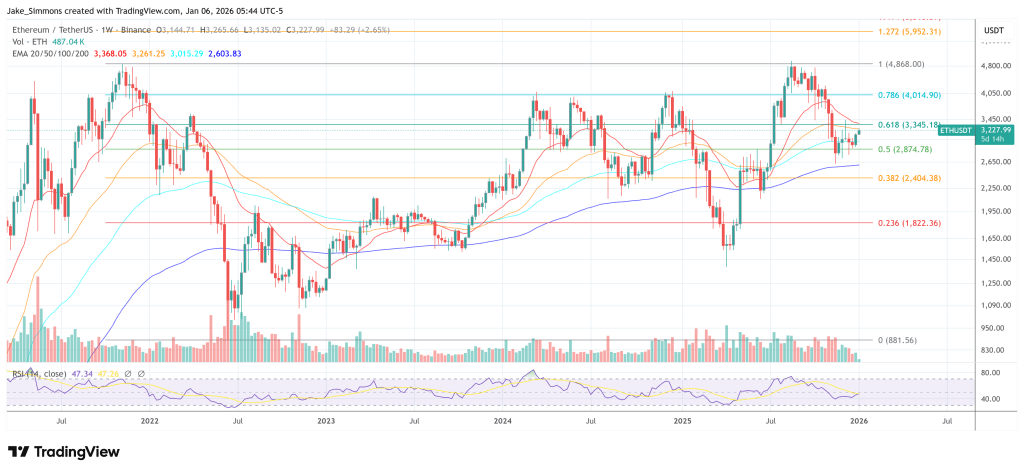
Featured image created with DALL.E, chart from TradingView.com
Editorial Process for bitcoinist is centered on delivering thoroughly researched, accurate, and unbiased content. We uphold strict sourcing standards, and each page undergoes diligent review by our team of top technology experts and seasoned editors. This process ensures the integrity, relevance, and value of our content for our readers.
Strive, the Bitcoin treasury and asset management firm founded by Vivek Ramaswamy, has announced a fresh $162 million BTC purchase. This followed the oversubscribed listing of its SATA preferred stock on Nasdaq. Strive’s IPO Powers Bitcoin Expansion According to post on the firm’s X channel, the acquisition of 1,567 BTC was at an average price
The post Vivek Ramaswamy’s Strive Acquires $162M in Bitcoin, Surpasses Galaxy Digital in BTC Holdings appeared first on CoinGape.
]]>Strive, Inc., the investment firm co-founded by Vivek Ramaswamy, has announced plans to acquire Semler Scientific in an all-stock deal. The agreement highlights the growing role of Bitcoin in corporate balance sheets and sets up Strive as one of the largest public holders of the cryptocurrency. Strive Seals Semler Merger Deal, Buys $675 Million in
The post Breaking: Vivek Ramaswamy’s Strive to Acquire Bitcoin Treasury Firm Semler Scientific appeared first on CoinGape.
]]>Strive Asset Management, co-founded by Vivek Ramaswamy, has filed an application for a novel Bitcoin Bond ETF. The proposed Strive Bitcoin Bond ETF aims to invest in derivatives such as swaps and options. If approved, this ETF could further boost BTC appeal by increasing institutional investment and demand. Having said that, the US SEC’s decision on the application is eagerly awaited by market participants.
Vivek Ramaswamy’s Strive Files For Bitcoin Bond ETF Launch
Vivek Ramaswamy’s Strive Asset Management has officially taken a step to advance the launch of the Bitcoin Bond ETF with its recent SEC filing. It will come as a new exchange-traded fund that will invest in bonds issued by companies like MicroStrategy that purchase Bitcoin tokens.
Strive Bitcoin Bond ETF will invest in swaps and options, among other derivatives. The new Bitcoin Bond ETF will utilize investments to target most of the companies that buy Bitcoin.
This development also comes as corporations have shifted their focus towards Bitcoin buying. Besides, a flurry of companies along with the global leaders are exploring opportunities for BTC Strategic Reserve. For context, MicroStrategy has recently acquired 1,070 BTC, highlighting its growing interest in the flagship crypto.
Meanwhile, the move to advance the launch of Bitcoin Bond ETF has sparked speculation about the rise in the price of BTC. Other factors like the involvement of Vivek Ramaswamy, Donald Trump’s election win, and the growing adoption of cryptocurrencies are also contributing to the bullish speculation for BTC.
Will It Impact BTC’s Value Ahead?
BTC price today was up by 1.69% to $99,130, while noting a surge of 6% in the last 7 days. Its market cap and trading volume soared by 1.35% and 56.73% to $1.96 trillion and $30.28 billion, respectively.
BTC Futures Open Interest, according to Coinglass data, has surged by 13%. This signals that the overall sentiments are bullish. Besides, the market is keeping close track of the flagship crypto, as it hovers around the brief $100K mark.
Meanwhile, Vivek Ramaswamy’s Strive Asset Management advancing the launch of this Bitcoin ETF is a positive move not only for BTC but for the entire crypto ecosystem. For context, US Spot Bitcoin ETFs have contributed the most inflows into digital assets in 2024, according to CoinShares reported. However, the report also noted that XRP reigns supreme among other digital assets in last week’s money flow.
Having said that, the Bitcoin Bond ETF, if gets approved, could further push the price of the crypto higher. However, investors should exercise due diligence, given the volatile nature of the crypto market.

Coingape Staff
CoinGape comprises an experienced team of native content writers and editors working round the clock to cover news globally and present news as a fact rather than an opinion. CoinGape writers and reporters contributed to this article.
Disclaimer: The presented content may include the personal opinion of the author and is subject to market condition. Do your market research before investing in cryptocurrencies. The author or the publication does not hold any responsibility for your personal financial loss.
Dogecoin To $2 As Elon Musk and Vivek Ramaswamy Proposes DOGE Reforms CoinGape
Source link ]]>
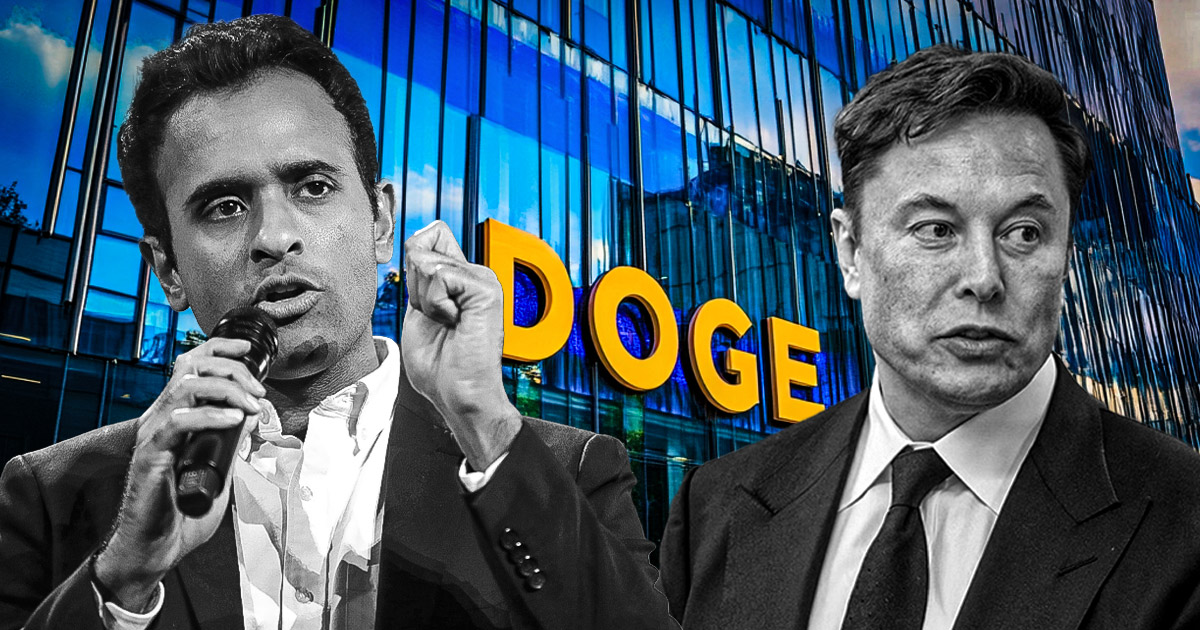
US President-elect Donald Trump has appointed two prominent crypto supporters—tech mogul Elon Musk and former Republican presidential candidate Vivek Ramaswamy—to lead a new initiative, the Department of Government Efficiency (DOGE).
On Nov. 13, Trump announced on his Truth Social platform that he aims to eliminate government inefficiencies, slash excess regulations, and streamline federal spending through DOGE. The Republican likened DOGE’s mission to the World War II-era Manhattan Project, describing it as a core part of his “Save America” campaign.
DOGE
DOGE’s primary goal is to significantly reduce the “waste and fraud” in the US government’s $6.5 trillion annual budget. The department is expected to operate independently. However, it will extensively collaborate with the White House and the Office of Management and Budget to guide structural reforms.
Trump expressed confidence in the impact of this initiative, envisioning “a smaller, more efficient government with reduced bureaucracy” by July 4, 2026. Interestingly, this date coincides with the 250th anniversary of the US Declaration of Independence.
Musk and Ramaswamy—both staunch Trump supporters—bring a unique perspective to the initiative. Musk publicly backed Trump’s campaign, appearing at rallies, while Ramaswamy endorsed Trump after exiting the presidential race. Both have been strong advocates for crypto, underscoring their forward-thinking approach to government reform.
Public involvement
In a Nov. 13 statement on X, Musk committed to transparent operations, promising that DOGE will post all updates online to allow public feedback. He stated:
“Anytime the public thinks we are cutting something important or not cutting something wasteful, just let us know!”
The X owner added that DOGE plans to launch a leaderboard highlighting the “most absurdly wasteful government expenditures”—a feature he anticipates will be enlightening and entertaining.
Echoing this sentiment, Ramaswamy shared that DOGE will soon invite public submissions on examples of government waste and misuse. He said:
“Americans voted for substantial reform, and they deserve to play a role in achieving it.”
Dogecoin price
Trump’s choice to name the department DOGE sparked a wave of enthusiasm among Dogecoin supporters, given the meme crypto’s cultural resonance.
Despite the excitement, Dogecoin’s price fell 10% after a recent upswing that pushed its value to a three-year high. According to CryptoSlate’s data, the memecoin was trading for $0.37 as of press time.
Meanwhile, market observers believe Musk’s involvement with DOGE may bode well for the memecoin, considering his strong support for the asset and the impending bull market run.
Mentioned in this article
Dogecoin Price Rallies Over 10% As Trump Announces DOGE Department Led By Elon Musk, Vivek Ramaswamy ABP Live
Source link ]]>
Grayscale’s victory over the US SEC on Tuesday has got everyone talking about Bitcoin including candidates for the U.S. Presidential Election 2024. Republican Presidential candidate Vivek Ramaswamy recently shared his bullish view on Bitcoin.
Sharing his skepticism towards the government, the conservative businessperson asserts that the “shadow government” in Washington is operating without restraint. According to the entrepreneur, federal courts represent the final defense against the “unlawful rogue actions” of government agencies identified by acronyms. In the situation involving Grayscale, the court’s decision validated this stance.
In his Wednesday Twitter post, Ramaswamy said: “This decision is strong and clears a path to keep Bitcoin and blockchain innovation in the U.S. instead of overseas. But this should have never reached the courts in the first place.”
In their lawsuit, Grayscale accused the SEC of approving other Bitcoin products like the future ETFs while having no grounds for rejection for the spot Bitcoin ETFs.
US Courts Favoring Bitcoin and Crypto
As pointed out by Vivek, recent months have witnessed courts siding with the cryptocurrency sector. In addition to deeming the SEC’s rejection of Grayscale’s ETF as “arbitrary and capricious,” the judicial system also favored Ripple in July. The court also asserted that XRP does not qualify as a security.
Vivek’s observations also align with the sentiments expressed by various leaders within the cryptocurrency industry. They have repeatedly cautioned against the SEC’s approach of “regulation by enforcement,” emphasizing that it could prompt crypto businesses and innovators to seek more favorable environments overseas.
These viewpoints also mirror the opinions expressed by a group of Republican congressmen supportive of cryptocurrencies. Some of these congressmen have openly called for the removal of SEC Chairman Gary Gensler from his position. In an exchange with Gensler in April, Representative Tom Emmer (R-MN) described him as an “incompetent cop on the beat”. Emmer suggested that his actions could inadvertently push the crypto industry toward communist China.
Just like Coinbase and other exchanges, Vivek stresses the need to attain greater regulatory clarity. Vivek has been quite vocal about his support for Bitcoin. During Bitcoin 2023, he expressed his disapproval of CBDCs and strongly criticized the Biden administration’s efforts to impose a 30% excise tax on Bitcoin miners.

The presented content may include the personal opinion of the author and is subject to market condition. Do your market research before investing in cryptocurrencies. The author or the publication does not hold any responsibility for your personal financial loss.
✓ Share: