Don’t Waste Time Investing In Dogecoin – Doge Uprising Is The Best New Meme Coin To Buy This Week TCU
Source link ]]>
Buying Shiba Inu and PEPE Coin Right Now is a Waste of Time, Only this Penny Token Can Turn $100 Into $10,000 By March Brave New Coin Insights
Source link ]]>
Don’t Waste Your Time Waiting for Another Shiba Inu (SHIB) and Dogecoin (DOGE) Mega Rally, Bag This Token While It’s Still Below 10 Cents The Cryptonomist
Source link ]]>
Elon Musk’s lawyers respond to motion to kick Tesla team off Dogecoin case: ‘waste of this court’s time’ Cointelegraph
Source link ]]>
Shiba Inu is Underperforming the Market and Avorak Wouldn’t Let You Waste Other Opportunities Analytics Insight
Source link ]]>

The IOG has introduced a new protocol to reduce PoW’s energy waste.
Cardano’s research and development company, Input Output Global (IOG), has introduced a new consensus protocol to reduce the energy waste of Proof-of-Work (PoW) blockchains.
The protocol, dubbed Ofelimos, was introduced at the Cryptology conference by members of the IOG research team. According to the IOG, the research was jointly carried out by some of its members, including Matthias Fitzi, Aggelos Kiayas, Giorgios Panagiotakos, and Alexander Russel.
“Today, at the leading international cryptology conference, Crypto, Input Output Global, Inc (IOG) introduces Ofelimos, a novel PoUW-based blockchain protocol whose consensus mechanism simultaneously realizes a decentralized optimization-problem solver,” IOG said.
Ofelimos Features and Offerings
Ofelimos aims to transform PoW into a proof of useful work (PoUW) algorithm. This is mainly because the PoUW algorithm intends to solve the problem of energy efficiency.
Notably, the new protocol introduced by the IOG will redirect the computational effort used to maintain blockchain security, as required in the PoW model, to solve other real-world problems.
Some of the sectors Ofelimos aim to repurpose PoW computational efforts, including optimizing company logistics and event schedules.
The IOG added that Ofelimos would tackle fraudulent miners’ behavior to direct the system to pose easily solvable problems or problems that have already been solved.
Per IOG, Ofelimos will deploy provable security for high levels of corruption.
“Ofelimos is only a first step towards provably secure and useful PoUW. Whereas the current work readily gives provable security for levels of high corruption, more research is still needed on the algorithmic side to provide suitable classes of optimization problems for which high usefulness can be provably demonstrated,” the IOG concluded.
Rising Concerns Over High Energy Consumption of PoW Networks
The massive energy consumption of PoW blockchains, especially Bitcoin, has been a major topic of discussion worldwide.
Both regulators and various advocacy groups have expressed concerns about the carbon footprints caused by these PoW networks.
Based on these concerns, a lot of research and funds have been channeled toward reducing PoW’s energy consumption.
As reported by TheCryptoBasic, Ripple’s Chairman Chris Larsen set aside $5 million to sponsor a campaign that will force Bitcoin to change its code from PoW to a Proof-of-Stake algorithm due to energy concerns.
– Advertisement –
- Dogecoin Price Prediction: Bulls Must Not Waste This Opportunity InvestingCube
- ‘Sell Now’—Reality Bites For Dogecoin As Expert Panel Says Joke Cryptocurrency Is Heading To Zero, Cuts Price Forecast For BNB, Solana & Cardano Forbes
- Dogecoin Investor Uncovers Suspicious Ponzi Scheme on the Network Watcher Guru
- Dogecoin Price Prediction: DOGE Bottoming, Upside Risks AskTraders
- Dogecoin price to provide positional traders a discount to buy DOGE before a 90% rally FXStreet
- View Full Coverage on Google News
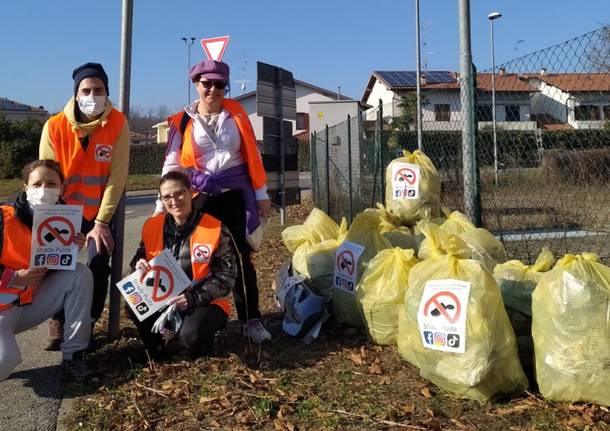
Clean Streets in Cardano al Campo. In the sense that the Gallarate group of “Clean Streets” – born in the Varese valleys from the commitment of Damiano Marangoni – debuted with an ecological morning in the Cardano area, near Malpensa.
Photo gallery
“Clean roads” in Cardano al Campo 4 of 13
Sunday morning the Gallarate group started to get serious in the area of the SS336Dir junction in Cardano al Campo. The ten volunteers (including many newcomers) took care of continuing the cleaning of the cycle path for Samarate that began last year and starting the section of the overpass from via Carreggia to the roundabout in via Allende.
Fill thirty bags of waste with a lot of plastic and paper, found several full bags thrown in the interchange, like many glass bottles, some trolleys with clothing were also recovered (perhaps luggage theft at the nearby airport), as well as four red plastic garden chairs, a full oil tank, damaged car parts and various.
“Thanks and congratulations to Georgina, Luca, Marta and Damiano and the new Graziella, Francisca, Elena, Ambrogio, Fabio, Maurizio to whom we also give a warm welcome, in particular Fabio, for bringing the brioches, he starts on the right foot!”
Instead of burning the natural gas, the senator wants it channelled into Bitcoin mining
Bitcoin miners can put the abundant natural gas wasted through flaring to “productive use” and help the environment, US Senator Ted Cruz said on Friday.
Texas is currently one of the top destinations for Bitcoin miners, especially after China’s crackdown on crypto mining and trading.
As well as the cheap and readily available wind-generated power, miners could also benefit from another energy source — the natural gas oil industries “burn” to avoid pressure building up in reservoirs during oil extraction.
Bitcoin mining is ‘productive’
While speaking at the Texas Blockchain Summit on 8 October, Cruz noted that Texas accounts for about 50% of the “flared” gas, a huge amount of energy he said should not be allowed to go to waste.
According to Cruz, the wastage comes about due to a lack of transmission equipment necessary to capture the natural gas and have it directed to areas where it should be used as it’s supposed to be.
“Use that power to mine Bitcoin,” the Texas politician urged, adding that this is a move that could instantly help the environment.
“…rather than flaring the natural gas you’re putting it to productive use,” he noted.
The energy can also be connected to the grid, providing reserves from which other critical uses can draw power, Cruz added.
Bitcoin, according to the US politician, has the potential to prove very important across the globe, especially in lots of “places on Earth where the sun shines a lot and the wind blows a lot but there aren’t any power lines and it’s not economically feasible to use that energy.”
CoinMetrics founder Nic Carter summed up Senator Ted Cruz’ speech advocating for the use of Bitcoin mining as below:
Sen. Cruz makes 3 key points
– Miners can mine off grid by mitigating waste nat gas (byproduct of oil extraction)
– Miners can participate in demand response and give energy back to grid when most needed
– Miners can take advantage of stranded renewables
— nic carter (@nic__carter) October 10, 2021
Cruz’s comments on Bitcoin mining were highly enlightened, and are a great advert for Bitcoin, which is often criticised for being a massive consumer of energy.
There have been many studies that have highlighted the carbon footprint and electricity usage problems of Bitcoin transactions. Founder of Digiconomist Alex de Vries and researcher at MIT’s Center for Energy and Environmental Policy Research, Christian Stoll, released a new study that shines a light on the electronic waste that Bitcoin generates.
Related Reading | How Elon Musk Is The Answer To Bitcoin Energy FUD
This study, “titled Bitcoin’s growing e-waste problem”, provides new insights into another major component of Bitcoin’s wasteful design.
The Electronic Waste Problem Of Bitcoin
Most studies have ignored the fact that Bitcoin miners go through a large amount of short-lived hardware that could increase global electronic waste growth.
“E-waste represents a growing threat to our environment, from toxic chemicals and heavy metals leaching into soils, to air and water pollutions caused by improper recycling.”
According to the study, a single transaction generates 272 grams of e-waste, the same amount of electronic waste as throwing two iPhone 12 minis in the bin. In 2020 the bitcoin network processed 112.5m transactions (compared with 539bn processed by traditional payment service providers in 2019).

“Bitcoin’s annual e-waste generation adds up to 30.7 metric kilotons as of May 2021,” they claim. “This number is comparable to the amount of small IT and telecommunication equipment waste produced by a country like the Netherlands.” This figure could increase to more than 64.4 metric kilotons of waste.
They also point out that the demand for mining hardware already today disrupts the global semiconductor supply chain, which is currently suffering a global shortage due to increased need in the coronavirus pandemic, as well as a US-China trade war and drought in Taiwan.
BTC trading at $47.6K | Source: BTCUSD on TradingView.com
Additionally, Bitcoin mining has evolved from a simple activity done on a laptop to a complex and very expensive game done through powerful ASICs (application-specific integrated circuits). These ASICs are specifically designed to mine crypto transactions. And as technology changes, miners have to constantly replace their ASICs with newer, more powerful ones to stay competitive. Therefore, these single-purpose ASIC chips quickly become waste. According to the researchers, “The lifespan of bitcoin mining devices remains limited to just 1.29 years,”
Researchers in Europe and the U.S. also claim that miners have been dumping tens of thousands of tonnes every year of ASIC rigs and contributing to the ever-growing environmental challenge.
Alex and Stoll also warn that the e-waste problem will probably grow further if the price of the cryptocurrency continues to rise since it will incentivize further investment in and replacement of ASIC hardware.
Related Reading | Why Bitcoin Could Rise To $53K, Here Are The Risks Bulls Must Overcome
If the community were to try to reduce its e-waste problem, the paper concludes, it would need to replace the bitcoin mining process in “its entirety with a more sustainable alternative,” One of those alternatives is “proof of stake” instead of “proof of work”, as an experimental replacement. “The first miner who finds a PoW [proof of work] that satisfies predetermined conditions broadcasts the block to all nodes in the network. The receiving nodes express their acceptance of the new block by building on top of it”, the paper explains.
Featured image from Interesting Engineering, Chart from TradingView.com