Access to finance remains a key growth constraint for small businesses, with data showing a $330 billion financing deficit for the small enterprises that make up 90% of Africa’s businesses.
This is the gap that Kenya’s embedded finance fintech Pezesha seeks to bridge as it expands into Nigeria, Rwanda and Francophone Africa following a $11 million pre-Series A equity-debt round led by Women’s World Banking Capital Partners II with participation from Verdant Frontiers Fintech Fund, cFund and Cardano blockchain builder Input Output Global (IOG). The round also included a $5 million debt from Talanton and Verdant Capital Specialist Funds.
The fintech’s new growth strategy follows its plan to power its embedded finance offering beyond its current markets including Uganda and Ghana, to bridge the financing gap affecting millions of micro, small medium-sized enterprises (MSMEs) across these markets.
Founded in 2017 by Hilda Moraa, Pezesha has built a scalable digital lending infrastructure that allows both traditional and non-traditional finance institutions to offer working capital to MSMEs.
“The opportunity and impact in solving working capital problems for SMEs is huge. [We are] solving the root cause, which is information asymmetry issues, to ensure quality and responsible borrowing. Pezesha solves this through our robust API driven credit scoring technology,” Moraa, also the CEO, told TechCrunch.
Pezesha is tapping local and international banking institutions, HNWIs and DeFi for additional liquidity for onward lending. Image Credits: Pezesha
The fintech works with partner companies such as Twiga and MarketForce, which integrate its credit scoring APIs in their platforms to enable their customers get real time loan offers.
Pezesha said it is currently working with over 20 partner companies that have enabled it to extend loans to over 100,000 businesses to date. It expects this number to grow before the end of the year as an additional 10 companies integrate with its infrastructure. The fintech is able to extend loans of up to $10,000 at single digit interest rates, and a repayment period of one year.
Pezesha plans to create a $100 million financing opportunity each year for businesses by tapping local and international banking institutions, high net-worth individuals and decentralized finance.
“We are building for the future and this means tapping new innovations for additional liquidity that allows us to offer affordable loans to SMEs,” said Moraa, a two-time founder, who started Pezesha after successfully exiting Weza Tele in 2015.
Charles Hoskinson, the co-founder of IOG and Cardano, while commenting on their investment in Pezesha said in a statement that, “Facilitating the movement of capital into emerging markets to support economic growth and job creation is a core promise of blockchain and cryptocurrencies. Our vision is centered on using technology to make it easier for people across the globe to borrow and lend to each other in a regulated way. This investment in Pezesha is an important milestone, and we’re excited to be a part of their growth story.”
The IOG’s investment into Pezesha follows an earlier announcement that the two companies had partnered to build a peer-to-peer financial operating system for Africa.
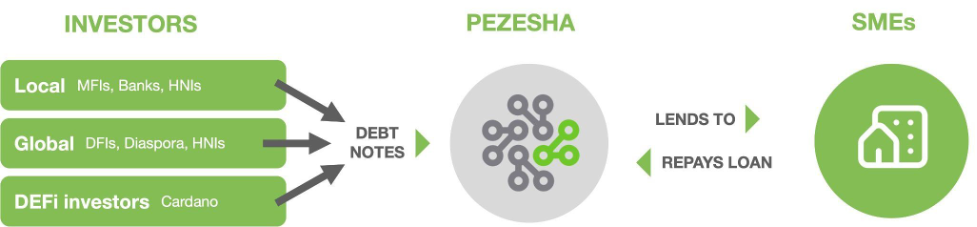
Image Credits: Pezesha
Moraa said that working with strategic partners like Cardano will open up the debt liquidity market and offer the affordable capital critical for the growth of all sectors of the economy.
The fintech plans to open up more lending opportunities for women entrepreneurs who continue to be locked out by the formal banking sector.
“Pezesha is dedicated to solving Africa’s working capital problem through its robust lending infrastructure, and this investment will allow them to deepen the range of financial products offering especially to women owned MSMEs,” said Christina “CJ” Juhasz, the chief investment officer of Women’s World Banking Asset Management.
Pezesha did not reveal how much it has raised in the past, but Moraa noted that 20% of its initial pre-seed investment in 2017 was from local angels. The fintech, which raised seven figures last year, counts Seedstarts, GreenHouse Capital and Consonance Investment Managers, among its several investors.
“We have the right business model, are profitable, and continue to pursue the kind of investors that are aligned with our goals and values,” Moraa said.

Down 43-29 to start the second half, Ohio State got the production it was looking for from its leaders — until Indiana responded with all the force of a top-10 team.
The No. 20 Buckeyes switched to a zone to open the second half, forcing a couple Hoosier misses to get Ohio State back into the game. Braxtin Miller scored a layup and Jacy Sheldon hit a 3-pointer to cut the deficit to nine in the opening minute of the third quarter. But turnovers and poor shooting allowed Indiana to blow open its lead once again.
The 43-34 deficit was the closest Ohio State (7-2, 1-1 Big Ten) would get in the second half. The No. 10 Hoosiers (8-2, 2-0 Big Ten) went on a 17-3 run as Ohio State missed its next eight shots after Sheldon’s triple and eventually lost to Indiana 86-66 on Sunday night at Value City Arena.
Jacy Sheldon led the Buckeyes with 23 points on 9-of-24 shooting, including 4-for-6 from beyond the arc, and turned the ball over four times with one assist. Taylor Mikesell added 15 points. Kateri Poole scored nine points with seven assists and five turnovers.
The big three of Mackenzie Holmes, Grace Berger and Nicole Cardano-Hillary dominated the Buckeyes. Holmes scored 30 points, followed by Berger’s 21 and Cardano-Hillary’s 17.
The start of the second half was the theme of the Ohio State’s first game this season against a ranked opponent. Just about any time it looked like the Buckeyes could claw their way back to drawing even, the Hoosiers pulled away.
And the main culprit was turnovers that were both self-inflicted and forced by a stellar Indiana defense.
“The turnovers really killed us,” coach Kevin McGuff said. “Even to start the second half, I thought we had a great start on the defensive end … but then, man. It’s not only turnovers, but turnovers leading to points.”
Indiana began the game on a 10-0 run that saw Ohio State miss its first five shots with five turnovers. During the stretch, Poole was called for an offensive foul, was blocked, and traveled. When she connected on a 3-point shot to trim the deficit to 14-7 with 2:18 left in the first quarter, Indiana leading scorer Mackenzie Holmes drilled one on the other end.
Despite the slow start and seven turnovers, the Buckeyes made five of their next six shots and were down just 19-15 after one quarter. Led by Cardano-Hillary, Indiana began the quarter on a 9-2 run before a layup from Rebeka Mikulasikova as a part of an 8-1 run by Ohio State put the Buckeyes back within four with 4:34 remaining in the half.
However, the Hoosiers went on another 7-0 run, beginning with Cardano-Hillary splashing a corner 3-pointer. Poole answered with one of her own to make it 36-28 Indiana, but her celebration of shooting an arrow after the made basket delayed her getting back on defense. Poole then fouled Kiandra Browne, who made the basket.
Ohio State shrunk a 26-point deficit with 1:27 left in the third quarter down to 14 points with 7:50 to go, mostly due to committing just one turnover in the final 11:52 of the game compared to 16 before that. But Ohio State couldn’t make enough stops to make up for mistakes earlier in the game. The Hoosiers turned those 17 turnovers into 26 points.
“In the first half we had way too many (turnovers) and we had trouble coming back from that,” Sheldon said. “We fought the whole game, but we didn’t take care of the ball well enough.”
As the point guard, Poole will always be scrutinized, good and bad. But turnovers are a team problem.
McGuff said Poole is improving and has the talent to be a reliable point guard, but against a tough team like Indiana, it’ll take a committee to replace injured point guard Madison Greene’s ball-handling.
“She’s still got to continue to grow and get better, and she’s doing that,” McGuff said. “Tonight was just a tough game and their defense is very good. We had some unforced errors but also a lot had to do with them playing excellent defense.”
McGuff called Indiana a legitimate Final Four contender last week. Ohio State is still assessing where it is after a 20-point home loss in its first ranked game this season.