In an analysis, Anders Helseth, Vice President at K33 Research, has mounted a strong case against the viability of the Uniswap (UNI) token. His analysis pivots on the intriguing dynamics of the decentralized finance (DeFi) market, fundamentally challenging the current valuation and future potential of UNI.
Helseth begins his argument with a seemingly straightforward question: “The Uniswap protocol generates significant trading fees, but will the UNI token ever capture its (fair) share?” His conclusion is emphatically negative.
Is The Uniswap (UNI) Token Worthless?
For context, UNI is a governance token for the Uniswap protocol, a decentralized exchange that earns a 0.3% fee on trades. However, as Helseth points out, the entire trading fee currently goes to liquidity providers, with UNI holders standing to gain only if governance votes permit fee dividends to UNI holders.
Even in a slow DeFi market, the fully diluted value of the UNI token is 15 times the annualized trading fees paid when using the protocol, currently around $6 billion. If the UNI token could capture all trading fees, it would arguably present an irresistible buy. However, Helseth makes a compelling argument to the contrary.
“The UNI token currently captures 0% of the 0.3% trading fee, which entirely goes to liquidity providers,” Helseth says, emphasizing the token’s current lack of intrinsic value.
The crux of his argument revolves around three players in the DeFi space: the users, the protocol (and hence UNI token), and the liquidity providers. According to Helseth, the interplay between these actors is detrimental to the UNI token’s potential for revenue generation. Helseth explains:
The entire protocol can be exactly copied within minutes at virtually no cost. This argument implies that all the power lies with the liquidity providers in the fight for trading fees.
The primary concern for users is liquidity and cost-effectiveness. If the same protocol can be replicated at a whim, users would inevitably gravitate towards the version with the most liquidity – to minimize slippage when executing trades. This dynamic significantly empowers liquidity providers who, unlike UNI holders, hold real, valuable tokens.
In addition, even though switching to another smart contract may entail some costs, these are relatively low, reinforcing the bargaining power of liquidity providers.
Concluding, Helseth states: “Given this relatively low cost of switching from the users’ perspective, we cannot conclude with anything else than that the power lies with the liquidity providers. Hence, even though the Uniswap protocol generates significant trading fees, we believe the potential for the UNI token to capture any of this revenue to be almost non-existent.”
At press time, the UNI price stood at $6.19 after being rejected at the 200-day EMA yesterday.
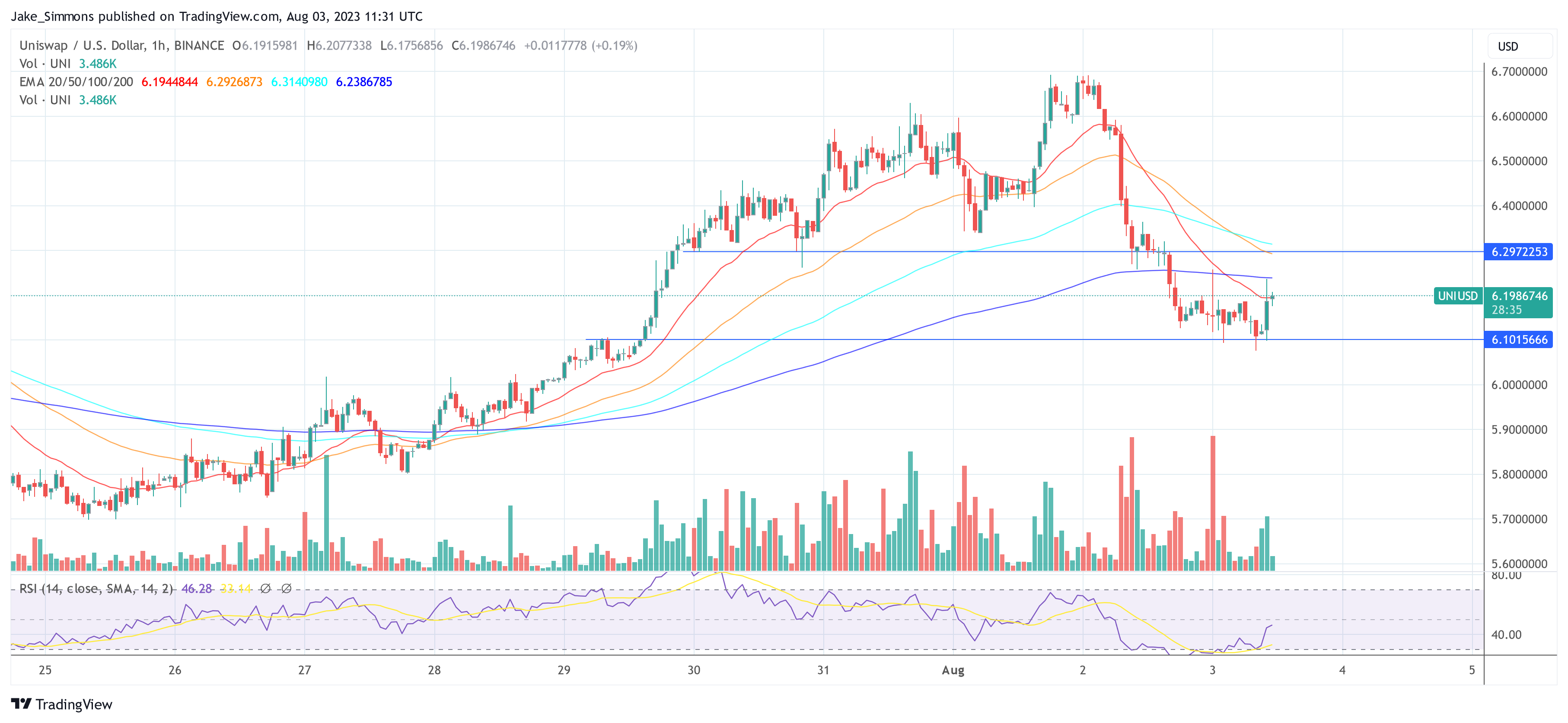
Featured image from Guarda Wallet, chart from TradingView.com
Benzinga Bulls And Bears: Amazon, Meta, Tesla, And A Bitcoin Bull Says Dogecoin Should Be Worthless Benzinga
Source link ]]>
JP Morgan’s CEO Jamie Dimon is not a big Bitcoin fan and he has made it known over the years and his skepticism continues despite $BTC reaching new highs. Dimon is among the very few skeptics who have maintained his disliking towards $BTC throughout, first, he called it a bubble and predicted it would burst. However, despite the growing popularity of BTC, Dimon remains aloof of its progress. Crypto proponents now believe no bull cycle is complete without China’s Ban and Dimon’s Bitcoin skeptism.
It’s not a Bitcoin bull market without Jamie Dimon saying it’s worthless.
— Joseph Young (@iamjosephyoung) October 11, 2021
In a recent virtual conference, the JP Morgan chief again reinstated his earlier stance on the top cryptocurrency and called it worthless, however, the reasons he gave to justify his belief only show that he understand little to nothing about Bitcoin.
“I personally think that bitcoin is worthless. I don’t think you should smoke cigarettes either. Our clients are adults. They disagree. If they want to have access to buy or sell bitcoin – we can’t custody it – but we can give them legitimate, as clean as possible access.”
Dimon said BTC’s value supposedly comes from its scarcity with only 21 million BTC to ever get minted, but what if someone manages to change the code to remove the 21 million limit. He was quoted saying,
“I’ll just challenge the group to one other thing: how do you know it ends at 21 million? You all read the algorithms? You guys all believe that? I don’t know, I’ve always been a skeptic of stuff like that.”
This is quite an old and redundant argument used by people who don’t understand how a decentralized Bitcoin network functions.
Here’s Why JP Morgan is Wrong Again
While the Bitcoin network is open source and decentralized, thus anyone can make changes to the source code, but for those changes to be widely accepted and become a part of the mainnet it has to be accepted by a majority. So even if I want to change the total supply of BTC to an infinite amount, it won’t be accepted unless the majority of miners or nodes accept the proposal.
Ari Paul, the co-founder of BlockTower has one of the better explanations in naysayers terms. He explained
“anyone can take Bitcoin’s code and change it however they like. It’s like changing the TCP/IP protocols or FTP protocol. You can change it on your personal computer, but then you’re on a different network than everyone else. Your change wouldn’t be noticed by anyone else.”
Most of my followers know the answer to this, but for anyone curious, here’s an honest, nuanced answer: /1 https://t.co/c55LXyvCLZ
— Ari Paul
(@AriDavidPaul) October 11, 2021
Coinbase CEO Brian Armstrong also took a dig at JP Morgan and said CEOs without a science and engineering background are going to be at a disadvantage.
CEOs without a science/engineering background are going to be at a disadvantage in the coming decades I think.
Honestly, probably politicians, journalists, and many roles. Software is eating the world, changing every industry.
— Brian Armstrong (@brian_armstrong) October 11, 2021
Disclaimer
The presented content may include the personal opinion of the author and is subject to market condition. Do your market research before investing in cryptocurrencies. The author or the publication does not hold any responsibility for your personal financial loss.
About Author

“Bitcoin is a bubble” is something that has been thrown around a lot ever since the last bull run began in 2017. A lot of prominent personalities in the finance industry took this stand when the digital asset hit its then all-time high of $19K. The bear market that followed seemed to validate this for the next few years. Then the bull run of 2020 started and a lot of those sentiments were put on the back burner. But now, John Paulson has come to hit the market with the same thing.
Related Reading | Here’s How Much Your $1,200 Stimulus Check Would Be Worth In Various Cryptocurrencies In 2021
Over a decade ago, billionaire John Paulson had bet against the housing market. Paulson had reportedly made his fortune from carefully placed bets against the housing market in 2007. The billionaire had used credit default swaps to bet against the housing market, which looked to be in its subprime. By 2010, Paulson himself had made $4.9 billion from his bet. The complete total Paulson made for himself and his clients from shorting the market in 2007 came out to about $20 billion, making it one of the biggest fortunes ever made in the history of Wall Street.
Bitcoin Has No Intrinsic Value
Paulson was on Bloomberg’s Wealth with David Rubenstein to talk about trading and financial markets. Paulson remained bullish on gold, as he has been for a number of years now, which he believed is coming into its moment. The billionaire although had nothing good to say about cryptocurrencies. Cryptos received harsh criticism from Paulson, where he stated, “I am not a believer in cryptocurrencies.”
Related Reading | Deloitte Survey Shows 76% Of Finance Execs Think Physical Money Is Nearing Its End
Paulson then went on to call cryptocurrencies a “bubble.” Paulson attributed the value of cryptocurrencies to the high demand for them. One could argue that this is the way economics works. Demand always plays the biggest role in how something is valued. Paulson also explained that there were way too many downsides to bitcoin. He added that the digital asset was just too volatile too short. Hence, the short methods
“I would describe cryptocurrencies as a limited supply of nothing. There is no intrinsic value to any of the cryptocurrencies.”
Although Paulson spoke critically on other investments like SPACs, he was harshest on bitcoin. The billion said that cryptocurrencies “will eventually prove to be worthless.”
Gold Versus BTC
Paulson’s track record after his famous 2007 short has not been noteworthy. Although his assets under management grew after the notoriety he gained from that trade, it soon dwindled down as investors pulled out their money. In 2019, Paulson went from managing $38 billion to only about $9 billion assets under management, at this point mostly managing his own money. So Paulson turned his hedge fund into a family office.
BTC has surpassed gold year over year | Source: BTCUSD on TradingView.com
Paulson is bullish on gold, despite the fact that bitcoin has outperformed the asset consistently over the past decade. While gold has brought consistently negative results to its investors, bitcoin has returned over 200% year over year in returns.
Featured image from Bitcoinist, chart from TradingView.com
Even though the crypto market has proved the test of times, some billionaire investors don’t consider it a place worth for retail investors. Billionaire investors John Paulson, who rightly predicted the subprime crisis a decade back, has called out on crypto investors.
Now, 14 years later the 2008 Financial Crisis, Paulson expresses concern over the excessive speculations in the crypto space. Speaking at an episode of “Bloomberg Wealth with David Rubenstein,” Paulson, 65, said that cryptocurrencies are a bubble that will “eventually prove to be worthless”.
“I wouldn’t recommend anyone invest in cryptocurrencies,” he added. Well, it’s not the first time that crypto assets have been receiving flak from billionaire investors. Giants like Warren Buffett have also criticized digital assets to the core.
However, over the last decade, the crypto assets have outperformed traditional asset classes like Gold by a huge margin. Moreover, Paulson’s record since his “greatest trade” in 2008 hasn’t been much appealing.
Last year itself, Paulson had to turn his hedge fund into a family office with assets dropping to $9 billion in 2019, from a staggering $38 billion in 2011.
Preferring Gold Over Crypto
Despite the fact that cryptocurrencies have been outperformed Gold by a great margin, Paulson prefers to stay old school and pick gold over crypto. Maybe he could make very good friends with Peter Schiff.
Jokes apart, Paulson said that as inflation picks up, they ten to get away from fixed assets and cash, and the right place to be in is Gold. Moreover, pointing at the 25% surge in the money supply by theFed, he expects inflation to be coming in excess of the current expectations. And thus, Gold! When asked whether he believes in crypto, Paulson said:
“No, I’m not. And I would say that cryptocurrencies are a bubble. I would describe them as a limited supply of nothing. So to the extent there’s more demand than the limited supply, the price would go up. But to the extent the demand falls, then the price would go down. There’s no intrinsic value to any of the cryptocurrencies except that there’s a limited amount”.
He further added that cryptocurrencies will eventually prove to be worthless. And once the liquidity in the market dries, they are heading to zero, as per Paulson. When asked whether he’s shorting crypto at this stage, Paulson denied saying:
In crypto, there’s unlimited downside. So even though I could be right over the long term, in the short term, I’d be wiped out. In the case of Bitcoin, it went from $5,000 to $45,000. It’s just too volatile to short.
Disclaimer
The presented content may include the personal opinion of the author and is subject to market condition. Do your market research before investing in cryptocurrencies. The author or the publication does not hold any responsibility for your personal financial loss.
About Author

