Is Shiba Inu A Dead Project, Or Is The Timing Just Wrong? Watcher Guru
Source link ]]>
Hoskinson might be wrong about the future of decentralized compute CoinDesk
Source link ]]>
Shiba Inu’s TREAT Token Price Drops Despite First Anniversary: What Went Wrong? Coinpaper
Source link ]]>
A crypto analyst has revealed how a well-timed XRP investment from the 2017 bull cycle turned into a missed $130 million opportunity, highlighting how execution failures can derail even the most promising strategies. The admission, shared publicly on X, has reignited debate over discipline, timing, and emotional control in long-term crypto investing.
XRP’s Perfect Entry, Failed Exit
The investment began with a disciplined entry. In early 2017, two participants collectively invested $1,200 into XRP at approximately $0.007, accumulating 171,428 tokens. From a market timing perspective, the entry was near optimal. XRP later surged during the cycle, briefly trading close to its peak and lifting the position’s value to roughly $770,000.
Related Reading
At this stage, the trade had already achieved what most investors aim for: asymmetric upside realized within a single market cycle. However, the position was never exited. Despite clear signs of market euphoria and a dramatic expansion in price, the gains remained unrealized. The analyst later acknowledged that hesitation and emotional attachment prevented decisive action, effectively transforming a winning trade into a missed opportunity.
This hesitation exposed a structural weakness in the strategy: there was no enforced exit discipline. While the entry was carefully planned, the decision to sell depended on the moments when emotional pressures are strongest and risk perception is most skewed. The scenario highlights a recurring issue in crypto markets, where many investors focus heavily on asset selection and timing entries, yet underestimate how psychologically demanding exits can be during periods of rapid price growth.
The Missed Rotation And Compounding Effect Of Inaction
The second failure compounded the first. The analyst explained that selling XRP near its peak would have freed capital to redeploy into Bitcoin while BTC traded around $1,000. That move could have converted the XRP proceeds into roughly 771 Bitcoin, effectively positioning the portfolio to benefit from the next major phase of the market cycle.
Related Reading
Holding those Bitcoin through later highs—approaching 170,000 CAD—would have resulted in total proceeds exceeding $130 million. The strategy was simple and systematic: take profits from an outperforming asset and rotate into another with asymmetric upside potential. It required no leverage, no complex instruments, and no precise market timing beyond a broad understanding of overall market cycles.
However, hesitation, second-guessing, and attachment to the original position prevented decisive action. By delaying the rotation, the investor forfeited the compounding advantage, leaving the portfolio largely static while the broader market continued to advance.
The analyst’s reflection highlights how the crypto market consistently rewards preparation and disciplined execution but punishes hesitation. This experience serves as a stark reminder that the ability to act decisively at critical moments is often the true determinant of long-term success in crypto investing.
Featured image created with Dall.E, chart from Tradingview.com
Dogecoin After The Election Surge: What Went Wrong With The $1 Thesis Yellow.com
Source link ]]>
What’s Wrong With Shiba Inu? Why Can’t It Delete A Zero? InteractiveCrypto
Source link ]]>
Bitwise Chief Investment Officer Matt Hougan is rejecting a growing claim that Strategy could be compelled to sell Bitcoin. He called the premise just flat wrong. His note argues that neither index changes nor market pressure creates a requirement to liquidate the firm’s BTC holdings. Bitcoin Jitters as MSCI Weighs Strategy A client note carried
The post Bitwise CIO Calls Strategy Bitcoin-Sell Narrative “Flat Wrong” in New Client Memo Note appeared first on CoinGape.
]]>BlackRock CEO Larry Fink has said he was wrong about Bitcoin and crypto in earlier views. He called Bitcoin an “asset of fear” and tied ownership to worries about safety and money. Those remarks came during comments on how markets respond to changing risk. Bitcoin Moves on Fear and Macro Shifts Recent price action, in
The post BlackRock CEO Larry Fink Admits He Was Wrong on Bitcoin as IBIT Hits New Milestone appeared first on CoinGape.
]]>There’s a growing undercurrent of frustration among crypto investors watching XRP drift lower, seemingly tied to broader swings in the entire market. But a different perspective came to light after a post by Versan Aljarrah, founder of Black Swan Capitalist, who suggested that the entire discussion around XRP’s day-to-day price movement is rooted in a fundamental misunderstanding of what the asset actually represents.
What XRP Really Does
Aljarrah challenged the tendency to judge XRP as if it were a typical speculative crypto asset running on a debt-based system of inflows and hype. His point was that saying XRP keeps dropping assumes it is meant to trade like every other token whose value is tied almost entirely to leverage trading and investor appetite.
Related Reading
According to the analyst, XRP’s behavior only appears conventional because it is currently coupled to the wider market for now. He framed its long-term purpose as entirely different. Instead of functioning primarily as a speculative instrument, the analyst described XRP as a settlement asset designed to assist in resolving debt, improve liquidity pathways, and ultimately step outside the constraints of the system it currently mirrors.
This reasoning implies that temporary dips, even deep ones, should not be interpreted as failures of the cryptocurrency but as noise while utility-based value continues to build underneath.
Recent Market Events Still Pull XRP Into Short-Term Volatility
XRP’s recent price and market cap behavior confirm its tight connection to market sentiment, at least in the near term. The XRP market cap chart shows the drastic decline that the cryptocurrency has faced in recent months. This decline has seen the XRP market cap fall from over $210 billion to around $129 billion at the time of writing.
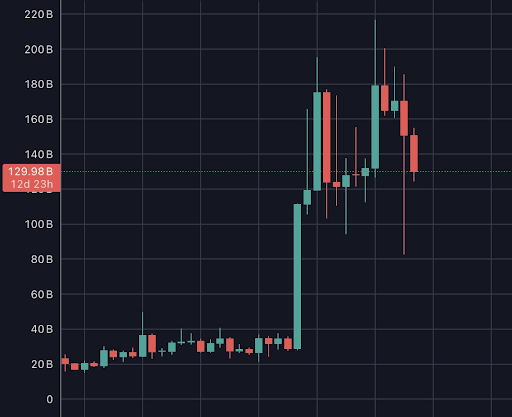
XRP Market Cap. Source: @VersanAljarrah On X
That volatility mirrors what has been happening across the wider crypto market, where investor positioning has shifted quickly around ETF expectations, news, and liquidations. In the past week, XRP’s price has pulled back along with Bitcoin and Ethereum due to heavy selling pressure.
Related Reading
However, speaking of utility-based value, the ecosystem around XRP has quietly been delivering some positive developments that may not yet be fully reflected in price action.
Ripple, the company behind XRP, has been making acquisitions and entering into partnerships to boost its adoption. Ripple has spent nearly $4 billion on acquisitions, including recent acquisitions of Hidden Road for $1.25 billion and stablecoin platform Rail for $200 million.
Another development is that Ripple Labs expanded its partnership with Thunes in September 2025 to improve its cross-border payment infrastructure. Momentum is also visible on the ETF front. A Spot XRP ETF launched by Canary Capital on November 13, 2025 pulled in $268 million in inflows so far and was described as the largest crypto-ETF debut of the year.
Further ETF launches are queued: four additional spot XRP ETFs were expected in the study week beginning November 18, 2025 (with one from Franklin Templeton, ticker EZRP, set to launch), which analysts estimate could bring up to $1.2 billion in new capital.
Featured image created with Dall.E, chart from Tradingview.com
CleanCore Solutions: An Unprofitable Business Treasuring A Meme Coin – What Could Go Wrong? Seeking Alpha
Source link ]]>