The Nil Foundation has launched a pioneering ZK-Rollup Layer 2 solution for Ethereum, boasting sharding capabilities designed to revolutionize the scalability of decentralized applications. This strategic development heralds a new chapter in the Ethereum network’s evolution, promising to elevate performance by merging multiple shards into a seamless execution layer.
Ethereum’s Scalability Leap with Sharding Integration
At the heart of this innovation is the integration of sharding technology within a Layer 2 framework, an approach set to transform how decentralized applications operate on the Ethereum blockchain. Misha Komarov, the CEO and co-founder of Nil Foundation, expresses excitement about this launch:
“We’re thrilled to roll out zkSharding to Ethereum’s vibrant developer community, paving the way for high-load and data-rich applications to thrive on the platform.”
Sharding is familiar to Ethereum’s scalability conversation since it is a core component of the network’s strategic blueprint, enabling concurrent transaction processing and boosting throughput. Consequently, the Nil Foundation’s zkSharding is not merely an addition but a critical evolution. It harmonizes the primary shard, where transactions gain verification through robust zero-knowledge proofs, with auxiliary shards that amplify the system’s capacity to handle transactions.
Competing at the Forefront of DeFi
With this move, Nil, formerly known for its innovative-proof marketplace, steps boldly into a competitive arena. It stands shoulder-to-shoulder with ventures like Polygon zkEVM, zkSync, and Scroll. This strategic pivot follows a successful funding initiative, which saw the foundation bolster its resources with a $22 million investment led by Polychain Capital in January.
Moreover, the integration of zkSharding is more than a technical upgrade since it is a beacon of scalability, inviting developers to imagine and realize a future where Ethereum’s potential is unbounded. The Nil Foundation’s commitment to facilitating decentralized sequencers, programmable data solutions, exchanges, and more within Ethereum’s ecosystem is not just significant but also revolutionary.

The presented content may include the personal opinion of the author and is subject to market condition. Do your market research before investing in cryptocurrencies. The author or the publication does not hold any responsibility for your personal financial loss.
MetaMask developer ConsenSys plans to deploy its layer-2 network, Linea, on the main Ethereum network this week. Linea incorporates the use of zero-knowledge (ZK) cryptography, which is regarded as one of the most significant blockchain trends of the year.
Zero-knowledge (ZK) cryptography, provides more cost-effective and expedited blockchain transactions. This layer-2 network aims to improve scalability and transaction processing on Ethereum, addressing network congestion and high gas fees. According to ConsenSys, the fee rates for transactions on Linea will be 15 times lower than those on Ethereum main network.
The roll-up network implemented by Linea is commonly referred to as zkEVM, which stands for zero-knowledge Ethereum Virtual Machine. This roll-up network is designed to be fully compatible with the Ethereum Virtual Machine (EVM) programming environment. Roll-ups are also regarded as a crucial component of Ethereum’s development plan.
Related Reading: Bulls Remain Resilient Despite Litecoin’s Fall Below $100, Key Levels To Watch
Linea is being launched following a successful testnet phase, during which 5.5 million unique wallets performed over 46 million transactions in three months. According to ConsenSys, this achievement makes Linea one of the most active initiatives on Ethereum’s Goerli testnet.
App developers can deploy their projects to Linea’s “alpha” network on Friday, and the general public will have access to it starting next week.
Key Features Of Linea’s Alpha Mainnet Phase
Linea has introduced several significant upgrades with the release of its alpha mainnet stage. This includes a new outer-proof system and a dynamic fee mechanism.
Linea’s alpha mainnet stage includes a feature called batch conflation. This feature optimizes the number of layer-2 transactions and blocks that can fit into a layer-1 submitted batch. By doing so, Linea is able to reduce the fixed costs associated with layer 1 and provide a more cost-effective transaction experience.
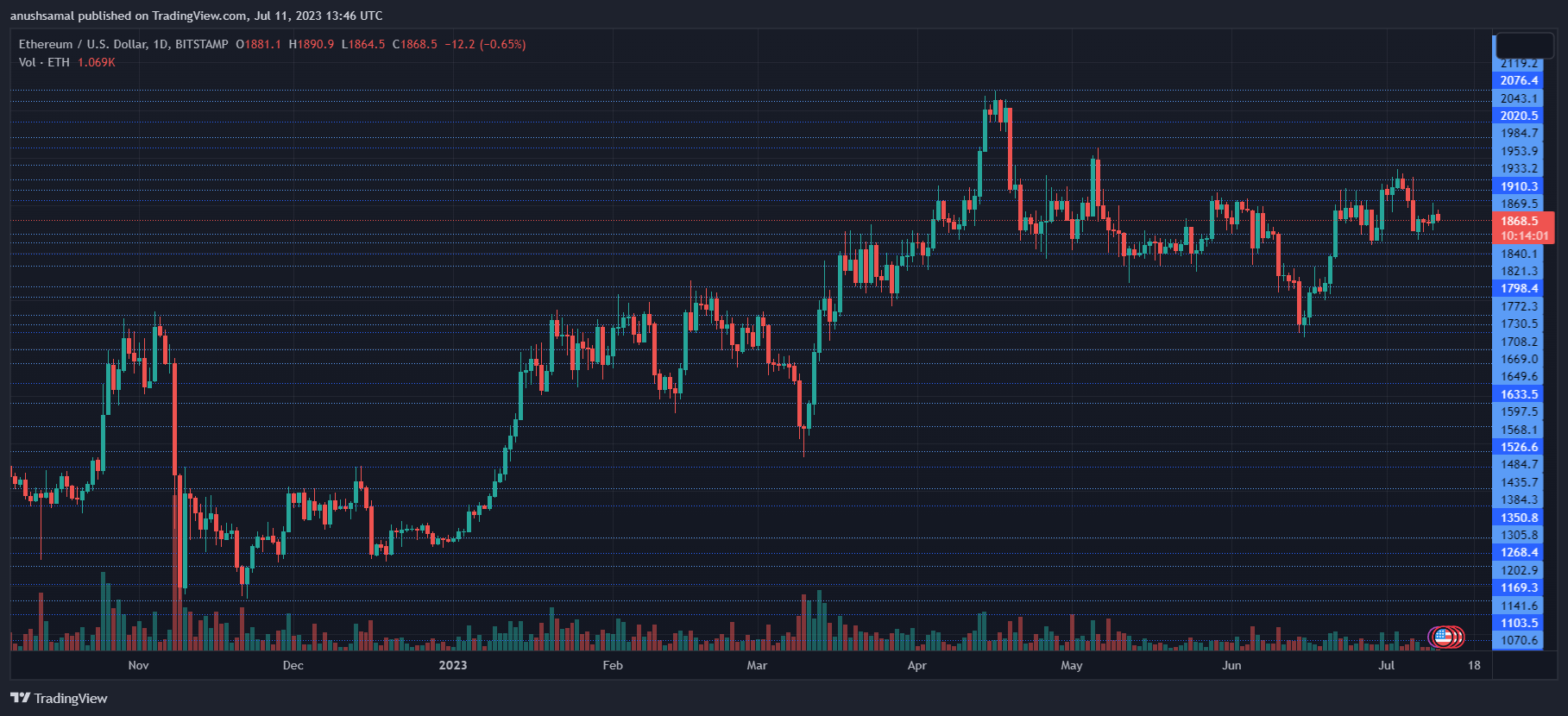
Ethereum was priced at $1,860 on the one-day chart | Source: ETHUSD on TradingView
In addition to the lower transaction fees, the launch of Linea’s alpha mainnet stage is expected to reduce friction for developers and improve onboarding with fast finality, a capital-efficient bridge, and inherited Ethereum security. These upgrades will enable Linea to offer transaction costs that are substantially cheaper than Ethereum’s base layer.
MetaMask To Include Linea Support As Well
Featured image from The Information, chart from TradingView.com
- Sebastien Guillemot, the co-founder of dcSpark, shares the team’s plans for Cardano development in 2023.
- dcSpark also achieved remarkable Cardano development milestones in 2022 according to Guillemot.
Sebastien Guillemot, co-founder and CTO of the crypto ecosystem development team dcSpark, has revealed that Cardano is set to welcome several bullish developments in 2023.
Guillemot shared dcSpark’s goals for Cardano 2023 in a tweet, noting that they will come “very fast.” These include zk-rollup layer 2 (L2) launch, gamefi L2 launch, decentralization of Milkomeda, and the publication of the first L2 research and development paper.
Goals for 2023:
– zk-rollup L2 launch
– gamefi L2 launch @PaimaStudios
– EVM L2 @Milkomeda_com decentralization
– First paper on our L2 R&DIt’s all going to come very fast
— Sebastien Guillemot (@SebastienGllmt) December 30, 2022
Currently, zero-knowledge rollup (zk-rollup) is a hot topic in the blockchain space. The term refers to a type of Layer 2 scaling solution that ensures a much higher throughput and much lower costs without sacrificing security. However, dcSpark does not specify that its zk-rollup solution will be mainly for Cardano.
dcSpark’s GameFi platform is being developed by Paima Studios. Its first non-fungible token (NFT) powered game, Jungle Wars, has released its first NFT collection. The blockchain game is set to launch on dcSpark developed Cardano’s L2 sidechain Milkomeda this January.
Meanwhile, dcSpark also plans to decentralize Milkomeda. The platform which enables developers to bridge Ethereum Virtual Machine (EVM) decentralized applications (dApps) to Cardano currently operates without a token.
Guillemot’s announcement could mean that the sidechain introduces a token that will power decentralized governance in its ecosystem. dcSpark’s zk-rollup solution could also focus on integrating Milkomeda fully on the Cardano blockchain.
Reflecting on Cardano’s progress in 2022.
While Guillemot highlighted plans for 2023, he also noted the progress dcSpark made in 2022. Calling 2022 a “mind-boggling productive year for the team,” he noted Cardano-related releases made in the year. These include Milkomeda and Flint Wallet.
dcSpark contributed six Cardano Improvement Proposals, two of which were included in the Vasil hardfork. Additionally, it wrote five Plutus contracts, and also developed a Cardano Rust SDK and Carp, a new Cardano indexer. The indexer already powers many dApps and other SDKs.
2022 – An mind-boggling productive year for our teams
RELEASED in 2022:
– @Milkomeda_com both Cardano (sidechain) & Algorand (L2!)
– Flint v1 (and 50 releases since!)
– 6 CIPs (2 in Vasil!)
– 5 open Plutus contracts
– Rust SDK & indexer that power many dapps & SDKs like Lucid— Sebastien Guillemot (@SebastienGllmt) December 31, 2022
Each of these achievements has gone on to make further progress. Flint Wallet has seen up to 60 upgrades in addition to seeing the release of its mobile versions. These upgrades have introduced features including deep linking support, wrapping to Milkomeda, biometric verification, and a DApp browser. Similarly, Flint wallet also allows QR scanning for mobile, integrated ADA handles, and introduced a compatibility mode, among other features.
Meanwhile, Milkomeda has expanded to also support the Algorand blockchain and is working towards supporting Solana. Since launching in March 2022, Milkomeda has also launched various initiatives to support the growth of the Cardano ecosystem. These include an accelerator program, a hackathon, and grants to developers building on Milkomeda.
These feats, as well as extensive plans for 203, could potentially bring more users to Cardano. With more users, the price of ADA could also surge to new highs. The Cardano native token currently trades at around $0.254, up 3.70 percent in the last 24 hours.


Milkomeda successfully delivers cross-chain dApp performance on Cardano
Cardano’s Milkomeda sidechain, which has been working for almost two months now, may one day become a roll-up to Cardano’s main chain, according to Cardano Insights.
As Cardano blockchain explorer suggests, Milkomeda has processed through more than five million transactions since launch, or almost 100,000 transactions daily. Despite such a large flow of transactions, users are not facing any issues with transaction costs or network congestion. The average cost of a transaction is at $0.001 USD.
In terms of security:
1. Even today @Milkomeda_com has better security and is cheaper than Binance Smart Chain because trusted Cardano operators are running it. If they would do something “dodgy” – they are likely to receive bad publicity and loose delegators on L1.— Cardano Blockchain Insights (@InsightsCardano) May 21, 2022
Currently, Milkomeda supports wrapped tokens via two bridges: Celer and Nomad. Traders can use stablecoins like USDT and USDC and cryptocurrencies like AVAX, BNB and ETH, besides a variety of Ethereum-based tokens.
In terms of security, the platform offers better and cheaper solutions compared to sidechains like BSC thanks to trusted operators on Cardano who run the network. As Insights Cardano suggests, any explicit activity by operators would cause an immediate loss of delegator spots on L1.
Ads
Milkomeda plans on having 32 validators and may now offer a relatively high capacity of 500 to 1,000 transactions per second. Also, another sidechain or L3 solution would have no issues running whatsoever. In comparison, Binance Smart Chain has only 13 validators, which puts it behind Milkomeda.
Milkomeda launched on Cardano network first with Solana support planned for the future. The project delivers roll-up tech for L1 ecosystems like Cardano and offers the building of cross-chain decentralized applications with Solidity, the most popular smart contracts language in the industry.
Finding the perfect scalability solution for Ethereum has always been a huge challenge. But over the last year, the use of ZK-Rollups has generated quite some buzz. In fact, at some pointed ZK-Rollups were touted as perhaps the best scalability solution for Ethereum and have already been adopted by several protocols. So, what this is all about, and how can you invest in these technologies? First, some highlights:
-
Zero-Knowledge Rollups (ZK-Rollups) are a series of smart contracts that use off-chain computations before submitting them back on-chain for validation.
-
The smart contracts simply bundle a huge number of transactions into one and compute them in large chunks.
-
Several protocols have already adopted ZK-Rollups, including Loopring (LRC) which surged to all-time highs after.
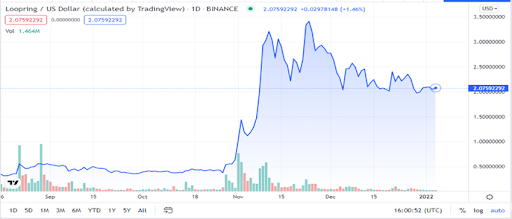 Data Source: Tradingview.com
It is obvious now that ZK-Rollups are going to be huge and as such, we wanted to give you a list of altcoins you can invest in below to take advantage of this technology:
The Mir Protocol (MIR)
The Mir Protocol (MIR) is a scaling solution for Ethereum designed to use ZK-roll ups. In fact, the project is in the process of developing additional ZK roll up solutions. Just last month, MIR was acquired by Polygon (MATIC) in a deal valued at around $400 million.
Polygon is already one of the cheapest chains in the market. The fact that it is going after a ZK-rollup project suggests that this could be a hot industry in the future.
zkSync Coin
zkSync is an upcoming ZK-roll-up project being developed by Matter Labs. The plan is to issue a native ERC 20 token once the project is fully operational.
The platform has already received up to $50 million in series B funding. Although we don’t have any dates as to when the token will be available, keep an eye on this in 2022.
✓ Share: